

The headline price of a 100kW solar project in Pakistan depends on the system design, not capacity alone. The 100kW solar system price in Pakistan is shaped by panel selection, inverter configuration, battery storage and site conditions; the project-specific price is provided after a quote request.
Choosing a system at this scale is a major energy decision, and the equipment and installation scope behind the quote matter. A 100kW system using 550-watt panels needs approximately 182 panels, while the final panel count varies with panel wattage and system design.
This guide explains what a 100kW system includes, how its component choices affect cost, what to consider when comparing system designs, and how installation progresses in Pakistan. You’ll also learn how the system connects to your facility’s electricity supply, so you can assess the project with a clearer view of its requirements and next steps.
Key Takeaways
- Compare on-grid and ground-mounted system designs to understand why a 100kW project’s indicative price can vary.
- Use panel wattage to estimate the array size: a 100kW system requires approximately 182 panels at 550 watts each.
- Assess how inverter configuration, battery storage, panel selection and site requirements shape the project’s component costs.
- Plan for a structured installation process, with a typical project timeline of 3-6 weeks from order confirmation to handover.
- Estimate potential solar output against your facility’s daytime electricity use, since location, climate and panel efficiency affect generation.
What Is a 100kW Solar System in Pakistan?
A 100kW installation combines solar panels, inverters, electrical protection, mounting structures, and grid connections. Its configuration determines how generated electricity serves a facility and whether batteries store energy.
For a useful comparison, separate system capacity from installation type. An on-grid system can be roof-mounted or ground-mounted. “On-grid” describes its electrical connection, while “ground-mounted” describes its physical installation.
On-Grid, Off-Grid, and Hybrid Options
An on-grid system connects to the electricity grid, offsetting facility consumption and exporting surplus generation when permitted. An off-grid design operates independently and relies on batteries to store solar energy for use when panels are not generating. A hybrid system combines grid connection and battery storage. Compare operating needs, backup requirements, and whether exporting excess electricity matters to your facility.
System Price Comparisons
Indicative 2026 market estimates place 100kW on-grid systems around Rs. 0.65 crore to Rs. 1 crore. Ground-mounted estimates are around Rs. 0.75 crore to Rs. 1 crore. These are market reference figures, not a project quotation. Hybrid configurations add battery storage, while mounting design, inverter choice, panel efficiency, and site conditions also affect the overall cost.
Your project price depends on system configuration, equipment selection, mounting requirements, and site conditions. A quote provides the exact figure for your project.
Grid Connection and Net Metering
A grid-connected 100kW system converts panel-generated DC electricity into grid-compatible AC electricity through inverters. The facility can use solar generation directly, export excess electricity, and draw grid power when solar production falls. Net metering measures imported and exported electricity, potentially creating credits or payments under the applicable arrangement. In Punjab, net metering is described as available across DISCOs.
Compare operating designs before weighing headline prices. An on-grid system focuses on serving daytime demand and interacting with the electricity network. Battery storage retains energy for later use. The key question is not simply “on-grid versus hybrid,” but whether storage meets an operational need.
Installation location also shapes the project scope. A roof-mounted array uses an existing structure, while a ground-mounted array requires suitable land and supporting structures. Layout, wiring routes, inverter placement, and grid connection all affect the design. These details help explain why systems with the same rated capacity can have different project requirements.
Review quotations by scope, not just by capacity. Check whether the configuration specifies panels, inverters, mounting, electrical protection, installation, and any battery storage. For grid export, distinguish the system’s ability to feed surplus electricity from the metering arrangement that records imports and exports. This makes comparisons meaningful without treating unlike configurations as equivalent.
Warranty terms also belong in a system comparison. Check which components each warranty covers and how its stated period applies. A panel warranty and an inverter warranty refer to different equipment. For a commercial facility, comparing equipment scope, mounting design, storage needs, and grid interaction provides a clearer basis for evaluating the full installation.
Required panel count and panel wattage
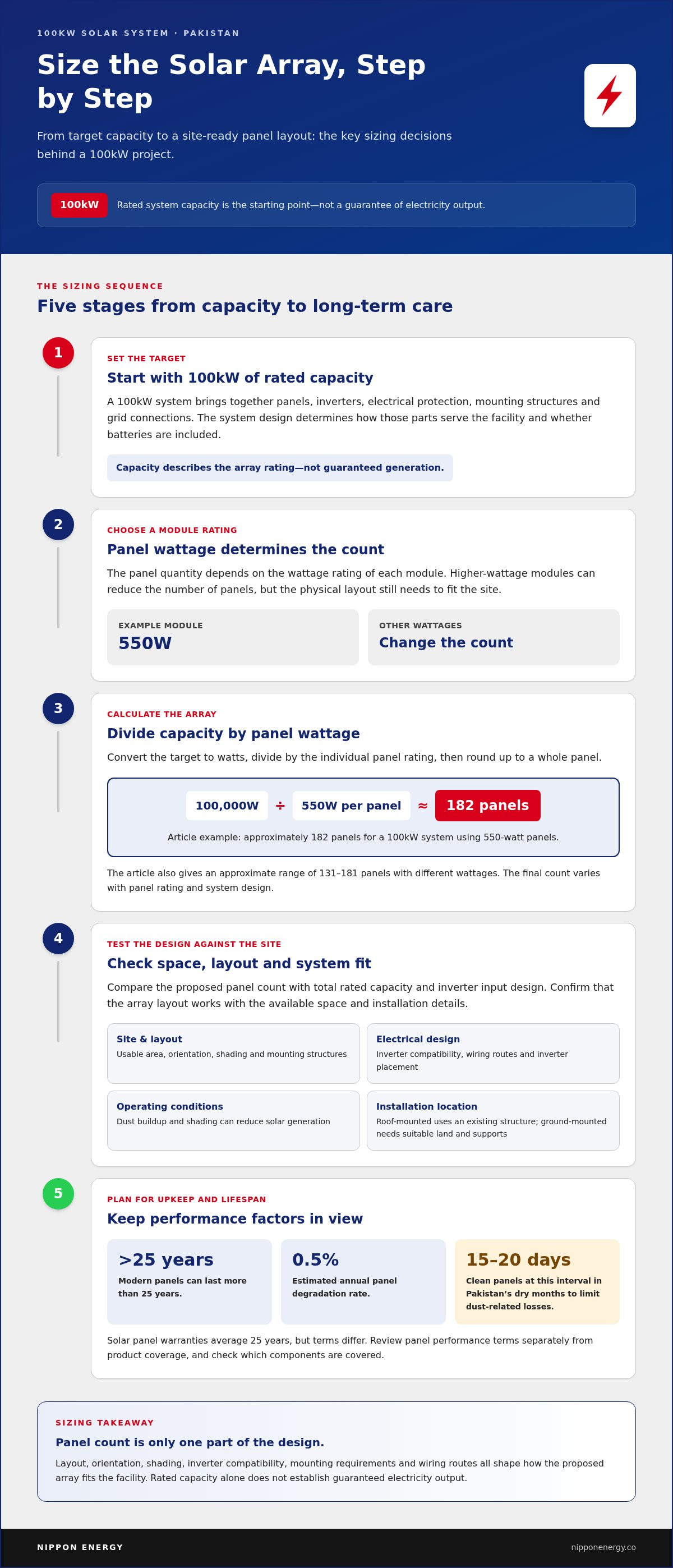
Key risks include shading, dust buildup, and gradual panel degradation, which can reduce solar generation. Maintenance costs depend on access, cleaning requirements, inspections, and any component repairs. In Pakistan’s dry months, clean panels every 15-20 days to limit dust-related losses.
Panel quantity depends on the wattage rating of each module. Divide the target system capacity by the individual panel rating, then round up to a whole panel. For example, 100,000 watts divided by 550-watt panels equals approximately 182 panels. The required count can range from approximately 131 to 181 panels with different wattages.
That estimate describes combined panel capacity, not guaranteed electricity output. Layout, orientation, shading, and inverter compatibility affect array performance. Before installation, compare the proposed panel count with the total rated capacity and the inverter’s input design. A mismatch can complicate system configuration and keep the array from operating as intended.
Panel lifespan and performance degradation also matter when assessing long-term value. Modern solar panels can last more than 25 years, with an estimated annual degradation rate of 0.5%. Solar panel warranties average 25 years, but warranty terms differ by component and coverage. Read the panel performance terms separately from product coverage, and keep the documentation with the installation records.
Panel selection should reflect the site and the project’s operating needs. Compare module wattage, efficiency, dimensions, and warranty terms across the proposed options. HJT and TOPCon are panel technologies buyers may encounter; evaluate their specifications against available roof or ground area and the required array capacity. Higher-wattage modules can reduce panel count, but the physical layout still determines whether they fit.
Use a clear sizing sequence during the installation process: establish the target capacity, select a panel rating, calculate the panel count, then test the layout against usable space. For example, a design using 550-watt modules requires approximately 182 panels to reach 100kW. The final arrangement must also account for mounting structures, wiring routes, and access for future cleaning.
For a 100kW grid solar system, panel quantity is only one design input. Match panel specifications with inverter configuration and decide whether the project includes batteries for stored energy. To structure these decisions, use solar system planning to connect panel capacity, site layout, and operating requirements before installation begins.
100KW system prices and component costs
Installed cost reflects the complete design, not panel capacity alone. Inverter configuration, storage, panel efficiency, mounting, and site conditions shape the project scope.
For a 100kW system, choose inverter capacity and type to match the array and facility load. Battery type and capacity should reflect which equipment needs backup and for how long; these requirements determine the storage design.
Installed Cost Factors Across Cities
When comparing installed costs across Pakistani cities, account for system size, panel efficiency, brand selection, inverter type, and battery configuration. Site access, roof or ground mounting, cable routes, and grid connection also affect the installation scope. Compare quotations using the same equipment and work categories, rather than treating capacity alone as a like-for-like basis.
Sunlight conditions and facility electricity use matter to the financial assessment, even though they do not change rated system capacity. For example, a textile facility with different operating hours may use solar generation differently from a site with a daytime-heavy load. Net metering can also affect how exported energy is accounted for.
For budgeting, the exact installed price depends on equipment selection, mounting design, storage requirements, and site work. A quote provides the figure for your project.
Inverter and Battery Selection
Match inverter capacity and configuration to the solar array, electrical load, and grid connection. Commercial string inverters used for 100kW systems are listed at 98%+ efficiency. That figure describes inverter efficiency, not total system output, which also depends on panel conditions and system design.
Battery sizing depends on backup requirements and the loads that must remain powered. Choose battery type and capacity around those needs, rather than assuming every grid-connected solar system requires storage. A hybrid design incorporates batteries; an on-grid design can operate without them.
Compare components by identifying what each quoted item covers. Review panels, inverter, mounting structures, wiring, protection equipment, installation, monitoring, and any batteries as distinct scope categories. This makes omitted or differently specified work easier to spot.
For an industrial facility, assess savings against electricity use during solar generation hours. A system that supplies daytime loads directly serves a different purpose from one designed around backup storage. Include the facility’s load profile, grid interaction, and net-metering arrangement in the comparison.
Use a consistent review sequence: confirm the array and inverter configuration, define storage needs, then compare mounting and installation scope. This links equipment choices to site requirements and provides a clearer basis for evaluating project quotations.
Installation process and timeline
A 100kW solar installation moves from project planning to equipment handover through defined technical stages. In Pakistan, the estimated timeline from order confirmation to handover is 3-6 weeks.
Each stage informs the next: site information shapes the system design, which determines component placement and electrical connections. A facility’s consumption profile also helps establish whether the configuration prioritizes daytime solar power, grid interaction, or lithium battery storage.
- Assess the site. Record roof or ground conditions, shading, available installation space, and cable routes. These observations help determine array layout and mounting requirements.
- Review electricity consumption. Examine the facility’s load pattern and operating hours. This helps align system design with the electricity bills the solar installation is intended to offset.
- Finalize the technical design. Match panel capacity with inverter configuration and decide whether batteries form part of the system. Confirm that the component layout suits the site and operating requirements.
- Prepare the installation area. Arrange mounting structures and equipment locations according to the approved design. A clear layout supports orderly panel placement and electrical connections.
- Install and connect components. Position the panels, connect wiring and protection equipment, then integrate the inverter with the facility’s electrical system. Add lithium storage when included in the design.
- Test and hand over. Inspect system connections and verify operation before handover. Provide the system documentation and explain the monitoring and maintenance requirements.
These stages explain the 3-6 week project window, but the work sequence depends on site readiness and system scope. Roof access, ground preparation, equipment placement, and the selected battery configuration can affect how installation tasks are arranged. Coordinating these decisions before equipment work begins helps reduce avoidable changes during delivery.
Commissioning should confirm that installed components match the design. The inverter must operate with the array, electrical connections must be secure, and any included lithium storage must integrate with the intended configuration. Monitoring lets you observe system operation after handover, while maintenance helps keep panels and equipment in serviceable condition.
Before handover, review the final layout, system documentation, and operating instructions. Confirm how the installation uses solar power, how the facility interacts with grid electricity, and which components need routine attention. This gives the site team a practical reference for managing the system after installation.
For a commercial facility, scheduling also means coordinating installation access with normal operations. Identify work areas, equipment routes, and site contacts before the installation team arrives. Clear coordination helps protect day-to-day activity while panels, mounting structures, and electrical components are installed.
How much electricity can a 100 kW solar system generate per day and per month in Pakistan?
A 100kW solar system in Pakistan is estimated to generate 400-450 kWh per day, depending on sunlight. Other estimates describe Punjab output as 400-550 units daily. Since one electricity unit equals one kilowatt-hour, these figures help facilities compare expected generation with their consumption.
Monthly estimates range from 12,000 to 16,500 units, while annual estimates range from 144,000 to 198,000 units. Another market estimate places annual generation at 120,000 to 150,000 kilowatt-hours. These published ranges differ, so treat them as separate estimates rather than combining them into one guaranteed output figure.
Pakistan receives an estimated 5-7 peak sun hours daily. That resource helps explain the expected production range, but the system’s actual output depends on location, climate, and solar panel efficiency. A facility in Punjab can use the 400-550-unit daily estimate as a regional reference, then compare it with its own electricity consumption pattern.
Daily generation varies throughout the year. Sunlight conditions affect the energy available to panels, while system design affects how that energy is converted and used. Monthly totals therefore provide a broader planning view than a single day’s figure. Compare expected generation with daytime loads, then consider how the facility uses or handles surplus electricity.
Use the estimates as a practical assessment sequence:
- Review daily demand. Compare the facility’s daytime electricity use with the estimated 400-450 kWh daily output, or the 400-550-unit Punjab range.
- Compare monthly consumption. Set the 12,000-16,500-unit monthly estimate beside the facility’s billing period and usage.
- Assess annual planning. Keep the 120,000-150,000 and 144,000-198,000 annual estimates distinct when modelling energy requirements.
- Account for site conditions. Include location, climate, and panel efficiency when interpreting any generation estimate.
Generation and bill reduction are related, but they are not identical. Solar electricity used on site offsets imported electricity at that time. Excess output may be exported through a grid-connected arrangement, while production below demand requires electricity from the grid. System design and metering determine how these flows are handled.
For a useful project assessment, connect the generation estimates to facility load data and site conditions. Plan a solar generation assessment to evaluate how a 100kW system’s expected output aligns with your operating profile.
Nippon Energy: Nippon HJT Solar Panels
Nippon Energy supports 100kW project planning through solar project development and EPC, connecting equipment choices with the site’s energy requirements. Nippon HJT Solar Panels and Nippon TOPCon Solar Panels are options to consider when specifying the array. For facilities that need stored energy, Nippon Lithium-ion Battery Storage Systems can form part of the system design.
Consider Nippon Energy when assessing panel technology, battery storage, or the technical scope of a commercial solar installation. Aligning these decisions with facility consumption and site conditions helps shape a coherent project plan. The right configuration depends on how the facility uses electricity and whether storage meets its operational needs.
Contact Nippon Energy to discuss your solar project requirements.
Turn Your Solar Assessment Into a Clear Project Plan
Assessing the price of a 100kW solar system in Pakistan is a starting point, not the whole decision. The next step is to define what the installation needs to achieve for your facility. Clarify whether your priority is using solar generation directly, storing energy, or planning a grid-connected system. A precise project brief makes equipment and design discussions more relevant to your operating needs.
Nippon Energy offers Nippon HJT Solar Panels, Nippon TOPCon Solar Panels, and Nippon Lithium-ion Battery Storage Systems. These products can inform panel and storage choices within a broader solar project. Bring your facility’s energy priorities to Nippon Energy to discuss a system design suited to its intended use.
For a project discussion, contact Nippon Energy about your system. A well-defined brief is a practical foundation for moving forward with confidence.
Frequently Asked Questions
What is the current price of a 100 kW solar system in Pakistan?
Indicative 2026 market estimates put a 100kW system at Rs. 0.65 crore to Rs. 1 crore. On-grid quotations include PKR 8,817,500 and PKR 8,945,000, reflecting different quoted scopes. Treat these as market references, not a universal installed price. The final project figure depends on panel and inverter selection, mounting requirements, battery storage, and site-specific electrical work.
What is included in the price of a 100 kW solar system in Pakistan?
A project quotation can cover solar panels, inverters, mounting structures, wiring, electrical protection, installation, and supporting items. The listed net-metering charge in one market estimate is PKR 200,000 additional. Compare each quotation by checking which equipment and work are included, especially grid connection, storage, monitoring, and installation scope. Components differ between on-grid and battery-backed designs, so identical capacity labels don’t ensure identical packages.
How much do 100 kW solar panels, inverters, mounting structures, and installation cost separately in Pakistan?
One market estimate places 100kW solar panels at PKR 3.5-4.5 million. An itemized quotation lists 85 galvanized iron structures at PKR 5,500 each, or PKR 467,500 total; installation is PKR 490,000. That quotation also lists flexible DC wire at PKR 800,000 and miscellaneous supporting items at PKR 900,000. These are sample line items, not fixed costs for every project.
What is the price difference between on-grid, hybrid, and off-grid 100 kW solar systems in Pakistan?
Indicative 2026 on-grid estimates range from Rs. 0.65 crore to Rs. 1 crore, while a premium on-grid design is estimated at Rs. 0.7 crore to Rs. 1 crore. A hybrid system adds battery storage, and an off-grid system relies on storage rather than grid supply. Their installed costs depend on battery capacity, backup loads, inverter design, and site requirements.
What are the net-metering rules and application requirements for a 100 kW solar system in Pakistan?
Net metering records electricity imported from and exported to the grid, allowing surplus generation to be credited or paid under the applicable arrangement. Market information describes availability for 100kW systems across Punjab DISCOs. The application and interconnection process concerns the facility’s grid connection and metering setup. The quoted net-metering charge in one estimate is PKR 200,000, additional to the system price.
What permits, inspections, and utility approvals are required to install a 100 kW solar system in Pakistan?
For a grid-connected project, utility interconnection and any net-metering arrangement are central approval considerations. The project also needs a site-specific electrical design and commissioning checks for installed components and connections. Requirements can depend on location, mounting design, and how the facility connects to the grid. Include approval coordination and inspection planning in the project scope, rather than treating installation as equipment placement alone.
Which solar panel and inverter brands are available for 100 kW systems in Pakistan, and how do their warranties compare?
Nippon Energy offers Nippon HJT Solar Panels, Nippon TOPCon Solar Panels, and Nippon Smart AI Inverters. Nippon HJT panels carry a 15-year product warranty and a 30-year linear power warranty; TOPCon panels carry a 12-year product warranty and a 25-year linear power warranty. Compare product and performance coverage separately. The panel warranty periods don’t establish inverter warranty terms.
What size and type of inverter and batteries are recommended for a 100 kW system in Pakistan?
Match the inverter capacity and configuration to the solar array, facility load, and grid connection; commercial string inverters for 100 kW systems are listed at 98%+ efficiency. Choose battery type and capacity based on which equipment needs backup and for how long.


