

Pakistan’s renewable-energy targets offer businesses a measurable policy reference for solar-led decarbonisation. The Alternative and Renewable Energy Policy 2019 sets targets for renewable energy to generate 20% of electricity by 2025 and 30% by 2030. For organisations achieving ESG goals with solar energy in Pakistan, the practical task is to connect on-site generation or renewable power procurement to their emissions priorities.
Solar can reduce reliance on grid electricity, but a credible ESG plan also accounts for investment, operations and the wider energy mix. The right approach depends on a facility’s demand profile, available space and whether storage is needed.
This article explains how Pakistan’s solar adoption and energy policy shape corporate decarbonisation strategies, what affects project costs, and how solar can support measurable ESG progress. It also covers system design, storage and implementation, helping turn renewable-energy goals into practical plans.
Key Takeaways
- Separate emissions priorities by scope, then assess whether on-site solar or renewable-energy procurement best fits each facility.
- Connect solar planning with energy efficiency and affordable, clean energy objectives to build a more coherent ESG strategy.
- Use site conditions, electricity demand and operational needs to evaluate Pakistan’s solar potential for your organization.
- Build investment decisions around project design, energy use and storage requirements rather than relying on a single headline cost.
- Include Pakistan’s energy mix and end-of-life panel management in a decarbonisation plan, not just the emissions avoided during operation.
Decarbonisation strategies
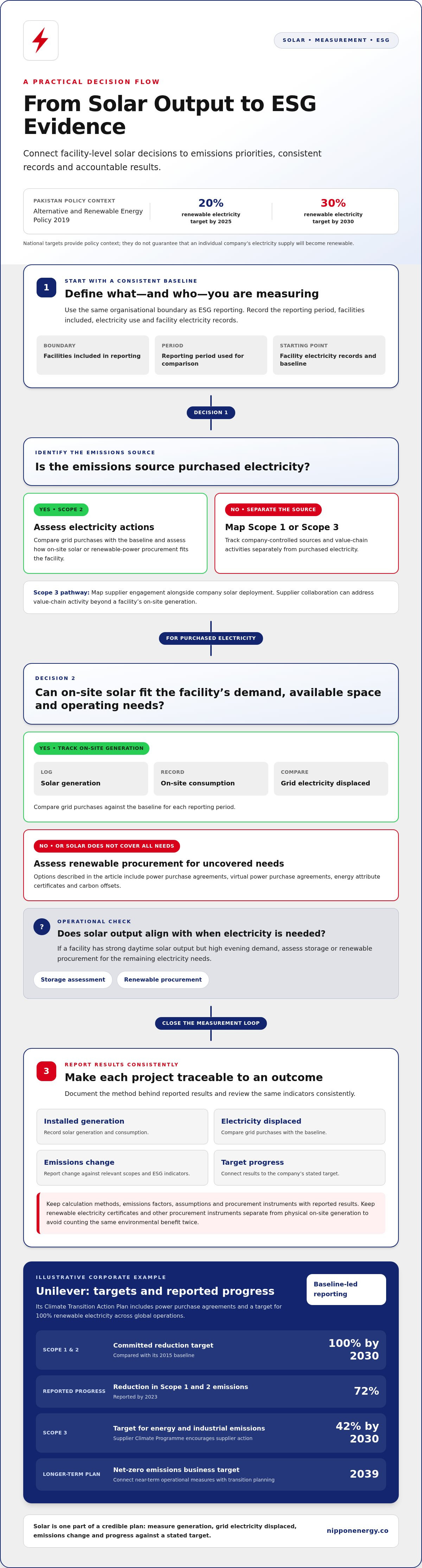
Pakistani companies can assess solar’s emissions impact by tracking generation, onsite consumption and grid electricity displaced. Compare these figures with a documented baseline, then report changes against relevant emissions scopes and ESG indicators.
For companies achieving ESG goals with solar energy in Pakistan, measurement starts with a clear reporting boundary. Separate emissions from company-controlled sources, purchased electricity and value-chain activities. Record the reporting period, facilities included, electricity use and solar generation to create a consistent basis for comparison. Keep renewable electricity certificates and other procurement instruments separate from physical onsite generation to avoid counting the same environmental benefit twice.
- Establish a baseline using facility electricity records and the same organisational boundary used for ESG reporting.
- Log solar generation and consumption, then compare grid purchases against the baseline for each reporting period.
- Document calculation methods, emissions factors, assumptions and procurement instruments alongside reported results.
Use the data to guide action, not just disclosure. A facility with strong daytime solar output but high evening demand may assess storage or renewable procurement for its remaining electricity needs. Manufacturers can also track solar alongside energy-efficiency measures, distinguishing reduced consumption from cleaner electricity in emissions reporting. This helps management see which actions drove progress.
Unilever illustrates how corporate targets can link direct operations and electricity sourcing. Its Climate Transition Action Plan includes power purchase agreements and a target for 100% renewable electricity across global operations. Unilever has committed to reduce Scope 1 and 2 emissions by 100% by 2030, compared with its 2015 baseline. It reported a 72% reduction in those emissions by 2023. These figures show why a company should report both its target and its progress against a stated baseline.
Scope 3 needs separate attention. Unilever targets a 42% reduction in Scope 3 energy and industrial emissions by 2030, while its Supplier Climate Programme encourages suppliers to set science-based targets and adopt renewable energy. Pakistani businesses serving international supply chains can map supplier engagement alongside their own solar deployment. This clarifies where onsite generation can reduce purchased-electricity emissions and where supplier collaboration is needed.
A robust report connects each project to an accountable outcome: installed generation, electricity displaced, emissions change and progress against the company’s target. Unilever’s net-zero emissions business target for 2039 also demonstrates the value of connecting near-term operational measures with a longer-term transition plan. Review the same indicators consistently, explain changes in the reporting boundary, and use the results to refine investment priorities.
Supplier engagement can complement these actions, while procurement choices address facilities or electricity needs that onsite systems do not cover. Assess whether onsite or offsite renewable power suits the facilities in your portfolio. Options include power purchase agreements, virtual power purchase agreements, energy attribute certificates and carbon offsets.
Technical and financial planning can also cover onsite renewable energy, including partner-supported power purchase agreements.
SDG 7 and affordable, clean energy policy
The United Nations’ seventh Sustainable Development Goal focuses on affordable and clean energy. For Pakistani businesses, this connects renewable electricity with access, reliability and responsible investment. Solar planning can contribute to the clean-energy goal while helping companies assess how their facilities use electricity.
Pakistan’s Alternative and Renewable Energy Policy 2019 sets targets for renewable energy to generate 20% of electricity by 2025 and 30% by 2030. These national targets provide a policy context for corporate energy planning. They are not a guarantee that an individual company’s electricity supply will become renewable. Businesses still need to assess facility demand, generation potential and how solar fits their operations.
For commercial solar, net-metering rules govern whether a connected system can export surplus electricity and how exported electricity is accounted for. Installations must also meet applicable interconnection and metering requirements. The Alternative and Renewable Energy Policy 2019 sets national generation targets, but those targets are not themselves project-level net-metering procedures.
Pakistan’s Sustainable Energy for All objectives are to be achieved by 2030 and include doubling the share of renewable energy. A company can connect its own plan to this direction by identifying facilities suitable for solar, estimating the share of electricity that generation could serve, and recording progress over time. This gives energy teams a practical basis for aligning facility-level decisions with wider clean-energy priorities.
Access remains part of the policy challenge. National energy access in Pakistan is 73%, and 32,266 villages are expected to remain without grid access in coming years. These figures underline why clean energy planning involves more than corporate emissions. For businesses operating across different locations, assess grid availability and electricity needs separately at each site. Where grid access is constrained, the system design must reflect the facility’s operating requirements and available energy sources.
Efficiency also shapes affordability. The policy discussed for Pakistan promotes end-use efficient devices and anticipates a 20% to 25% reduction in total energy consumption. The Pakistan energy scenario models electricity demand at 20% below the baseline scenario. Companies can apply the same demand-first logic: identify energy waste, improve equipment efficiency, then size renewable generation against the resulting load. That sequence avoids designing a solar project around consumption that efficiency measures could reduce.
- Map electricity use by facility and operating schedule.
- Identify efficiency actions before estimating solar demand.
- Assess generation, grid connection and export needs under applicable rules.
- Track renewable electricity and access outcomes alongside ESG indicators.
For companies developing a site-specific approach, solar project planning can connect technical design with facility energy needs.
Solar photovoltaic potential and adoption in Pakistan
Pakistan’s solar adoption has expanded rapidly. The country imported 17 GW of solar panels in 2024, and estimated capacity reached approximately 22 GW after additional imports in subsequent years. These national indicators show growing photovoltaic deployment, but they don’t measure corporate installations or company-level ESG results.
For Pakistani businesses, rooftop solar, utility-scale solar and solar-plus-storage meet different operating needs. Rooftop systems generate electricity onsite, while utility-scale projects supply power from larger installations. Storage can shift some solar energy for use when generation and demand do not coincide. The best fit depends on site conditions, load patterns and procurement arrangements.
Pakistan’s corporate solar adoption and ESG statistics require careful interpretation. The reported 55 to 63 million solar panels estimate describes national panel stock, not corporate ownership or emissions reductions. Companies should measure their own generation, electricity use and emissions against a consistent baseline before reporting project-level ESG performance.
Household research also illustrates how adoption differs across Pakistan. A study analysed nationally representative household data from the Pakistan Social and Living Measurement Survey for 2018-19. It found household income, education, number of rooms and a male household head were positively associated with choosing solar over dirty fuels. These findings describe household choices, not commercial purchasing behaviour.
Geography matters. Almost 50% of villages in lower Punjab and upper Sindh have solar power, while more than 90% of the population in AJK and Gilgit-Baltistan has access to the electricity grid. For a company with sites across these regions, assess each location separately: grid availability, facility demand, usable installation area and operating hours shape the system’s role.
Solar projects in Pakistan can face risks from grid interruptions, policy changes that affect project economics, and equipment quality that influences performance. Reduce exposure through site-specific engineering, clear documentation, suitable interconnection design, and planned inspection and maintenance. Include end-of-life management in environmental planning: Pakistan lacks comprehensive infrastructure for solar-panel waste, and improper disposal can create environmental hazards.
Assess installers and suppliers based on engineering quality, equipment documentation, commissioning procedures and ongoing maintenance capability. Confirm that equipment and grid connections meet applicable requirements, and review relevant certification documents for the components used. A single installer name or certificate does not establish suitability for every Pakistani site.
- Compare rooftop, utility-scale and storage options against each facility’s load profile.
- Separate national adoption figures from company-specific generation and ESG data.
- Assess grid, policy, equipment and end-of-life risks during project planning.
The figures provided describe Pakistan’s overall solar deployment, not corporate adoption or company-level ESG performance. Assess each company’s results using its own solar generation, electricity use and emissions against a consistent baseline.
Investment costs for energy transitions
Pakistan’s energy sector has investment potential of $66.56 billion under a high-growth scenario through 2030. This outlook signals a substantial role for capital in the transition, but it is not a budget estimate for an individual solar project. Businesses need to build project economics around their own sites, electricity demand and operational requirements.
Start by defining the project scope. Rooftop systems, ground-mounted installations and solar paired with storage have different design requirements. Site surveys, structural needs, grid connection, equipment, installation and commissioning all shape the investment plan. Analyse demand, too: a facility that uses more electricity during daylight can consume more of its solar generation directly.
For Pakistani projects, compare internal capital, commercial borrowing, leasing structures and green-finance terms where available. Include tax incentives in the model only if the project meets applicable fiscal rules and eligibility conditions. Assess financing against expected generation, operating profile, repayment schedule and the business’s capital priorities.
Payback and savings depend on project costs, solar output, onsite consumption, electricity tariffs, maintenance and financing terms. Higher self-consumption can increase the value of each unit generated by reducing electricity purchases. Export arrangements, if used, also affect the calculation. Model these inputs using facility records and project-specific estimates, rather than assuming one payback period applies to every business.
A sustainable investment case should include more than initial equipment and installation. Include expected maintenance, monitoring, inverter or storage requirements, downtime planning and end-of-life management. Solar panels are expected to reach the end of their lifespan in 25-30 years, so responsible planning accounts for eventual replacement and disposal. Pakistan lacks comprehensive infrastructure for managing solar panel waste, making lifecycle planning relevant to environmental and financial risk.
- Scope: Define the site, operating hours, electricity load and project configuration.
- Cash flow: Compare capital sources and repayment obligations against expected energy value.
- Performance: Test generation and onsite consumption against actual facility demand.
- Lifecycle: Include maintenance, monitoring and end-of-life considerations in the investment case.
For companies achieving ESG goals with solar energy in Pakistan, investment appraisal connects decarbonisation targets with measurable financial assumptions. Revisit the model as electricity use, project performance and financing conditions change. This turns a one-time capital decision into a managed energy asset, with costs and benefits tracked over its operating life.
Businesses linking investment decisions to ESG priorities can assess renewable projects alongside their financial case. Clear objectives help guide choices about site configuration, generation and solar’s role in the wider energy plan. The business case should still reflect facility demand, expected output, financing and lifecycle costs, with assumptions tested against operational needs. This connects environmental aims to practical investment decisions without replacing project-specific analysis.
Unilever’s Climate Transition Action Plan includes investment in onsite renewable energy, including solar and wind. Businesses considering a similar direction should assess their own sites and requirements: which configuration suits the facility, how generated electricity will be used, and how costs and performance will be measured over the project lifecycle. Addressing these questions in planning can align renewable investment with operational priorities and the broader transition.
Pakistan’s energy mix and fossil-fuel dependence
Pakistan’s energy transition involves more than adding solar capacity. Companies must consider how electricity from fossil fuels affects emissions, operating costs and exposure to changes in energy supply. The country’s policy scenario rules out building new coal-, natural-gas-, oil- or nuclear-based power-generation capacity after 2030. This is a modeled scenario, not a statement that existing plants will close by that date.
Grid electricity and onsite generation have different emissions implications. Solar used at a facility can displace some grid purchases during generation hours, while remaining demand may still rely on grid supply. The actual emissions impact depends on how much solar electricity the site consumes and the emissions profile used for reporting. Separate these factors in ESG accounts instead of treating all electricity as coming from one source.
Pakistan’s energy scenario models electricity demand at 20% below the baseline scenario. That demand reduction shows how efficiency can work alongside renewable generation. A company can first review equipment schedules, process loads and avoidable consumption, then size solar against the remaining demand. The sequence links operational efficiency with lower dependence on fossil-fuel electricity without assuming solar alone can meet every load.
Reliance on fossil fuels also presents an economic planning challenge. Facilities exposed to grid supply should assess how changes in purchased electricity affect budgets and decarbonisation targets. Solar can reduce the amount of electricity bought from the grid, while storage or other procurement arrangements can address needs beyond solar generation hours. Compare options using the site’s load profile and operational priorities.
Use a facility-level energy map to translate national transition scenarios into practical decisions. Record electricity consumption by building or process, identify when demand occurs, and distinguish grid purchases from onsite renewable generation. Then set actions for each source: reduce avoidable demand, add clean generation where it fits, and manage remaining electricity through procurement or operational changes. This gives ESG teams a clearer view of progress and emissions still to address.
Long-term planning also requires attention to equipment lifecycle and system operation. Solar panels are expected to reach the end of their lifespan in 25-30 years, and Pakistan lacks comprehensive infrastructure for managing panel waste. Include maintenance, monitoring and end-of-life planning alongside generation forecasts. These steps connect decarbonisation with environmental responsibility beyond the immediate reduction in grid electricity use.
To achieve ESG goals with solar energy in Pakistan, businesses can use the modeled transition pathway as strategic context, then build plans from facility data. Track grid electricity, onsite generation, efficiency measures and emissions consistently. Review these indicators as operations change, so investments respond to actual energy demand rather than assumptions about the national mix.
Plan a solar project around your facility’s energy profile and decarbonisation priorities.
Nippon Energy: Nippon HJT Solar Panels
Nippon Energy supports Pakistani organisations planning solar projects around their energy and ESG priorities. Nippon HJT Solar Panels and Nippon TOPCon Solar Panels offer panel options for project design. Nippon Lithium-ion Battery Storage Systems can also be considered when a facility needs to manage the timing of solar generation and electricity demand.
Nippon Energy’s Solar Project Development and EPC services bring project development, engineering, procurement and construction together within a coordinated project scope. Assessing site conditions, operating demand and grid requirements helps shape a system suited to the facility’s objectives.
To discuss a solar project for your organisation, contact Nippon Energy.
Turn Your Solar Strategy Into the Next Step
For Pakistani organisations, achieving ESG goals with solar energy means moving deliberately from targets to project decisions. Start by aligning facility requirements, energy use and reporting priorities before selecting a system. This keeps decarbonisation planning connected to operational needs.
Nippon Energy offers Nippon HJT Solar Panels, Nippon TOPCon Solar Panels and Nippon Lithium-ion Battery Storage Systems for solar project planning. Consider these products as part of a broader assessment of facility energy requirements and project objectives. The right configuration depends on the site and the organisation’s intended use.
Bring your energy priorities into a focused project discussion. Contact Nippon Energy to discuss solar and explore a practical next step for your organisation. A clear plan can help turn ESG ambition into purposeful action.
Frequently Asked Questions
How can solar energy help Pakistani companies achieve ESG goals?
Solar energy can help Pakistani companies reduce emissions from purchased electricity and document progress toward environmental targets. A factory, for example, can assign generation and consumption records to each site, then include them in ESG reporting alongside energy-efficiency actions. This strengthens governance by making methods and evidence traceable. Solar contributes most directly to the environmental pillar; assess social and governance priorities separately rather than treating a solar installation alone as complete ESG performance.
What are Pakistan's corporate solar energy adoption and ESG statistics?
Pakistan imported 17 GW of solar panels in 2024, and estimated solar capacity reached approximately 22 GW after later imports. The estimate of 55 to 63 million panels describes national stock, not corporate ownership or emissions reductions; companies should track their own generation, electricity use and emissions against a consistent baseline.


