

What if the strongest case for corporate solar starts with your operating data, not a headline savings estimate? Building a credible business case for corporate solar investment means understanding how site conditions, electricity demand, and project design work together. For organizations in Pakistan, those factors help determine whether solar alone, solar with battery storage, or a different balance of on-site generation and grid use best supports operational priorities.
It’s reasonable to scrutinize assumptions before committing capital. A sound assessment should make its inputs visible, compare relevant system configurations, and distinguish company-wide experience from the expected performance of an individual project. Nippon Energy has 2,600 MW of solar systems in operation and construction and reports annual generation of 3,900 GWh. These figures provide company-wide context, not a forecast for your facility.
This article presents a practical framework for assessing site suitability, connecting solar and storage choices to operating priorities, and testing projected returns. It also outlines how to move from preliminary analysis to project development, EPC, and ongoing monitoring, so decision-makers can build an investment case around their facility’s conditions and needs.
Key Takeaways
- Build a business case for corporate solar investment around your organization’s operating priorities, facility conditions, and energy demand.
- Use a structured model to establish a baseline, compare scenarios, test assumptions, and document decision criteria.
- Compare solar-only, solar-plus-storage, and staged development based on how each configuration may align with your demand profile and operating schedule.
- Separate verified site and demand evidence from assumptions that still need analysis before an investment decision.
- Connect preliminary assessment to project development through solar modules, inverters, battery storage, EPC, maintenance, and monitoring.
Why a Corporate Solar Investment Case Starts with Business Priorities
A business case for corporate solar investment is an evidence-based assessment of whether a solar project fits an organization’s operational requirements, financial criteria, and strategic direction. It should explain how the project could support defined objectives, what evidence underpins its projected value, and which assumptions still need testing. The same system design may suit one facility but not another because their demand patterns, site conditions, and operating priorities differ.
Start with the organization’s priorities, not a preferred system size. A factory planning to expand, a warehouse managing electricity procurement, and a business focused on emissions reduction may each need a different assessment. Keep site-level value distinct from wider employment, tax, or community impacts. Those broader effects may matter to stakeholders, but they do not show how a specific facility’s project performs.
Which business objectives can solar investment support?
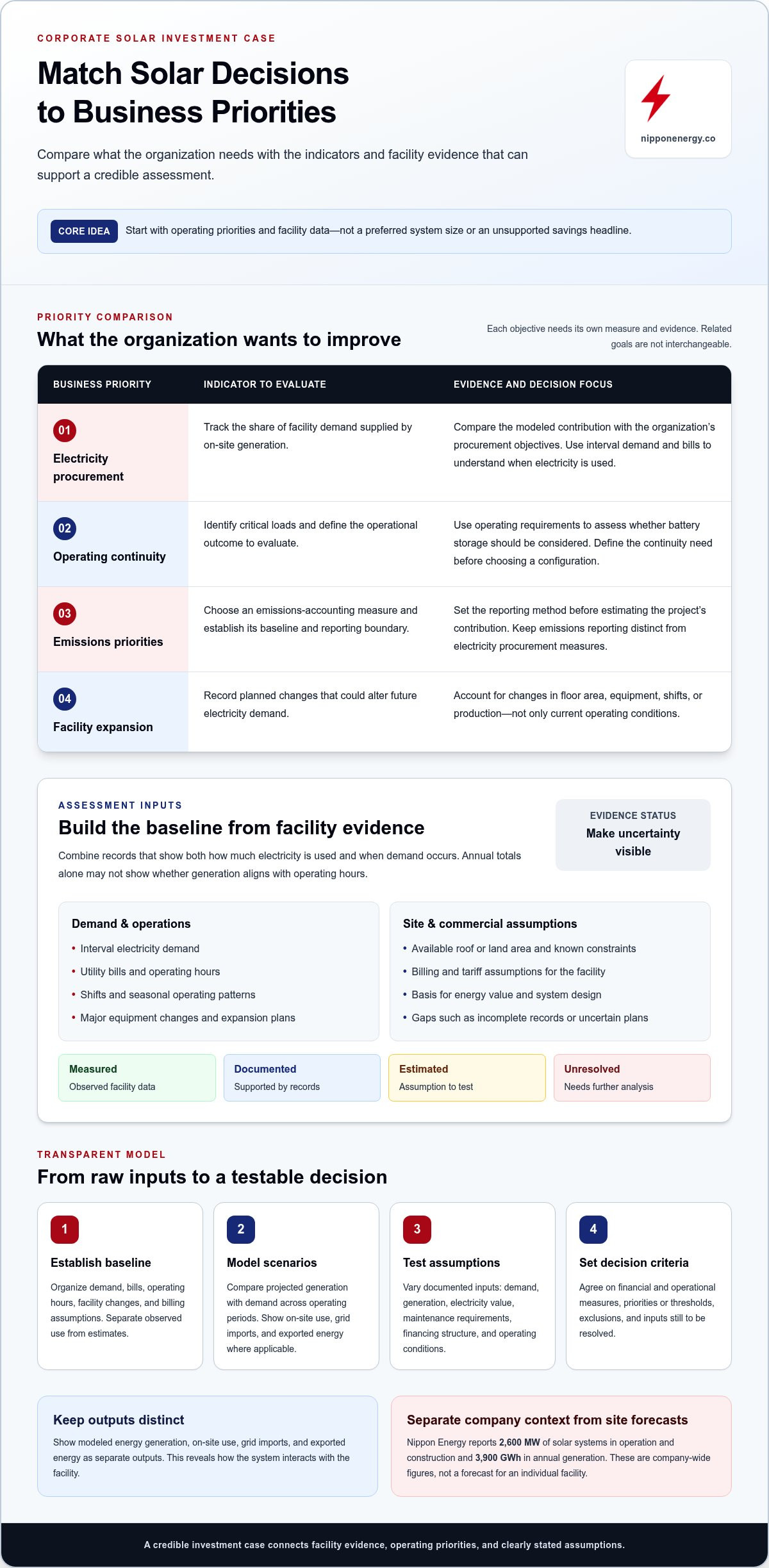
Translate each objective into an indicator the organization can monitor. This gives finance, facilities, operations, and sustainability teams a shared basis for evaluating the project and clarifies who owns each decision.
- Electricity procurement: Track the share of facility demand supplied by on-site generation and compare it with the organization’s procurement objectives.
- Operating continuity: Identify critical loads and define the operational outcome to evaluate, including whether battery storage should be considered.
- Emissions priorities: Select an emissions-accounting measure and establish the reporting boundary and baseline before estimating the project’s contribution.
- Facility expansion: Record planned changes in floor area, equipment, shifts, or production so the assessment accounts for future as well as current demand.
These objectives are related but not interchangeable. Electricity procurement concerns how energy is sourced and used; emissions goals concern reported environmental impact; resilience priorities relate to operational requirements during supply interruptions. Finance can set investment and approval criteria, facilities can provide asset and site information, operations can define load requirements, and sustainability teams can set reporting methods.
What evidence belongs in the initial assessment?
Build a documented baseline before comparing configurations. Gather interval electricity demand, utility bills, operating schedules, and planned facility changes. Bills show recorded consumption and charges, while interval data reveals when demand occurs. Together, these records help assess whether projected generation aligns with actual operating hours, rather than relying on annual totals alone.
- Record available roof or land area and known site constraints that may affect project scope.
- Note shifts, seasonal operating patterns, and major equipment changes that could alter demand.
- Identify gaps, such as incomplete demand records or uncertain expansion plans.
- Log commercial assumptions separately, including the basis for energy value and system design.
Label each input as measured, documented, estimated, or unresolved. This makes uncertainty visible and shows reviewers where further analysis is needed. Project economics depend on site data, system design, and commercial assumptions, so a transparent evidence record is more useful than a return figure without its supporting inputs.
How to Build a Corporate Solar Investment Model Without Guesswork
A useful model turns facility evidence into transparent, testable outputs. For a business case for corporate solar investment, match projected generation to the organization’s demand profile and operating schedule, then evaluate it using clearly stated commercial assumptions. The model should show not just a preferred result, but how that result changes when key inputs shift.
- Establish the baseline. Organize interval demand, electricity bills, operating hours, and known facility changes. Record the billing and tariff assumptions used for the Pakistan facility, distinguishing observed consumption from estimates.
- Model relevant scenarios. Estimate generation for the proposed system design and compare it with demand across operating periods. Show how much energy is used on site, how much is imported from the grid, and any exported energy where applicable.
- Test assumptions. Vary documented inputs such as demand, generation, electricity value, maintenance requirements, financing structure, and operating conditions. Make each scenario traceable to its source or rationale.
- Document decision criteria. Agree on the financial and operational measures that matter to the organization, along with the thresholds or priorities used to assess results. Record exclusions and unresolved inputs.
Which financial and operational metrics belong in the model?
Present modeled energy generation, on-site use, grid imports, and exported energy as separate outputs. This shows how the system interacts with the facility instead of reducing performance to a single annual total. Include project-specific assumptions for electricity value, maintenance, financing, and operating conditions so reviewers can see what drives the result.
Payback estimates how long modeled benefits take to recover the investment under stated assumptions. Net present value (NPV) compares the present value of projected cash flows with the investment, using a stated discount rate. Internal rate of return (IRR) is the discount rate at which modeled NPV equals zero. These are analytical outputs, not guaranteed outcomes. Keep them distinct from historical data and company-wide portfolio figures.
How can decision-makers test uncertainty?
Run alternative demand, generation, and operating scenarios using documented inputs. For example, compare current operations with a planned expansion, or test how a changed operating schedule affects the share of solar generation used on site. Sensitivity analysis reveals which assumptions have the greatest influence on the decision, helping teams prioritize better data where it matters most.
Nippon Energy reports $550M in customer savings over PV system lifetimes. This is a reported aggregate figure, not a forecast for an individual facility. Project results depend on the site, system design, and assumptions used. For a Pakistan project, ground the model in the facility’s utility bills and documented commercial inputs.
A disciplined model makes its limits visible. Nippon Energy’s solar project development and EPC capabilities connect the analysis with project planning while keeping facility-level projections distinct from portfolio-wide reporting.
Compare Corporate Solar Configurations by Their Business Value
Choose a system configuration based on the facility’s demand timing and operating objectives, not a default preference for more equipment. Compare how each option may use generated energy, interact with the grid, and support operational priorities. A defensible business case for corporate solar investment makes those trade-offs clear without assigning savings before site-specific modeling.
| Configuration | Potential fit | Key decision factors |
|---|---|---|
| Solar-only | Facilities with daytime demand that can use a meaningful share of expected generation as it occurs. | Demand timing, installation area, load changes, and how exported energy is treated in the project model. |
| Solar-plus-storage | Organizations assessing whether stored energy could better support defined operating priorities or load requirements. | Load profile, intended storage use, system design, operating assumptions, and how storage changes grid imports or energy use over time. |
| Staged development | Organizations considering an initial project scope alongside planned facility or load changes. | Expansion plans, site constraints, sequencing assumptions, and how later stages may affect the overall project design. |
These are comparison categories, not performance rankings. The model should also account clearly for grid interaction: track energy used on site, energy drawn from the grid, and exports where applicable. The value of each flow depends on the facility’s demand profile and commercial assumptions, so do not treat exported energy as equivalent to energy consumed on site.
When might solar generation alone fit a facility?
Solar-only may suit facilities whose operating hours overlap with expected generation. A facility with active daytime processes can compare interval demand with projected output to estimate how much generation may be consumed directly. Review available roof or land area and expected changes to equipment, shifts, or production. Because site design affects configuration and modeled output, annual consumption alone can hide a mismatch between generation timing and demand.
When might battery storage add strategic value?
Assess storage against a defined operating priority and the facility’s load profile. State what the battery is intended to do, when it would operate, and how that pattern affects modeled energy flows. Nippon Battery is an advanced utility-scale battery system with a capacity range of 1,260-5,000 kWh and 200+ installations. These figures describe the product and installation base, not a recommendation or forecast for a particular site.
Evaluate lithium-ion storage in relation to the project’s operating objectives and system design. A staged approach can help decision-makers assess an initial scope alongside future facility needs, provided each phase is modeled using its own assumptions. Compare configurations using consistent demand, generation, and operating inputs, then select the option that best aligns with the organization’s priorities and available evidence.
Assess Site Readiness, Project Risks, and Implementation Assumptions
Site readiness connects a modeled concept to an executable project. A thorough review tests whether the demand profile, physical site, proposed scope, and internal decision process support the same project assumptions. For a business case for corporate solar investment, this helps distinguish verified conditions from unresolved questions before they affect design, timing, or expected performance.
What should a corporate solar site assessment cover?
Review consumption patterns alongside facility plans, usable roof or land area, and project objectives. For a Pakistan facility, include its relevant electricity bills and applicable utility documentation so the assessment reflects actual supply and billing context. Record the source and date of each input, then assign owners for technical, financial, operational, and sustainability information.
- Demand and operations: Confirm how consumption varies with shifts, production cycles, and planned equipment changes.
- Site conditions: Document the areas under consideration and known physical or access constraints that may affect scope.
- Project dependencies: Note planned construction, facility expansion, internal approvals, and other dependencies that could influence timing or design.
- Ownership: Identify who provides site data, evaluates financial assumptions, approves the scope, and defines operational requirements.
Classify each issue as evidence-backed, estimated, or requiring further analysis. A measured demand record is evidence; a future production schedule may still be an assumption. A roof area shown on a plan does not, by itself, establish that the area suits the proposed design. Flag these distinctions instead of carrying uncertain inputs forward as established facts.
How can execution planning strengthen the investment case?
Set evaluation milestones that connect engineering, procurement, construction, and commissioning. At each stage, define the decisions required, the responsible team, and the information needed to proceed. This makes dependencies visible and allows the organization to revisit scope or assumptions if site findings differ from preliminary analysis.
Select modules, inverters, and storage against documented project requirements, not generic specifications. Define how the system will be monitored, which performance indicators will be reviewed, and who will respond to material differences between modeled and observed operation. Include maintenance and monitoring in the operating plan because they shape how performance is assessed after construction.
Keep a concise risk register alongside the project model. Separate issues needing investigation, such as unresolved site constraints or incomplete load information, from assumptions supported by records. State how each open item could affect scope, schedule, or modeled output. Nippon Energy’s project development and EPC capabilities connect engineering, procurement, and construction planning with the project’s defined requirements.
Use readiness findings to structure the next development steps. Plan your corporate solar project around documented site conditions, clear ownership, and measurable monitoring needs.
Turn the Business Case into a Nippon Energy Solar Project
A completed assessment gives decision-makers a structured basis for moving from analysis to project development. Nippon Energy provides solar modules, inverters, battery systems, project development and EPC, and ongoing maintenance and monitoring. These capabilities support a coordinated project pathway. Facility load, site conditions, and operating objectives guide system design and modeled outcomes.
How can Nippon Energy support a project from planning onward?
Project development and EPC connect planning with equipment selection and construction. Nippon Energy offers TOPCon Modules and HJT Modules as distinct solar module options. Nippon Inverter and Nippon Battery provide additional project capabilities, while maintenance and monitoring support ongoing system oversight. The appropriate combination depends on project-specific requirements, not portfolio scale alone.
Nippon Inverter has an efficiency of up to 99%, a capacity range of 250-2,500 kW, and 200+ installations. Nippon Energy’s solar systems in operation and construction total 2,600 MW, with annual generation of 3,900 GWh. These figures describe the broader portfolio. They are not forecasts of a specific facility’s generation, efficiency, or financial results.
Keep those scopes distinct throughout the review. A project assessment should establish expected generation and operating assumptions from site information and the proposed design. Portfolio experience provides company-level context; it does not replace project-specific engineering or determine a facility’s results.
What are the practical next steps for a decision team?
Bring the working group a concise project file with energy records, facility information, operating priorities, and internal decision criteria. Assign owners for technical review, financial evaluation, operational requirements, and sustainability inputs. This lets project-development discussions focus on decisions and evidence instead of reconstructing basic facility information.
- Confirm the scope: Identify the facility or facilities under consideration and planned changes that could affect demand or site use.
- Define the questions: Specify what the assessment needs to resolve about configuration, generation, on-site use, storage, and grid interaction.
- Set evaluation criteria: Record the operational and financial measures decision-makers will use to review alternatives.
- Track open items: Separate documented inputs from estimates and questions requiring further project analysis.
A project-specific assessment connects facility evidence to system design, implementation planning, and ongoing monitoring needs. It also gives decision-makers a clearer basis for reviewing assumptions before advancing the project scope. Explore a solar project discussion grounded in your facility data with Nippon Energy’s project development team.
Set the Next Decision in Motion
Turn the analysis into an internal decision brief. Identify who owns the recommendation, which assumptions need validation, and what evidence leadership needs before approving further project development. This keeps the business case for corporate solar investment connected to operational realities and gives each team a defined role in moving the decision forward.
Use the brief to frame a focused project review: clarify facility priorities, document unresolved questions, and explain how proposed system choices will be assessed. A structured discussion can align finance, facilities, and operations around the information needed to evaluate a project-specific path, without treating preliminary estimates as final commitments.
Explore how Nippon Energy’s corporate solar solutions can support your assessment and project planning. Explore Nippon Energy’s corporate solar solutions and take the next step toward a decision grounded in your organization’s priorities.
Frequently Asked Questions
How do you calculate the business case for corporate solar investment?
Calculate it by comparing a project’s estimated costs and operating benefits over an agreed evaluation period, using assumptions tied to the specific facility. Include the proposed system scope, expected energy flows, electricity value, maintenance, financing, and the organization’s evaluation criteria. Then calculate outputs such as payback, net present value, and internal rate of return. Treat these as model results, not promised returns, and test how they change when key inputs vary.
Can a company assess solar investment without a full year of energy data?
Yes. A preliminary assessment can use available bills, interval readings, operating schedules, and equipment information, provided missing periods are clearly identified. For example, a facility with several months of demand records can compare those readings with its production calendar and note seasonal operations the data does not represent. Treat the result as provisional, document estimates, and refine the assessment as more complete records become available.
Is corporate solar a good fit for a factory or warehouse?
It can be, but the facility type alone does not establish suitability. A factory may have substantial process loads, while a warehouse may concentrate consumption around lighting, refrigeration, or material handling. Assess when those loads operate, how the site is used, and whether future changes could alter demand. The project evaluation should reflect those facility-specific conditions rather than assuming every industrial roof or parcel supports the same design.
Does a corporate solar project always need battery storage?
No. Storage is one configuration to evaluate, not an automatic requirement. A company can first assess how much solar generation aligns with demand during production or business hours. A battery becomes relevant to the analysis when the organization has a defined operating objective for stored energy. Compare the operational purpose and expected energy flows of solar-only and solar-plus-storage designs before deciding whether storage belongs in the project scope.
What happens to a solar investment case when a company’s energy demand changes?
A change in demand can alter how much generated electricity a facility uses, imports, or exports, changing the project’s modeled value. Revisit the analysis when production shifts, new equipment is installed, operating hours change, or a facility expands. For a planned change, model both current and future operating conditions so decision-makers can see whether the proposed project still aligns with expected demand.
Can a business expand a solar project in stages?
Yes. Staged development can be assessed when it aligns with facility plans and project requirements. A decision team might evaluate an initial installation for current operations alongside a later phase associated with planned expansion. Consider how each stage affects site use, system design, procurement, and the assumptions behind the overall project. Define each phase as a scope and assess its contribution separately rather than assuming later capacity will proceed unchanged.
How should a company distinguish modeled solar savings from actual results?
Label projections clearly as modeled estimates and preserve the assumptions used to calculate them. After commissioning, compare recorded system output and facility energy data with the model over equivalent reporting periods, noting operational changes that may explain differences. Keep actual utility bills, meter readings, and system performance records distinct from forecasts. This creates an auditable basis for reviewing performance and updating future planning assumptions without presenting estimates as achieved savings.


