

What if a solar quote that fits your budget leaves important project risks outside its scope? The hidden costs of industrial solar projects can emerge between proposal and commissioning, especially when site work, grid requirements, financing, and long-term operations are treated as separate assumptions. In Pakistan, industrial buyers need to look beyond the headline price and identify who owns each cost and decision.
A competitive proposal is useful only when its boundaries are clear. Roof repairs, electrical upgrades, utility interconnection work, battery storage, insurance, maintenance, and future equipment replacement can all affect a project’s total cost, depending on site conditions and system design. Financing terms can also change the amount paid over the project lifecycle.
This guide explains how to build a more complete industrial solar budget, assign responsibilities before contracting, and compare proposals using consistent scope and lifecycle assumptions. It covers project, operating, and financing costs that may sit outside an initial quote, with practical questions to raise during planning. Nippon Energy provides project development and EPC services to help coordinate scope across a project, making it easier to evaluate the full plan rather than a headline figure alone.
Key Takeaways
- The hidden costs of industrial solar projects often sit in conditional or separately assigned scope, not just the equipment list.
- Separate one-time development and construction expenses from recurring maintenance, monitoring, insurance, and replacement responsibilities.
- Review financing terms and generation assumptions independently to understand how payment timing, downtime, and system performance shape project economics.
- Use a scope matrix to mark each item as included, excluded, conditional, or owner-assigned before signing.
- Coordinated project development and EPC connect design, procurement, and construction planning, while helping clarify how storage, maintenance, and monitoring fit the project.
Hidden costs of industrial solar projects begin before installation
In a solar proposal, “hidden” does not necessarily mean unforeseeable. It often describes a known scope item that is missing from the quoted work, depends on a survey or approval, or is assigned to the owner rather than the EPC provider. The hidden costs of industrial solar projects can therefore surface before equipment reaches the site, as planning assumptions become defined responsibilities.
A module-only price covers a specific equipment boundary. A headline EPC figure may cover a wider package, but it does not represent the complete scope of every project unless inclusions, exclusions, conditions, and owner responsibilities are stated. Development, site preparation, grid connection, equipment supply, commissioning, and operations are distinct stages. Each can involve different parties and requirements.
Total project cost is the scoped capital required to develop, prepare, connect, equip, and commission the system, plus its defined lifecycle obligations. Use this definition to compare proposals on consistent boundaries instead of treating one headline figure as the full financial commitment.
Which development and site costs can sit outside the headline proposal?
Before design is finalized, surveys and feasibility work may be needed to assess the site, access routes, structural or ground conditions, and system layout. A geotechnical assessment can inform foundation design for a ground-mounted array. Civil preparation may involve grading, drainage, or access improvements. These are possible scope items, not universal charges: their relevance depends on site conditions and the project boundary.
Record permitting and approval activities separately from engineering and construction. Requirements vary by location and project circumstances, so identify who prepares submissions, coordinates approvals, and handles any resulting design changes. In Pakistan, the applicable process depends on the project’s location and relevant authorities. Do not assume one approval pathway applies to every site.
How grid connection and commissioning affect project scope
Grid connection can involve studies, technical coordination, connection works, and testing before the system can be commissioned. A utility review may influence the design or identify work beyond the solar equipment boundary. Record who coordinates studies, prepares application documents, manages any required connection infrastructure, and carries costs triggered by the findings. Responsibilities and approval processes depend on the project jurisdiction and local utility requirements.
Commissioning is a separate milestone from installation. Define the tests, system checks, documentation, and handover activities required to confirm the installed system is ready for operation. Specify who performs each task and who accepts the results. For an overview of how project development, engineering, procurement, and construction fit together, read this solar EPC services guide.
Clear boundaries also make the technical scope easier to evaluate. A broad overview of solar power can provide context on technologies and applications, but industrial project decisions depend on site and connection conditions. Map each activity to a project stage and responsible party. This reveals whether a gap is an exclusion, a conditional item, or work assigned to the owner.
Industrial solar operating costs continue after commissioning
Commissioning marks the transition from construction to operation, not the end of project expenditure. Budget one-time development and construction costs separately from recurring operations and maintenance (O&M) obligations. O&M may include monitoring, inspections, cleaning, maintenance coordination, insurance, repairs, and eventual component replacement. Which categories apply, and who is responsible for them, depends on the system design, site, contract, and operating plan.
Planned O&M covers scheduled activities and defined responsibilities; unplanned repair exposure arises when faults, damage, or performance issues require work outside that plan. Keep these categories separate when reviewing lifecycle assumptions, rather than treating every possible expense as a fixed charge.
What belongs in an industrial solar O&M plan?
Build the plan around the installed system and its operating context. Define inspection activities, monitoring responsibilities, maintenance coordination, reporting expectations, and how identified issues move from detection to resolution. State who maintains records and communicates operational findings to the owner. Set service frequency according to the project design and site conditions instead of relying on a generic schedule.
A practical scope can specify:
- Which equipment and site areas are covered by inspections.
- How monitoring information is reviewed and reported.
- Who coordinates cleaning and routine maintenance, where applicable.
- How repair requests, site access, and work approvals are handled.
These details distinguish a monitoring arrangement from hands-on maintenance. Nippon Energy’s solar system maintenance guide provides further context on planning maintenance over the operating life of a system.
How monitoring, insurance, and replacement assumptions shape lifecycle planning
Monitoring provides operational information. It does not, by itself, define who inspects equipment, diagnoses a fault, or carries out repairs. Document what is monitored, how findings are reported, and which party follows up. This distinction is especially useful when a system supports industrial processes, where operating needs can vary by application, as outlined in the DOE Solar for Industrial Processes resource.
Insurance and replacement assumptions also belong in lifecycle planning, but they are project-dependent. Coverage terms can vary with location, insured assets, and contract conditions. Replacement planning should identify the components considered, the assumptions used in financial models, and the party responsible for managing procurement and installation if replacement becomes necessary. Do not treat a model assumption as a guaranteed service life or fixed replacement date.
For a clearer operating budget, record each obligation by activity, frequency or trigger, responsible party, and payment basis. Nippon Energy provides solar system maintenance and monitoring as part of project-level lifecycle planning, with the scope aligned to the system and operating requirements. This makes it easier to compare lifecycle responsibilities alongside construction scope.
Nippon Energy’s solar project and maintenance capabilities provide more information about planning project delivery and ongoing system care.
Financing and performance assumptions can hide industrial solar exposure
A project’s business case depends on more than its equipment scope. Capital requirements, financing structure, payment timing, lender conditions, and expected system output are separate inputs, but proposals may combine them in a single financial model. The hidden costs of industrial solar projects are harder to identify when these inputs are unclear or different proposals use different assumptions.
Projected returns depend on the stated inputs and operating conditions; they are not a guaranteed outcome. Review the technical forecast and financing terms as distinct parts of the proposal, then check how each affects the model’s results.
Which financing assumptions should decision-makers make visible?
Start with the payment schedule. Identify when payments are due, which milestones trigger them, and whether any amount depends on approvals, delivery, or completion. Review financing conditions, fees, contingencies, and lender requirements in the project documents. Separate the project’s capital requirement from the cost and timing of the chosen financing structure so neither is obscured by a summary figure.
Currency exposure, tax treatment, and lending conditions vary by market and project structure. For a project in Pakistan, make the applicable currency and financial assumptions explicit in the model and supporting documents rather than importing terms from another market. This is a review framework, not a statement of a particular tax or lending rule.
How generation and system design assumptions affect the business case
Forecasts should state the design and operating assumptions behind projected generation. These may include the selected modules and inverters, site and weather inputs, shading, expected system availability, the facility’s load profile, and how generated electricity is expected to be used. If storage is part of the system design, show how its intended operating role is represented in the model. A lithium-ion battery storage guide can help frame the storage assumptions to include in project planning.
Degradation assumptions and downtime scenarios matter because they influence forecast output over time. Ask for the model’s assumptions and scenario analysis, not just a headline generation figure. Compare proposals using the same operating boundaries wherever possible, including how maintenance interruptions and periods of reduced availability are treated.
| Proposal assumption | Potential exposure | Documentation to request |
|---|---|---|
| Capital and payment milestones | Cash requirements may fall earlier or later than planned. | Payment schedule, milestone definitions, and exclusions. |
| Financing conditions and fees | The financing structure may change total repayment obligations. | Financing terms, fee schedule, contingencies, and lender conditions. |
| Generation and degradation inputs | Actual output may differ from the modeled case. | Forecast methodology, design basis, and stated assumptions. |
| Downtime and storage operation | Availability or dispatch may differ from the modeled scenario. | Operating assumptions, scenario analysis, and system configuration. |
Use the table to trace each financial result back to a documented input. When assumptions are visible, decision-makers can distinguish design differences from financing differences and compare proposals on a consistent basis.
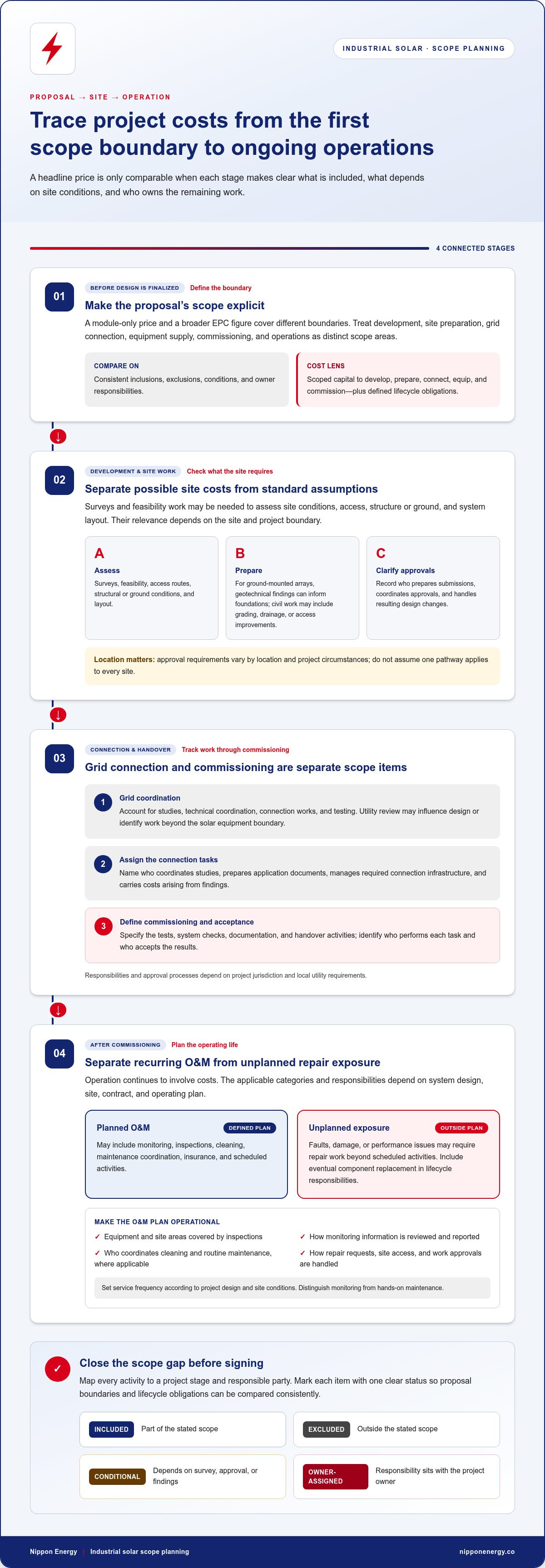
Use a scope checklist to uncover solar project costs before signing
A proposal comparison is meaningful only when each document describes the same project boundary. Use a consistent review sequence to trace work from site assumptions through commissioning and ongoing responsibilities. When identifying the hidden costs of industrial solar projects, the aim is not to assume every possible item applies. Make each item’s status visible before finalizing the contract scope.
Build a cost-ownership matrix for every proposal
Create one matrix per proposal with columns for cost or task, responsible party, proposal status, assumption, and supporting documentation. Classify each item as included, excluded, conditional, or owner-assigned. This prevents omissions from being mistaken for zero-cost items and shows where a decision, approval, or site finding could change the scope.
Include these categories in the matrix:
- Site works: surveys, access, ground or roof preparation, and civil works. Record the site assumptions behind the design.
- Permits and approvals: identify submission and coordination responsibilities, and flag location-specific requirements for verification in the project’s jurisdiction.
- Grid connection: capture studies, connection works, utility coordination, and any conditional requirements.
- Equipment: define the included modules, inverters, and storage equipment according to the engineered system boundary.
- Commissioning: state testing, documentation, and handover activities, including who performs and accepts each task.
- Operations, insurance, and financing: record maintenance responsibilities, monitoring scope, insurance assumptions, financing conditions, and relevant documentation.
For each conditional item, state the trigger and how the resulting scope will be documented. For example, if site assessment findings could change civil work, record the assessment basis and the process for documenting a resulting change. In Pakistan, verify permitting and grid-connection requirements for the project’s jurisdiction instead of assuming they are identical across locations.
Normalize proposals before comparing project economics
Before comparing financial models, align the capacity boundary and system configuration described in each proposal. Then compare the equipment included, grid scope, commissioning activities, and operating assumptions on the same basis. If one proposal includes storage and another does not, or if connection work is assigned differently, their headline figures are not directly comparable.
Keep exclusions and conditional work visible in the comparison. Record open assumptions, the party responsible for resolving each one, and any scenario changes that affect the design or operating model. Do not enter an unsupported monetary estimate to fill a gap. Mark the item unresolved and retain its documentation trail. This creates a disciplined basis for review and reduces the risk of treating missing scope as an assumed saving.
For coordinated solar project development and EPC planning, Nippon Energy’s solar project capabilities bring project development and delivery together.
How Nippon Energy connects industrial solar planning with EPC delivery
Industrial solar planning works best when design decisions, procurement, and construction are coordinated against a defined project scope. Nippon Energy provides solar project development and EPC, bringing these workstreams into a project-level framework where scope boundaries and responsibilities can be made visible. This helps teams assess the delivery plan instead of treating equipment selection as a standalone decision. Nippon Energy has 2,600 MW of solar systems in operation and construction across its broader project portfolio.
That coordination matters when planning for the hidden costs of industrial solar projects. Site requirements or lifecycle obligations can be overlooked when each project stage is planned in isolation. EPC planning can map work and assumptions across stages, while the agreed project scope defines the services and equipment included in the engagement.
Coordinate equipment decisions with project-level requirements
Evaluate modules, inverters, and storage as parts of the engineered system. Nippon Energy’s HJT Modules (Nippon G12 series) and TOPCon Modules can be considered alongside site and design requirements. Nippon Inverter technologies should be assessed within the system’s electrical configuration. Nippon Inverters have an efficiency of up to 99%, a specification for technical evaluation rather than a guarantee of project output.
Where storage serves a defined operating objective, its capacity and intended role belong in the project design and financial assumptions. Nippon Battery systems have a capacity range of 1,260-5,000 kWh and 200+ installations. These figures describe the offering; they do not mean storage is suitable or included in every industrial project. Determine the system configuration according to project requirements.
Make lifecycle responsibilities part of the delivery conversation
Delivery planning should address how the system will be monitored and maintained after commissioning. Monitoring and maintenance are related but distinct: monitoring supports operational visibility, while maintenance planning defines activities, responsibilities, and reporting. Nippon Energy provides solar system maintenance and monitoring as part of lifecycle planning. Set out the specific work assigned to each party in the project scope.
A clear handover connects design assumptions to the operating plan. Document equipment boundaries, monitoring responsibilities, maintenance activities, and how operational findings will be recorded and addressed. This creates continuity from project development through construction and into operation, giving industrial teams a defined basis for reviewing scope and ownership.
Bring your site requirements, operating objectives, and scope priorities into the planning discussion. Discuss an industrial solar project with Nippon Energy.
Turn clearer scope into a stronger project decision
A well-planned industrial solar project starts with decisions that remain useful after the proposal is signed. Before moving forward, align the people responsible for site access, approvals, operations, and finance around one shared view of the project boundary. That coordination gives each team a clearer basis for managing changes and evaluating how the system fits the facility’s longer-term plans.
The hidden costs of industrial solar projects are easier to manage when assumptions are visible and ownership is agreed before they become contractual or operational issues. Keep the scope record active as the project develops: update it when design decisions change, document shifts in responsibility, and carry unresolved items into the next review rather than treating silence as agreement.
Nippon Energy brings solar project development and EPC together with relevant equipment and lifecycle planning, helping industrial teams structure project discussions around their requirements. Share your site context, operating objectives, and priorities to begin a focused discussion.
Start planning your industrial solar project with Nippon Energy. A disciplined first step can help your team move forward with greater clarity and confidence.
Frequently Asked Questions
What are the hidden costs of an industrial solar project?
Hidden costs are project expenses or responsibilities that a proposal omits, makes conditional, or assigns outside its stated scope. They can arise during development, site preparation, grid connection, commissioning, or ongoing operation. For example, a facility might need additional site work or separate monitoring arrangements that are not part of the quoted package. Review each proposal’s assumptions and exclusions to determine whether an item is unnecessary or simply unaccounted for.
Can grid interconnection costs change after an industrial solar proposal is issued?
Yes. Costs can change if later technical reviews or utility requirements alter the connection work needed. A proposal may be based on preliminary information, while a subsequent study identifies additional design or infrastructure requirements. For a project in Pakistan, the applicable utility process and responsibilities depend on the project location and connection arrangements. Record the assumptions used in the proposal and how changes will be reviewed, approved, and documented.
How much should a business budget for solar project maintenance?
There is no single maintenance allowance that fits every industrial system. Build a project-specific budget from the proposed service scope, inspection and cleaning requirements, monitoring arrangements, site conditions, and division of work between the owner and service team. Keep scheduled activities separate from an allowance for unplanned repairs or component replacement. Use documented assumptions and revise the budget when the system design or operating plan changes.
What happens if site preparation or permitting is excluded from the EPC scope?
If either item is excluded, the project owner may need to arrange and fund that work separately, or assign responsibility to another party before construction proceeds. Unclear boundaries can also create coordination issues if site readiness or approvals affect the planned sequence. Identify the excluded task, its owner, required documentation, and any dependency on construction. Verify permit and approval requirements for the project’s jurisdiction in Pakistan.
Does an industrial solar project need battery storage to manage costs?
No, battery storage is not necessary for every industrial solar project. Its role depends on the facility’s operating objectives, electricity-use pattern, and intended storage application. Compare a solar-only configuration with a storage option using the same project boundary and stated operating assumptions. Include battery equipment and its operating responsibilities where they fit the engineered design; do not treat storage as an automatic requirement or a guaranteed source of savings.
Are solar monitoring and maintenance included in every EPC contract?
The contract’s defined scope determines whether monitoring and maintenance are included. EPC delivery covers project development, engineering, procurement, and construction, while monitoring or ongoing maintenance can be specified as separate, optional, or owner-assigned work. Review the contract for covered equipment, activities, reporting, duration, and follow-up responsibilities. Nippon Energy provides solar system maintenance and monitoring, with project responsibilities set out in the agreed scope.
How can a business compare industrial solar proposals fairly?
Compare proposals on the same technical and financial basis, not just by their headline totals. Align the system capacity and equipment boundary, then assess connection work, commissioning, operating assumptions, payment milestones, and exclusions. For example, proposals with different storage configurations or grid scopes may not be directly comparable. Record unresolved items separately and assess how each proposal handles changes, so omissions are not mistaken for included work or zero exposure.


