

The proposal with the highest projected return may not be the strongest choice. When system sizes, production assumptions, and financial models differ, evaluating commercial solar proposals starts with aligning what each one is designed to deliver. For businesses in Pakistan, the comparison should reflect the specific site, operating load, and project conditions, not just a headline savings figure.
Payback and energy savings matter, but both depend on the design and assumptions beneath them. Equipment selection, expected generation, battery integration, operating costs, and the delivery scope can all affect the result. A clear proposal makes these inputs visible and assigns responsibility for each project stage.
This framework covers technical design, production modelling, financial projections, and commercial terms on consistent assumptions. It shows how to identify design gaps, assess whether maintenance and monitoring are defined, and trace delivery responsibility from development through operations. Nippon Energy’s solar project development and EPC services bring these considerations together, helping buyers assess a proposal as a complete energy system rather than simply a projected return.
Key Takeaways
- Use a consistent checklist to capture each proposal’s system design, equipment, production estimate, schedule, and operating responsibilities.
- When evaluating commercial solar proposals, align capacity boundaries and equipment assumptions before comparing projected energy generation.
- Separate model inputs from commercial structure, inclusions, exclusions, and operating obligations to make financial comparisons more meaningful.
- Build a side-by-side worksheet to record key assumptions and expose gaps without relying on a universal scoring formula.
- Assess how each proposal connects planning, delivery, and ongoing operations through clearly defined development, EPC, and lifecycle responsibilities.
What a Commercial Solar Proposal Should Tell You Before You Compare
A commercial solar proposal should be a project-specific design and delivery plan, not a generic presentation of equipment or expected savings. It translates a facility’s site conditions and energy requirements into a defined system, explains how that system is expected to perform, and sets out the work and responsibilities needed to deliver and operate it.
A commercial solar proposal is both a technical design and a commercial scope, linking the system’s configuration and expected output to the work, assumptions, and responsibilities behind delivery. That distinction matters in Pakistan, where the proposal should reflect the facility and its operating conditions rather than rely on broad claims that may not apply to the site.
Solar technologies convert energy from sunlight into useful forms. The technology and system configuration determine what a specific project includes. For foundational context, the Solar Power Overview describes solar power technologies and their applications. A buyer’s decision requires a document with traceable project assumptions and clearly allocated responsibilities.
Which project details should appear in every proposal?
Start with the project boundary: the site or facility covered, proposed capacity, system configuration, and major design limits. Then review the equipment schedule for model names, quantities, and the roles of modules, inverters, and battery storage. These details help distinguish a complete project design from a high-level equipment estimate.
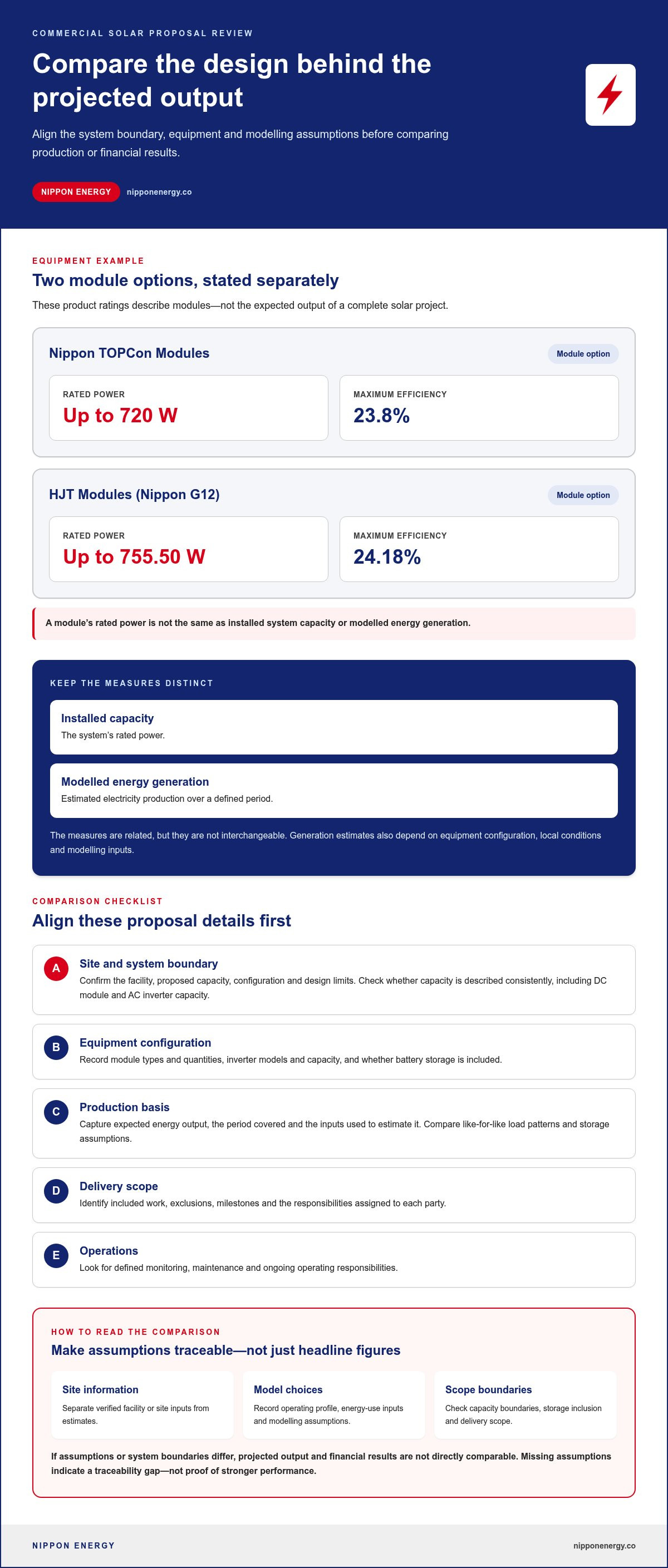
- Site and system: Identify the facility, proposed capacity, configuration, and design boundaries.
- Production basis: Record expected energy output, the period covered, and the inputs used to estimate it.
- Equipment: Capture model names and quantities for modules, inverters, and storage, where included.
- Delivery scope: Note included work, exclusions, milestones, and the responsibilities assigned to each party.
- Operations: Look for defined monitoring, maintenance, and ongoing operating responsibilities.
Equipment descriptions should distinguish between configurations. Nippon TOPCon Modules are rated at up to 720 W with max efficiency 23.8%, while HJT Modules (Nippon G12) are rated at up to 755.50 W with max efficiency 24.18%. These are separate module options, not measures of a complete project’s expected output. The proposal should connect the selected equipment to the project’s system design.
How do proposal assumptions shape the comparison?
Separate verified site information from estimates and modelling assumptions. Record the operating profile, energy-use inputs, and project boundaries used in each proposal. If one model assumes a different load pattern or includes storage while another does not, their projected output and financial results are not directly comparable.
Build a baseline before interpreting headline figures. Mark which inputs come from facility records or site information, which are estimates, and which are modelling choices. Note whether each proposal uses the same capacity boundary and delivery scope. Missing assumptions create a traceability gap, not proof of stronger performance. This first step makes evaluating commercial solar proposals more consistent and prepares you for a detailed technical and commercial review.
Evaluate Solar Design and Energy-Production Assumptions
A production estimate is meaningful only when it relates to the system described in the proposal. Layout, module selection, inverter capacity, storage configuration, and site conditions shape how much energy the system can generate and how much may be usable at the facility. When evaluating commercial solar proposals, first align the design boundaries, then assess the energy model.
Installed capacity describes the system’s rated power, while modelled energy generation estimates how much electricity it will produce over a defined period. These related measures are not interchangeable. A larger capacity may indicate greater potential output, but the estimate also depends on equipment configuration, local conditions, and modelling inputs.
How can you review the proposed system design?
Compare the proposed layout, capacity, major components, and stated design constraints across submissions. Check whether each proposal describes DC module capacity and AC inverter capacity consistently. If one figure covers only the solar array while another uses a different system boundary, the proposals do not yet provide an equivalent basis for comparison.
- Layout and capacity: Note the proposed array arrangement and whether capacity figures are stated on a consistent basis.
- Equipment configuration: Record module types and quantities, inverter models and capacity, and any battery storage included.
- Design boundaries: Identify what is included in the system design and any stated constraints affecting its configuration.
Check whether the components match the stated boundary. A proposal that includes storage should explain its role in the system; one without storage should not be assessed as though it offers the same configuration. Nippon Energy’s commercial project development and EPC services connect project planning with delivery, bringing design decisions into the project scope.
What makes an energy-yield estimate assessable?
A useful estimate explains its basis rather than presenting a single annual figure without context. Record each proposal’s energy-use profile, weather or solar-resource data, array orientation, shading assumptions, temperature effects, system losses, and operating availability where these are used. The inputs should describe the same site and project boundary before you compare model outputs.
- CUF: Capacity Utilization Factor compares energy generated over a stated period with the energy the system could produce if it operated at rated capacity throughout that period.
- PR: Performance Ratio relates actual system output to the output expected from the solar resource received, accounting for system performance and losses under the stated methodology.
Neither measure replaces the assumptions behind the estimate, and neither has a universal benchmark that establishes credibility on its own. Check whether the proposal defines the calculation period, data source, and treatment of losses. The Solar Energy Industries Association (SEIA) provides broader industry context, but Pakistan-specific project conditions should remain the basis for a local design review. Compare the disclosed inputs first, then interpret the projected generation.
Compare Financial Models and Contract Scope on Equal Terms
A financial projection is comparable only after the proposals describe equivalent projects. Differences in equipment, delivery scope, operating responsibilities, or commercial structure can change both the model inputs and the result. When evaluating commercial solar proposals, separate what each model assumes from what it calculates, then compare the contract boundaries alongside the projected figures.
How should you interpret projected savings and returns?
Read projected savings, returns, and payback as model outputs, not promises. Trace each result to its inputs: expected energy generation, the share used on site, the value assigned to that energy, operating assumptions, and the analysis period. If proposals use different periods or energy-value assumptions, their outputs are not like-for-like comparisons.
Record the assumptions in a common worksheet before drawing conclusions. For projects in Pakistan, local incentives, electricity tariffs, and contract rules can vary by project and jurisdiction. Review how each model treats them, and do not assume that policy or tariff inputs apply universally.
| Comparison area | What to align or record | Why it matters |
|---|---|---|
| Model inputs | Analysis period, energy generation, on-site use, energy-value assumptions, and any incentive or tariff inputs. | Different assumptions can produce different outputs even when system designs appear similar. |
| Commercial structure | Payment or ownership structure, stated payment milestones, and the basis used to present projected returns. | Different structures may shift costs, responsibilities, and the meaning of a return figure. |
| Included scope | Design, equipment, project delivery, and other work explicitly included in the proposal. | Included work defines what the quoted model and contract cover. |
| Exclusions | Work, services, or project conditions expressly outside the stated scope. | Exclusions reveal potential gaps between the modelled project and the delivered project. |
| Operating obligations | Monitoring, maintenance, reporting, and responsibility for ongoing operations, as stated. | Lifecycle duties affect who manages the system after project delivery. |
Which contract and lifecycle terms need comparison?
Review the written terms, not just the summary page. Compare inclusions, exclusions, responsibilities, milestones, and any warranty terms stated in each proposal. Confirm that the commercial scope matches the system represented in the financial model, so projected results are not tied to work or equipment the contract excludes.
Pay particular attention to monitoring and maintenance. The proposal should define whether these are included and who is responsible for them; vague operating language makes lifecycle accountability harder to assess. Nippon Energy provides solar system maintenance and monitoring, which can be defined as part of the operational scope. For additional lifecycle context, consult the solar system maintenance guide.
Compare each model only within its documented boundaries. Keep projected outputs distinct from contractual commitments, and treat jurisdiction-specific incentives, tariffs, and contract rules as items for project-level review. This gives decision-makers a more defensible comparison than ranking proposals by headline return alone.
Use a Side-by-Side Process to Find Gaps and Red Flags
A useful comparison does not force every proposal into one score. It makes differences visible, separates genuine design choices from mismatched assumptions, and records the evidence behind each option. When evaluating commercial solar proposals, start with the same project boundary and operating requirements, then document where submissions diverge.
Compare like-for-like project boundaries before ranking headline results. If one proposal includes storage and another does not, or their modelled outputs rely on different inputs, a direct comparison can conceal more than it reveals. A structured worksheet preserves those distinctions without implying that one scoring formula fits every facility.
What is a practical proposal-comparison sequence?
Follow the same sequence for every submission. Keep source documents and notes alongside your worksheet so each entry can be traced to the proposal or its supporting material.
- Define the project boundary. Record the facility, operating requirements, system boundary, and project conditions that should remain consistent across proposals.
- Normalize the submissions. Align the design basis, equipment details, production inputs, commercial structure, and lifecycle scope. Mark items as different when they cannot be aligned, rather than treating them as equivalent.
- Log differences and evidence. Note unresolved assumptions, missing documentation, and the explanation or evidence provided for each design and model. Compare what each proposal demonstrates, not just its conclusions.
Use a worksheet with one column per proposal and a shared set of fields. This makes omissions as visible as stated figures:
- Scope: Facility, system boundary, included work, and project milestones.
- Inputs: Operating requirements, production-model assumptions, and analysis basis.
- Equipment: Models, quantities, system configuration, and storage scope.
- Model outputs: Projected generation and financial outputs, with the inputs they depend on.
- Exclusions: Items or work expressly outside the proposal.
- Responsibilities: Delivery handoffs, operating duties, monitoring, and maintenance scope.
Which gaps deserve clarification before selection?
Flag an item when it cannot be traced to a stated design, input, document, or responsibility. Missing equipment models make it difficult to understand what the design specifies. An unexplained production estimate leaves its methodology unclear. A model output without identifiable assumptions cannot be compared reliably with one built on a different basis.
Also mark exclusions that could change the project boundary, handoffs without an assigned party, and operating obligations that are not defined in writing. Classify each gap as a difference to normalize, a document to obtain, or an unresolved responsibility. This directs review toward material issues rather than vague impressions. For related context on delivery capability, see evaluating solar EPC partners.
Once the worksheet shows aligned assumptions and remaining differences, assess which proposal offers the clearest design basis, scope, and accountability. Nippon Energy’s commercial solar EPC services connect project development with delivery.
Connect Proposal Evaluation to EPC Delivery and Long-Term Performance
A proposal sets expectations for more than system capacity and projected generation. It establishes how the project is intended to move from development into procurement, construction, commissioning, and ongoing operations. Evaluating commercial solar proposals means tracing technical and commercial commitments into the delivery plan, so the design presented for approval remains connected to the work and responsibilities that follow.
How should delivery accountability appear in a proposal?
Look for a clear allocation of responsibility at each project stage. The document should identify deliverables and handoffs, not rely on broad statements that work will be completed. A milestone schedule is more useful when it describes the work associated with each stage and the information or decision needed to move forward.
- Development: Identify the project design basis and the outputs that support the proposed system.
- Procurement: Connect specified equipment to the project scope and procurement responsibilities.
- Construction and commissioning: Define the planned work, milestones, and handoffs between stages.
- Operations: State who is responsible for monitoring, maintenance, and related operating activities.
These details make progress easier to assess and reveal where responsibility changes hands. They also connect the equipment schedule to lifecycle arrangements. If the proposal specifies modules, inverters, or storage, its operating scope should explain how ongoing monitoring and maintenance are addressed. Clear boundaries reduce ambiguity without assuming that every project follows the same delivery sequence.
What can an integrated EPC relationship bring to the decision?
Nippon Energy provides commercial and industrial solar project development and EPC services, connecting project planning with delivery. An integrated proposal can present the design basis, equipment scope, project milestones, and operational responsibilities as connected parts of the project rather than isolated sections. Buyers can assess whether the stated responsibilities carry through each handoff.
Use product specifications as evidence of equipment-level detail, not as a substitute for project modelling. Nippon Inverter efficiency is up to 99%; that specification applies to the inverter and should be considered alongside its role in the proposed system, not mistaken for a measure of the complete project’s energy output. Where storage is part of the design, the lithium-ion battery storage guide offers related context for understanding how storage fits into an energy system.
Nippon Energy reports 2,600 MW of solar systems in operation and construction. This figure describes the combined scope of systems in those two categories; it is not a performance claim for an individual project. For each proposal, the useful evidence remains the project-specific design, defined deliverables, and written accountability from development through operations.
Review Nippon Energy’s commercial solar solutions for project development and EPC.
Turn Your Evaluation Into a Confident Project Decision
Convert your comparison into a decision record. Identify the assumptions your organisation accepts, the open items that need resolution, and the responsibilities that must carry into the final project documents. Assign an owner to each outstanding item and retain the agreed design and operating basis as a reference for delivery. This creates continuity between the decision and the project’s later stages.
Evaluating commercial solar proposals is about making a decision your team can explain and manage, not finding a headline figure that appears strongest in isolation. A disciplined record helps align technical, financial, and operational stakeholders around the same project definition and gives the selected proposal a clear foundation for execution.
Explore Nippon Energy’s commercial solar solutions to plan your project’s path from development to delivery.
Frequently Asked Questions
How many commercial solar proposals should a business compare?
There is no fixed number that suits every project. The useful comparison is one that gives your team enough information to assess different approaches while allowing time to review each submission carefully. Start by defining the facility requirements and project boundary, then assess whether each proposal addresses them. If a submission differs substantially in design or delivery scope, record that difference rather than treating its projected return as directly comparable.
What is the difference between solar capacity and annual energy production?
Solar capacity describes the system’s rated power, while annual energy production estimates the electricity generated over a year. Capacity is expressed as power; energy production is expressed as energy over time. A proposal may list installed capacity and separately estimate yearly generation. Review them as different measures, and check that the production estimate reflects the proposed configuration and site.
Can commercial solar proposals include battery storage?
Yes. A commercial solar proposal can include battery storage as part of the system design. The document should identify the battery system and its proposed role, such as storing solar energy for later use when that is the project objective. Compare whether storage is included and how its scope appears in the design and financial analysis. Nippon Energy supplies Nippon Lithium-ion Battery Storage Systems for commercial and industrial applications.
What should a commercial solar proposal say about maintenance?
A proposal should state whether maintenance and monitoring are included, what activities fall within that scope, and which party is responsible. It should also explain how ongoing service relates to project handover and any separate operating arrangements. If monitoring is included but maintenance is handled under a separate scope, make that division explicit. Nippon Energy provides solar system maintenance and monitoring services.
How can a buyer assess solar equipment in a proposal?
Check that the proposal identifies equipment by model or product name, quantity, and role in the system. Compare those details with supporting technical documents, such as manufacturer datasheets, to confirm the equipment described matches the design under review. Note any substitutions or equipment options clearly. This gives technical and procurement teams a shared reference and reduces ambiguity when finalizing the project scope.
What does EPC mean in a commercial solar proposal?
EPC means engineering, procurement, and construction. In a commercial solar proposal, it describes a delivery scope covering system engineering and design, sourcing project equipment, and construction. The division of work can vary, so review which activities and deliverables are included and where responsibility transfers between stages. Nippon Energy provides solar project development and EPC services, connecting planning with project delivery for commercial and industrial customers.
Should the proposal’s projected return be treated as guaranteed?
No. A projected return is a modelled estimate based on assumptions, not a guaranteed financial outcome. Its result can depend on estimated energy generation, the value assigned to solar electricity, operating costs, and the analysis period. When evaluating commercial solar proposals, keep the model inputs with the result and distinguish projections from contractual commitments. Assess whether the assumptions are transparent and relevant to the specific facility.


