

Could you identify the right commercial solar financing option before choosing a lender? In Pakistan, commercial solar financing options pakistan should be assessed against a project’s actual cash flow, not headline savings. NEPRA’s 2026 Prosumer Regulations shifted new applicants to net-billing, making on-site electricity use more important to project economics than exporting surplus power.
Loan terms, eligibility, and documentation matter, but they are useful only after you define the project’s energy profile and costs. Unsupported savings assumptions can weaken the business case and make lender review more difficult.
This guide compares the main routes, including commercial bank finance, eligible renewable-energy lending, and self-funded investment. It explains how to assess project readiness using site-specific load and generation evidence, prepare a credible cash-flow case, and align financing assumptions with equipment selection and EPC delivery. The aim is a practical next step: a technically coherent project that can be evaluated using evidence rather than estimates.
Key Takeaways
- Compare commercial solar financing options pakistan by ownership, cash-flow timing, flexibility, documentation, and who carries each project responsibility.
- Build a finance-ready case from your facility’s energy records, site conditions, operating profile, and clearly stated assumptions.
- Evaluate self-funding, business lending, Islamic financing, leasing, and project-finance approaches against your organisation’s objectives and capacity.
- Involve finance, operations, procurement, and facilities teams so project assumptions align with implementation requirements.
- A coordinated EPC scope can define project boundaries and connect system design with Nippon modules, inverters, and battery storage where suited to the project.
Why commercial solar financing in Pakistan needs a project-first approach
Commercial solar financing is the funding or capital structure used to develop a business-scale energy project. The key question is not simply which lender offers a product. It is whether the proposed system, ownership arrangement, operating conditions, and cash-flow objectives form a coherent investment case.
A factory running energy-intensive equipment during daylight hours has a different demand pattern from a warehouse with intermittent activity or a distribution centre with distinct operating shifts. Those differences affect how much solar generation the business can use on site, whether storage has a role, and how the project’s expected value should be assessed. Solar Power in Pakistan provides background on the country’s solar development and policy context, but each project still depends on its own site and operating evidence.
Keep financing decisions distinct from system design, EPC scope, and equipment procurement. Financing defines how capital is arranged and repaid. Design translates site conditions and load data into a technical system. EPC scope sets out project delivery responsibilities, while procurement identifies the required equipment. These workstreams must align, but one does not establish the assumptions of another. Pakistani lender products, eligibility criteria, documentation, and commercial conditions can change, so base your assessment on current requirements and the specific project.
How commercial solar differs from home-solar finance
Household-focused finance commonly centres on an individual applicant and personal eligibility. A commercial proposal may also require organisational approvals, a defined ownership structure, operational data, and review by finance, facilities, procurement, or senior management. The decision must fit the business’s governance as well as its energy needs.
Project scale and delivery boundaries add complexity. A factory, warehouse, and distribution centre can each have different load profiles and site constraints. Decision-makers need a clear account of operating schedules, energy use, project scope, and implementation responsibilities, rather than household-oriented assumptions or a generic system estimate.
What financeability means for a solar project
A financeable project presents a credible technical scope, documented assumptions, and a clear repayment or return case. Separate verified information, such as utility bills, operating schedules, and site observations, from forecasts, such as future energy use or projected solar output. Label assumptions so reviewers can distinguish evidence from estimates.
“A sound project review brings together documented energy use, operating conditions, site and technical scope, ownership, and a transparent cash-flow case.” These are practical inputs for internal review and financing discussions, not a universal checklist. Documentation requirements vary by institution and transaction.
- Business evidence: Energy records, operating profile, and relevant approval responsibilities.
- Project definition: Site conditions, proposed system scope, ownership, and delivery boundaries.
- Financial logic: Stated assumptions, expected cash-flow effect, and the basis for repayment or return.
For businesses searching for “commercial solar financing options pakistan,” the first useful step is to establish this project case. It gives financing discussions a defined technical and operational foundation without treating projected savings as guaranteed outcomes.
Commercial solar financing options in Pakistan: how each structure works
Commercial solar financing options pakistan can refer to several ways to fund or structure a business energy project. The routes differ in who provides capital, who owns or uses the system, how payments are scheduled, and who carries operational responsibilities. Availability, documentation, pricing, and eligibility depend on the institution, contract, and project. Use the comparison below as a framework, not as a statement of current lender terms.
Self-funded investment
Typical fit: Businesses allocating internal capital to the project.
Decision factors: Available capital, competing investment priorities, ownership, and internal approval process.
Review: Project budget, accounting treatment, procurement process, and responsibilities after commissioning.
Conventional business lending
Typical fit: Organisations seeking external debt while retaining the system as a business asset, subject to the lending structure.
Decision factors: Repayment schedule, security or other conditions, cash-flow capacity, and effect on existing borrowing.
Review: Eligibility, documentation, pricing, repayment terms, and project-specific requirements in the current written offer.
Islamic financing
Typical fit: Businesses seeking a Shariah-compliant arrangement structured through an institution’s approved model.
Decision factors: Contract structure, asset ownership during the term, payment obligations, and allocation of responsibilities.
Review: The institution’s product documents, Shariah description, eligibility, and contractual terms.
Leasing or asset-use arrangements
Typical fit: Businesses considering use of a solar asset under a contract rather than purchasing it outright at the start.
Decision factors: Ownership, payment timing, maintenance duties, contract duration, and end-of-term treatment.
Review: The lease terms, accounting treatment, asset responsibilities, and any purchase or return provisions.
Project finance or power-purchase arrangements
Typical fit: Projects assessed around defined cash flows, contracts, and parties, rather than solely through a company’s general borrowing capacity.
Decision factors: Project scale, revenue or payment structure, risk allocation, and contractual complexity.
Review: Whether the structure applies to the specific project and how its agreements assign ownership, performance, and payment obligations.
Debt, leasing, and self-funded investment
Self-funding uses the business’s own capital. Borrowing adds scheduled repayment obligations. Leasing separates use of an asset from direct purchase, according to the contract. Ownership and accounting consequences can differ, so finance teams should model each option under their own policies. No structure is universally superior. Suitability depends on capital priorities, operational needs, and documented terms.
Islamic finance and project-based structures
Islamic financing may use asset-based arrangements, and some structures can include shared ownership or a transfer of ownership over time. Project finance and power-purchase arrangements define rights and obligations through project-specific contracts. A label alone does not establish suitability. Have finance and legal teams review the relevant documents and assess the obligations and risk allocation.
For a business comparing these routes, a coordinated technical scope can clarify what the capital structure needs to cover, from equipment procurement to delivery responsibilities. Nippon Energy’s commercial solar project development and EPC capabilities support this project-planning work alongside financial and legal review.
How to compare commercial solar financing structures without relying on headline terms
A headline rate or payment figure captures only one part of a commercial solar proposal. A useful comparison considers who owns the system, when payments fall due, how obligations interact with operating cash flow, and which party is responsible for delivery and ongoing operation. Assess the commercial solar financing options pakistan businesses consider against the same project scope and documented assumptions, rather than comparing isolated promotional offers.
Keep two sets of variables distinct. Financing terms describe obligations such as repayment timing, security, covenants, ownership, and exit conditions. Technical assumptions describe the proposed system, including its size, generation profile, site conditions, and whether storage is part of the scope. If these inputs differ across proposals, you may be comparing different projects rather than different financing structures.
Which evaluation criteria matter to a business?
Start with the payment schedule. Map each obligation against expected operating cash flow and internal investment priorities, then assess whether the timing leaves sufficient flexibility for other business needs. Review ownership and operational responsibilities alongside payments. A lower initial commitment may come with different asset rights or duties over the contract term.
Where an offer specifies them, examine security requirements, covenants, conditions for early repayment or exit, and obligations triggered by project changes. Compare the complete documents, not only a summary or calculator result. Finance, legal, procurement, and facilities teams can each identify a different exposure, so record open questions and assumptions in one comparison sheet.
- Ownership: Identify who owns the equipment during the term and at completion.
- Cash-flow timing: Map payment dates and conditions against the business’s operating cycle.
- Flexibility: Review documented provisions for early exit, repayment, or project changes.
- Responsibilities: Clarify who handles project delivery, maintenance, and other operational duties under the arrangement.
- Evidence: Separate confirmed contract terms from estimates and unverified assumptions.
Headline rates alone cannot determine project suitability. Ownership, payment timing, contractual obligations, and the technical scope must work together.
How solar design changes the financing case
System design shapes the operating case behind a financing comparison. Test a generation forecast against the facility’s actual load profile and operating schedule, including when electricity demand occurs. A proposal that assumes more on-site use than the business can support may overstate expected value. Keep measured site and consumption data distinct from forecast generation so reviewers can see the basis for each assumption.
Evaluate battery storage against the specific project. It can change the system scope and the timing of energy use, but its inclusion does not automatically improve returns. Assess its intended operational role and model the case with and without storage using consistent assumptions. This lets decision-makers compare financing structures against a defined design, rather than allowing lender terms to obscure technical differences.
Before approving a structure, align the financing model with the same system boundaries, procurement assumptions, and delivery responsibilities used in the technical proposal. That discipline makes differences between offers visible and gives internal reviewers a sounder basis for deciding which arrangement fits the business.
How to prepare a finance-ready commercial solar project in Pakistan
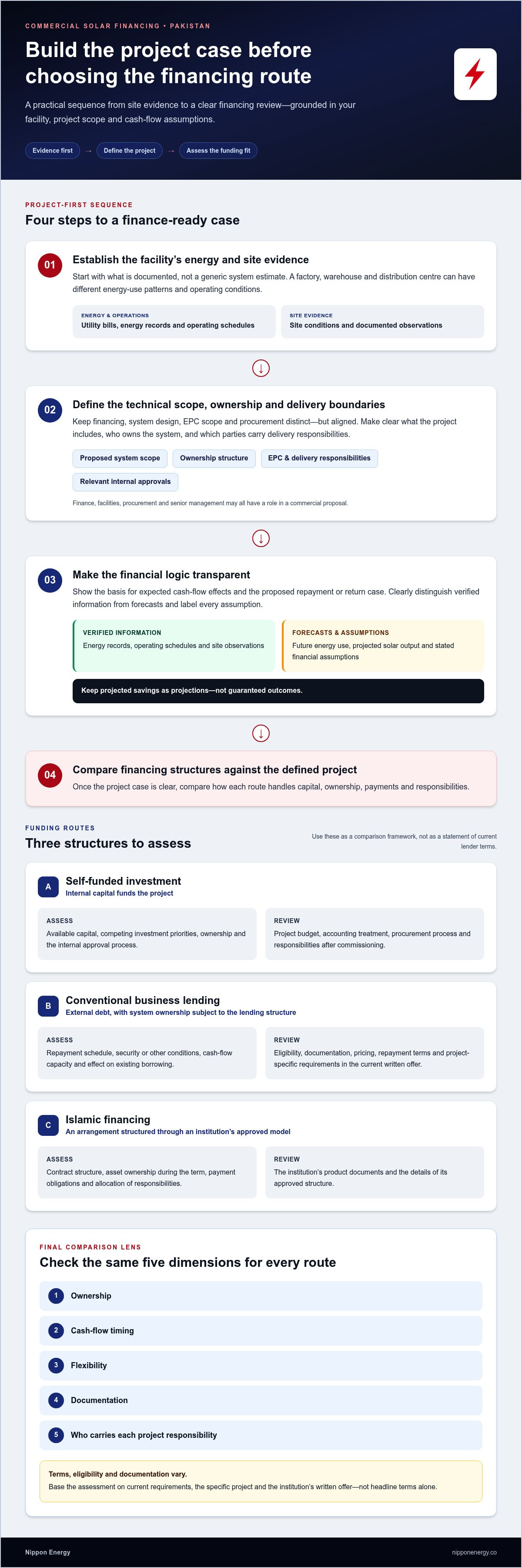
A strong project file makes commercial solar financing options pakistan easier to assess because it connects business objectives, site evidence, technical scope, and financial assumptions. Prepare the case in sequence, then align it with institution-specific application requirements and current Pakistan policy or grid conditions, using authoritative information from NEPRA and the applicable distribution company.
- Establish objectives. Define whether the priority is reducing grid electricity use, managing daytime demand, or supporting a stated resilience objective. Identify decision-makers and the approval route.
- Document energy use. Assemble available electricity bills, interval or meter data, operating schedules, and notes on planned changes to facility demand. Record the period each dataset covers.
- Assess the site. Document roof or land conditions, usable area, shading or access constraints, and relevant electrical infrastructure. Separate observations from assumptions that need technical assessment.
- Model scenarios. Compare a clearly defined system scope and operating case with alternative assumptions. Include storage only where it serves a stated purpose, and show how changes in generation or self-consumption affect the model.
- Review terms. Compare complete, dated financing documents against the same project scope. Assess eligibility, required records, payment obligations, ownership, and any applicable project or grid approvals.
Build the technical and operational project brief
Bring finance, operations, procurement, and facilities stakeholders into one project review. Operations can document shift patterns and essential loads. Facilities can record site conditions. Procurement can define equipment and delivery boundaries, while finance can set investment criteria. Specify the project boundary, including modules, inverters, and optional battery storage, then align responsibilities for design, procurement, installation, and ongoing operation. Nippon Energy’s commercial solar project development and EPC capabilities can help define a coordinated technical scope.
Useful records to organise include:
- Recent electricity bills and available meter or interval data.
- Operating schedules, facility plans, and known changes to energy demand.
- Site photographs, roof or land information, and electrical documentation available to the business.
- Internal approval records, ownership details, and financial statements where relevant to the application.
- A preliminary technical scope, assumptions register, and delivery-responsibility matrix.
This preparation file is not a universal lender checklist. Institutions may request different corporate, financial, technical, or security documents. Use current institution materials to establish the applicable list, format, and validity period. Check Pakistan-specific policy, interconnection, and distribution-company requirements against current official sources before treating them as project inputs.
Create a transparent financial review
Show the basis for each forecast: expected generation, the portion used on site, assumed savings, and any storage-related operating scenario. Mark each figure as verified, estimated, or pending validation. Include sensitivity cases that show how the investment case changes if operating hours, consumption, or generation differ from the base assumptions. Do not present projected savings as guaranteed.
For a coordinated project scope that supports technical and operational review, see Nippon Energy’s commercial solar EPC capabilities.
How Nippon Energy's EPC capabilities support commercial solar planning
A financing comparison is more useful when it is built around a defined project, not a generic system estimate. Nippon Energy’s commercial project development and EPC capabilities help businesses shape a coordinated scope that connects site requirements, technical design, equipment planning, and delivery responsibilities. This gives internal reviewers and financing discussions a clearer project basis, while the business and its financial institution assess financing terms.
Nippon Energy reports solar systems in operation and construction: 2,600 MW. An individual commercial project still needs a design that reflects the facility’s load profile, operating conditions, site constraints, and objectives. Equipment selection follows that assessment. Nippon HJT and TOPCon solar panels, Nippon Smart AI Inverters, and Nippon Lithium-ion Battery Storage Systems can be considered within a project-specific design. Not every site requires the same configuration.
Align project scope, equipment, and delivery
A practical project brief should show what the proposed system includes and where each delivery responsibility sits. Connect the site assessment and design basis to module and inverter selection, any proposed storage, procurement planning, installation scope, and defined handover or operational responsibilities. Clear boundaries help decision-makers understand what their financing case covers and keep technical assumptions connected to the delivery plan.
Include storage only where its role is supported by the facility’s needs and project analysis. Nippon Battery systems have capacities of 1,260 to 5,000 kWh and 200+ installations. These company-reported figures provide context for the offering, not a recommendation for a specific site. The right configuration depends on project requirements and technical design. An EPC-led scope can bring these components into one coordinated plan rather than treating equipment choices as separate purchasing decisions.
For commercial solar financing options pakistan, this coordination matters because lenders and internal reviewers need to understand the asset and project being evaluated. A well-defined EPC scope can identify the system boundary, procurement assumptions, and delivery responsibilities. It does not establish financing eligibility, determine lender terms, or guarantee a financial outcome.
Move from financing assessment to project discussion
Before moving from comparison to project planning, bring together the information already developed: facility energy records and operating schedules, site conditions, intended project scope, generation and self-consumption assumptions, any storage rationale, and open financing questions. This gives technical and finance teams a shared reference point and helps identify assumptions that need further assessment.
Nippon Energy’s commercial solar project development and EPC capabilities connect technical planning with delivery scope. A defined project can then be assessed alongside the business’s financing approach and current institution documentation.
Explore Nippon Energy's commercial solar and EPC solutions to move from financing assessment toward a defined project scope.
Turn your project case into a defined next step
Convert your analysis into a decision-ready project brief. Identify who will own each open question, which assumptions need validation, and what information internal approvers need before committing capital. This gives discussions about commercial solar financing options pakistan a concrete foundation: a business objective, a defined technical scope, and a clear path for evaluating the project alongside current financing terms.
Nippon Energy’s commercial solar project development and EPC capabilities can help shape the technical scope and delivery responsibilities around your facility’s requirements. The company reports 2,600 MW of solar systems in operation and construction. A coordinated project definition gives your business and its financial institution a more grounded basis for assessing the proposed site and system.
Discuss your commercial solar project scope with Nippon Energy and take the next step toward a well-defined investment case. A disciplined start can help your team move forward with clarity and confidence.
Frequently Asked Questions
How much does commercial solar financing cost in Pakistan?
Commercial solar financing costs depend on the institution, structure, applicant, and project terms. Any quoted charge should come from a current written offer, not a general market estimate. Compare dated documents for finance charges, fees, payment schedules, security conditions, and early-settlement provisions. Keep financing charges separate from system design, equipment procurement, installation, and other project costs so your business can assess the complete financial commitment.
What commercial solar financing options are available in Pakistan?
For businesses researching commercial solar financing options pakistan, categories to evaluate include self-funding, business lending, Islamic finance, leasing, and project-based structures. Each allocates ownership, payments, and project responsibilities differently. Availability and eligibility can vary by institution, applicant, and project. Treat these as structures to compare, and use current institution documents to establish the applicable terms.
Can a business finance solar panels through Islamic finance in Pakistan?
Yes, Islamic financing may be structured for an asset through arrangements based on ownership, sale, lease, or partnership, depending on the institution’s model. The precise mechanics are set out in the institution’s product documents. A general description of an Islamic finance structure does not establish a business’s eligibility, current pricing, or the presence of Shariah certification. Review the relevant documents with your finance and legal teams before treating a structure as applicable.
What documents are usually needed for commercial solar financing?
Businesses can prepare records in several categories: company identity and ownership information, financial statements, electricity bills or meter data, site details, and a technical proposal. This is a preparation list, not a universal lender requirement. The institution’s current application checklist controls, and requested documents may differ by applicant and financing structure. Keep source records legible, consistent, and dated, and note which technical or financial assumptions are estimates rather than verified information.
Is leasing or a business loan better for a commercial solar project?
Neither is universally better. A business loan may place asset ownership and repayment obligations with the borrower, while a lease may define use and ownership differently under its contract. Compare payment timing, accounting treatment, flexibility, and each party’s responsibilities against your project objectives. Contract terms vary, so use the complete written offer rather than a summary. Have your finance and accounting teams assess the implications without relying on general financial or tax advice.
How do I assess whether a commercial solar project is financeable?
Assess financeability by assembling a defined scope, site-specific energy records, credible generation assumptions, transparent cash-flow scenarios, and clear delivery responsibilities. For example, distinguish measured facility consumption from projected solar output, and show how the case changes if operating schedules differ. These materials help reviewers examine the project, but they do not establish an approval outcome. The relevant institution makes its own assessment under its current criteria and documentation requirements.
Can battery storage be included in commercial solar financing?
Battery storage may form part of a commercial solar project scope, subject to technical design and the financing structure. Its suitability depends on the facility’s operating needs and the assumptions used to evaluate the project. Inclusion alone does not guarantee savings or financing approval. Nippon Energy offers Nippon Lithium-ion Battery Storage Systems. Define the proposed storage role in the technical scope so it can be assessed as part of the overall project.


