

A solar installation is only one part of a business energy strategy. Green energy solutions for Pakistani businesses can combine solar generation, battery energy storage, net metering and energy monitoring. Businesses using hybrid solar systems may see electricity-bill reductions of 40-80%, depending on roof size and usage.
That potential matters when electricity costs put pressure on operating budgets. But the right system is not simply the largest array a site can accommodate. Generation, storage and consumption need to work together around the business’s operating patterns.
This article explains how each technology contributes, how battery storage can support energy use when solar generation falls, and how net metering and monitoring fit into a system. You’ll also learn what affects system design and bill savings, and how to plan a practical next step for your business in Pakistan.
Key Takeaways
- Assess your site’s roof space, operating schedule and electricity demand to understand how commercial solar could fit your business.
- Explore battery storage when you need to shift solar energy for use beyond sunny production hours or support a hybrid system.
- Plan for net metering as a process: approval timing varies by DISCO and workload, and export activation can take a few weeks after submission.
- Use energy monitoring to identify when and where electricity is consumed, then align system design with those patterns.
- Compare commercial solar proposals by their full system scope and design factors, not only by a per-kW figure.
Which industries are mostly working on Green Energy?
Commercial and industrial solar solutions suit facilities with usable roof or ground space and regular electricity demand. Manufacturers, warehouses, paper mills, offices and food-processing sites can use solar energy to serve daytime loads. Match system output to the facility’s operating schedule, electrical loads and available installation area. Energy monitoring then helps operators compare generation with consumption and identify periods of high grid use.
Solar, wind, biomass and hybrid systems suit different operating conditions. Solar converts sunlight into electricity, wind relies on a suitable wind resource, and biomass uses available organic material as fuel. A hybrid system combines energy sources or pairs solar with storage, helping businesses align generation with changing demand.
Businesses using hybrid solar systems may see bill reductions of 40-80%, depending on roof size and usage. Rooftop solar can reduce grid purchases when generation coincides with a facility’s consumption, while monitoring reveals how closely those patterns match.
Industrial adoption can involve more than one installation. A representative of Century Paper & Board Mills said the company had 3 to 4 solar plants from different companies. For businesses with multiple facilities or large loads, that example highlights the value of assessing each site’s roof, electricity profile and expansion plans separately.
For commercial solar, suitable locations have usable roof or land with limited shading, ideally near the facility’s electrical infrastructure. Wind projects depend on measured, consistent wind at the proposed site, so assess the local resource rather than inferring it from a city name. Compare site conditions and load profiles before choosing a technology.
Maintenance costs and system lifespan depend on the equipment, operating conditions and work required over time. A practical maintenance plan should include cleaning panels when dust or debris reduces sunlight exposure, inspecting electrical connections, and reviewing inverter and monitoring data. Record service findings to identify recurring faults and plan component care.
When planning an installation, map the facility’s main loads, operating hours and available roof area. Then assess the connection point, shading, structural suitability and expected self-consumption. These steps help determine the system configuration and whether storage or another generation source suits the business’s operating pattern.
- Grid outages can interrupt supply, while storage may support selected loads when the system is designed for that purpose.
- Policy changes can affect export arrangements and project economics, so model the business case around on-site use as well as grid exports.
- For a multi-site operator, compare each facility’s demand and site conditions before standardising equipment or installation plans.
Battery energy storage systems (BESS)
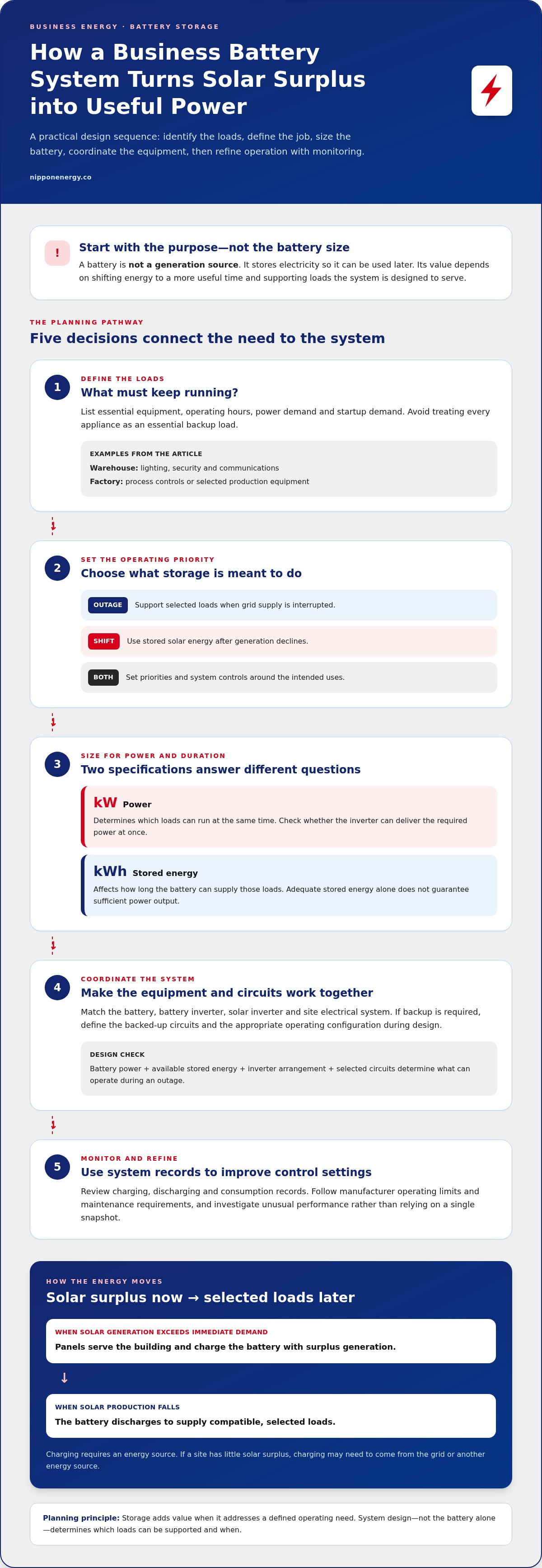
A battery energy storage system stores electricity for later use. For a Pakistani business, it can capture surplus solar generation during the day and supply selected loads when panels produce less. A battery is not a generation source; its value comes from shifting energy to a more useful time.
Start by identifying the loads the business needs to support. A warehouse may prioritise lighting, security and communications, while a factory may focus on process controls or selected production equipment. List those loads, their operating schedules and power demands before sizing the system. This avoids treating every appliance as an essential backup load.
Two specifications matter: power, measured in kilowatts, and stored energy, measured in kilowatt-hours. Power determines which loads can run at the same time; stored energy affects how long the battery can supply them. Even a battery with sufficient stored energy can fall short if its inverter cannot deliver the required power at once.
In a solar-plus-storage system, panels supply the building and charge the battery when generation exceeds immediate demand. Later, the battery discharges to serve compatible loads. Controls must coordinate the solar inverter, battery inverter and site electrical system. If backup during a grid outage is needed, the system requires an appropriate operating configuration and clearly defined backed-up circuits.
- Map the load: identify essential equipment, startup demand and operating hours.
- Set the operating priority: decide whether storage should target outage support, solar self-consumption or both.
- Check system compatibility: match the battery, inverter and existing electrical equipment.
- Review monitoring data: use charging, discharging and consumption records to refine control settings.
Each battery system has manufacturer-specified operating limits and maintenance requirements. Follow those requirements, keep the equipment area suitable for its installation, and use monitoring to identify unusual performance. Since battery performance changes with operating conditions and use, review system records rather than relying on a single snapshot.
Storage adds value when it addresses a defined operating need. For example, a site with daytime solar surplus and evening demand can use stored energy after production declines. A site with little surplus may need a different configuration, since charging the battery requires solar, grid or another energy source.
In Pakistan, grid interruptions make backup planning relevant, but storage alone does not guarantee power for an entire facility. The inverter arrangement, selected circuits, battery power and available stored energy determine what can operate. Define these requirements during project design, then compare system performance through ongoing monitoring.
Net metering and energy monitoring
Net metering lets a business feed surplus solar electricity into the main grid. At a factory where solar generation exceeds daytime demand, exported energy can be recorded through the approved connection arrangement. Its value depends on generation, on-site consumption and the applicable export terms.
Approval timing in Pakistan varies by DISCO and workload. Allow a few weeks from submission to export activation. Include this interval in project planning, since a system can generate solar energy before grid export is activated.
For a commercial solar installation, first map the site’s electrical system and intended operating mode. Obtain internal site authorization, coordinate the electrical design, and decide whether the business plans to export surplus power. Net metering requires approval from the relevant DISCO for export activation; the application process and timing vary by DISCO and workload.
Energy monitoring turns system readings into useful operational information. Track solar generation, building consumption, grid imports, exports and battery activity where storage is installed. Compare records across operating shifts to see whether production matches demand. For example, midday exports alongside evening imports can reveal a mismatch between solar output and business hours.
- Review generation: compare solar output with expected production patterns and note unexpected drops.
- Review consumption: identify equipment or shifts that drive grid imports.
- Review exports: match exported energy records with meter and utility statements.
- Act on trends: adjust operating schedules or system controls when the data supports a change.
A consistent monitoring routine can also help improve efficiency by connecting system performance with facility operations. Assign someone to review the data regularly, record faults and maintenance actions, and compare later readings. This helps distinguish a production issue from a change in demand.
Incentives, tax treatment and financing options depend on the applicable programme, business eligibility and project structure. Assess those terms alongside expected on-site use and the export arrangement, rather than making an incentive the project’s only financial basis.
For an export-enabled project, prepare the technical details and submit the net-metering application to the relevant DISCO. Allow a few weeks from submission to export activation, with timing shaped by the DISCO and its workload. Keep application records and commissioning information together to support the approval process.
Monitoring becomes a useful operational indicator when managers use it to spot changes early. By comparing solar output and grid imports, a site can identify whether equipment schedules, maintenance needs or demand patterns require attention. System data can then inform practical decisions about business operations.
Business electricity-bill savings
Hybrid solar systems may reduce business electricity bills by 40-80%, depending on roof size and usage. Treat that range as context, not a forecast for an individual site. A warehouse operating through daylight hours has a different consumption profile from a factory running evening shifts. For green energy solutions for Pakistani businesses, savings depend on how well system output matches actual demand.
Start with electricity bills and meter records. Separate electricity consumed during solar-production hours from use outside those hours. This comparison shows how much generated power could serve immediate demand instead of being exported or left unused. Use representative operating periods, including busy shifts and quieter production days.
Solar savings primarily come from replacing grid electricity with on-site generation. A business gets more direct value when its equipment operates during productive solar hours. For example, scheduling flexible processes during daytime generation can increase self-consumption without changing the system’s nameplate capacity.
Net metering can record surplus solar electricity supplied to the grid, but its export value depends on the applicable arrangement. Build two separate estimates: electricity used on site and electricity exported. This prevents assumptions about export value from being confused with direct bill reductions. It also gives businesses a clearer basis for evaluating green energy solutions for Pakistani businesses.
Battery storage can shift some solar energy for later use. Before including storage in a savings model, compare when surplus generation occurs with when electricity demand rises. A site exporting energy at midday and importing power later may have a different storage case from a facility that consumes most generation immediately.
- Collect records: assemble electricity bills, meter readings and operating schedules.
- Map demand: identify large loads and the hours they run.
- Estimate solar use: compare expected generation with demand occurring at the same time.
- Separate exports: model grid exports apart from electricity consumed on site.
- Review performance: compare monitoring records with bills after commissioning.
Monitoring helps explain changes in actual bills. If solar generation falls while imports rise, review system performance and maintenance records. If generation remains steady but imports increase, check operating schedules and electricity-consuming equipment. This helps separate a production issue from a change in demand.
For a sustainable savings plan, assess the full electricity profile rather than relying only on annual consumption. Seasonal production, site shading, available roof area, shift schedules and export arrangements all affect the result. A business with daytime cooling loads may use solar differently from one whose main machinery runs after sunset.
Compare the projected bill impact with measured results over time. Keep reporting periods consistent, track solar generation, imports and exports, and document operational changes. This gives finance and facilities teams a consistent basis for evaluating whether the system continues to deliver the intended reduction.
What is the cost of commercial solar systems in Pakistan per kW?
There is no single per-kW price for a commercial solar system that applies to every Pakistani business. The total depends on system design, site conditions and included equipment. Pricing is provided after a quote request, with key factors including panels, inverters, mounting, electrical work, storage and project scope.
Start by distinguishing system capacity from total project cost. A per-kW figure may describe a basic generation system, while a turnkey installation may also include engineering, grid connection work, commissioning and monitoring. Compare proposals with the same scope, or a per-kW comparison may mislead.
Equipment choices affect system design and the quoted amount. Panel technology, inverter configuration and mounting requirements must suit the site. A rooftop with difficult access or structural constraints may require different engineering and installation work than a clear, accessible roof. These differences change project scope, not just the panel count.
Battery storage is a separate cost component. It adds equipment and integration work, while its capacity and intended role shape the system design. A business seeking backup for selected loads needs a different configuration from one using storage to shift solar energy into later operating hours.
Use this checklist to make a per-kW estimate more meaningful:
- Confirm capacity: distinguish the planned solar capacity from the total project package.
- List included equipment: compare panels, inverters, mounting and electrical components.
- Identify site work: account for roof access, structural requirements and connection work.
- Separate storage: compare battery inclusion, capacity and operating purpose independently.
- Review after-sales scope: note whether commissioning, monitoring and maintenance are included.
Energy use also matters to project value, even though it does not determine equipment pricing by itself. A facility with substantial daytime demand may use more of its solar generation directly. A site with later demand can assess storage separately, then compare the added scope with its operating objectives.
Ask for a written proposal that identifies capacity, equipment categories, installation work and exclusions. Check whether the quoted amount includes grid connection coordination, commissioning and monitoring. Then compare the proposed design with the site’s roof area, electrical loads and operating schedule.
For a practical estimate, prepare recent electricity bills, site information and the business’s operating schedule before requesting a quote. These details help define project scope and explain the price per kW. A project-specific quotation is more useful than applying a generic rate to a system with different equipment or installation conditions.
Green Solar Solutions describes net metering as a system that feeds surplus solar electricity into the main grid, which businesses can consider separately from installed-system pricing.
Nippon Energy: Nippon HJT Solar Panels
Nippon Energy supports Pakistani businesses planning solar generation, storage and project delivery. Its Nippon HJT Solar Panels and Nippon TOPCon Solar Panels provide options for commercial system design, while Nippon Lithium-ion Battery Storage Systems can form part of projects that require storage.
For businesses moving from assessment to implementation, Solar Project Development and EPC brings project development and engineering, procurement and construction together. The right configuration depends on site conditions, electricity demand, operating schedules and whether storage is part of the plan.
When you’re ready to turn your energy profile into a project scope, share your site requirements and operating priorities with Nippon Energy. Contact Nippon Energy to discuss your business’s solar requirements.
Turn Energy Planning Into a Practical Project
A useful next step is to turn energy priorities into a clear project brief. Identify what the business wants its system to support, which operating needs matter most, and how the project should fit future plans. This gives technical discussions a defined starting point and keeps design decisions connected to business requirements.
Nippon Energy offers Nippon HJT Solar Panels, Nippon TOPCon Solar Panels and Nippon Lithium-ion Battery Storage Systems. These products can inform a project built around solar generation, storage or both. The right configuration depends on the site and the business’s operating needs.
With a defined brief, green energy solutions for Pakistani businesses become easier to evaluate as long-term infrastructure rather than isolated equipment purchases. Set clear priorities, gather relevant site and energy information, and use those inputs to shape the next planning conversation.
Contact Nippon Energy to discuss solutions and take a considered next step toward your business’s energy goals.
Frequently Asked Questions
Why Choose Green Energy Product?
Choose a green energy product when its role matches a clear business need. Solar panels can supply on-site electricity, while battery storage can support selected loads or shift stored energy to another operating period. For example, a business prioritising essential equipment during an outage should define those loads before selecting system components. Compare product specifications, site requirements and how each component integrates with the facility’s electrical system.
What green energy solutions are available for Pakistani businesses?
Pakistani businesses can consider solar panels, battery storage, inverters, solar project development and EPC, along with system maintenance and monitoring. Nippon Energy offers Nippon HJT Solar Panels, Nippon TOPCon Solar Panels, Nippon Lithium-ion Battery Storage Systems and Nippon Smart AI Inverters. A business planning an installation can assess these components as part of a project design, while an existing system may benefit from maintenance and monitoring.
What are the latest net metering rules for businesses in Pakistan?
Net metering allows surplus solar electricity to be fed into the main grid, with export activation following the relevant DISCO’s approval process. Timing varies by DISCO and workload; allow a few weeks from submission to activation. For planning, distinguish electricity used on site from electricity exported, and include the application and activation process in the project timeline. Export arrangements depend on the applicable terms for the business’s connection.
What are the maintenance costs and lifespan of commercial renewable energy systems in Pakistan?
Maintenance costs and system lifespan depend on equipment, operating conditions and the work required over time. Plans should include cleaning panels when dust or debris reduces sunlight exposure, inspecting electrical connections, and reviewing inverter and monitoring data.
Which Pakistani cities and regions are best suited for commercial solar or wind power?
Commercial solar suits sites with usable, lightly shaded roof or ground space near electrical infrastructure, and demand that matches solar production. Wind suitability depends on measured, consistent wind at the proposed site, so assess local conditions rather than relying on a city name.


