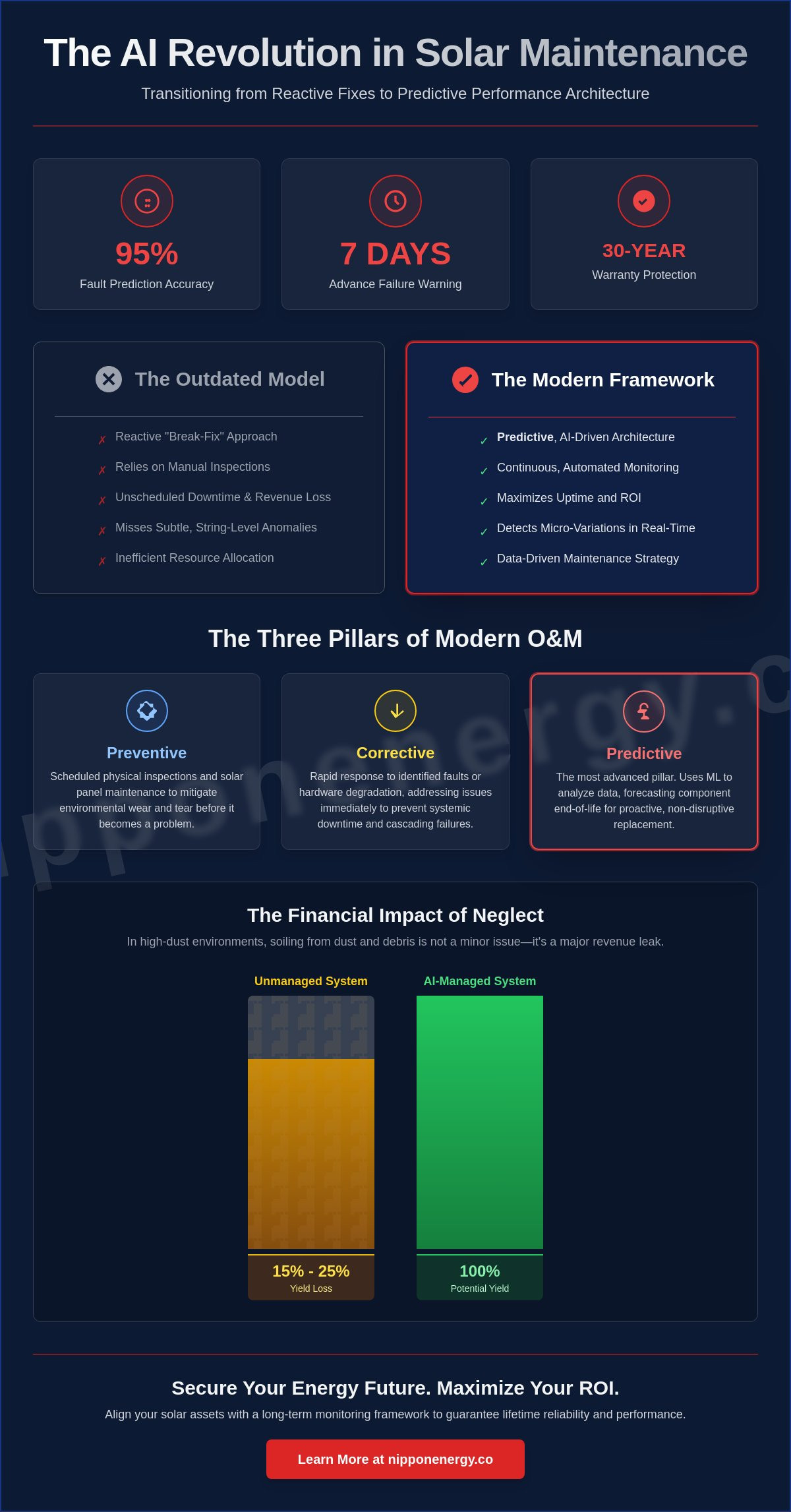
Advanced machine learning algorithms now predict faults with 95% accuracy, identifying potential failures up to seven days before they occur. For asset owners in high-dust environments like Dubai or Karachi, integrating these tools into your solar system maintenance routine is no longer optional; it's a financial necessity. You understand that unexplained drops in power generation directly impact your bottom line, yet the uncertainty of manual cleaning schedules often leads to inefficient resource allocation. With the expiration of the 30% US federal residential solar tax credit in 2026, the focus has shifted entirely toward maximizing the internal efficiency of existing hardware.
This guide provides a technical roadmap for long-term energy security through the lens of performance architecture. We'll detail how to implement a structured O&M schedule that protects your ROI and ensures your system achieves its full 30-year linear power warranty. You'll gain a clear understanding of how to use AI-driven monitoring software to transform raw data into actionable maintenance strategies. We'll move from broad operational visions to the granular technical specifications required to future-proof your energy infrastructure.
Key Takeaways
- Transition from reactive "break-fix" models to predictive O&M architectures that anticipate equipment failures before they compromise your system's output.
- Identify the specialized thermal monitoring and cell integrity protocols required to maintain the peak performance of high-efficiency HJT and TOPCon solar hardware.
- Leverage AI-powered monitoring software to detect string-level anomalies, a critical component of modern solar system maintenance that manual inspections often miss.
- Implement a structured 2026 maintenance checklist with specific environmental adjustments for high-dust climates to ensure consistent energy generation throughout the year.
- Understand the strategic advantage of aligning solar EPC services with long-term monitoring frameworks to maximize the total return on your energy investment.
What is Solar System Maintenance in the AI Era?
In 2026, the definition of solar system maintenance has undergone a fundamental shift. It's no longer a simple routine of washing glass and checking wire connections. Today, we define maintenance as "Performance Architecture," a rigorous discipline that merges physical preservation with high-level digital optimization. The industry has moved away from the outdated reactive model, where technicians only responded after a component failed. Instead, modern O&M (Operations and Maintenance) utilizes a predictive framework. This transition ensures that every kilowatt-hour of potential energy is captured, processed, and utilized, minimizing the Levelized Cost of Energy (LCOE) over the entire 25 to 30 year lifespan of the asset.
The core of this digital health is the Nippon Smart AI Inverter. These units act as the central nervous system of the array. They don't just convert power; they analyze string-level data in real-time to detect micro-variations in electrical signatures. This allows for a level of precision that manual testing can't match. When you maintain a system through this lens, you aren't just fixing parts; you're managing a sophisticated power plant to ensure it operates at its peak theoretical efficiency every single day.
The Three Pillars of Modern O&M
A resilient maintenance strategy rests on three distinct operational categories. First is Preventive Maintenance, which involves scheduled solar panel maintenance and physical inspections to mitigate wear. Second is Corrective Maintenance, the process of addressing identified faults or hardware degradation immediately to prevent systemic downtime. Third is Predictive Maintenance, the most advanced pillar. It uses machine learning to analyze historical performance data and environmental variables, forecasting exactly when a component will reach its end-of-life. This allows for proactive replacements that don't interrupt your energy production cycle.
Why Maintenance is an Investment, Not a Cost
Viewing maintenance as a line-item expense is a tactical error that compromises long-term ROI. In regions prone to high particulate matter, "soiling" from dust and debris can trigger a yield loss of 15% to 25% if left unmanaged. Professional cleaning and monitoring aren't chores; they're revenue recovery mechanisms. Furthermore, consistent solar system maintenance is often a prerequisite for maintaining the validity of your manufacturer warranties. For systems utilizing Nippon HJT Solar Panels, these protocols are vital to stay within the parameters of the 30-year linear power warranty. By investing in a structured O&M plan, you're effectively buying back lost energy and ensuring your hardware remains a high-performing asset for decades.
Core Maintenance Requirements for High-Efficiency Hardware
Modern high-efficiency modules require specialized attention that generic industry guides often overlook. While older P-type systems are relatively forgiving, the advanced architectures of TOPCon solar panels and HJT modules demand a higher level of technical scrutiny. This nuance is critical for maintaining long-term solar photovoltaic performance. Effective solar system maintenance in 2026 centers on preserving the integrity of these N-type cells, which are more sensitive to micro-cracks and thermal variations than their predecessors. Precision in hardware care directly translates to the preservation of your 30-year power warranty.
Maintaining Nippon HJT and TOPCon Modules
HJT (Heterojunction) technology is celebrated for its superior bifaciality and low temperature coefficient. However, these technical advantages require specific monitoring protocols. Maintenance teams should utilize high-resolution infrared thermography to identify hotspots that indicate potential cell delamination or micro-fractures before they lead to string failure. Cleaning is another precision task. You must use deionized water and non-abrasive tools to avoid stripping the specialized anti-reflective coatings that give these panels their high-yield advantage. If your system is installed over reflective surfaces like white gravel or specialized membranes, monitoring the bifacial gain is essential to ensure the rear-side production matches the original engineering specifications.
Lithium-Ion Battery Storage Care
Energy storage systems represent a significant portion of your infrastructure investment. Maintaining Nippon Lithium-ion Battery Storage Systems involves more than just checking charge levels; it requires a deep dive into the Battery Management System (BMS). You must monitor the State of Health (SoH) through the Nippon management app to track capacity fade and ensure cell balancing is functioning correctly. Temperature control is the primary factor in battery longevity. Enclosures must remain within the specified thermal range to prevent accelerated electrolyte degradation. Additionally, ensuring seamless firmware synchronization between the battery and the Nippon Smart AI Inverter prevents communication lag that can lead to inefficient discharge cycles or unexpected safety shutdowns.
Inverters are the hardest-working components in any array and require a dedicated cooling strategy. Heat is the primary enemy of power electronics. Regular solar system maintenance should include cleaning the cooling fins and verifying that internal fans are unobstructed. Software is just as important as hardware in 2026. Regular firmware updates optimize the maximum power point tracking (MPPT) algorithms, which allows the system to adapt to new grid conditions or hardware aging. For those looking to optimize these variables without the burden of manual oversight, exploring a professional monitoring and O&M partnership ensures these technical details are handled with industrial precision.
Manual Inspections vs. AI-Powered Predictive Monitoring
While physical inspections remain a foundational element of solar system maintenance, they're no longer the primary diagnostic tool. Traditional O&M relied on technicians physically walking the site to find visible issues. Modern solar panel performance monitoring software uses high-frequency data sampling to identify anomalies at the string level. This digital oversight captures performance dips caused by internal resistance or micro-shading that a human eye would never detect. By integrating real-time weather data, these systems distinguish between a natural drop in irradiance and a genuine hardware fault. This reduces the need for unnecessary on-site visits and ensures that technician time is spent only on verified issues.
Remote diagnostics have transformed the speed of recovery. When a fault occurs, the system provides a specific error code and a probable cause before a technician even leaves the office. This "first-time fix" capability is essential for large-scale projects where downtime directly translates to significant revenue loss. High-level solar system operations and maintenance now relies on these data-driven insights to maintain the performance ratios promised during the project development phase. It's a shift from looking at the glass to analyzing the electrons.
The Power of Smart AI Inverters
Nippon Smart AI Inverters represent the pinnacle of this technological integration. These units do more than just relay data; they actively safeguard the infrastructure. For instance, the AI can detect arc faults with extreme precision, neutralizing potential fire hazards before they escalate. In commercial applications, this level of detail is essential for EPC compliance and meeting rigorous safety standards. The software also optimizes battery discharge cycles based on the specific health of the cells, extending the lifecycle of your energy storage investment through intelligent load management. Automated reporting further streamlines operations by providing stakeholders with transparent, evidence-based performance metrics.
When to Call a Professional
Understanding the threshold between a user-managed alert and a critical system failure is vital for operational safety. Basic alerts, such as connectivity issues or minor debris warnings, can often be addressed by the owner through simple resets or surface cleaning. However, errors involving high-voltage DC components or significant power deviations require professional intervention. For commercial solar farms, technicians use IV curve tracing to map the performance of every module under specific conditions. This process identifies degradation patterns that are invisible to standard monitoring. Safety is paramount; high-voltage inspections must follow strict protocols to prevent electrical shock or equipment damage. Professional O&M ensures these complex tasks are executed with the precision required to maintain system integrity.
The Professional Solar Maintenance Checklist for 2026
Under 2026 operational standards, a structured solar system maintenance protocol is the primary safeguard for energy security. Relying on sporadic cleaning is insufficient for high-performance assets like N-type modules. A professional checklist must transition from simple visual observations to technical verification of electrical and structural integrity. This methodical approach ensures that every component, from the mounting rails to the earthing system, functions within its designed safety and performance parameters. In regions with extreme environmental stressors, such as the high-dust corridors of Riyadh or Lahore, these protocols must be accelerated to prevent permanent degradation of the module's anti-reflective coatings.
Maintaining the structural integrity of the array is as critical as the electrical output. Over time, thermal expansion and contraction can loosen mounting hardware, while coastal or high-humidity environments can trigger corrosion in galvanized steel or aluminum structures. Verifying the continuity of the earthing and lightning protection systems is also essential, especially under the revised NEC 2026 safety guidelines. These steps prevent catastrophic failure during extreme weather events and ensure the long-term resilience of the installation.
Monthly and Quarterly Performance Audits
The first tier of O&M focuses on data consistency and environmental management. You should review monitoring logs from the Nippon Smart AI Inverter daily to identify yield fluctuations that deviate from forecasted irradiance models. A physical visual check every quarter is necessary to identify shading from new vegetation, building additions, or accumulated debris in the gutters of the mounting system. For industrial-scale installations, cleaning the air filters on inverter housings is a mandatory quarterly task. This action prevents thermal throttling and ensures the power electronics operate at peak efficiency, even during peak summer temperatures.
Annual Deep-Technical Inspections
Once per year, the system requires a comprehensive technical audit that goes beyond surface-level checks. This process includes torque testing of all mounting bolts and electrical terminations to ensure they meet the manufacturer's specific tension requirements. Technicians should perform thermal imaging of all combiner boxes, DC disconnects, and string connections to detect high-resistance points that could lead to arc faults. Finally, a full system recalibration of the NipponHev management software ensures that the AI algorithms are accurately interpreting sensor data. This rigorous annual cycle preserves the validity of your 30-year linear power warranty and optimizes the total ROI of the asset. To ensure your infrastructure receives this level of technical precision, you can schedule our professional O&M and monitoring services to maintain peak performance architecture.
Nippon Energy’s Lifetime Reliability Framework
Nippon Energy views the commissioning of a project as the start of a multi-decade technical partnership rather than the conclusion of a contract. Our Lifetime Reliability Framework integrates solar system maintenance into the core architecture of every project from the design phase. By utilizing our solar EPC services, asset owners benefit from a turnkey approach where long-term O&M planning is embedded in the initial engineering. This synergy ensures that the specific thermal and electrical requirements of Nippon HJT and TOPCon modules are met with industrial precision. We operate global monitoring centers in Tokyo, Dubai, and Berlin to provide continuous oversight of our installations worldwide. These facilities analyze live data streams from Nippon Smart AI Inverters, allowing our engineers to implement performance corrections before minor deviations impact your energy yield.
Proprietary hardware integration is the foundation of our success. Because we manufacture the panels, inverters, and storage systems, our diagnostic software has a deeper understanding of the hardware's internal logic than any third-party tool. This vertical integration eliminates the communication gaps that often lead to delayed repairs or misdiagnosed faults. It's a closed-loop system designed for maximum uptime.
Global Expertise, Local Support
Our operational reach extends into the most challenging climates on the planet. We maintain a strong presence in Karachi and Lahore, where we provide localized care tailored to the specific humidity and particulate challenges of South Asia. In the Middle East, we manage commercial O&M for expansive industrial parks, ensuring that large-scale arrays maintain their efficiency despite extreme ambient temperatures. The Nippon guarantee centers on 24/7 remote monitoring and a rapid response protocol. When the system detects a critical anomaly, our global centers coordinate with local technical teams to deploy solutions immediately. This ensures that solar system maintenance is proactive rather than reactive, protecting your revenue stream at all times.
Securing Your Energy Future
Solar is a 25-year asset that requires expert oversight to hit peak ROI. Without a rigorous framework for technical management, even the most advanced hardware will succumb to environmental stressors and electrical degradation over time. Protecting your energy investment requires a shift from simple cleaning to a data-driven, architectural approach to performance. You can book a comprehensive professional system health audit through our technical portal to baseline your current output and identify optimization opportunities. Our engineers will review your string-level data and provide a roadmap for long-term reliability. Protect your investment with Nippon O&M Services and ensure your infrastructure delivers its full theoretical potential for decades.
Future-Proofing Your Energy Infrastructure for 2026 and Beyond
The paradigm of energy management has shifted from simple hardware ownership to a rigorous commitment to performance architecture. Effective solar system maintenance is now a sophisticated technical discipline where real-time data analysis and physical preservation converge to protect your bottom line. By transitioning from reactive "break-fix" models to predictive O&M strategies, you ensure that high-efficiency assets like Tier 1 Nippon HJT panels operate at their peak theoretical limit for their entire 30-year lifecycle. This methodical approach is the only way to navigate the complexities of modern energy grids while maximizing long-term ROI.
Nippon Energy supports this mission through global monitoring centers established in 5+ regions, utilizing advanced AI-integrated fault detection to identify anomalies before they impact production. Our framework provides the technical precision and structural integrity required for large-scale success, allowing you to focus on growth while we secure your power generation. Maximize Your System Performance with Nippon Professional O&M and secure the long-term resilience of your energy investment. The future of global power belongs to those who prioritize technical excellence today.
Frequently Asked Questions
How often should I clean my solar panels in dusty climates?
In high-dust environments like the Middle East or South Asia, a monthly cleaning schedule is often required to prevent "soiling" losses. Accumulated particulate matter creates a physical barrier that reduces photon absorption. You should monitor your daily yield through the NipponHev app; if production drops by more than 5% compared to forecasted irradiance, it's time for a professional cleaning to restore peak efficiency.
Can I perform solar system maintenance myself?
You can safely perform basic visual inspections and surface-level cleaning using non-abrasive tools and deionized water. However, technical solar system maintenance involving high-voltage DC circuits, torque testing, or firmware synchronization requires professional certification. Attempting to service the Nippon Smart AI Inverter or battery storage system without specialized training risks hardware damage and voids your 30-year linear power warranty.
Does rain count as cleaning for my solar panels?
Rain is rarely an effective substitute for professional cleaning. In many regions, light rainfall mixes with accumulated dust to create a "mud film" that further reduces cell efficiency. While heavy storms might remove loose debris, they often leave behind mineral deposits or streaks. Structured O&M ensures that the specialized anti-reflective coatings on Nippon HJT modules remain clear of all obstructions.
What are the signs that my solar inverter needs maintenance?
Primary indicators include persistent error codes on the management interface, unusual fan noise, or excessive heat radiating from the housing. If the Nippon Smart AI Inverter shows a decrease in conversion efficiency or fails to synchronize with the grid during peak hours, it requires a technical audit. Regular firmware updates and cooling fin cleaning prevent these operational issues from escalating into hardware failure.
How does maintenance affect my solar panel warranty?
Consistent maintenance is a core requirement for preserving manufacturer warranty validity. Most 25 to 30-year performance guarantees are contingent upon the owner providing evidence of regular professional inspections and cleaning. Documenting your O&M activities ensures that if a technical defect occurs, you remain eligible for hardware replacement or repair under the terms of the Nippon HJT or TOPCon module warranties.
What is the cost of professional solar maintenance for commercial systems?
The cost of professional maintenance for commercial arrays is determined by the system's megawatt capacity and the specific environmental challenges of the site. Factors such as the frequency of AI-driven monitoring, the complexity of the mounting structures, and the regional labor rates for certified technicians influence the final O&M budget. Asset owners should evaluate these operational costs against the potential 15-25% yield loss caused by neglect.
How do AI inverters help in solar system maintenance?
Nippon Smart AI Inverters utilize machine learning to analyze electrical signatures across every string in the array. This technology detects micro-variations that indicate arc faults or potential component degradation before they cause system downtime. By automating the reporting process, these inverters allow for predictive maintenance; this ensures that technicians only visit the site when a genuine hardware intervention is necessary.
What is thermal imaging in solar inspections and why is it used?
Thermal imaging uses infrared cameras to detect temperature variations across the module surface. Technicians use this tool to identify "hotspots," which are localized areas of high resistance caused by cell damage or micro-cracks. In a comprehensive solar system maintenance routine, thermography allows for the non-destructive identification of internal faults that are invisible to the naked eye, preventing localized heat from damaging the panel's structural integrity.


