
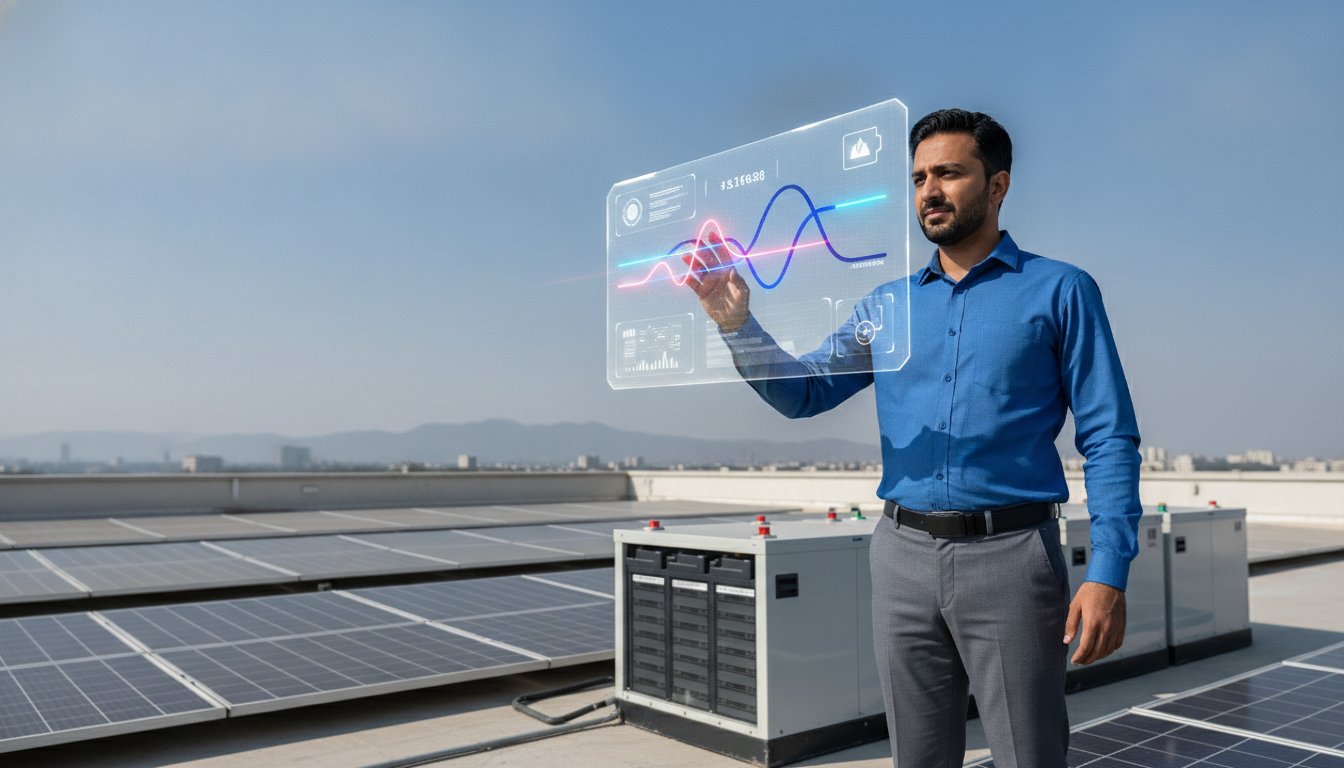
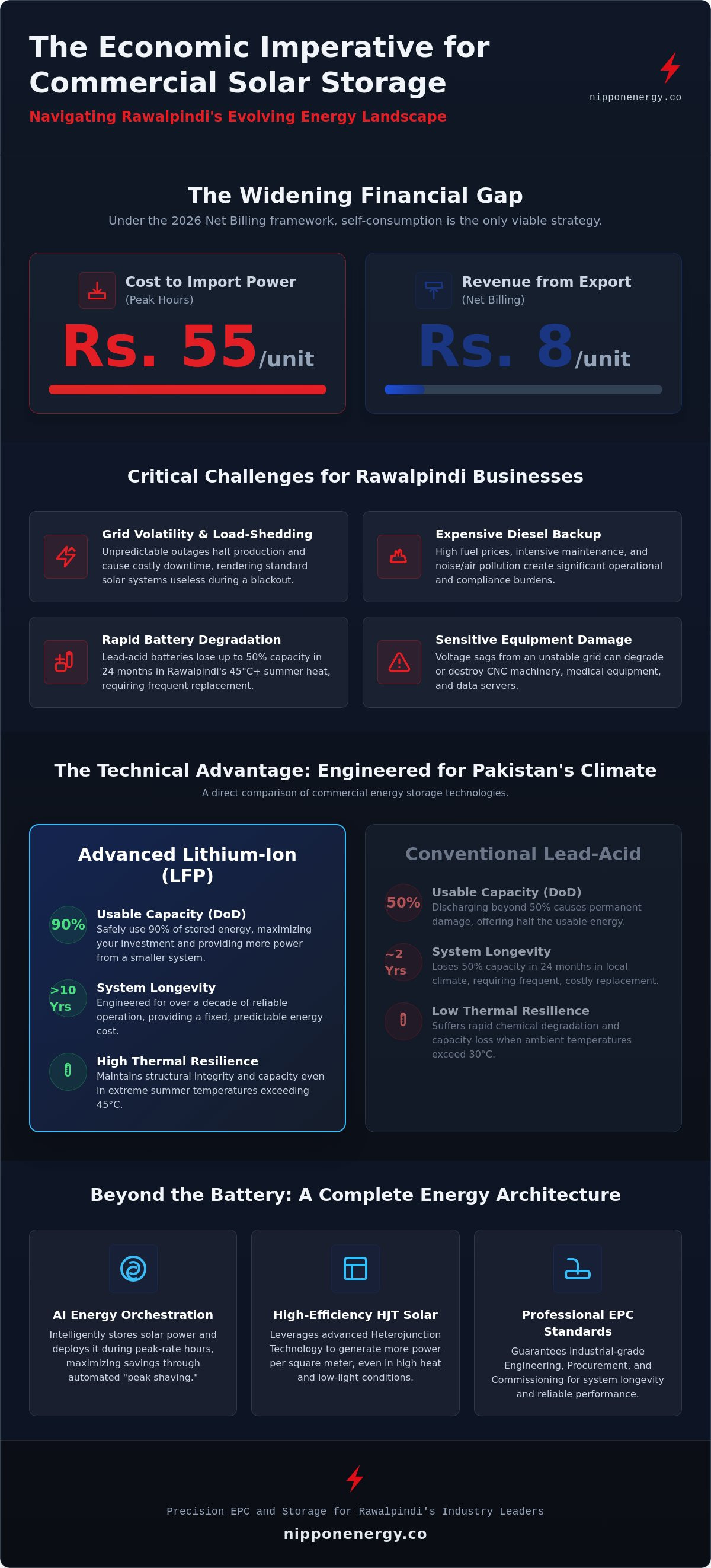
While the 2026 transition to net billing has lowered export rates to as little as Rs. 8 per unit, the cost of importing power during peak hours in Rawalpindi remains as high as Rs. 55 per unit. For local enterprises operating under IESCO jurisdiction, the financial gap between what you sell and what you buy is widening; this makes a robust commercial solar battery backup rawalpindi solution a critical strategic necessity. You've likely felt the strain of unpredictable load-shedding and the soaring costs of diesel fuel, all while watching standard lead-acid batteries fail under the city's punishing summer heat.
We recognize that achieving true energy independence requires more than just panels. It demands an intelligent architecture designed for longevity and technical precision. This guide explores how advanced lithium-ion storage and intelligent energy orchestration secure your commercial operations against grid volatility and extreme temperatures. We'll examine the technical shift toward self-consumption strategies that ensure your system exceeds a 10-year lifespan, eliminates dependency on expensive generators, and maintains uninterrupted 24/7 productivity in the face of evolving 2026 energy regulations.
Key Takeaways
- Analyze the impact of IESCO grid volatility on commercial productivity and learn to eliminate the financial burden of diesel-dependent operations.
- Evaluate the technical superiority of lithium-ion storage over conventional batteries, focusing on thermal resilience during Rawalpindi's extreme summer temperatures.
- Secure a high-performance commercial solar battery backup rawalpindi by leveraging AI-driven energy orchestration and HJT solar technology.
- Adapt your energy strategy to the 2026 NEPRA net billing framework to ensure maximum self-consumption and superior long-term ROI.
- Implement professional EPC standards for industrial-scale solar projects to guarantee system longevity and reliable commissioning.
Energy Resilience in Rawalpindi: The Case for Commercial Solar Battery Backup
As of mid-2026, the energy infrastructure within the Islamabad Electric Supply Company (IESCO) jurisdiction faces a complex transition. While the expansion of Solar power in Pakistan has reached record levels, the regional grid remains susceptible to localized instability and frequent load-shedding. The 2026 shift from net metering to net billing has fundamentally altered the ROI landscape for local businesses. With export rates dropping to approximately Rs. 8-11 per unit, the financial value of selling surplus power back to the grid has diminished. For commercial entities, a standard grid-tied inverter is programmed to deactivate during a grid failure to ensure safety, rendering your solar investment useless during a blackout. This technical limitation makes a dedicated commercial solar battery backup rawalpindi the only viable path toward total energy autonomy.
Rawalpindi’s Industrial Power Challenges
In high-density zones like the I-10 Industrial Area and the Saddar commercial district, the grid often struggles with peak-hour load distribution. These localized stresses cause voltage sags that can degrade the sensitive electronics in CNC machinery, medical imaging equipment, and data servers. Businesses can no longer treat energy backup as an optional luxury. It's now a component of critical infrastructure. By integrating advanced storage, enterprises can stabilize incoming voltage and bridge the gap between grid failure and solar activation. This prevents the hidden costs associated with equipment recalibration, production resets, and the labor downtime that follows every power interruption.
Beyond Diesel: The Economic Shift to Solar Storage
The financial logic for transitioning from diesel generators to Nippon Lithium-ion Battery Storage Systems is now undeniable. Diesel generation carries a high Levelized Cost of Energy (LCOE) due to rising fuel prices and intensive maintenance schedules. In contrast, lithium storage offers a fixed-cost solution with a projected system longevity exceeding ten years. Beyond the balance sheet, urban offices in Rawalpindi must contend with tightening noise pollution regulations and environmental compliance standards. Intelligent storage systems eliminate the acoustic and atmospheric pollution of combustion engines while providing a near-instantaneous response time.
As grid tariffs for commercial users fluctuate between Rs. 37 and Rs. 55 per unit, the ability to store solar energy for use during peak evening hours provides a definitive hedge against future price hikes. Investing in a high-capacity commercial solar battery backup rawalpindi allows for seamless peak shaving during the most expensive hours of the day. This strategic orchestration of power ensures that your business remains resilient, regardless of grid volatility or shifting regulatory frameworks.
Lithium-Ion vs. Lead-Acid: Engineering Reliability for Rawalpindi’s Climate
Selecting the storage chemistry is the most consequential decision in designing a commercial solar battery backup rawalpindi. Traditional lead-acid or tubular batteries, while initially cost-effective, suffer from rapid chemical degradation when ambient temperatures exceed 30°C. In the Pothohar plateau, where summer peaks frequently reach 45°C, lead-acid systems often lose 50% of their rated capacity within 24 months. Nippon Lithium-ion Battery Storage Systems utilize advanced Lithium Iron Phosphate (LFP) chemistry, which maintains structural integrity at much higher thermal thresholds. This resilience is vital as Pakistan’s energy transition moves toward decentralized, high-performance storage solutions for industrial stability.
The technical disparity extends to energy density and discharge efficiency. Lead-acid batteries generally shouldn't be discharged beyond 50% to avoid permanent damage. Lithium-ion systems allow for a 90% Depth of Discharge (DoD), effectively providing more usable energy from a smaller physical footprint. For a commercial facility in Rawalpindi, this means you can support larger loads, such as central air conditioning or industrial machinery, without doubling the size of your battery room. The space efficiency of lithium storage is a decisive advantage for businesses operating in high-density urban areas where every square foot of floor space carries a premium.
The Science of High-Temperature Storage
Heat is the primary enemy of battery longevity. Standard batteries lack active thermal management, leading to internal plate sulfation in the Punjab heat. Nippon systems incorporate integrated thermal monitoring to prevent thermal runaway, a critical safety feature for high-density commercial hubs. By maintaining optimal internal temperatures, these systems ensure a cycle life exceeding 6,000 charges. Nippon Lithium-ion storage converts the volatility of Rawalpindi’s climate into a decade of predictable, high-yield energy resilience.
Total Cost of Ownership (TCO) Analysis
A 10-year financial map reveals that lead-acid systems require at least three full replacements to match the lifespan of a single lithium installation. This replacement trap triples the long-term CAPEX and introduces recurring labor costs for maintenance. Lithium storage follows a "set and forget" philosophy, requiring zero electrolyte top-ups or terminal cleaning. For a deeper technical dive into these architectures, consult our Lithium-Ion Battery Storage Pillar.
The transition to lithium is an investment in operational continuity rather than just a purchase of hardware. While the initial entry price is higher, the cost per cycle is significantly lower than any alternative. If you're planning to future-proof your facility, choosing Nippon Lithium-ion Battery Storage Systems ensures that your energy infrastructure remains an asset rather than a recurring liability. This engineering-first approach is what separates a standard backup from a truly resilient commercial power plant.
Intelligent Energy Orchestration: AI Inverters and HJT Integration
True energy resilience in Rawalpindi requires more than just high-capacity storage; it demands the intelligent orchestration of power flows. A commercial solar battery backup rawalpindi reaches its maximum utility when managed by Nippon Smart AI Inverters. These units serve as the central nervous system of the facility. They don't just convert DC to AC; they actively balance inputs from the grid, solar modules, and battery banks. By analyzing historical IESCO grid data, the AI anticipates load-shedding cycles and prioritizes battery charging during surplus solar windows. This predictive load management ensures that critical commercial operations, such as server rooms or industrial cooling, remain online despite grid instability.
The efficiency of this orchestration is further enhanced by Nippon HJT Solar Panels. Heterojunction technology is specifically engineered for high-performance environments. While standard panels often struggle with efficiency losses in the Punjab heat, HJT modules maintain a superior low-temperature coefficient. They generate more power in diffuse light and hazy conditions, providing a steady supply of energy to the battery system even during Rawalpindi's dust-heavy pre-monsoon season. Real-time data from these components is aggregated into comprehensive mobile and desktop dashboards, giving facility managers granular control over their energy assets.
The Synergy of HJT and Smart Inverters
The combination of HJT efficiency and AI intelligence enables a strategy known as "Peak Shaving." The system monitors real-time consumption and discharges stored energy during periods of high grid demand. Since the 2026 net billing regulations offer lower buyback rates of approximately Rs. 8 to Rs. 11 per unit, using stored energy to avoid high grid tariffs is the most profitable path. This synchronization reduces the fixed demand charges on your IESCO bill and maximizes your ROI. For a detailed technical exploration of these capabilities, see our Smart AI Solar Inverters Guide.
NipponHev: The Integrated Architecture
For enterprises seeking a turnkey solution, we provide NipponHev. This pre-engineered architecture streamlines the commercial EPC process by ensuring absolute compatibility between panels, inverters, and storage. It simplifies installation and commissioning while providing automated maintenance alerts and remote performance monitoring. By choosing an integrated system, Rawalpindi business leaders eliminate the technical risks of mixing disparate technologies, securing a robust energy future through Japanese-standard engineering precision.
Sizing and ROI: Calculating Payback for Rawalpindi Businesses
The transition to net billing in 2026 has shifted the financial objective of solar investment from power exportation to maximum load displacement. For a commercial solar battery backup rawalpindi, the ROI is no longer dictated solely by the credits on your IESCO bill, but by the avoidance of grid imports priced at Rs. 37 to Rs. 55 per unit. Achieving a rapid payback period requires a precise engineering audit to distinguish between essential loads, such as data servers and security systems, and non-essential loads that can be shed during prolonged outages. By prioritizing high-value operational continuity, businesses can reduce the required battery capacity while maintaining 100% uptime for critical infrastructure.
Calculating the "Autonomy Period" is the next technical hurdle. In Rawalpindi’s industrial zones, where load-shedding can occur in 2-hour or 4-hour cycles, your storage capacity must bridge these gaps without reaching a critical depth of discharge. Federal tax incentives, including accelerated depreciation benefits for renewable energy assets, further enhance the fiscal case. Under the 2026-27 budget framework, while the 10% import tax remains, the absence of new levies on solar equipment provides a stable window for capital expenditure. This regulatory environment favors businesses that invest in high-efficiency components with documented longevity.
Commercial Sizing Framework
Determining your kWp requirement starts with an analysis of your highest monthly IESCO units. For a typical medium-scale enterprise, a system must be sized to cover both daytime consumption and the energy required to recharge the battery bank before sunset. Strategically oversizing the solar array ensures the battery bank reaches full capacity even on short winter days, thereby accelerating the ROI by maximizing self-consumption during evening peak hours. This ensures that your commercial solar battery backup rawalpindi remains a productive asset rather than a reactive one.
Navigating the IESCO Net Metering Process
As of mid-2026, the timeline for net meter approval in Rawalpindi typically spans 6 to 10 weeks, depending on the localized grid capacity of your feeder. Bi-directional metering remains essential under the new Prosumer Regulations, as it allows the system to synchronize with the grid while prioritizing battery health. Managing this complex regulatory and technical landscape requires professional oversight. You can explore our Solar EPC Services Pillar for a granular breakdown of project management and commissioning standards. To begin your transition to energy independence, request a technical feasibility study from Nippon Energy today.
Nippon Energy: Precision EPC and Storage for Rawalpindi Leaders
Engineering a high-performance energy system requires a departure from the "off-the-shelf" mentality that dominates the local market. At Nippon Energy, we apply Japanese-standard engineering precision to the specific industrial challenges found in the Pothohar region. Our approach to a commercial solar battery backup rawalpindi is rooted in total system integrity, ensuring that every component, from the high-efficiency modules to the lithium storage banks, operates as a unified, resilient architecture. We don't just provide hardware; we deliver a complete Solar Project Development and EPC (Engineering, Procurement, and Construction) cycle that transitions your facility from energy dependence to absolute autonomy.
Our end-to-end EPC framework begins with a rigorous technical feasibility study and load profile analysis. We manage the entire lifecycle of the project, including the complex IESCO commissioning and net billing integration processes. This professional oversight is backed by a commitment to long-term reliability. Our Nippon Lithium-ion Battery Storage Systems are supported by comprehensive warranties and a local technical support infrastructure that understands the thermal stresses of the Punjab climate. In a recent implementation for a large-scale commercial facility in Punjab, our integrated storage solution eliminated four hours of daily grid downtime while reducing monthly operational costs by over 30% through intelligent peak shaving.
The Nippon Advantage in Pakistan
Nippon Energy maintains a robust global supply chain that ensures the immediate availability of Nippon HJT and TOPCon technology for our Pakistani clients. We recognize that a 2026 installation must remain productive until 2050. Achieving this longevity requires more than just quality parts; it demands professional maintenance. Our specialized teams provide ongoing Solar System Maintenance and Monitoring to prevent degradation and optimize yield. You can explore the technical requirements for long-term performance in our Solar System Maintenance Pillar.
Partnering for Energy Independence
Initiating your transition to a commercial solar battery backup rawalpindi begins with a professional site survey. Our engineers evaluate the structural and electrical readiness of your facility, whether you're managing a hospital in Saddar, a school in Bahria Town, or a factory in the I-10 Industrial Area. We customize our storage solutions to match your specific autonomy requirements and financial objectives. By choosing a partner that values precision over speed, you secure a future where grid volatility no longer dictates your productivity. Secure your commercial future with Nippon Energy.
Securing Your Commercial Energy Future in the Pothohar Region
The convergence of IESCO grid volatility and the 2026 shift toward net billing makes a robust commercial solar battery backup rawalpindi a non-negotiable asset for business continuity. We've explored how transitioning from traditional lead-acid systems to Japanese-engineered Nippon Lithium-ion technology provides the thermal resilience required for Rawalpindi's extreme climate. By integrating AI-driven orchestration with Nippon HJT panels, which carry a 25-year performance warranty, your facility can achieve maximum self-consumption and financial stability despite rising utility tariffs.
Navigating these technical and regulatory shifts requires a partner capable of delivering comprehensive EPC project management. From the initial load audit to the final IESCO net metering commissioning, we ensure your energy architecture is built for decades of peak performance. Don't let unpredictable power outages or shifting policies compromise your operational efficiency. Consult with a Nippon Energy Engineer for your Rawalpindi Commercial Project to design a system that transforms energy from a recurring cost into a strategic advantage. It's time to take control of your power and build a resilient foundation for your enterprise.
Frequently Asked Questions
How long does a commercial solar battery backup last during a power outage in Rawalpindi?
The duration of a commercial solar battery backup rawalpindi is determined by your total kWh capacity and the specific load you prioritize. Most industrial designs for the IESCO region target 2 to 4 hours of autonomy to bridge standard load-shedding cycles. By isolating essential circuits like servers and security systems, you can extend this duration significantly during prolonged grid failures.
Is lithium-ion safe for high-temperature environments like Rawalpindi?
Lithium Iron Phosphate (LFP) chemistry is specifically engineered for thermal stability in high-temperature environments. Unlike lead-acid batteries that suffer from plate sulfation when temperatures exceed 40°C, Nippon Lithium-ion systems feature integrated thermal management. These systems maintain peak performance during Rawalpindi's summer peaks without the risk of thermal runaway or significant capacity loss.
What is the typical ROI for a commercial solar system with battery storage in 2026?
ROI for commercial storage in 2026 is primarily driven by avoiding grid imports priced between Rs. 37 and Rs. 55 per unit. While the 2026 net billing regulations offer lower export rates of Rs. 8 to Rs. 11, the financial value of self-consumption has increased. Most businesses see a return on investment within a timeframe that reflects the 10-year lifespan of lithium components.
Can I add Nippon Lithium-ion batteries to my existing solar system?
You can integrate Nippon Lithium-ion Battery Storage Systems into existing arrays through AC-coupling or by upgrading to a hybrid Nippon Smart AI Inverter. This modular approach allows businesses to add storage capacity without replacing their entire solar infrastructure. Our engineers conduct a technical compatibility audit to ensure seamless communication between your current panels and the new storage bank.
Does IESCO allow net metering for systems with battery backup?
IESCO supports net metering for hybrid systems under the current NEPRA Prosumer Regulations. Your system can export surplus energy to the grid while simultaneously maintaining a full battery bank for backup. This dual-functionality ensures you benefit from bi-directional metering credits while protecting your operations against localized grid failures or voltage instability in the Rawalpindi area.
What maintenance is required for commercial-grade solar battery systems?
Commercial-grade lithium systems require significantly less maintenance than conventional lead-acid alternatives. Maintenance typically involves remote software updates, periodic thermal monitoring, and visual inspections of electrical connections. Nippon Energy provides automated system monitoring to identify performance deviations before they impact your operations, ensuring the system reaches its 6,000-cycle design life without manual intervention.
How much space is needed for a 50kW commercial battery backup system?
A 50kW lithium-ion storage bank is remarkably space-efficient and typically requires only two standard server racks. This compact footprint is approximately 70% smaller than a lead-acid bank of equivalent usable capacity. This allows businesses in high-density areas like Saddar or the I-10 Industrial Area to install high-capacity backup systems in confined electrical rooms or existing technical spaces.
Why should I choose HJT panels over standard PERC panels for my Rawalpindi business?
Nippon HJT Solar Panels offer a superior temperature coefficient compared to standard PERC modules, meaning they lose less efficiency as Rawalpindi's ambient temperature rises. HJT technology also provides higher bifaciality and better performance in diffuse light or hazy conditions. These technical advantages result in a higher daily energy yield, which maximizes the charging rate for your battery storage system.


