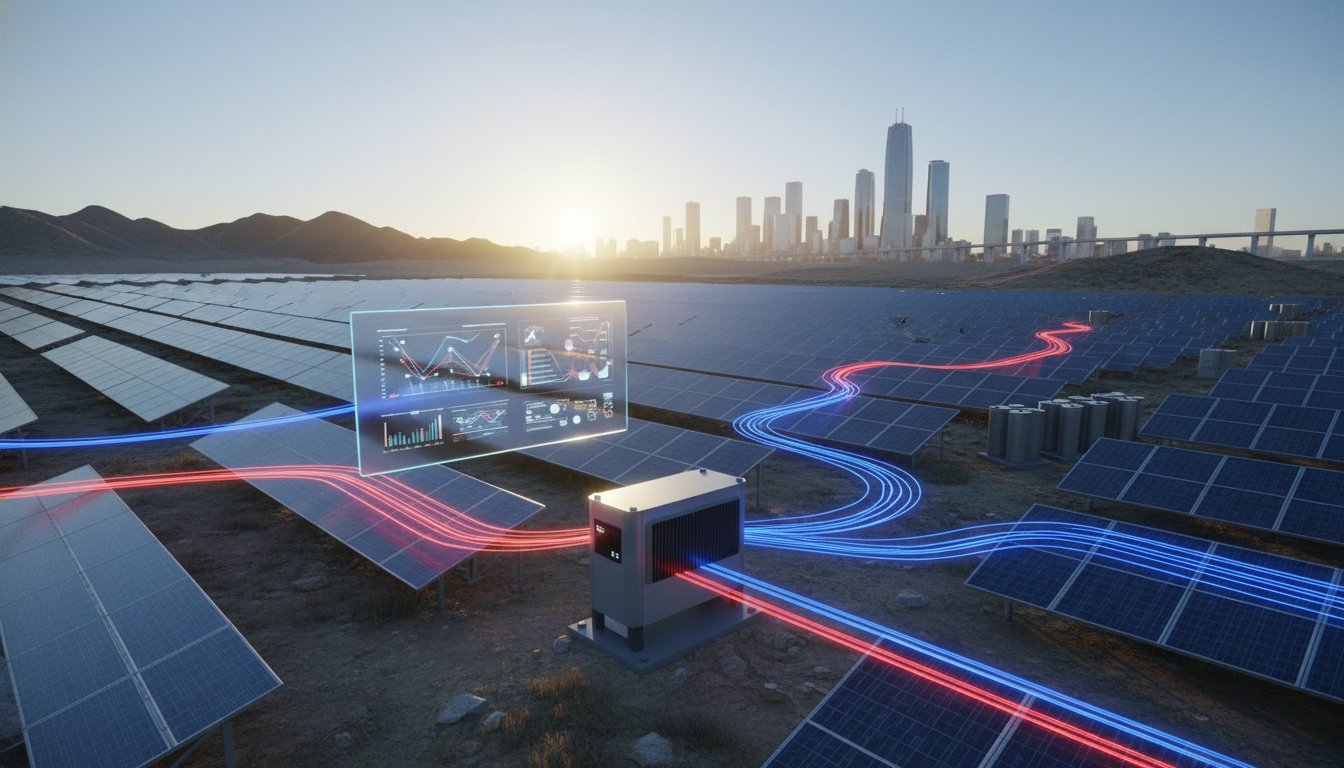
The era of the passive solar inverter has ended. In 2026, the modern energy landscape in Pakistan demands more than simple DC-to-AC conversion; it requires a central nervous system capable of autonomous decision-making. You likely recognize that even the most advanced HJT or TOPCon panels lose their value if energy is wasted through poor load forecasting or if battery cycles are mismanaged. It's a technical reality that suboptimal charging leads to premature degradation and unnecessary financial loss.
This guide demonstrates how the smart ai solar inverter has evolved into a predictive orchestrator that minimizes your levelised cost of energy (LCOE) while safeguarding grid stability in high-demand regions. We'll explore the technical shift toward autonomous energy management, the integration of AI with lithium-ion storage, and the specific regulatory standards like NERC and NEC 2026 that now define system resilience. Discover how to transition from passive power generation to a fully optimized, future-proof energy architecture that prioritizes long-term performance and technical precision.
Key Takeaways
- Understand the transition from basic power conversion to edge-based orchestration, where a smart ai solar inverter manages local energy loads autonomously to eliminate cloud latency.
- Learn how machine learning algorithms utilize hyper-local weather data and consumption patterns to anticipate peak loads and maximize your return on investment.
- Explore the technical synergy between AI-driven MPPT and high-efficiency Nippon HJT or TOPCon panels to optimize bifacial energy gains and battery life.
- Identify critical selection criteria for 2026 infrastructure, including processing power and open communication standards like SunSpec and Modbus for seamless system scalability.
- Discover the impact of Nippon Energy’s proprietary algorithms in creating a unified energy ecosystem through integrated EPC workflows and NipponHev systems.
The Evolution of Power Electronics: Defining the Smart AI Solar Inverter
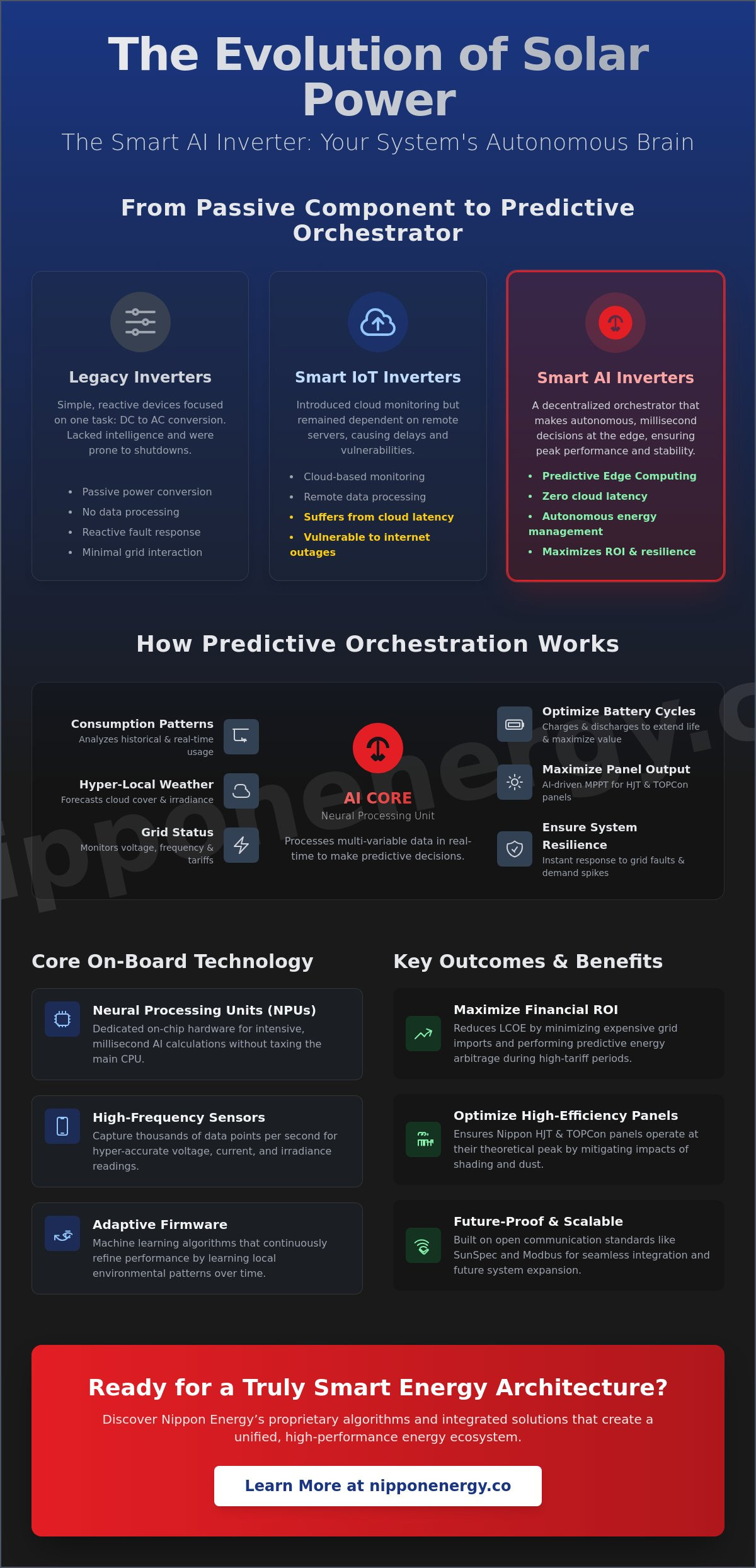
Power electronics have undergone a radical transformation over the last decade. Historically, a solar inverter functioned as a simple bridge between DC panels and the AC grid. These legacy units were reactive, lacking the intelligence to do more than shut down during a system fault. Smart IoT inverters improved this by adding cloud-based monitoring, yet they remained tethered to remote servers for data processing. By 2026, the smart ai solar inverter has emerged as a decentralized energy orchestrator. It doesn't just report data; it executes millisecond-level decisions at the edge of the network.
In Pakistan, where grid instability remains a persistent technical hurdle, cloud latency is a significant liability. Edge computing allows the inverter to process environmental data locally, ensuring system stability even during internet connectivity drops. This capability is vital for solving the "Intermittency Challenge." While cloud-dependent systems struggle with rapid cloud cover or sudden voltage spikes, AI-driven units use predictive irradiance modeling to adjust power flows instantly. We're witnessing a shift from basic peak-shaving to predictive energy arbitrage. The system anticipates high-tariff periods and optimizes battery discharge cycles to maximize financial yields without human intervention.
From Passive Conversion to Active Orchestration
Modern engineering standards now require inverters to function as autonomous grid participants rather than passive components. Legacy Maximum Power Point Tracking (MPPT) was a linear process that followed a single variable. Today, smart ai solar inverter technology employs multi-variable neural network optimization to manage complex inputs. Energy orchestration means the system simultaneously balances panel generation, lithium-ion storage levels, and real-time demand. It's a move from being a simple converter to becoming the central nervous system of the entire solar architecture.
Core Components of an AI-Driven Inverter
The hardware architecture of these units has changed to support intensive cognitive tasks. Integrated Neural Processing Units (NPUs) now sit directly on the circuit board to handle complex datasets without taxing the primary power CPU. High-frequency sensor arrays capture voltage and current data at intervals that legacy systems can't match. This information feeds into adaptive firmware that learns from local environmental patterns over time. Over months of operation, the inverter refines its understanding of local shading or dust accumulation. This ensures that high-performance modules, such as Nippon HJT or TOPCon panels, consistently operate at their theoretical peak efficiency.
The Mechanism of Predictive Energy Management and Load Forecasting
Predictive energy management isn't a passive dashboard feature; it's an active operational protocol that defines system efficiency. The smart ai solar inverter utilizes advanced AI applications in solar energy to synthesize multi-modal data streams in real time. It correlates hyper-local weather forecasting with satellite-derived irradiance modeling to determine exactly when a facility should transition to battery power. This prevents energy wastage during unexpected cloud cover or sudden shifts in atmospheric conditions. By analyzing industrial consumption patterns, the system identifies peak load periods before they occur. It then modifies output dynamically to ensure the most cost-effective power source is prioritized.
This level of precision directly impacts the levelised cost of energy (LCOE) by minimizing expensive grid imports during high-tariff periods. In the Pakistan market, where grid reliability varies, this predictive capability ensures that critical loads remain powered without over-stressing the battery bank. Precise energy allocation reduces the reliance on unstable grid infrastructure, creating a self-sustaining energy loop that prioritizes technical longevity and financial ROI.
Neural Networks in Load Forecasting
Deep learning models excel at identifying non-linear consumption patterns that traditional algorithms miss. For commercial facilities, this means "Day-Ahead" forecasting can slash industrial energy costs by preparing the system for heavy machinery start-ups or cooling cycles. Predictive load forecasting is the ability to pre-allocate battery reserves based on 24-hour consumption models. This ensures that a smart ai solar inverter maintains sufficient depth-of-discharge (DoD) margins to protect Nippon Lithium-ion Battery Storage Systems from premature degradation.
Grid-Interactive Intelligence and V2G/V2H
The role of AI extends to managing bi-directional flows in Vehicle-to-Grid (V2G) and Vehicle-to-Home (V2H) configurations. The inverter acts as an intelligent gatekeeper, ensuring that EV charging doesn't compromise domestic stability or battery health. These systems also participate in frequency regulation programs, providing a secondary layer of grid support. For a deeper look at the market implications of these technologies, see The Strategic Benefits of AI in Solar Energy: A 2026 Industry Analysis. Integrating these advanced capabilities requires a robust maintenance framework. You should consider exploring professional solar system maintenance and monitoring to ensure your AI algorithms remain calibrated for maximum performance.
Technological Synergy: AI Inverters, HJT Panels, and Lithium Storage
The efficiency of a solar power plant is determined by the harmonious interaction between its core components. While standard inverters treat all panels as generic DC sources, a smart ai solar inverter recognizes the specific performance curves of Nippon HJT and TOPCon solar panels. Heterojunction (HJT) technology operates with a significantly lower temperature coefficient than standard PERC cells. The AI orchestrator monitors real-time thermal data to maintain the optimal operating point as ambient temperatures fluctuate. This synergy ensures that high-efficiency modules don't just produce more power, but produce it more consistently across varying environmental conditions.
Bifacial gain optimization requires a dynamic approach to Maximum Power Point Tracking (MPPT). Standard algorithms often fail to account for the rapid variations in rear-side irradiance caused by ground albedo changes. AI-driven MPPT utilizes predictive modeling to scan the power-voltage curve at high frequencies, capturing energy that legacy trackers miss. This results in a measurable increase in total yield, particularly in industrial installations where ground conditions vary. By integrating high-speed data processing, the system adapts to the unique electrical characteristics of N-type cells, ensuring that every photon is converted with maximum efficiency.
In high-temperature climates like Pakistan, thermal derating is a common cause of energy loss. The smart ai solar inverter employs proactive thermal management by adjusting switching frequencies before internal components reach critical thresholds. This preventive action maintains high output levels during peak solar hours, preventing the sudden drops in performance that plague less sophisticated hardware. By combining high-speed cooling logic with predictive load management, the system ensures that the hardware remains within its ideal thermal envelope even during intense summer heatwaves. This technical resilience is essential for maintaining grid stability in regions where infrastructure is under constant thermal stress.
Maximizing Heterojunction (HJT) Potential
Synchronizing inverter switching frequencies with HJT characteristics allows for reduced harmonic distortion and improved conversion efficiency. The AI system monitors bifaciality factors in real-time to maximize rear-side energy harvest. Technical analysis shows that AI-optimized HJT arrays consistently outperform standard PERC systems by maintaining higher voltage stability. This precision engineering ensures that the investment in premium panel technology translates into tangible energy gains through superior low-light performance and spectral response.
Intelligent Battery Lifecycle Architecture
Predictive charging algorithms are essential for extending the operational life of Nippon Lithium-ion Battery Storage Systems. By identifying and avoiding micro-cycling patterns, the AI preserves the integrity of the lithium-ion cell chemistry, potentially extending cycle life by 40%. State of Health (SoH) monitoring is conducted through advanced electrochemical impedance spectroscopy, providing a granular view of battery degradation. AI-driven State of Charge (SOC) management prevents deep discharge damage by intelligently reserving power during extended outages based on anticipated recovery times.
Engineering a Future-Proof Infrastructure: Selection and Implementation
Selecting a smart ai solar inverter requires a fundamental shift in engineering perspective. It's no longer sufficient to evaluate hardware based solely on peak efficiency ratings or initial capital expenditure. In the 2026 energy market, the primary selection criteria have moved toward raw processing power, protocol compatibility, and long-term scalability. A robust energy orchestrator must possess the computational headroom to handle future firmware updates and evolving AI models without requiring hardware replacement. This future-proofing ensures that your infrastructure remains an asset rather than becoming technical debt as grid requirements become more complex.
Open communication standards are the bedrock of a resilient system. We prioritize the use of SunSpec, Modbus, and high-speed Ethernet to facilitate seamless data exchange between the inverter and external management platforms. These protocols prevent vendor lock-in and allow for the integration of diverse components, such as Nippon Lithium-ion Battery Storage Systems and third-party grid controllers. By maintaining an open architecture, facility managers can ensure their systems are ready for the next generation of energy markets and utility-scale interaction.
Cybersecurity has emerged as a critical pillar of decentralized energy management. As inverters take on more autonomous roles, protecting the underlying AI models from external manipulation is paramount. Modern systems must utilize local-first AI processing, which keeps sensitive decision-making data within the facility's perimeter. This approach not only enhances data privacy but also ensures that the smart ai solar inverter maintains operational integrity during internet outages or network attacks. Security is no longer a secondary feature; it's a core component of the system's structural integrity.
Sizing for Commercial and Industrial (C&I) Scalability
Modular expansion is the most effective strategy for transitioning from pilot projects to large-scale solar farms. Calculating inverter capacity requires a deep understanding of how multiple AI units will synchronize within a unified site management system to maintain voltage stability. For a comprehensive technical breakdown, consult our Solar Inverter Sizing for Commercial Projects: A 2026 Engineering Guide. This modular approach allows for phased deployments that align with industrial growth and capital expenditure cycles.
Security and Protocol Standards
Data integrity is protected through mandatory TLS encryption for all inverter-to-cloud communications. This prevents unauthorized actors from intercepting performance data or altering control parameters. Our systems are engineered to comply with the latest international grid codes and AI safety standards, ensuring that every installation meets the highest benchmarks for reliability. If you're planning a large-scale deployment in Pakistan, you should partner with our EPC experts to ensure your system architecture is fully optimized for 2026 regulatory requirements.
Nippon Smart AI Inverters: The Global Standard for Energy Excellence
Nippon Energy has synthesized decades of power electronics expertise to develop proprietary AI algorithms that set a new benchmark for energy orchestration. This isn't just a component; it's a precision-engineered solution that spans from Tokyo's high-tech labs to the rigorous environments of Dubai. The smart ai solar inverter by Nippon serves as the cornerstone of a unified energy ecosystem. It integrates seamlessly with NipponHev and existing EPC service workflows to ensure that system design and operational execution are perfectly aligned. This architectural cohesion allows for a level of performance that defines 2026 energy standards, moving beyond simple conversion to total asset management.
The architectural advantage of the Nippon system lies in its ability to act as a localized grid controller. By processing data at the edge, the system reduces reliance on external servers while maintaining millisecond-level response times. This decentralized approach ensures that large-scale solar deployments remain stable and productive, regardless of local grid fluctuations. Our commitment to technical excellence means that every unit is built to withstand the rigors of industrial use while maintaining the sophisticated intelligence required for modern energy arbitrage.
The Nippon Advantage in High-Temperature Climates
Karachi and Riyadh present some of the most demanding thermal conditions for power electronics in the world. Our smart ai solar inverter utilizes proprietary cooling logic that prioritizes component longevity over short-term, unsustainable yield spikes. By proactively modulating switching frequencies and thermal dissipation, the system prevents the accelerated aging of internal semiconductors. This technical resilience is a core component of our Solar EPC Services, providing a turnkey solution that remains stable in complex environmental zones. The result is a system that maintains structural integrity while delivering consistent energy output during the most intense heatwaves.
Integrated Monitoring and Maintenance
Real-time performance monitoring is facilitated through the Nippon cloud platform, which provides a granular view of every system parameter. Predictive failure analysis identifies potential hardware anomalies before they manifest as operational downtime. This proactive approach utilizes advanced data modeling to detect subtle deviations in electrical signatures, allowing for preemptive maintenance. Remote firmware updates continuously refine the accuracy of the AI models, ensuring that the system evolves alongside changing grid conditions and consumption behaviors. This commitment to ongoing optimization ensures that your energy infrastructure remains at the forefront of technical excellence. For those ready to transition to a more resilient energy future, we invite you to contact Nippon Energy for a comprehensive AI-driven solar feasibility study.
Architecting the Future of Decentralized Power
The transition to intelligent energy orchestration is no longer a theoretical projection; it's a technical necessity for the 2026 energy landscape. By integrating a smart ai solar inverter, industrial and residential facilities in Pakistan can effectively mitigate grid instability while optimizing the performance of high-efficiency HJT and TOPCon panels. These systems leverage edge computing to eliminate latency. They ensure that predictive load forecasting and thermal management remain active even during connectivity disruptions. This shift from reactive hardware to proactive orchestration is what defines a truly resilient infrastructure.
Achieving maximum ROI requires a holistic engineering approach that combines hardware durability with cognitive software. Nippon Energy delivers this through Japanese precision engineering and proprietary AI energy management algorithms. Our end-to-end EPC integration ensures that every component is calibrated for the specific environmental demands of the region, from the intense heat of Karachi to the shifting loads of industrial centers. It's time to move beyond simple power generation and embrace autonomous orchestration. Explore Nippon Smart AI Inverters for Your Next Project and secure your energy future with technical excellence.
Frequently Asked Questions
What is the primary difference between a smart inverter and an AI-enabled inverter?
A smart inverter provides remote monitoring and basic programmable logic, while a smart ai solar inverter utilizes machine learning to make autonomous, predictive decisions. While legacy smart units react to historical data, AI-driven systems anticipate future variables like irradiance shifts and load spikes. This transition from passive monitoring to active orchestration ensures that energy flows are optimized in real time without requiring manual intervention from the facility manager.
Can a smart AI solar inverter function without an active internet connection?
Yes, a Nippon smart ai solar inverter is designed with edge computing capabilities to maintain autonomous operations without an active internet connection. Local processing ensures that critical energy management tasks, such as load balancing and battery protection, continue during grid or network outages. While cloud connectivity is required for remote firmware updates and global monitoring, the core AI decision-making engine resides on the hardware itself for maximum reliability in the Pakistan market.
How does AI technology actually increase the lifespan of my solar battery storage?
AI technology extends battery life by eliminating micro-cycling and maintaining optimal State of Charge (SOC) through predictive algorithms. By analyzing consumption patterns, the system avoids unnecessary discharge cycles that cause chemical degradation in Nippon Lithium-ion Battery Storage Systems. The inverter also manages thermal profiles proactively, ensuring that batteries operate within their ideal temperature range to preserve cell integrity over thousands of cycles.
Are AI inverters compatible with older solar panel technologies like PERC or Polycrystalline?
AI inverters are fully backward compatible with legacy panel technologies, including PERC and Polycrystalline modules. While they're engineered to maximize the performance curves of Nippon HJT and TOPCon panels, they provide immediate benefits to older arrays through superior Maximum Power Point Tracking (MPPT). The AI identifies the optimal electrical operating point more accurately than traditional trackers, which improves the total energy yield of existing solar infrastructure.
What cybersecurity measures are in place to protect AI-driven solar systems from hacking?
Cybersecurity is integrated through multi-layer protocols, including TLS encryption for data transmission and isolated Neural Processing Units (NPUs) for local decision-making. By prioritizing local-first processing, the system minimizes the attack surface available to external actors. These measures protect the integrity of the AI models and ensure that autonomous energy orchestration remains secure from unauthorized manipulation or data breaches.
How much additional efficiency can I expect from an AI-managed solar array?
Efficiency gains manifest as a reduction in the levelised cost of energy (LCOE) through more precise energy allocation and captured bifacial yields. While specific improvements depend on site conditions, the system's ability to anticipate peak tariffs and optimize battery discharge ensures that every kilowatt-hour is used at its highest value. This technical precision reduces grid reliance and prevents energy wastage that typically occurs in non-predictive systems.
Is an AI inverter necessary for a small residential solar setup, or is it only for commercial use?
AI inverters provide significant value to both residential and commercial installations. For homeowners, the primary benefit is autonomous management that eliminates the need for manual system adjustments. In commercial and industrial (C&I) settings, the focus shifts to large-scale energy arbitrage and grid-interactive intelligence. The modular architecture of Nippon systems allows for seamless scalability, making intelligent orchestration accessible for any project size.
Does the AI in the inverter require manual training, or is it ready to use out of the box?
The system is ready for immediate operation out of the box but features adaptive firmware that refines its logic over time. It doesn't require manual training by the user; instead, it automatically learns local environmental patterns and consumption behaviors through continuous data acquisition. This self-optimizing capability ensures that the inverter's performance improves as it gathers more site-specific data, providing a truly future-proof energy solution.


