
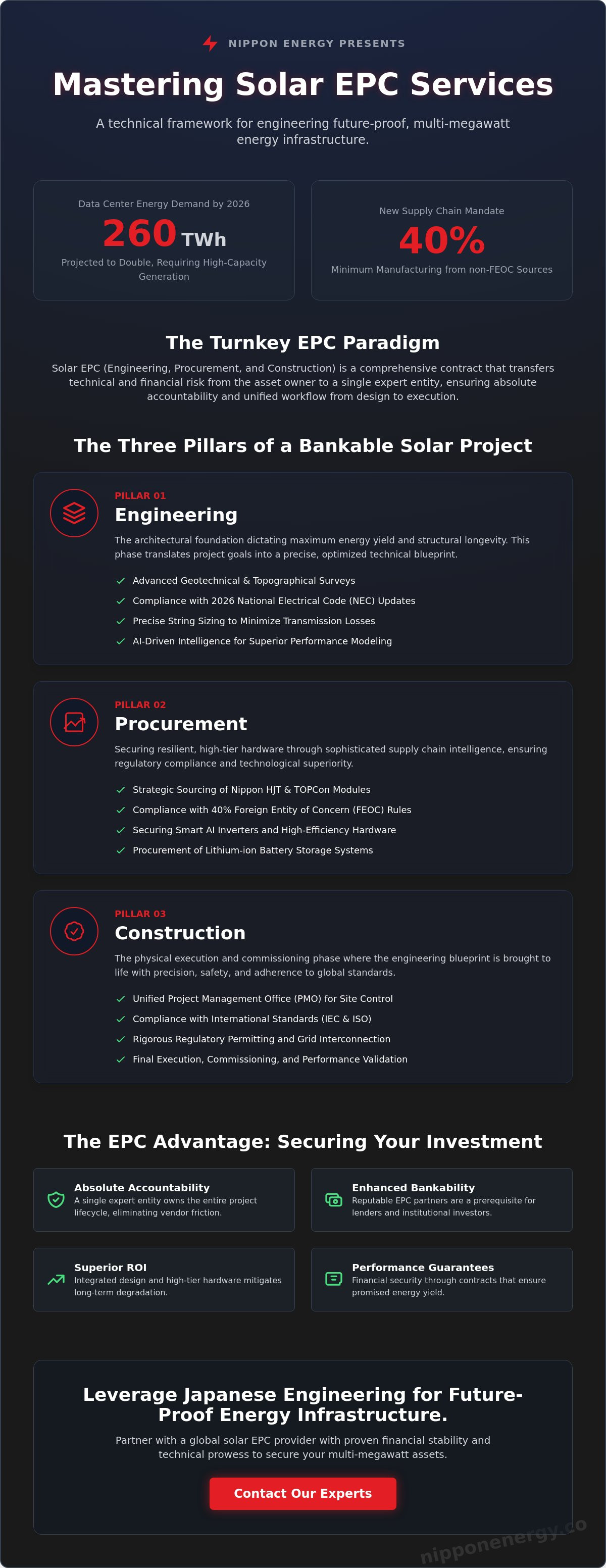
With data center energy demand projected to double by the end of 2026, reaching 260 terawatt-hours, the margin for engineering error in large-scale infrastructure has effectively vanished. The complexity of managing multiple vendors while adhering to new 40% Foreign Entity of Concern (FEOC) regulations represents a significant operational risk. Fragmented oversight often leads to technical failure in harsh climates or accelerated degradation that erodes long-term ROI. Mastering solar epc services is the only way to establish a single point of accountability for your multi-megawatt project.
This guide provides the technical framework to ensure your energy infrastructure is engineered for maximum yield and structural longevity. You'll learn how to navigate the 2026 National Electrical Code updates and integrate advanced HJT solar technology to future-proof your assets. We'll analyze the transition from basic construction to a high-tech engineering lifecycle that utilizes AI-driven intelligence for superior performance.
Key Takeaways
- Understand how the turnkey paradigm transfers technical and financial risks to a single expert entity, ensuring absolute accountability throughout the project lifecycle.
- Learn to optimize energy yield through precise engineering blueprints and the strategic procurement of high-tier components like Nippon HJT and TOPCon modules.
- Master the critical milestones of solar epc services, moving from initial pre-feasibility and conceptual design to rigorous regulatory permitting and final execution.
- Discover how integrating smart AI inverters and high-efficiency hardware mitigates long-term degradation to secure a superior return on investment.
- Evaluate global partners based on financial stability and technical prowess, leveraging Japanese engineering standards for future-proof energy infrastructure.
What are Solar EPC Services? Defining the Turnkey Paradigm
The global energy industry has transitioned away from simple assembly toward high-tech engineering lifecycles. In 2026, the complexity of grid interconnection and supply chain traceability makes the What are Solar EPC Services? model essential for large-scale success. As electricity demand from data centers is projected to double by 2026, reaching 260 terawatt-hours, the need for reliable, high-capacity generation is paramount. The EPC model addresses this by providing a disciplined, methodical framework that moves from macro-level purpose to micro-level technical specifications. This turnkey paradigm represents a comprehensive contract where a single partner manages the engineering design, procures specialized hardware, and executes the construction. Utilizing solar epc services allows for a strategic shift that transfers technical and financial risk from the asset owner to the expert entity. While fragmented contracting creates silos of information, the EPC model ensures a unified workflow. Every decision made during the design phase directly informs the procurement of Nippon TOPCon solar panels and the eventual installation. This continuity is vital for projects aiming to maximize efficiency and long-term ROI.
The Single Point of Accountability
Establishing a unified Project Management Office (PMO) is critical for multi-megawatt sites. When you engage solar epc services, you eliminate the friction that typically occurs between designers, suppliers, and installers. There's no blame game if a technical fault occurs during commissioning because one entity owns the entire process. The EPC partner ensures the entire system complies with international standards, including IEC and ISO. By maintaining control over the entire vertical, the provider guarantees that the physical build matches the optimized engineering blueprint. It's a methodical approach that prioritizes structural integrity and future-proofing over short-term cost savings.
Bankability and Financial Security
Lenders and institutional investors view a reputable EPC partner as a prerequisite for bankability. In the 2026 energy market, projects must prove they can withstand harsh climates and meet the 40% FEOC manufacturing requirements. Reputable EPC contracts provide financial security through performance guarantees and liquidated damages. These clauses ensure the project delivers the promised energy yield, protecting the owner's capital from underperformance. Because the EPC partner manages the procurement of advanced hardware like Nippon Lithium-ion Battery Storage Systems, they offer performance certainty that fragmented teams can't match. This financial stability turns a complex energy project into a reliable, long-term asset.
The Three Pillars: Engineering, Procurement, and Construction
The structural integrity of a multi-megawatt project depends on the seamless integration of three distinct yet interdependent disciplines. In the 2026 market, solar epc services have evolved into a high-precision science where the failure of one pillar compromises the financial viability of the entire asset. Engineering provides the optimized blueprint; procurement secures the resilient hardware; and construction delivers the physical execution. When these pillars function in unison, they eliminate the technical bottlenecks that lead to system downtime and eroded ROI. This methodical approach ensures that every megawatt of capacity is engineered for peak performance over a 25-year lifecycle.
Engineering: Precision Design and Feasibility
Engineering is the architectural foundation that dictates energy yield. It begins with advanced geotechnical and topographical surveys to determine soil load-bearing capacities for ground-mount solar farms. Designers must now adhere to the 2026 National Electrical Code (NEC) updates, which removed the 100 kW minimum threshold for calculating PV source circuit currents. Integrating solar project development expertise during the initial site assessment allows for precise string sizing. This reduces electrical resistance and minimizes transmission losses across large-scale sites. Every calculation serves to future-proof the facility against fluctuating grid demands.
Procurement: Sourcing the Future of Solar
Procurement in 2026 requires sophisticated supply chain intelligence to navigate new regulatory landscapes. EPC firms must now ensure that at least 40% of manufactured products originate from non-FEOC sources to maintain project compliance. We prioritize N-Type TOPCon technology, which currently accounts for 70% of the market due to efficiency ratings reaching 24%. Strategic sourcing involves selecting high-tier components like Nippon HJT modules and Nippon Lithium-ion Battery Storage Systems to ensure long-term durability. Managing global logistics with this level of precision ensures that industrial timelines remain intact despite increasing supply chain complexity. To optimize your system's output, consider the long-term benefits of Nippon HJT Solar Panels for your next installation.
Construction: From Breaking Ground to Grid Connection
Construction represents the transition from theoretical design to live energy infrastructure. This phase demands a highly skilled workforce, often utilizing resources from the Solar Training Network to ensure technical excellence. Civil works must be executed with precision to withstand high-wind and high-temperature environments. Electrical integration includes the installation of Nippon Smart AI Inverters and the critical deployment of SCADA systems for real-time monitoring. Final commissioning protocols involve verifying performance ratios through rigorous testing before the official hand-over. This disciplined execution ensures that the completed system meets or exceeds the original engineering specifications.
Technological Superiority in Modern Solar EPC
Modern solar epc services demand more than logistical coordination; they require the integration of advanced materials science. In the 2026 landscape, the "C" in EPC has become synonymous with "Complexity" rather than just construction. Managing this complexity is impossible without high-efficiency hardware that maximizes every square meter of land. The engineering phase must now account for the specific performance characteristics of next-generation cells to ensure the infrastructure remains resilient over decades of operation. Utilizing inferior hardware during the procurement phase creates technical debt that erodes ROI through higher maintenance costs and lower energy yield.
The HJT and TOPCon Advantage
The adoption of topcon solar panels has fundamentally altered site design. Because these modules offer efficiencies reaching 24%, engineers can significantly reduce the total land footprint required for megawatt-scale projects. This spatial efficiency is vital in high-cost land markets or constrained industrial zones. Additionally, the low temperature coefficients of Nippon HJT and TOPCon modules ensure that energy yield remains stable during extreme heat, such as Middle Eastern or South Asian summers. High-albedo environments further benefit from bifacial gain, where EPC procurement strategies leverage reflected light to boost total system output. Technical insights from Solar Energy International emphasize that understanding these advanced cell structures is critical for accurate yield forecasting and long-term asset management.
AI-Driven Energy Infrastructure
Energy management has transitioned from passive monitoring to AI-enhanced predictive analytics. Integrating Nippon Smart AI Inverters allows for real-time grid stabilization and intelligent load shedding in industrial sectors. These systems don't just report data; they actively manage power flow to prevent surges and optimize consumption patterns. During the engineering phase, the creation of "Digital Twins" allows for real-time simulation of environmental variables before a single component is installed. This level of foresight reduces commissioning errors and ensures the physical asset performs exactly as the digital model predicted. It's a methodical approach that replaces guesswork with technical certainty.
Integrating Nippon Lithium-ion Battery Storage systems is the final step in securing a future-proof infrastructure. These storage solutions mitigate the intermittency of solar generation, allowing industrial clients to maintain operations during peak demand or grid instability. By combining high-efficiency generation with intelligent storage and AI-driven management, modern EPC projects achieve a level of reliability that matches traditional baseload power plants. This technological synergy ensures that your energy infrastructure is prepared for the increasing demands of the next decade.
The Lifecycle of an EPC Project: Timeline and Milestones
The execution of solar epc services follows a disciplined, 48-week trajectory from conceptualization to grid synchronization. This timeline isn't a mere suggestion; it's a rigorous engineering schedule designed to mitigate the risks of project slippage. Each phase serves as a technical prerequisite for the next. This ensures that specifications are validated before significant capital is deployed. In the high-stakes energy market of 2026, adherence to these milestones is the difference between a high-yield asset and a stranded investment.
- Phase 1: Pre-feasibility and conceptual design (Weeks 1-4). Engineers conduct initial site data collection and solar resource assessments to establish the project's theoretical viability.
- Phase 2: Detailed engineering and regulatory permitting (Weeks 5-12). This phase involves finalizing structural calculations, electrical schematics, and securing the necessary legal clearances.
- Phase 3: Global procurement and supply chain management (Weeks 13-24). Logistics teams coordinate the delivery of Nippon TOPCon panels and AI inverters, ensuring compliance with non-FEOC manufacturing regulations.
- Phase 4: On-site construction and mechanical completion (Weeks 25-40). Civil works and physical mounting of the solar array occur during this window, followed by electrical integration.
- Phase 5: Testing, commissioning, and grid synchronization (Weeks 41-48). The system undergoes rigorous performance verification before being energized and connected to the national grid.
Navigating Regulatory and Grid Hurdles
Securing project bankability in 2026 requires specialized intelligence regarding local grid constraints. EPC partners must navigate the complexities of Net Metering and wheeling agreements in markets like Pakistan and the UAE. Environmental Impact Assessments (EIA) have become mandatory for utility-scale solar farms to ensure long-term ecological compliance. Coordinating with local utilities for safe grid injection is critical. Without this alignment, even the most advanced systems face delays during the final synchronization phase. A methodical approach to these hurdles ensures the project moves from design to generation without regulatory friction.
Commissioning and Performance Testing
The final milestone is the 'Golden Week' of performance testing. During this period, engineers verify the Performance Ratio (PR) to confirm the system meets its engineered output targets. Meticulous documentation is provided at this stage, including as-built drawings and comprehensive O&M manuals. Transitioning from turnkey solar projects to long-term asset management ensures the infrastructure continues to operate at peak efficiency. This hand-over is a formal process that guarantees the owner has all the tools for operational success. For a partner that handles every milestone with technical precision, explore our expertise in Solar Project Development and EPC.
Selecting a Global Solar EPC Partner for 2026
Selecting a partner for solar epc services requires a transition from simple vendor evaluation to a deep architectural assessment. In the 2026 energy market, where technical complexity has scaled alongside global demand, the financial stability and technical prowess of your partner are the primary safeguards for your capital. A provider must demonstrate more than just a list of completed megawatts. They must prove an ability to navigate the 40% non-FEOC manufacturing requirements while maintaining the structural integrity of the system in volatile climates. Choosing a partner with a local presence ensures that grid-interconnection nuances are managed with precision, preventing the delays that often plague fragmented project teams.
The integration of Japanese engineering standards provides a distinct advantage in global EPC execution. These standards prioritize a methodical, disciplined approach that treats every energy site as a permanent piece of critical infrastructure. When an EPC provider utilizes proprietary hardware, such as Nippon HJT panels and Nippon Smart AI Inverters, the result is a cohesive ecosystem where components are designed to work in synergy. This vertical integration reduces warranty friction and eliminates the technical gaps that occur when mixing disparate technologies. It's a calculated strategy that secures long-term ROI through engineering excellence rather than just low-cost procurement.
The Nippon Energy EPC Standard
Our "High-Tech Architect" approach combines the precision of Japanese engineering with the scalability required for global energy transitions. We've established a proven track record in high-temperature environments, including Lahore, Karachi, Riyadh, and Dubai. These regions demand specific civil and electrical adaptations to prevent thermal degradation and maintain high performance ratios. Because we provide direct manufacturer support for all core components, our clients benefit from a streamlined service model. This eliminates the "blame game" between hardware suppliers and installers, ensuring that your solar epc services result in a resilient, high-performing asset.
Evaluating Long-Term System Reliability
System reliability doesn't end at the point of grid synchronization. It's essential to negotiate the transition to Operations and Maintenance (O&M) during the initial EPC contract phase. This foresight ensures that the team which engineered the site is the same team responsible for its performance. Utilizing Solar System Maintenance and Monitoring services allows for 24/7 remote oversight and rapid-response technical intervention. AI-enhanced predictive analytics identify potential faults before they lead to downtime, maintaining the energy yield promised during the design phase. This lifecycle focus turns a one-time construction project into a durable, multi-decade energy solution.
Your large-scale infrastructure deserves the precision of a global pioneer. Secure the future of your energy production by choosing a partner that values longevity and technical authority. Partner with Nippon Energy for your next utility or industrial project to ensure your infrastructure is engineered for excellence.
Engineered for Longevity: The Future of Energy Infrastructure
The transition to a decarbonized industrial landscape requires more than just installation; it demands a high-tech engineering lifecycle. Integrating Tier-1 HJT and TOPCon hardware with AI-driven monitoring creates a resilient energy asset capable of withstanding the most demanding climates. Mastering solar epc services isn't just about meeting 2026 regulatory standards; it's about establishing a foundation for 25 years of operational excellence. By consolidating engineering, procurement, and construction under a single point of accountability, you eliminate the technical gaps that threaten long-term ROI.
Our methodology leverages Japanese Engineering Excellence and a robust global presence across PK, UAE, and KSA to deliver projects that are both bankable and future-proof. We don't just build systems; we architect energy security through technical precision. Partner with Nippon Energy for World-Class Solar EPC Services to ensure your next industrial project is engineered for maximum yield. The path to energy independence begins with a partner who prioritizes structural integrity above all else.
Frequently Asked Questions
What is the difference between a solar installer and a solar EPC company?
A solar installer primarily executes the physical placement of hardware, whereas a solar EPC company manages the entire engineering lifecycle. Solar epc services provide a single point of accountability for design, procurement, and construction. This turnkey model transfers technical risks from the owner to the provider. It ensures that every component is architected for maximum efficiency rather than just assembled on-site according to generic specifications.
How much do solar EPC services typically cost for industrial projects?
The financial investment for solar epc services is determined by technical specifications, site topography, and the choice of high-efficiency hardware. Factors such as grid interconnection complexity and the integration of lithium-ion storage also influence the total project expenditure. Asset owners should evaluate the total cost of ownership over a 25-year lifecycle. Prioritizing high-performance components often results in a superior long-term ROI compared to lower initial capital outlays.
What is included in a turnkey solar EPC contract?
A comprehensive turnkey EPC contract includes detailed engineering blueprints, the procurement of Tier-1 hardware, and the full physical construction phase. It also encompasses regulatory permitting, environmental impact assessments, and final grid synchronization. The contract typically outlines performance guarantees and liquidated damages to protect the investor's capital. This structure ensures that the transition from conceptual design to live energy production is handled by a single expert entity with technical authority.
How long does a 5MW solar project take from design to commissioning?
A 5MW solar project typically follows a 40 to 48-week trajectory from initial design to final commissioning. This schedule accounts for pre-feasibility studies, detailed engineering, and the procurement of specialized components like Nippon HJT panels. Mechanical construction usually takes the longest window, followed by a rigorous 'Golden Week' of performance testing. Adhering to this methodical timeline prevents project slippage and ensures the facility meets all technical requirements before synchronization.
Does a solar EPC provider handle government permits and net metering?
An expert EPC provider manages all regulatory hurdles, including government permits and net metering agreements. This involves coordinating with local utilities for grid injection and ensuring compliance with the 2026 National Electrical Code updates. Managing these administrative complexities is a core component of the turnkey service model. It allows industrial clients to focus on their core operations while the provider secures the necessary legal clearances for energy generation and grid connectivity.
What performance guarantees should I expect from a solar EPC partner?
Investors should expect specific performance guarantees, most notably the Performance Ratio (PR), which measures the system's actual output against its theoretical potential. Contracts often include energy yield guarantees that specify the minimum kilowatt-hours the system must produce annually. These metrics are verified during the commissioning phase through standardized testing protocols. Such guarantees provide financial security and ensure the infrastructure is engineered to meet the long-term ROI targets established during the feasibility phase.
Why is HJT technology preferred for EPC projects in hot climates?
HJT technology is preferred for high-temperature regions due to its superior temperature coefficient, which minimizes power loss as ambient heat rises. While traditional cells experience significant degradation in extreme summers, Nippon HJT modules maintain a stable energy yield. This resilience is critical for projects in the UAE, KSA, and Pakistan. Utilizing these advanced modules during the EPC phase ensures that the system remains efficient and durable even during peak thermal stress over several decades.
Can an EPC contract include battery storage and AI energy management?
Modern EPC contracts frequently integrate Nippon Lithium-ion Battery Storage and Smart AI Inverters to provide proactive energy management. These technologies allow industrial sites to stabilize their load and manage peak demand effectively. AI-driven analytics move the system from passive monitoring to predictive maintenance, identifying potential faults before they cause downtime. Incorporating these smart solutions during the initial engineering phase future-proofs the infrastructure against evolving grid demands and energy price volatility.


