

Selecting the lowest upfront price for a utility-scale solar asset in 2026 is often the fastest way to compromise the long-term Levelized Cost of Energy. You likely recognize that as N-type modules replace older PERC standards, the choice of hjt vs topcon defines the trajectory of your project's financial performance for the next thirty years. The industry's shift toward maximizing power density requires a calculated approach to hardware selection that prioritizes structural resilience over mere cost-per-watt metrics.
This analysis provides a definitive technical and commercial comparison of these high-performance technologies to determine the optimal investment for high-yield solar infrastructure. We'll evaluate validated performance data for extreme climates, compare annual degradation rates ranging from 0.25% to 0.4%, and establish a clear decision-making framework for selecting future-proof hardware. By the end of this guide, you'll possess the quantitative evidence needed to verify which technology aligns with your specific operational requirements and long-term asset value goals.
Key Takeaways
- Analyze the transition to N-type dominance and understand the thermodynamic limits that forced the industry beyond traditional PERC designs.
- Compare the mechanical architecture of hjt vs topcon to identify how different passivation layers impact cell efficiency and structural integrity.
- Identify the specific climatic conditions where HJT’s 0.25% annual degradation rate provides a superior return on investment compared to standard modules.
- Utilize our strategic selection framework to align your project’s scale and environmental constraints with either Nippon TOPCon or HJT hardware.
The N-Type Dominance of 2026: Why HJT and TOPCon Replaced PERC
The global solar market has reached a definitive pivot point. By mid-2026, N-type technologies have effectively marginalized legacy P-type architectures, now commanding over 85% of the global market share. This transition isn't merely a market trend; it's a physical necessity driven by the thermodynamic limitations of older hardware. P-type PERC (Passivated Emitter and Rear Cell) technology reached its practical efficiency ceiling at approximately 24.5%, leaving little room for further optimization. For utility-scale developers and EPC firms, this stagnation made PERC a non-viable candidate for new high-yield infrastructure. The industry discussion has shifted from "if" to "which," specifically focusing on the technical merits of hjt vs topcon for long-term asset security.
The Efficiency Ceiling: Beyond 24%
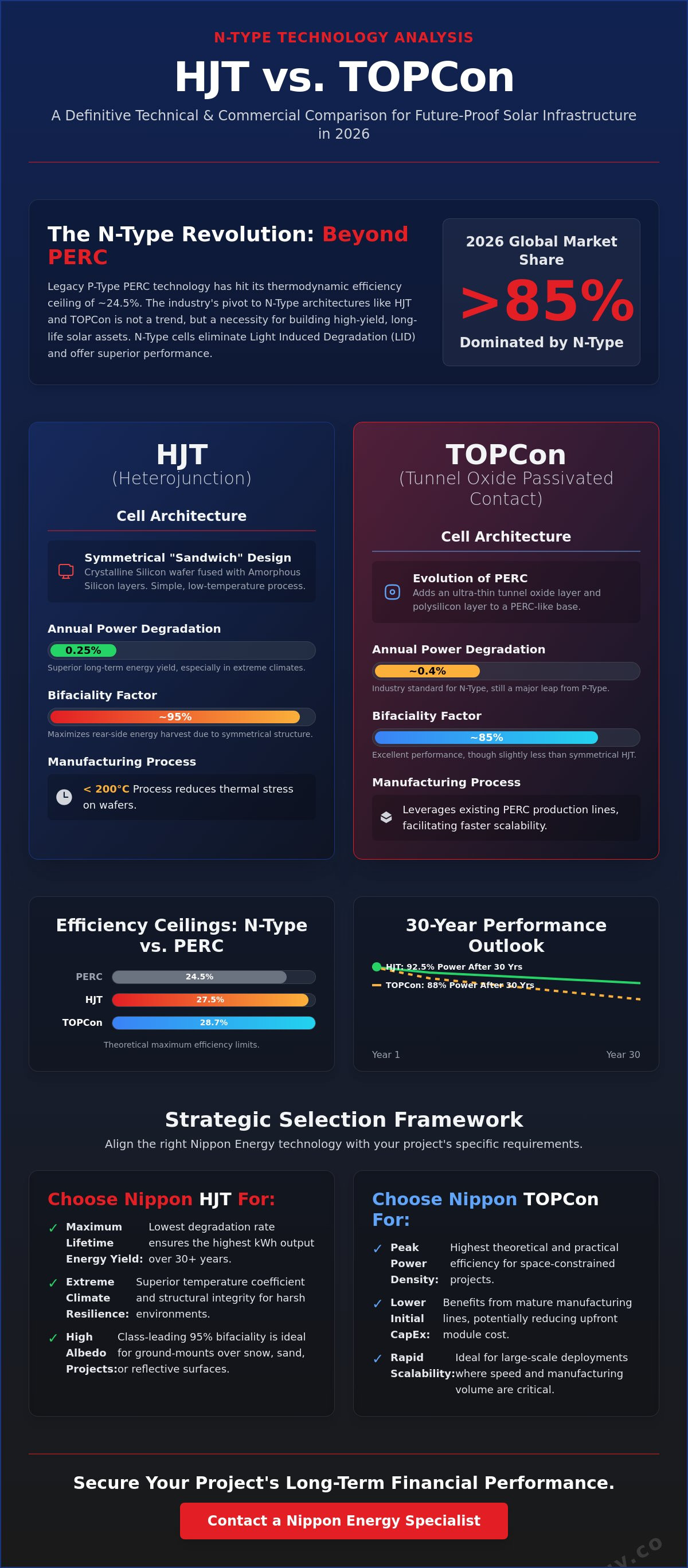
The 'Shockley-Queisser' limit defines the maximum theoretical efficiency for single-junction solar cells. While PERC struggled to approach its theoretical peak, N-type architectures provide a significantly higher ceiling for energy harvest. Commercial Heterojunction (HJT) solar cells offer a theoretical limit exceeding 27.5%, while TOPCon (Tunnel Oxide Passivated Contact) pushes the boundary toward 28.7%. In 2026, mass-produced modules consistently deliver between 24% and 26% efficiency. This leap in performance enables project owners to maximize power density. By producing more energy per square meter, these technologies effectively reduce the balance of system (BOS) costs, including land use, cabling, and mounting structures.
N-Type Reliability: A New Standard for Infrastructure
Reliability serves as the cornerstone of Nippon Energy’s hardware philosophy. Legacy P-type cells rely on boron-doped silicon, which is inherently susceptible to Light Induced Degradation (LID) caused by boron-oxygen defects. This flaw often resulted in a 2% to 3% performance drop within the first year of operation. N-type cells utilize phosphorus-doped silicon instead. This fundamental change in material science offers several advantages:
- Zero LID: The elimination of boron-oxygen complexes ensures that modules maintain their rated power output during the critical first year of operation.
- Enhanced Electron Lifetime: Phosphorus doping facilitates superior electron flow, which directly correlates to higher energy yield in low-light conditions.
- Structural Resilience: N-type wafers are less prone to micro-cracking during thermal cycling, preserving the integrity of the cell over a 30-year lifecycle.
Nippon Energy integrates these advancements into our proprietary hardware lines to ensure energy independence for our global partners. Our focus on high-efficiency monocrystalline silicon provides the structural foundation required for resilient, high-capacity solar arrays. By adopting these N-type standards, we ensure that your infrastructure remains productive and technologically relevant well into the next three decades.
Structural Engineering: Decoding the Mechanism of HJT vs. TOPCon Cells
Understanding the structural divergence of hjt vs topcon requires an engineering-level inspection of how charge carriers are managed at the wafer surface. While both technologies utilize N-type silicon to enhance performance, their mechanical compositions and manufacturing sequences differ significantly. These architectural choices impact both production scalability and the long-term field durability of the modules. Engineers must weigh the streamlined simplicity of heterojunction designs against the established manufacturing synergy of passivated contact cells.
The HJT Architecture: Symmetrical Simplicity
The HJT architecture is defined by a symmetrical "sandwich" structure that fuses a crystalline silicon wafer with ultra-thin layers of intrinsic and doped amorphous silicon (a-Si:H). This configuration creates a superior passivation effect that minimizes carrier recombination at the surface. Because the cell is naturally symmetrical, HJT modules achieve bifaciality factors of up to 95%, allowing for substantial energy harvest from the rear side in high-albedo environments. Production involves a streamlined 4-step process conducted at temperatures below 200°C. This low-temperature processing reduces thermal stress on the silicon, resulting in a more resilient wafer that resists micro-cracking during environmental cycling.
The TOPCon Architecture: Evolution of the PERC Line
TOPCon (Tunnel Oxide Passivated Contact) represents a sophisticated refinement of the traditional PERC manufacturing line. The core innovation is a microscopic, ultra-thin tunnel oxide layer paired with a doped polycrystalline silicon layer. This configuration allows charge carriers to tunnel through while effectively blocking recombination, which preserves voltage. Modern TOPCon solar panels utilize selective emitter technology to further enhance conductivity and efficiency. However, achieving this performance requires a high-temperature 10-step process involving multiple deposition and annealing stages. While this complexity mirrors the established manufacturing ecosystem, it introduces higher thermal loads during fabrication compared to HJT.
The choice between these architectures dictates the mechanical longevity and asset value of the infrastructure. HJT’s simplified structure and low-temperature manufacturing yield a panel with lower annual degradation rates, typically around 0.25%. TOPCon’s reliance on existing manufacturing synergy makes it the dominant choice for high-volume utility projects, though it faces a slightly higher degradation profile of 0.35% to 0.40%. Asset managers seeking to optimize specific site yields should evaluate how these structural differences influence long-term energy production. For a detailed technical consultation on your next high-yield installation, you can explore the specifications of Nippon HJT Solar Panels.
Performance in Extreme Environments: Temperature Coefficients and Bifaciality
Performance in extreme environments serves as the ultimate validator in the hjt vs topcon debate. While efficiency ratings are measured under Standard Test Conditions (STC) at 25°C, real-world utility assets rarely operate in such temperate climates. In regions like the Middle East and South Asia, module temperatures frequently soar, triggering significant energy loss through thermal degradation. Nippon Energy's field data from deployments in Dubai and Karachi confirms that theoretical advantages translate directly into measurable kilowatt-hour gains when hardware is pushed to its physical limits.
The High-Temperature Advantage
The Pmax temperature coefficient is the metric that dictates how much power a module loses for every degree Celsius above the 25°C benchmark. For 2026 commercial modules, typical values for HJT sit at -0.24%/°C, while TOPCon averages around -0.29%/°C. This 0.05% delta might appear negligible on a spec sheet, but it becomes monumental in desert environments where module temperatures often hit 75°C. At these operating levels, the 50°C deviation from STC results in a 12% power loss for HJT systems compared to a 14.5% loss for TOPCon arrays. HJT is the 'High-Tech Architect's' choice for Riyadh or Karachi projects because its structural integrity and thermal stability ensure maximum energy harvest when ambient temperatures exceed 45°C.
Maximizing Albedo Yield with Bifaciality
Bifaciality refers to the ability of a solar cell to generate power from light hitting its rear surface. This is a critical factor for ground-mounted infrastructure installed on high-albedo surfaces like desert sand or white crushed gravel. The architectural differences between the two technologies create a clear performance gap:
- HJT Bifaciality: These cells achieve a bifaciality factor between 90% and 95% due to their symmetrical N-type structure.
- TOPCon Bifaciality: Standard 2026 modules typically hover between 80% and 85% because of the shading effects from the rear-side metal contact grid.
In high-albedo environments, this 10% advantage in rear-side contribution significantly lowers the Levelized Cost of Electricity (LCOE). By capturing more reflected irradiance, Nippon HJT Solar Panels provide a higher energy density per hectare than comparable TOPCon systems. This increased yield doesn't just improve the immediate ROI; it future-proofs the asset against the rising operational costs of large-scale solar farms. When selecting hardware for high-yield infrastructure, engineers must prioritize these environmental resilience metrics to ensure the long-term viability of the energy system.
The Commercial Equation: Comparing LCOE and Long-Term Degradation
The financial viability of a utility-scale solar asset depends on its performance over decades, not just its performance on day one. While the hjt vs topcon debate often centers on initial capital expenditure (CAPEX), sophisticated investors prioritize the Levelized Cost of Electricity (LCOE). Initial price per watt is a misleading metric if it ignores the compound impact of annual degradation and operational expenses. Asset managers must evaluate the lifecycle of the infrastructure to determine which technology provides the most secure long-term return.
Calculating the 30-Year Yield
Long-term energy output is a direct result of the semiconductor's material stability. To accurately project the 30-year yield of an N-type asset, developers should follow a structured calculation model:
- Step 1: Factor in the initial first-year degradation. Both HJT and TOPCon typically remain below 1%, providing a stable start compared to legacy P-type cells.
- Step 2: Apply the annual linear degradation rate over the 30-year power warranty. HJT maintains a superior profile with approximately 0.25% annual decay, while TOPCon exhibits a higher rate of 0.40%.
- Step 3: Account for the temperature-adjusted yield based on the project's geographic location. Over three decades, the slower degradation of HJT can result in a significant cumulative energy gain over TOPCon alternatives.
LCOE Sensitivity Analysis
HJT's higher initial cost is frequently offset by its enhanced energy harvest in high-yield environments. In regions with high ambient temperatures, the technology's 3% to 5% higher energy yield directly reduces the LCOE by spreading the fixed costs over more generated kilowatt-hours. Additionally, the higher efficiency of HJT modules facilitates balance-of-system (BOS) savings. Because fewer panels are required to achieve the same peak power capacity, developers realize immediate reductions in land use, racking hardware, and installation labor.
Future-proofing remains a critical commercial variable. HJT's architecture is uniquely compatible with future Tandem (Perovskite) technology, positioning these assets for potential efficiency upgrades by 2030. Nippon Energy optimizes these high-performance modules by pairing them with our Nippon Smart AI Inverters. These systems utilize intelligent algorithms to manage the specific power curves of N-type hardware, ensuring maximum precision in energy conversion. To secure your energy infrastructure with our high-performance hardware, consult with our team regarding Nippon HJT and TOPCon solutions.
Strategic Selection: Choosing the Right Nippon Technology for Your Infrastructure
The selection between hjt vs topcon isn't a binary choice of "better" or "worse" but a strategic alignment of hardware with site-specific variables. As a global partner in energy infrastructure, Nippon Energy provides a dual-track technology portfolio designed to optimize the Levelized Cost of Energy (LCOE) across diverse geographic and commercial contexts. Decision-makers must evaluate specific irradiance profiles, thermal conditions, and spatial constraints to ensure the selected hardware delivers maximum asset value over its 30-year operational life. This calculated approach to hardware selection prevents technology obsolescence and secures long-term energy independence.
Project-Specific Technology Matching
For utility-scale solar farms in temperate zones, Nippon TOPCon Solar Panels often represent the most balanced investment. With commercial efficiencies ranging from 22% to 24%, these modules leverage manufacturing scalability to provide a competitive upfront cost profile. The typical payback period for TOPCon over legacy PERC technology is now three to four years, making it the standard choice for cost-sensitive, high-volume deployments where land is not a primary constraint.
Conversely, industrial rooftops in high-heat zones or regions with high ground albedo necessitate the use of Nippon HJT Solar Panels. HJT’s superior -0.25%/°C temperature coefficient and 95% bifaciality ensure that energy yield remains high even when module temperatures peak. Integrating these panels with Nippon Smart AI Inverters allows for granular monitoring and real-time optimization of these specific power curves, ensuring maximum uptime and precision in energy conversion. This combination is essential for high-yield infrastructure where every square meter must be optimized for peak performance.
Engineering Your Energy Future
Securing a high-yield energy future requires more than just premium hardware; it demands a comprehensive approach to Solar Project Development and EPC. N-type systems require precise installation and ongoing Solar System Maintenance and Monitoring to preserve their low degradation profiles. Nippon Energy maintains a global presence, supporting complex infrastructure in Tokyo, Dubai, Berlin, and Lahore. This global reach ensures that our technical authority is backed by localized environmental data and engineering expertise. By pairing our N-type modules with Nippon Lithium-ion Battery Storage Systems, developers can bridge the gap between generation and demand, creating a resilient, self-sustaining energy ecosystem.
The transition to N-type dominance is complete, but the refinement of your specific energy strategy is just beginning. Our engineering mindset focuses on structural integrity and future-proofing to protect your capital investment against shifting market standards. Consult with Nippon Energy's engineering team for a project feasibility study to determine the optimal configuration for your next deployment.
Securing Long-Term Asset Integrity in the N-Type Era
The transition from legacy PERC to N-type standards is a permanent shift in the global energy landscape. Selecting between hjt vs topcon requires a precise evaluation of your project's thermal environment and target Levelized Cost of Electricity. While TOPCon offers immediate manufacturing synergy for large-scale utility projects, HJT provides the structural resilience and low 0.25% degradation rates necessary for high-heat environments. Nippon Energy supports this selection process through Tier 1 Global Manufacturing Standards and hardware that delivers field-tested performance in Middle Eastern desert climates. Every module we deploy is backed by comprehensive 30-year linear power warranties to ensure your infrastructure remains a productive asset for decades.
We invite you to Request a Technical Specification Sheet for Nippon HJT and TOPCon Modules to begin your technical feasibility study. Our engineering team is ready to help you optimize your hardware configuration for maximum long-term yield. Your path to resilient, high-capacity energy independence starts with the right architectural foundation.
Frequently Asked Questions
Is HJT better than TOPCon for residential solar installations?
HJT is often superior for residential sites with restricted roof area because its higher power density maximizes energy generation per square meter. It allows homeowners to achieve higher peak capacity on smaller surfaces. However, TOPCon remains a highly effective choice for standard residential applications where roof space is abundant, as it provides a reliable balance of efficiency and competitive upfront costs.
Can TOPCon solar panels handle high humidity as well as HJT?
HJT modules typically exhibit higher resilience in high-humidity environments because their symmetrical structure and specialized encapsulation minimize moisture ingress. While TOPCon panels are engineered for durability, their complex manufacturing process involves multiple layers that can be more susceptible to moisture-induced degradation over long periods. For tropical regions, the architectural simplicity of HJT often provides better long-term protection against humidity.
How much more expensive are HJT solar panels compared to TOPCon in 2026?
In the 2026 market, HJT modules generally command a price premium over TOPCon due to the requirement for dedicated production lines. This initial cost difference in the hjt vs topcon comparison is typically balanced by HJT’s lower annual degradation rate of 0.25%. Over the system's 30-year life, the increased energy harvest in high-temperature environments often results in a lower Levelized Cost of Electricity.
What is the expected lifespan of an N-type HJT solar module?
Modern N-type HJT modules are designed for a 30-year operational lifespan, supported by linear power warranties that guarantee high output levels after three decades. Their structural stability and inherent resistance to light-induced degradation ensure that the hardware remains productive well beyond the initial payback period. This makes them a reliable choice for investors seeking long-term security for their energy infrastructure.
Does Nippon Energy provide EPC services for both HJT and TOPCon projects?
Nippon Energy provides comprehensive Solar Project Development and EPC services for both HJT and TOPCon technologies. Our engineering teams manage the entire lifecycle of the installation, ensuring that the selected hardware is integrated correctly for maximum efficiency. This includes site-specific modeling to determine which N-type technology aligns best with your specific geographic and operational requirements.
What happens to the temperature coefficient as solar panels age?
The Pmax temperature coefficient remains relatively stable over the module's life, but the cumulative impact of thermal stress can accelerate other degradation mechanisms. Because HJT maintains a superior temperature coefficient of -0.24%/°C, it preserves its efficiency advantages in hot climates more effectively than TOPCon as the system ages. This stability is a key factor in securing the asset's long-term energy yield.
How do HJT panels perform in low-light or cloudy conditions?
HJT panels demonstrate excellent performance in low-light conditions due to the intrinsic amorphous silicon layers that facilitate better electron flow at lower irradiance levels. This sensitivity allows HJT systems to begin generating power earlier in the morning and continue later into the evening. This extended daily operation window increases the total energy harvest, providing a significant advantage in the hjt vs topcon performance analysis.
Are TOPCon panels compatible with existing string inverters?
TOPCon modules are fully compatible with standard string inverters, provided the electrical specifications match the inverter's input parameters. For optimal performance, Nippon Energy recommends pairing these panels with Nippon Smart AI Inverters. These systems are specifically engineered to manage the high current and voltage profiles of modern N-type modules, ensuring maximum energy conversion efficiency across the entire power curve.


