
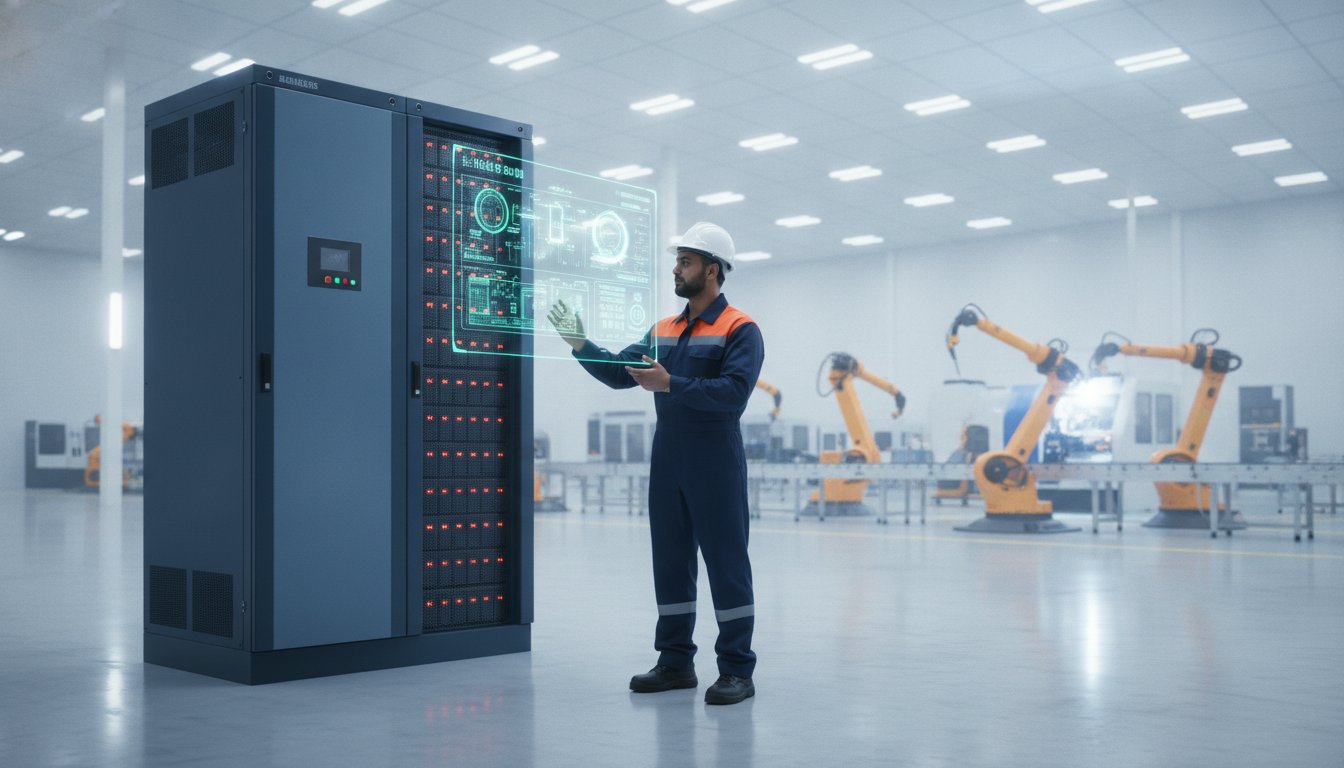
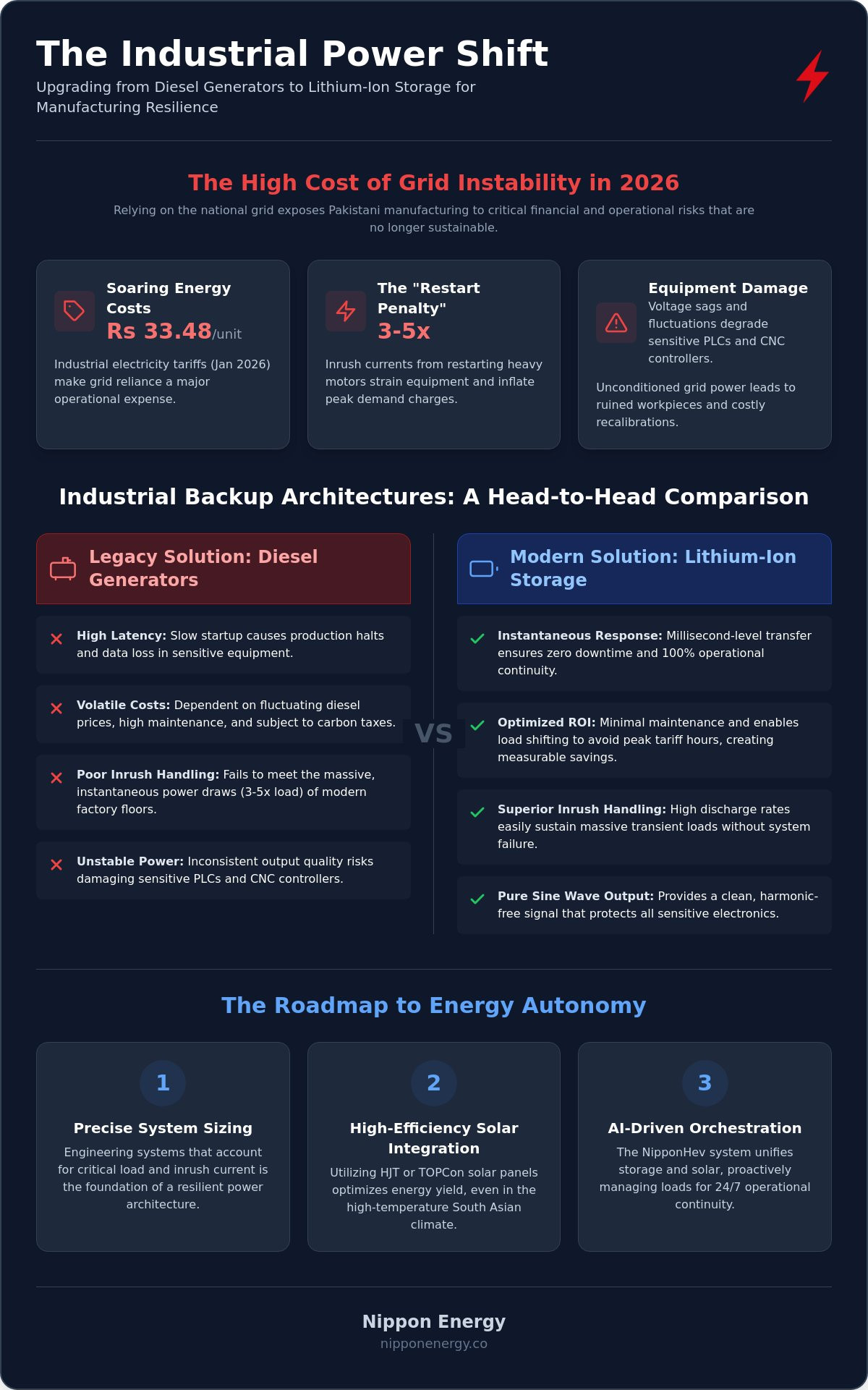
Relying on the national grid for precision manufacturing in 2026 is no longer a calculated risk; it's a documented liability for your facility's bottom line. You've likely experienced how a single voltage fluctuation can compromise sensitive PLC systems or how unplanned downtime leads to cascading revenue losses. With industrial electricity tariffs at Rs 33.48 per unit as of January 2026 and a net billing framework that de-incentivizes grid exports, the necessity for localized energy autonomy is critical. Integrating a sophisticated industrial ups system with battery backup in Pakistan is the only way to insulate your production from these volatile external variables.
This guide provides a technical roadmap to eliminate production interruptions by utilizing high-capacity lithium storage and AI-driven energy orchestration. We'll examine how to bypass grid instability and rising diesel maintenance costs through advanced power architectures that prioritize efficiency. You'll learn how to implement a system that doesn't just react to outages but proactively manages your load to ensure 24/7 operational continuity. By the end of this analysis, you'll understand how to transform your power infrastructure into a resilient asset that supports long-term industrial growth and technical excellence.
Key Takeaways
- Identify the systemic risks of grid instability and learn how to mitigate the "Restart Penalty" that occurs when re-initiating heavy industrial motors after a power failure.
- Evaluate the transition from volatile diesel-based models to a resilient industrial ups system with battery backup pakistan utilizing high-capacity lithium storage.
- Master the engineering requirements for sizing industrial power systems, specifically accounting for inrush currents that can reach 3-5x the standard running load.
- Optimize energy yield in the high-temperature South Asian climate by integrating high-efficiency HJT or TOPCon solar panels into your facility's energy architecture.
- Discover how unified AI-driven orchestration through the NipponHev system streamlines factory backup and future-proofs your operational continuity against rising tariffs.
The Impact of Industrial Load Shedding on Pakistan's Manufacturing in 2026
Industrial load shedding in 2026 has evolved from simple scheduled outages into a complex landscape of systemic grid instability. For high-output facilities, the challenge isn't just the absence of power but the unpredictability of frequency fluctuations and voltage sags that precede a total collapse. Relying on an unconditioned grid connection exposes sensitive machinery to electrical stress that degrades component lifespan over time. Implementing a robust industrial ups system with battery backup pakistan serves as a critical buffer, isolating your facility from the volatile national infrastructure and ensuring a stabilized power feed. This transition from reactive backup to proactive energy orchestration is essential for maintaining a competitive edge in an environment where industrial electricity tariffs have reached Rs 33.48 per unit as of January 2026.
The "Restart Penalty" represents one of the most significant hidden costs of grid reliance. When heavy industrial motors or hydraulic systems are re-initiated after a sudden halt, they require an inrush current that often reaches 3 to 5 times their standard operating load. These energy spikes don't just strain the internal electrical architecture; they trigger peak-demand charges that inflate monthly utility bills. Traditional lead-acid UPS systems consistently fail to meet these 2026 megawatt-scale requirements because their high internal resistance and slow discharge rates cannot sustain the massive, instantaneous power draws required by modern factory floors. High-capacity lithium storage has become the only viable solution for handling these rapid transients without system failure.
Technical Risks to Sensitive Factory Equipment
Modern manufacturing relies on precision. Voltage sags during grid-to-generator transitions can cause PLCs and CNC controllers to reset or lose calibration, resulting in ruined workpieces and hours of manual reconfiguration. Grid-to-Backup Latency is the critical metric for industrial continuity, defining the exact millisecond-interval required for a system to detect a utility failure and transfer the full electrical load to stored energy reserves. To preserve the integrity of laboratory and medical-grade equipment, a Uninterruptible Power Supply (UPS) must provide a pure sine wave output. This ensures that sensitive electronics receive a clean, harmonic-free signal that prevents hardware overheating and logic errors during extended backup cycles.
Economic Consequences of Unplanned Halts
Unplanned halts threaten more than just immediate output; they compromise ISO certifications and safety standards. In high-density zones like the Korangi and Sundar Industrial Estates, where grid density often leads to cascading failures, the economic argument for a storage-first model is undeniable. Shifting away from diesel-heavy backup reduces the operational overhead associated with fuel procurement and the rising maintenance costs of aging generator fleets. A storage-integrated industrial ups system with battery backup pakistan allows for seamless load shifting, enabling factories to draw from stored reserves during peak tariff hours. This creates a measurable ROI by avoiding the highest utility rates while ensuring that export deadlines are met without the risk of material waste or equipment damage.
Industrial Backup Architectures: Diesel Generators vs. Lithium-Ion Storage
The traditional reliance on diesel generators as a primary backup strategy is rapidly becoming a fiscal liability. Fuel price volatility, combined with the implementation of 2026 carbon taxes, has significantly altered the ROI calculation for industrial facilities across the country. The economic impact of electricity shortages in Pakistan has historically forced manufacturers into diesel dependency, yet this reliance now introduces new technical risks. Transitioning to lithium ion battery storage provides a stable, high-performance alternative that serves as the new benchmark for industrial resilience. Lithium Iron Phosphate (LFP) chemistry is specifically selected for its superior safety profile in high-temperature industrial zones. LFP's thermal stability ensures that systems remain operational even when ambient temperatures exceed 45 degrees Celsius, a condition that frequently compromises lead-acid alternatives.
Maximizing backup capacity within limited factory floor space is a critical requirement for modern engineering. Lithium systems offer significantly higher energy density than traditional chemistries, allowing for a 70% reduction in physical footprint. This space efficiency enables manufacturers to scale their energy reserves without requiring expensive structural expansions. An industrial ups system with battery backup pakistan provides the necessary power density to support heavy machinery while maintaining a compact, modular design that integrates seamlessly into existing electrical rooms.
The ROI of Nippon Lithium-ion Battery Storage Systems
Nippon Lithium-ion Battery Storage Systems offer a lifecycle exceeding 6,000 cycles at 80% depth of discharge. This stands in stark contrast to Valve Regulated Lead Acid (VRLA) batteries, which typically require replacement every two years due to capacity fade in harsh environments. Eliminating the recurring capital expenditure of battery replacements significantly reduces the total cost of ownership over a ten-year horizon. These systems are maintenance-free; they remove the need for periodic battery watering or the intensive servicing schedules required by combustion engines. In geographically constrained areas like Karachi's Sector 15, this compact architecture allows for maximum power availability in minimal square footage. It's a strategic move that turns energy storage into a long-term financial asset.
Eliminating Diesel Dependency
The inherent 10-15 second startup lag of a diesel generator is incompatible with modern automated production lines. A high-capacity industrial ups system with battery backup pakistan provides instantaneous switching, ensuring that sensitive PLC and CNC systems never experience a power dip. This seamless transition prevents the mechanical stress and data loss associated with sudden halts. Beyond operational efficiency, shifting to storage-first models aligns your facility with 2026 international ESG mandates and environmental compliance standards. Calculating the "True Cost of Diesel" requires factoring in transportation, secure storage, and the accelerated wear on generator components during frequent short-cycle operations. If you're ready to modernize your facility's power strategy, you can consult with our engineering team to design a tailored storage solution.
Sizing Your Industrial UPS: Calculating Critical Load and Inrush Current
Engineering a resilient power architecture requires moving beyond generic kVA ratings to a granular understanding of load dynamics. A comprehensive factory load audit is the first step, where electrical engineers must categorize equipment into essential and non-essential zones. Essential loads, such as PLC controllers, sensitive sensors, and critical cooling systems, require absolute continuity. By contrast, non-essential loads can be shed during extended outages to preserve battery life. Correctly sizing an industrial ups system with battery backup pakistan ensures that your most vital assets remain online during the 4, 8, or 12-hour load shedding cycles common across the country's industrial hubs. This methodical approach prevents over-investment in battery capacity while guaranteeing operational security for high-value production lines.
The most frequent cause of backup system failure in industrial settings is the failure to account for inrush current. Heavy induction motors and large-scale compressors often demand 3 to 5 times their rated running current during the initial startup phase. If your UPS architecture only accounts for steady-state consumption, these momentary surges will trigger protective circuit trips, leading to the very downtime you intended to avoid. A high-performance backup system must be engineered with a high peak-power handling capability to absorb these transients. Modular scaling allows for this precision; you can deploy a system sized for current demands while maintaining the structural flexibility to add power modules as your factory floor expands.
Peak Shaving and Demand Management
Battery storage in 2026 is no longer just a passive insurance policy; it's an active tool for financial optimization. Peak Shaving reduces monthly utility bills for factories by discharging stored energy during high-tariff periods, effectively bypassing the most expensive grid hours. This strategy smooths the facility's load profile, preventing the unpredictable spikes that often trip industrial circuit breakers. By orchestrating when your facility draws from the grid and when it utilizes stored lithium reserves, you create a stabilized energy cost regardless of utility rate hikes.
Inverter Synchronization for Industrial Loads
Precision manufacturing requires perfectly synchronized three-phase power to prevent motor overheating and vibration. Paralleling smart ai solar inverters allows for high-voltage output that maintains strict phase balance across heavy machinery. This intelligent synchronization ensures that even under heavy load, the electrical signal remains clean and consistent. Furthermore, the inclusion of "Black Start" capability is vital for autonomous recovery. This feature allows an industrial ups system with battery backup pakistan to restart the entire power network from a total shutdown state without requiring an external grid signal, ensuring your facility remains truly independent during systemic grid collapses.
Implementation Roadmap: Integrating Solar, Storage, and AI Orchestration
Executing a transition to a resilient energy architecture requires a phased, engineering-led approach to ensure structural and electrical compatibility. Phase 1 begins with a rigorous site assessment and structural integrity check of industrial rooftops. Because high-capacity solar arrays add significant dead load, verifying the load-bearing capacity of existing steel or concrete frames is non-negotiable. Once the site is cleared, Phase 2 moves to the procurement of high-efficiency Nippon HJT or TOPCon solar panels. These technologies are selected for their superior bifaciality and low temperature coefficients, ensuring maximum energy yield even in the intense heat of Pakistan's industrial corridors. Integrating these components into a unified industrial ups system with battery backup pakistan creates a foundation for long-term energy independence.
The transition from hardware installation to operational intelligence occurs in Phase 3 with the integration of AI management software. This layer of energy orchestration enables predictive load shedding responses by analyzing historical grid stability patterns and real-time weather data. Finally, Phase 4 involves commissioning and rigorous testing under full industrial load conditions. Engineers must simulate utility failures to verify that the system maintains phase synchronization and handles inrush currents without deviation. This methodical commissioning process ensures that the facility is prepared for the systemic grid instability projected for 2026.
The Critical Role of Solar EPC Services
Partnering with professional solar epc services is mandatory for maintaining industrial-grade safety and regulatory compliance. Navigating the Prosumer Regulations 2026 and securing net-billing permissions requires technical documentation that only an experienced EPC provider can deliver. A turnkey strategy also streamlines the procurement of Tier-1 hardware, which is essential for ensuring 25+ year system longevity. By centralizing design, procurement, and construction, plant managers eliminate the risks associated with fragmented vendor management. If you are ready to secure your facility's future, request a technical site evaluation from our engineering team today.
AI-Driven Energy Management
AI-driven energy management transforms a standard backup system into an intelligent asset. Unlike traditional setups that react only after a failure, AI prioritizes critical production lines by anticipating grid fluctuations and pre-charging lithium reserves. Plant managers gain transparency through real-time performance analytics accessible via mobile and desktop dashboards, allowing for data-driven decisions on load shifting. Automated health checks work in the background to detect panel or cell-level degradation before a failure occurs. This predictive maintenance model reduces unplanned downtime and ensures that the industrial ups system with battery backup pakistan remains at peak efficiency throughout its operational life.
The Nippon Energy Solution: Future-Proofing Pakistan's Industrial Power
The culmination of industrial energy resilience is found in the NipponHev system, a unified architecture designed to transcend the limitations of traditional backup. This integrated solution combines high-capacity lithium storage with advanced power electronics to create a self-sustaining energy ecosystem for the factory floor. By deploying an industrial ups system with battery backup pakistan that utilizes Japanese engineering precision, manufacturers in Lahore and Karachi can achieve a level of stability previously reserved for global Tier-1 facilities. This system doesn't just provide emergency power; it orchestrates energy flow to maximize efficiency and minimize grid dependency during the most volatile periods of the 2026 energy cycle.
Customizing HJT and TOPCon deployments for the South Asian climate is a core pillar of the Nippon Energy approach. Standard solar hardware often suffers from significant efficiency degradation when ambient temperatures exceed 40°C. Our engineering teams utilize specialized mounting and cooling configurations to ensure that the industrial ups system with battery backup pakistan remains a high-performance asset regardless of external thermal stress. Japanese engineering standards are applied to every local installation, ensuring that structural integrity and electrical safety meet international benchmarks. The final step in securing your facility's future is initiating a comprehensive feasibility study to determine the optimal configuration for full energy independence.
Why Nippon HJT Panels Lead the Industrial Market
Nippon HJT Solar Panels are engineered with superior temperature coefficients that allow them to maintain peak efficiency during 45°C+ Pakistani summers. Unlike conventional panels, HJT technology minimizes energy loss in high-heat environments, ensuring that your backup reserves are always fully replenished. Bifacial gains play a critical role in industrial roof settings, where reflected light from metallic or light-colored surfaces can increase total energy production by up to 25%. This architectural advantage ensures 30+ years of backup power security, providing a permanent solution to the recurring costs of grid instability. The durability of these panels is matched by their high performance, making them the ideal choice for megawatt-scale industrial deployments.
Securing Continuous Performance
The longevity of a high-capacity power architecture depends entirely on professional solar system maintenance. Nippon Energy provides localized support infrastructure in Karachi and Lahore to ensure that every system component functions at its design specification. Our technicians conduct thermal imaging and string-level diagnostics to prevent minor issues from escalating into production-stopping failures. This commitment to maintenance-free operation for the client is backed by our specialized local teams who understand the specific dust and environmental challenges of the region. To begin the transition toward a resilient, AI-orchestrated power infrastructure, consult with Nippon Energy engineers for an industrial site feasibility study today.
Securing Industrial Resilience through Advanced Energy Orchestration
The transition toward energy autonomy is a critical requirement for maintaining a competitive edge in Pakistan's 2026 industrial landscape. By replacing volatile diesel-dependent models with a high-performance industrial ups system with battery backup pakistan, your facility can eliminate the "Restart Penalty" and protect sensitive PLC architectures from grid-induced damage. This strategic shift ensures that production lines remain operational regardless of systemic utility failures or rising tariff structures that currently challenge the manufacturing sector.
Nippon Energy combines proprietary HJT and TOPCon solar technology with a global engineering presence across Japan, the UAE, and Pakistan to deliver end-to-end EPC excellence. Our AI-driven management systems provide the predictive orchestration necessary for future-proofing large-scale manufacturing plants against an unstable grid. Request a Professional Industrial Energy Audit from Nippon Energy to define the technical roadmap for your facility's energy independence. Build a foundation that isn't just powered for today, but is engineered for decades of uninterrupted growth and technical excellence.
Frequently Asked Questions
What is the best backup power for a factory during 8-hour load shedding?
High-capacity lithium-ion storage coupled with solar generation is the superior solution for long-duration outages. Unlike traditional lead-acid batteries that degrade under deep discharge or diesel generators that incur high fuel costs, lithium systems provide stable, long-term power. An industrial ups system with battery backup pakistan ensures 8-hour continuity while avoiding the energy spikes associated with frequent grid transitions.
Can a lithium-ion battery system run heavy industrial motors?
Yes, provided the system is engineered to handle the specific inrush current requirements of industrial motors. High-performance lithium storage can sustain the 3x to 5x current spikes required during motor startup. Proper sizing of the inverter and battery discharge rate is essential to ensure that heavy machinery operates without triggering protective circuit trips during utility failures.
How much does an industrial solar backup system cost in Pakistan in 2026?
Costs vary based on system capacity, storage duration, and technical complexity. While specific project pricing depends on site-specific engineering requirements, industrial consumers should evaluate the total cost of ownership over a 10-year horizon. Shifting from diesel to storage-first models provides a significant ROI by bypassing high utility tariffs and reducing fuel maintenance overhead.
Is it possible to integrate solar storage with my existing diesel generator?
Hybrid integration is a standard engineering practice that allows solar storage to work in tandem with existing diesel assets. The storage system acts as the primary buffer to eliminate the 10-15 second diesel startup lag, while the generator serves as a secondary backup for extended outages. This configuration optimizes fuel consumption and extends the operational life of the generator fleet.
What is the lifespan of Nippon Lithium-ion Battery Storage Systems in high heat?
Nippon Lithium-ion Battery Storage Systems utilize Lithium Iron Phosphate (LFP) chemistry, which is engineered to exceed 6,000 cycles even in high-temperature environments. In the Pakistani climate, where industrial zones often exceed 45°C, LFP maintains thermal stability and capacity retention far beyond traditional chemistries. This durability ensures over 15 years of reliable service with minimal performance degradation.
How does AI improve factory power reliability during grid instability?
AI improves reliability by providing predictive energy orchestration rather than simple reactive switching. By analyzing grid frequency patterns and weather forecasts, the system pre-charges reserves and prioritizes critical production lines before a failure occurs. This proactive management minimizes the risk of unplanned halts and optimizes the performance of an industrial ups system with battery backup pakistan.
What are the space requirements for a 1MW industrial battery storage system?
A 1MW lithium-ion storage system requires significantly less space than lead-acid alternatives, typically fitting within a standard 20-foot or 40-foot shipping container. This high energy density allows for a 70% reduction in physical footprint, making it ideal for crowded industrial sectors. Modular designs allow for flexible placement within existing electrical rooms or dedicated outdoor enclosures.
Does Nippon Energy provide turnkey EPC for industrial parks in Pakistan?
Nippon Energy delivers comprehensive turnkey EPC services for large-scale industrial parks across Pakistan. Our scope includes everything from structural site assessments and procurement of HJT/TOPCon hardware to AI integration and long-term maintenance. We manage regulatory compliance and grid synchronization to ensure a seamless transition to a resilient, self-sustaining power architecture.


