
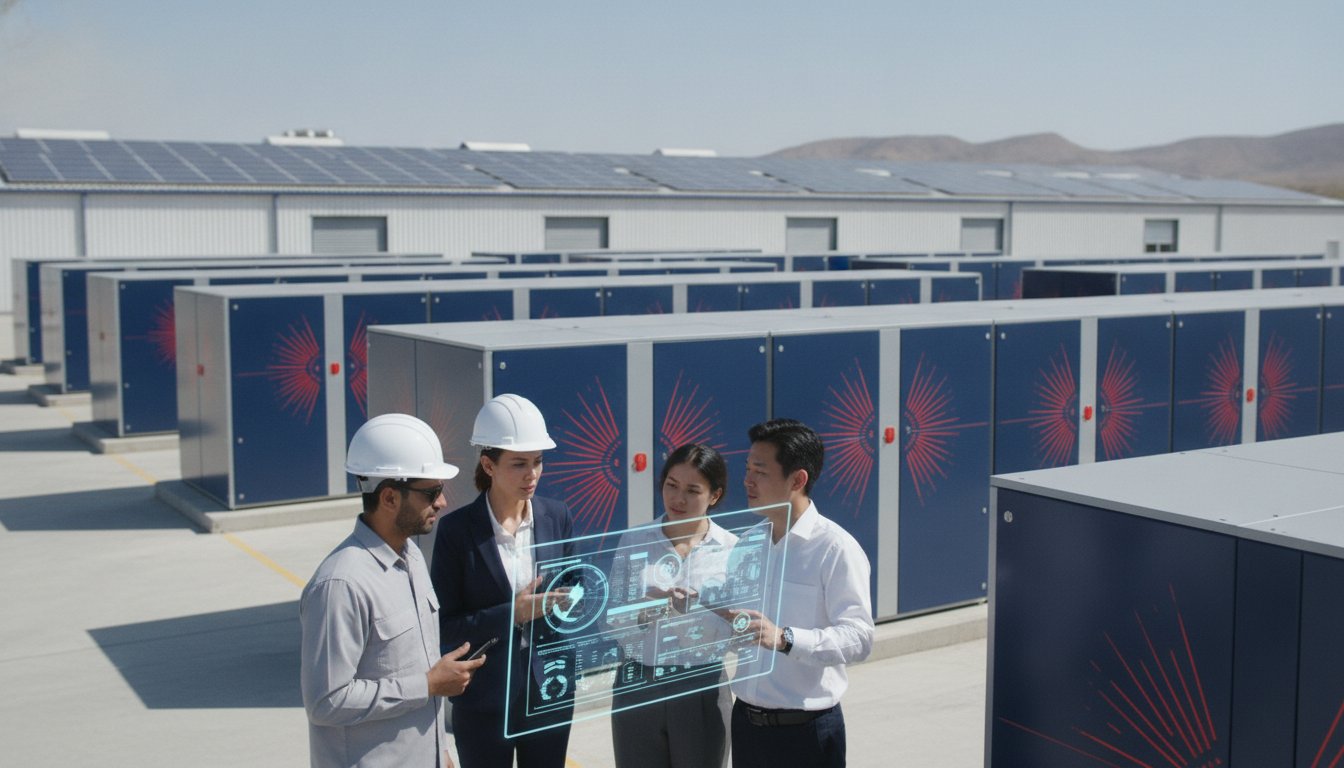
In 2026, a commercial battery storage system is a high-performance financial asset rather than a simple backup tool. You're likely facing the dual pressure of disruptive load shedding and a regulatory environment that now demands maximum self-consumption to maintain profitability. It's a demanding reality where ambient temperatures exceeding 45°C can rapidly erode the lifespan of poorly specified lithium-ion systems. Precision in commercial battery storage sizing pakistan is no longer just a technical preference; it's a structural necessity for industrial continuity.
We recognize your objective is a resilient, future-proofed energy architecture that minimizes the Levelized Cost of Energy. This guide provides the technical blueprint to master storage sizing by leveraging AI-driven analytics and the latest NEPRA (Prosumer) Regulations. You'll learn how to engineer a system using high-performance Nippon Lithium-ion Battery Storage to maintain 24/7 operations. We will analyze the transition from net metering to net billing and provide a granular framework for calculating the exact capacity required to secure your enterprise’s energy independence.
Key Takeaways
- Understand the strategic shift from emergency backup to sophisticated energy orchestration within the 2026 Pakistani industrial landscape.
- Evaluate why LiFePO4 (LFP) chemistry is the established technical standard for thermal resilience in environments exceeding 45°C.
- Identify the financial mechanisms of peak shaving and load shifting to eliminate utility penalties and accelerate your system's payback period.
- Follow a systematic implementation roadmap for commercial battery storage sizing pakistan to achieve 24/7 operational continuity.
- Discover how the NipponHev system integrates smart AI inverters and lithium-ion storage into a unified, future-proofed energy architecture.
The State of Commercial Energy Storage in Pakistan (2026)
The Pakistani energy landscape has moved past the era of reactive power management. In 2026, the industrial sector in Karachi and Lahore has shifted toward a proactive model where energy is no longer just a utility but a managed asset. A battery energy storage system (BESS) provides the technical foundation for this shift. It allows enterprises to decouple their operations from the volatility of the national grid. While traditional lead-acid batteries were once common, the extreme thermal conditions of Pakistan, often exceeding 45°C, have made Tier-1 Nippon Lithium-Ion Battery Storage the mandatory standard for any serious commercial installation. Accurate commercial battery storage sizing pakistan is now a prerequisite for any enterprise aiming to secure its operational future.
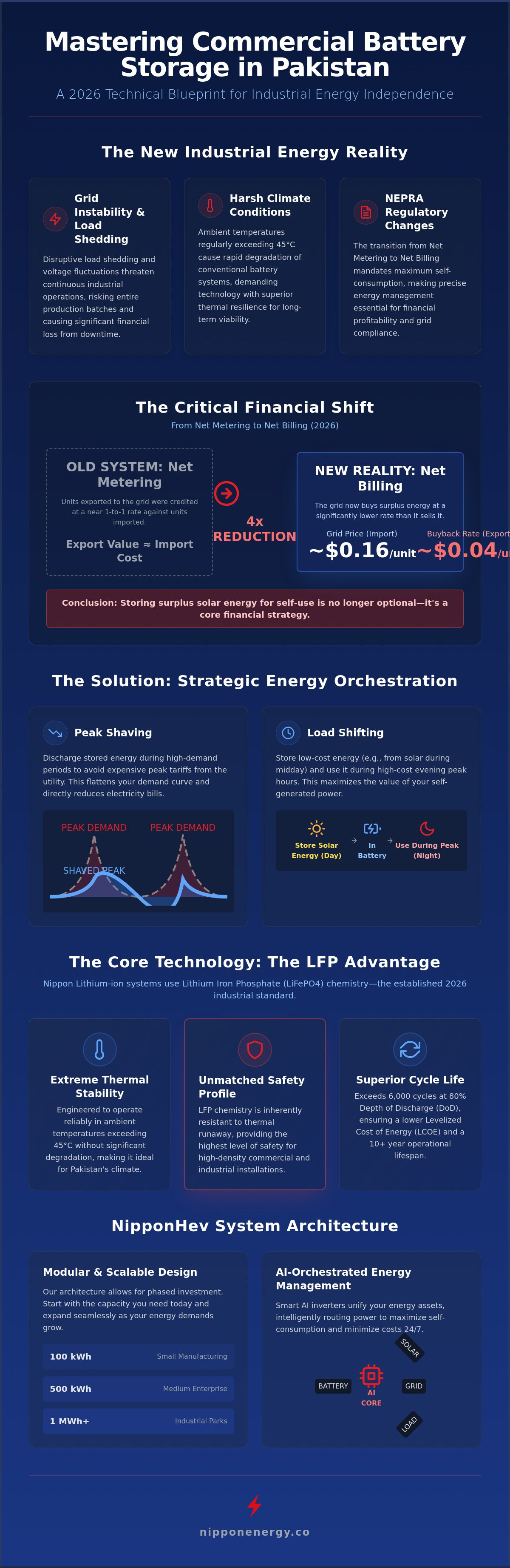
We've seen the 2026 uniform tariff for commercial consumers reach approximately $0.16 per unit. This pricing structure, combined with the shift from net metering to net billing where the buyback rate is only about $0.04 per unit, has changed the math. High-performance storage is now used for "Energy Orchestration"-the intelligent routing of power to maximize self-consumption. This makes commercial battery storage sizing pakistan a critical financial calculation. If you size too small, you're exposed to peak tariffs; if you size too large, your Levelized Cost of Energy (LCOE) rises unnecessarily.
Grid Instability and the True Cost of Downtime
For textile mills and high-precision manufacturing, a single voltage sag can ruin an entire production batch. The financial loss isn't just the electricity; it's the raw materials, labor, and missed delivery deadlines that can cost an industrial unit thousands of dollars in a single hour. BESS technology acts as a high-speed buffer, bridging frequency fluctuations and voltage sags that traditional generators can't catch in time. A BESS is critical infrastructure that ensures Pakistani businesses remain resilient against grid inconsistencies.
Regulatory Evolution: NEPRA and Net Metering in 2026
Compliance with the "Technical Standards for Grid Connectivity Regulations, 2026" (SRO 936(1)/2026) is now a prerequisite for industrial grid-tied systems. These regulations demand stricter control over harmonic distortion and grid synchronization. By integrating storage, enterprises can smooth out their export profiles, ensuring they stay within NEPRA's technical limits while optimizing for future Time of Use (TOU) tariff shifts. Storage allows you to store solar energy during the day and discharge it during peak hours when the tariff is at its highest, effectively future-proofing your energy architecture. This methodology ensures that your investment remains compliant with evolving grid standards while maximizing corporate profitability.
Nippon Lithium-ion Battery Storage: Technical Architecture
The 2026 industrial standard for energy resilience in Pakistan is defined by Lithium Iron Phosphate (LFP) chemistry. This specific chemical composition, utilized in Nippon Lithium-ion Battery Storage systems, offers the thermal stability required to operate in ambient temperatures that frequently exceed 45°C. Unlike older lead-acid or standard nickel-cobalt chemistries, LFP provides a "Chemistry of Resilience" that resists thermal runaway. This safety profile is essential for high-density industrial zones in cities like Faisalabad and Gujranwala. When considering the future of Pakistan's electricity grid, it's clear that LFP’s superior cycle life-often exceeding 6,000 cycles at 80% Depth of Discharge (DoD)-ensures a lower total cost of ownership over a ten year operational horizon.
Scalability is a core pillar of modern engineering. Our modular architecture allows Pakistani enterprises to design systems starting at 100kWh for small manufacturing units and expanding to multi-megawatt industrial parks. This flexibility is vital for commercial battery storage sizing pakistan, as it allows for phased investment. You don't need to over-capitalize on day one. Instead, you can expand your capacity as your load profile evolves or as additional production lines are commissioned. Each module integrates seamlessly into a unified energy spine, maintaining technical consistency across the entire site.
AI-Orchestrated Energy Management
Storage without intelligence is merely a passive reserve. By integrating Smart AI Solar Inverters, the system shifts into active energy orchestration. These AI-driven units use predictive analytics to forecast load patterns based on historical usage and weather data. The result is automated peak shaving, where the battery discharges during the highest tariff windows to prevent expensive demand charges. This level of precision is why many leading firms choose to consult with energy architects to optimize their storage logic.
Hardware Synergy: Storage Meets High-Efficiency PV
The efficiency of the storage cycle is heavily influenced by the input source. Utilizing Nippon TOPCon Solar Panels ensures that the battery receives a high-density, consistent charge even during low-light conditions. High-efficiency charging reduces the time the battery spends in high-stress states, which directly slows long-term degradation rates. For existing industrial sites, we evaluate DC-coupled versus AC-coupled architectures to determine which path offers the best round-trip efficiency. DC-coupling is often preferred for new installations to minimize conversion losses, while AC-coupling provides a simplified integration path for facilities with established solar arrays. This technical synergy is what makes commercial battery storage sizing pakistan a calculation of both capacity and connectivity.
Operational ROI: Peak Shaving and Load Shifting
The profitability of a commercial BESS in 2026 is anchored in its ability to actively manipulate the cost of electricity. Financial modeling for the Pakistani industrial sector suggests a payback period of four to six years for most manufacturing units. This ROI is primarily driven by the dual mechanisms of peak shaving and load shifting. Peak shaving allows an enterprise to eliminate the top 20% of its power demand, effectively avoiding the heavy utility penalties associated with exceeding sanctioned load limits. By utilizing intelligent commercial battery storage sizing pakistan strategies, businesses can discharge stored energy during these critical windows to flatten their demand profile. Load shifting takes this further by charging the system during low-cost off-peak hours and discharging during expensive peak Time of Use (TOU) windows. This strategy aligns with Pakistan's renewable energy policy, which seeks to integrate more distributed resources into the national grid to achieve 60% renewable generation by 2030.
Thermal resilience is a non-negotiable factor for operational success. Nippon Lithium-ion Battery Storage Systems are engineered to maintain 98% round-trip efficiency even in 45°C+ ambient temperatures. High-efficiency performance ensures that the energy you store isn't lost to heat before it can be used. Every percentage point gained in efficiency directly translates to reduced Levelized Cost of Energy (LCOE) and a faster return on investment. Proper commercial battery storage sizing pakistan must account for these thermal variables to ensure the system delivers its promised financial results over its entire lifecycle.
Thermal Management in South Asian Climates
Maintaining high performance in the intense heat of Sindh and Punjab requires sophisticated active cooling strategies. Industrial battery containers often utilize liquid-cooling circuits to regulate internal cell temperatures precisely. This technology mitigates heat-induced capacity fade, which is the primary cause of premature battery failure in tropical regions. Precise temperature control is the technical prerequisite for maintaining 10-year warranty viability in harsh industrial environments. By keeping the cells within an optimal thermal window, we ensure that the system provides consistent power delivery regardless of external weather conditions.
BESS vs. Diesel Generators: A 2026 Cost Comparison
Diesel generators are increasingly liabilities due to extreme fuel price volatility and high mechanical maintenance overhead. In contrast, BESS offers a stable, solid-state alternative with significantly lower operational costs. Transitioning from mechanical combustion to solid-state electronics reduces the frequency of service interventions and eliminates the risk of fuel theft. For Pakistani exporters, replacing diesel backup with a battery system also enhances ESG reporting scores. This transition is becoming a requirement for maintaining competitiveness in global markets that prioritize sustainable supply chains. The move to solar-plus-storage provides a predictable cost structure that diesel can't match.
Implementation Roadmap: From Sizing to Commissioning
The transition from financial modeling to physical deployment requires a disciplined, multi-phase methodology. Engineering a reliable energy spine involves more than just purchasing hardware; it necessitates a structured approach to integration. The process begins with a comprehensive energy audit to map your facility's specific load profile across a 24-hour cycle. This data provides the empirical foundation for commercial battery storage sizing pakistan, ensuring the system can handle both surge currents and sustained discharge requirements without over-stressing the cells. Once the audit is complete, the technical sizing of the Nippon Lithium-Ion Battery Storage system is finalized to match your specific autonomy targets.
Successful execution relies on the following standardized steps:
- Step 1: Load Profile Analysis: Identifying peak demand periods and transient loads to prevent system undersizing.
- Step 2: Technical Configuration: Finalizing the capacity and discharge rates for the storage array.
- Step 3: Strategic Procurement: Leveraging professional Solar EPC Services to manage the complex supply chain and technical integration.
- Step 4: Installation and Synchronization: Executing the physical build, followed by rigorous safety testing and grid synchronization according to NEPRA standards.
- Step 5: Lifecycle Monitoring: Establishing ongoing maintenance protocols and remote performance tracking to ensure the system operates at peak efficiency.
To begin your transition to energy independence, request a technical site evaluation from our engineering team.
Sizing Your Storage for 24/7 Independence
Achieving true independence requires a clear distinction between critical and non-critical loads. For industrial operations, critical loads include climate-controlled storage, high-precision machinery, and security systems. We calculate the "Days of Autonomy" by analyzing seasonal solar yield data specific to Pakistan's geography. This ensures your facility remains operational even during consecutive days of low solar irradiance. We also architect these systems with modular headroom to accommodate future-proofing requirements, such as the upcoming integration of EV fleet charging for corporate logistics.
Selecting a Strategic EPC Partner
In the industrial corridors of Karachi and Lahore, the choice of an EPC partner determines the long-term reliability of your investment. You should prioritize partners with a strong local engineering presence to ensure rapid response support for any technical contingencies. International safety standards must be non-negotiable. Every high-capacity installation should feature integrated fire suppression and advanced electrical protection to safeguard your facility. This methodical approach to commercial battery storage sizing pakistan and deployment ensures that your energy architecture is built for permanence rather than just convenience.
Nippon Energy: Architecting Pakistan's Industrial Future
Nippon Energy represents the rigorous intersection of Japanese engineering precision and deep-rooted Pakistani market expertise. We don't merely supply hardware; we architect the energy infrastructure that powers the nation’s industrial growth. Precision in commercial battery storage sizing pakistan is the core of our technical philosophy. By utilizing the NipponHev System, we create a unified energy spine where solar generation, AI-driven inversion, and lithium-ion storage operate in perfect synchronicity. This integrated approach ensures that every kilowatt-hour is accounted for and every surge is mitigated.
Evidence of this architecture's efficacy is demonstrated by our recent project for a major Karachi-based industrial facility. By deploying a custom-sized LFP storage array, this enterprise achieved 99.9% uptime despite frequent grid disturbances and voltage sags. This level of reliability is not accidental. It is maintained through professional monitoring and rigorous Solar System Maintenance protocols. Our specialized monitoring teams provide real-time oversight from our operations centers. We identify potential thermal or electrical deviations before they can impact your production schedule.
Global Standards, Local Execution
We leverage our global footprint to source Tier-1 components, ensuring that every cell and circuit meets international safety benchmarks. However, our execution remains intensely local. Through our dedicated offices in major industrial hubs, we provide the rapid response support and engineering presence required for large-scale operations. We provide the technical tools for long-term industrial energy independence. This commitment allows Pakistani exporters to meet global sustainability standards while securing their domestic profitability. We prioritize the structural integrity of your energy system to ensure it remains a permanent asset.
Initiating Your Energy Transition
The path to 24/7 operational continuity begins with a high-level technical consultation with our engineering team. We conduct a granular assessment of your facility’s load profile to provide a customized ROI and feasibility report. This document outlines the exact parameters for commercial battery storage sizing pakistan needed to meet your specific financial and operational goals. It provides a clear roadmap for capital expenditure and long-term energy savings. You can Secure Your Business Energy Independence with Nippon Energy by initiating this architectural review today.
Securing Your Industrial Energy Architecture
Mastering commercial battery storage sizing pakistan is the definitive step toward shielding your enterprise from the volatility of the 2026 energy market. We've detailed how AI-integrated storage and LiFePO4 chemistry provide the thermal resilience required for 45°C+ environments while maximizing the ROI of peak shaving. By shifting from reactive backup to proactive energy orchestration, you transform power from an unpredictable liability into a controlled operational advantage. This strategic transition ensures that your facility remains productive regardless of grid instability or shifting tariff structures. It's a fundamental shift that prepares your business for a high-cost energy landscape.
Nippon Energy combines Japanese Engineering Excellence with a robust local EPC presence in Karachi and Lahore to deliver these high-performance systems. Our advanced AI-integrated storage systems are engineered for structural integrity and long-term precision. You've seen the roadmap; now it's time to execute. Contact Nippon Energy for a Bespoke Industrial Storage Solution to begin your technical evaluation. Building a more resilient and profitable future for your Pakistani enterprise starts with a single, calculated decision today. We're ready to architect your energy independence.
Frequently Asked Questions
Is lithium-ion battery storage safe for high-temperature regions like Sindh and Punjab?
Lithium Iron Phosphate (LFP) chemistry is specifically engineered for thermal stability in regions where temperatures exceed 45°C. This chemistry has a significantly higher thermal runaway threshold compared to standard lithium-ion variants. Nippon systems utilize active liquid cooling and advanced battery management systems to maintain internal cell temperatures within optimal ranges. These safety layers prevent degradation and ensure operational security in the intense heat of Sindh and Punjab.
What is the typical lifespan of a commercial BESS in Pakistan?
A tier-1 commercial BESS typically operates for 10 to 15 years under standard industrial conditions. This durability is based on a cycle life of 6,000 cycles at 80% Depth of Discharge. The actual lifespan depends heavily on the quality of the thermal management system and regular maintenance. Systems that are correctly sized and cooled will maintain high capacity throughout their intended operational decade.
How much space is required for a 500kWh industrial battery system?
A 500kWh industrial battery system generally occupies the footprint of a standard 20-foot shipping container, which is approximately 160 square feet. This compact design allows for high energy density while leaving room for integrated cooling and fire suppression hardware. Professional commercial battery storage sizing pakistan ensures that the physical layout is optimized for both safety clearances and ease of maintenance access.
Can energy storage systems work with existing on-grid solar setups?
Yes, energy storage can be integrated into existing on-grid solar infrastructures through a process called AC-coupling. This method allows the battery system to work alongside your current grid-tied inverters without requiring a total system overhaul. It's an efficient way for established industrial sites to upgrade their energy architecture. This retrofitting capability provides a path to resilience for businesses that already have significant solar investments.
What are the current NEPRA regulations for commercial battery storage integration?
NEPRA's 2026 regulations, specifically SRO 936(1)/2026, outline the technical standards for grid connectivity and synchronization. These rules ensure that distributed energy resources don't compromise grid stability or power quality. Compliance requires hardware that meets IEC 62109-1/2 certifications. Following these standards is essential for maintaining your net billing agreement and ensuring your system remains a legal, grid-compliant asset.
How does AI-driven peak shaving actually reduce my monthly bill?
AI-driven peak shaving monitors your facility's real-time power consumption and automatically discharges the battery when demand spikes. This prevents your load from exceeding the sanctioned limit, which avoids expensive Maximum Demand Indicator (MDI) penalties. By flattening your demand profile, you also avoid purchasing power during the highest peak-hour tariff windows. It's a calculated method to lower the overall cost per unit of electricity consumed.
Are there any tax incentives or rebates for businesses installing storage in 2026?
In 2026, the Federal Board of Revenue (FBR) provides specific customs values for lithium-ion batteries under Valuation Ruling No. 2062/2026. While duty structures fluctuate, businesses often benefit from accelerated depreciation on renewable energy assets. These tax treatments can significantly improve the internal rate of return for a project. We recommend consulting with your corporate tax advisor to evaluate the specific fiscal benefits available for commercial battery storage sizing pakistan in your sector.
What happens if the battery system fails during peak production hours?
If a battery system encounters a technical fault, high-speed static transfer switches automatically bypass the storage unit. This transitions your load back to the utility grid or a backup generator in milliseconds to ensure zero production downtime. Modern industrial architectures are designed with internal redundancies to isolate faults without affecting the entire facility. This fail-safe engineering is a standard feature in our high-performance energy systems.


