
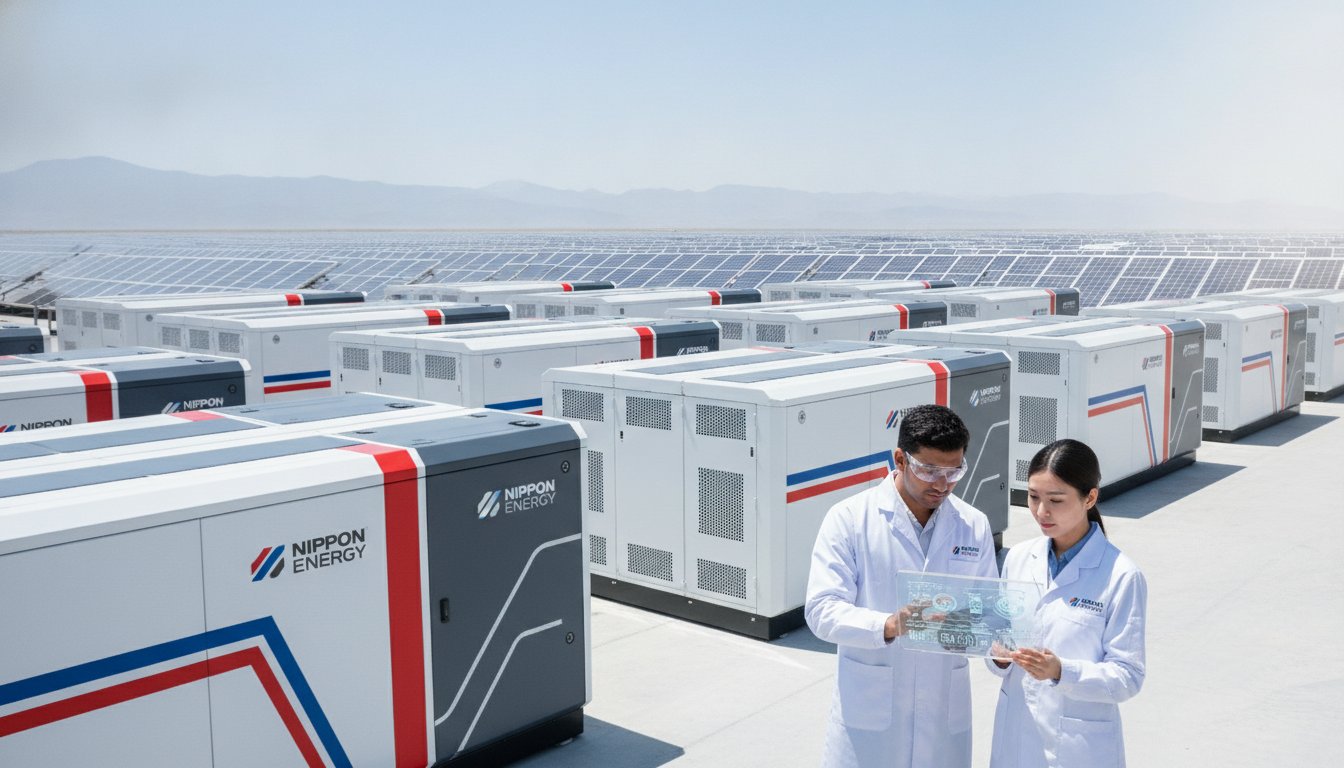
Industrial operations in Pakistan have reached a critical tipping point where relying solely on the national grid is a calculated risk few can afford. With utility tariffs for upper slabs frequently exceeding PKR 90 per unit, the search for a stable Nippon lithium ion battery price in pakistan has shifted from a simple procurement task to a strategic necessity for industrial survival. You likely recognize that the 2026 transition from net metering to net billing has fundamentally changed the financial landscape. It's no longer about selling power back to the grid; it's about securing your own production cycles through intelligent self-consumption.
This guide will provide the technical clarity needed to master the complexities of commercial energy storage and calculate the true ROI for your infrastructure. We'll examine how high-performance storage survives local climate extremes while providing a predictable ten-year expenditure model through advanced LFP chemistry. By the end of this analysis, you'll understand how to integrate resilient storage systems to secure energy independence and protect your bottom line from the escalating costs of the national grid.
Key Takeaways
- Understand how the 2026 transition to net billing makes high-capacity energy storage a technical requirement for industrial cost stability.
- Identify the specific hardware components, such as thermal management systems, that are essential for maintaining battery performance in local climate extremes.
- Compare LFP and NMC chemistries using the Levelized Cost of Storage metric to determine the most efficient 10-year investment path.
- Analyze the Nippon lithium ion battery price in pakistan by evaluating the total cost of ownership and savings from AI-integrated peak shaving.
- Discover the structural advantages of a unified energy ecosystem that combines HJT solar technology with advanced lithium-ion storage.
The 2026 Commercial Energy Storage Landscape in Pakistan: Pricing and Market Trends
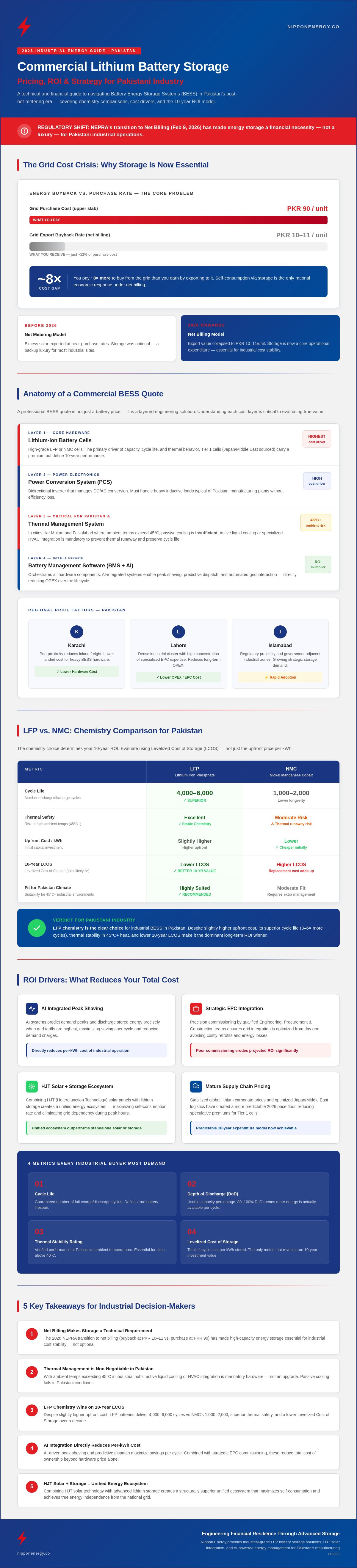
The 2026 fiscal year marks a decisive shift in Pakistan's industrial energy architecture. The National Electric Power Regulatory Authority (NEPRA) transition to net billing on February 9, 2026, has rendered traditional grid-tied solar systems without storage financially inefficient. With buyback rates for exported energy currently at approximately PKR 10-11 per unit while purchase costs from the grid climb toward PKR 90 per unit, the storage-first model is now the standard for commercial resilience. This regulatory pivot directly influences the Nippon lithium ion battery price in pakistan, as enterprises move from viewing batteries as luxury backups to essential components of their operational expenditure strategy.
The global energy market has matured, shifting the valuation of industrial Battery Energy Storage Systems (BESS) from capacity-only metrics to performance-based assessments. Industrialists no longer ask only for the price per kilowatt-hour; they demand data on cycle life, depth of discharge, and thermal stability in high-ambient environments. This evolution in Lithium-ion battery technology ensures that the capital invested today secures a predictable energy cost for the next decade. By integrating advanced storage, Pakistani manufacturers can effectively decouple their production costs from the volatility of national utility tariffs.
Supply Chain Evolution and the 2026 Price Floor
The stabilization of lithium carbonate prices globally has created a more predictable pricing environment for Tier 1 energy products in 2026. Manufacturing hubs in Japan and the Middle East have optimized South Asian logistics, reducing the transit times and insurance premiums that previously inflated local quotes. This diversified supply chain mitigates the risks of single-source disruptions, allowing for a more consistent flow of high-grade cells into the Pakistani market. By mid-2026, the global price floor for Tier 1 lithium cells has stabilized, reflecting a mature supply chain that favors large-scale industrial adopters over speculative retail buyers. This maturity allows Nippon Energy to offer sophisticated storage solutions that emphasize long-term durability over short-term savings.
Regional Price Variance: Karachi, Lahore, and Islamabad
Geographic location remains a secondary but significant driver of the final commissioned cost for industrial storage systems. In Karachi, proximity to the port reduces inland freight expenses, often resulting in a lower landed cost for heavy hardware like Nippon Lithium-ion Battery Storage Systems. Conversely, Lahore’s industrial clusters benefit from a high concentration of specialized EPC (Engineering, Procurement, and Construction) expertise. This local technical presence is vital for reducing long-term OPEX through precision commissioning and grid integration. Nippon Energy’s strategic localized presence across these hubs acts as a cost-mitigation factor, ensuring that technical support is available to maintain system health without the premium of long-distance service deployment. This regional infrastructure ensures that the Nippon lithium ion battery price in pakistan remains competitive when viewed through the lens of total lifecycle value.
Anatomy of a Commercial BESS Quote: What Defines the Price in Pakistan?
Commercial energy storage procurement in Pakistan differs significantly from residential retail purchases. A professional Battery Energy Storage System (BESS) quote represents an integrated engineering solution where the hardware stack is only the first layer of the investment. While the Nippon lithium ion battery price in pakistan covers the high-grade cells, the total project cost includes the Power Conversion System (PCS), thermal management infrastructure, and the software that orchestrates these components. For industrial applications, these elements must work in absolute synchronicity to handle the heavy inductive loads typical of Pakistani manufacturing plants.
Thermal management is perhaps the most critical price driver for local installations. In industrial hubs like Multan or Faisalabad, where ambient temperatures frequently exceed 45°C, passive cooling is insufficient. High-performance systems require active liquid cooling or specialized HVAC integration to prevent thermal runaway and maintain the 6,000-cycle lifespan typical of LiFePO4 chemistry. Investing in these environmental controls ensures that the system survives the local climate and delivers a consistent return over its 10-year operational life. You can review authoritative cost and performance estimates for LFP and NMC to understand how these engineering choices impact long-term valuation.
The Battery Management System (BMS) and Safety Standards
The Battery Management System (BMS) serves as the primary safeguard for your industrial assets. A Japanese-engineered BMS utilizes active cell balancing to redistribute energy across the stack during charge and discharge cycles. This process maximizes usable capacity and prevents the premature degradation of individual cells. In the Pakistani market, NEPRA regulations now mandate IEC 62619 and IEC 62133 certifications for all storage systems. These safety standards ensure the system integrates safely with local fire suppression protocols and environmental controls, protecting your facility from catastrophic electrical failures.
Inverter Synergy and Power Conversion
The efficiency of a BESS is largely determined by its Power Conversion System. Integrating a smart ai solar inverter ensures that energy flows between the battery, the grid, and the factory floor with minimal conversion loss. Properly sizing the PCS is essential for managing peak load requirements in industrial parks, where sudden surges can stress inferior hardware. This synergy between storage and inversion is what allows for effective peak shaving and load shifting. If you're planning a MW-scale installation, consulting with experts in solar project development and EPC can help you optimize these technical specifications to ensure the lowest total cost of ownership.
LFP vs. NMC: Comparing Chemistry for Commercial ROI in 2026
Selecting the appropriate chemical composition for a Battery Energy Storage System (BESS) is the most significant technical decision in the procurement process. In 2026, the industrial debate focuses on Lithium Iron Phosphate (LFP) versus Nickel Manganese Cobalt (NMC). While NMC offers higher energy density, the Nippon lithium ion battery price in pakistan is strategically optimized around LFP chemistry due to its superior thermal stability and extended cycle life. For enterprises in Sindh and Punjab, where ambient temperatures frequently breach 45°C, LFP’s higher thermal runaway threshold provides a critical layer of operational safety that NMC struggles to match without expensive, energy-intensive cooling infrastructure.
Calculating the Levelized Cost of Storage (LCOS) over a 10-year horizon reveals the true financial performance of these systems. LCOS moves beyond the initial purchase price to account for the total energy throughput over the battery's life. A system’s Depth of Discharge (DoD) directly correlates to its price per cycle; LFP systems typically allow for a 90% to 100% DoD without accelerating cell degradation. This high utilization rate means industrial users can extract more value from every kilowatt-hour of installed capacity compared to older technologies that require significant "buffer" capacity to prevent premature failure.
Cycle Life and Longevity Metrics
Industrial-grade LFP cells are engineered for high-frequency cycling, maintaining approximately 80% of their original capacity after 6,000 charge-discharge cycles. This durability is essential for peak shaving applications where the battery must discharge rapidly during high-tariff periods. While traditional lead-acid systems require replacement every three to four years due to their 1,200-cycle limit, LFP chemistry provides over 16 years of daily operational service in commercial settings. Investing in 6,000-cycle cells reduces the long-term Levelized Cost of Storage, making the initial capital expenditure more efficient than cheaper, low-cycle alternatives.
Density vs. Safety: The Industrial Trade-off
Safety certifications, including IEC 62619 and UL 9540A, are now mandatory for securing competitive insurance premiums for Pakistani industrial facilities. LFP chemistry is inherently safer because it doesn't release oxygen during a thermal event, which significantly reduces fire risks in densely packed urban industrial zones like Karachi. While NMC might be preferred where space is extremely limited, Nippon Energy prioritizes high-stability LFP for South Asian deployments to ensure maximum structural integrity. This focus on safety and resilience ensures that the Nippon lithium ion battery price in pakistan reflects a product designed for the specific rigors of the local environment rather than a generic global specification.
Calculating ROI: Why Strategic EPC and AI Integration Reduce Costs
Achieving a rapid return on investment requires shifting focus from the initial Capital Expenditure (CAPEX) to the long-term Operational Expenditure (OPEX). While the Nippon lithium ion battery price in pakistan represents the foundational hardware cost, the system's ability to intelligently mitigate peak tariff rates determines its true profitability. In 2026, a high-performance BESS acts as a financial hedge against the volatility of DISCO pricing. It's not just a storage unit; it's a dynamic asset that responds to grid fluctuations in real time. This technical orchestration ensures that every stored kilowatt-hour is deployed at the moment of maximum financial impact.
The "AI Premium" associated with modern storage systems is often misunderstood as an unnecessary cost. In reality, intelligent orchestration increases the value of every stored kWh by predicting load patterns and grid availability. This predictive capability prevents deep discharge cycles when they aren't necessary, which preserves the battery's health and maintains warranty compliance. Integrating these systems requires a comprehensive solar epc services strategy that aligns hardware capacity with your facility's specific inductive load profiles.
Peak Shaving and Demand Charge Management
Peak shaving is the most effective method for reducing commercial utility bills in Pakistan. Most industrial consumers are penalized with high "demand charges" based on their Maximum Demand Indicator (MDI). By discharging the BESS during these peak surge periods, a facility can artificially lower its MDI, resulting in significant monthly savings. For a typical 500kWh industrial installation, these avoided charges can accelerate the ROI timeframe by several years. Real-time monitoring systems ensure the battery is always ready to intervene during these critical windows, protecting the bottom line from expensive utility spikes.
Grid Services and Revenue Generation
As Pakistan's energy market matures, AI-enabled storage systems are transitioning from passive backups to active revenue generators. Nippon Smart AI Inverters serve as the brain of the system, executing energy arbitrage by storing energy when costs are low and deploying it when grid prices peak. These systems are also designed to participate in emerging frequency regulation markets and virtual power plants (VPPs). This dual-purpose functionality ensures that the Nippon lithium ion battery price in pakistan is offset by both cost avoidance and active energy management. If you're ready to transition to an intelligent energy model, you can request a custom ROI analysis to see how these technologies apply to your specific infrastructure.
The Nippon Advantage: Engineering Financial Resilience with Advanced Storage
Securing industrial energy stability in 2026 requires more than a simple hardware purchase; it demands a unified energy ecosystem designed for long-term performance. Nippon Lithium-ion Battery Storage Systems represent a synthesis of Japanese engineering precision and global manufacturing scale, specifically optimized for the Pakistani industrial landscape. By moving beyond isolated components, enterprises can deploy a synchronized architecture where HJT solar panels, AI-driven inverters, and high-density storage work in absolute harmony. This integrated approach ensures that the Nippon lithium ion battery price in pakistan reflects a comprehensive financial solution rather than just a commodity expenditure.
Project risk in Pakistan often stems from fragmented procurement and inconsistent commissioning standards. Nippon Energy mitigates these risks through end-to-end EPC services, ensuring that the transition from design to grid integration is seamless. Professional commissioning by localized engineering teams eliminates the hidden costs associated with improper system balancing or thermal mismanagement. This meticulous attention to technical detail future-proofs your investment, protecting your facility from the shifting regulatory requirements and utility tariff hikes that define the current energy market.
Integrated Energy Architecture
The nipponhev system represents the pinnacle of efficiency in modern energy orchestration. This architecture is custom-engineered to handle the specific inductive load profiles and extreme thermal conditions found in South Asian industrial zones. By utilizing high-stability LFP chemistry and active thermal controls, the system maintains peak performance even during the most demanding production cycles. To ensure this efficiency remains constant over the 10-year operational horizon, professional solar system maintenance is integrated into the service model, safeguarding the structural integrity of the entire energy stack.
Procurement and Local Support in Pakistan
Operational continuity depends on the availability of rapid technical support and streamlined procurement. Nippon Energy maintains a robust presence through strategic offices in Karachi and Lahore, providing Pakistani enterprises with direct access to specialized engineering expertise. This localized support structure ensures that the Nippon lithium ion battery price in pakistan includes the peace of mind of professional commissioning and immediate on-site assistance. When you partner with a global leader that understands local grid complexities, you gain more than energy independence; you gain a predictable operational expenditure model for the next decade. If your organization is ready to master its energy future, you can contact our technical team today for a customized commercial feasibility study and a detailed ROI projection.
Securing Industrial Energy Autonomy for the Next Decade
The transition to a net billing framework in 2026 has fundamentally redefined the financial logic of industrial energy in Pakistan. Success now depends on deploying high-stability LFP chemistry that can withstand the rigorous thermal demands of the local climate while delivering over 6,000 operational cycles. By integrating intelligent orchestration and peak-shaving strategies, enterprises can effectively neutralize utility tariff hikes and secure a predictable cost structure. Understanding the Nippon lithium ion battery price in pakistan is the first step in constructing an energy architecture that prioritizes long-term resilience over short-term savings.
Nippon Energy provides the technical infrastructure necessary for this transition through Japanese-engineered Nippon Lithium-ion Battery Storage Systems. Our proven track record in high-temperature climates ensures that your investment remains productive under extreme stress, supported by full-cycle EPC services and AI-driven monitoring. You can take the definitive step toward operational security by choosing to Request a Commercial Energy Storage Feasibility Study today. We look forward to engineering your path to energy independence and securing your industrial future.
Frequently Asked Questions
How much does a 100kWh commercial Nippon lithium-ion battery cost in Pakistan in 2026?
Commercial pricing for 100kWh systems is determined by technical specifications, including discharge rates and the complexity of the integrated Power Conversion System (PCS). The Nippon lithium ion battery price in pakistan for such large-scale storage reflects an engineered solution rather than a static hardware cost. These systems require professional commissioning to ensure grid compliance and optimal thermal management, which are factored into the total project investment for industrial enterprises.
What is the primary difference between LFP and NMC for industrial storage in hot climates?
LFP (Lithium Iron Phosphate) is the superior choice for hot climates due to its higher thermal runaway threshold and inherent chemical stability. NMC chemistry offers higher energy density but requires sophisticated, energy-intensive cooling to prevent degradation in Pakistan's extreme heat. LFP provides a safer, more durable alternative that maintains its 6,000-cycle lifespan even in high-ambient environments like Sindh and Punjab.
How long do commercial lithium-ion batteries typically last in Pakistan's environment?
Commercial lithium-ion batteries typically last over 16 years in Pakistan when managed by an active thermal cooling system and high-quality Battery Management System (BMS). High-grade LFP cells are rated for 6,000 cycles, providing a significantly longer service life than traditional lead-acid batteries. Longevity is further secured through real-time AI monitoring, which prevents over-discharge and ensures the cells operate within their optimal performance parameters.
Can I integrate Nippon lithium-ion storage with my existing commercial solar array?
Nippon lithium-ion storage systems are designed for AC-coupled integration with existing commercial solar arrays. This flexibility allows businesses to upgrade their energy infrastructure without discarding their previous investments in solar panels. A compatible smart AI inverter is typically required to orchestrate the energy flow between the existing array, the new storage stack, and the national grid.
What are the hidden costs in a commercial energy storage project in Pakistan?
Hidden costs often include the specialized infrastructure required for fire suppression, NEPRA-mandated grid connection fees, and the energy consumption of active thermal management systems. Additionally, the labor for MW-scale commissioning and the installation of high-voltage protective gear can impact the final budget. A detailed EPC feasibility study is essential to identify these operational variables and provide a transparent total cost of ownership before project commencement.
How does peak shaving help in reducing commercial electricity bills in Karachi?
Peak shaving reduces commercial electricity bills by discharging stored energy during high-tariff periods, effectively lowering the facility's Maximum Demand Indicator (MDI). In Karachi, where peak utility rates are high, this strategy avoids the most expensive energy units while protecting the facility from sudden demand surges. This technical orchestration ensures the Nippon lithium ion battery price in pakistan is balanced by immediate and predictable reductions in monthly utility expenditures.
Is commercial lithium-ion storage safe for indoor installation in industrial zones?
Commercial lithium-ion storage is safe for indoor industrial installation when the system utilizes LFP chemistry and complies with IEC 62619 safety certifications. LFP cells are non-combustible and don't release oxygen during thermal stress, making them ideal for densely packed industrial zones. Safety is further enhanced by integrated aerosol fire suppression and automated BMS shut-off protocols that intervene before a thermal event can escalate.
What is the typical payback period for a commercial BESS investment in 2026?
The typical payback period for a commercial BESS investment in 2026 is approximately 4 to 6 years, driven by the wide gap between grid purchase prices and solar export rates. As net billing makes self-consumption more profitable, the ability to avoid peak grid tariffs significantly accelerates the return on investment. High-performance storage systems provide a stable 10-year operational expenditure, making the capital investment a high-yield asset for industrial resilience.


