
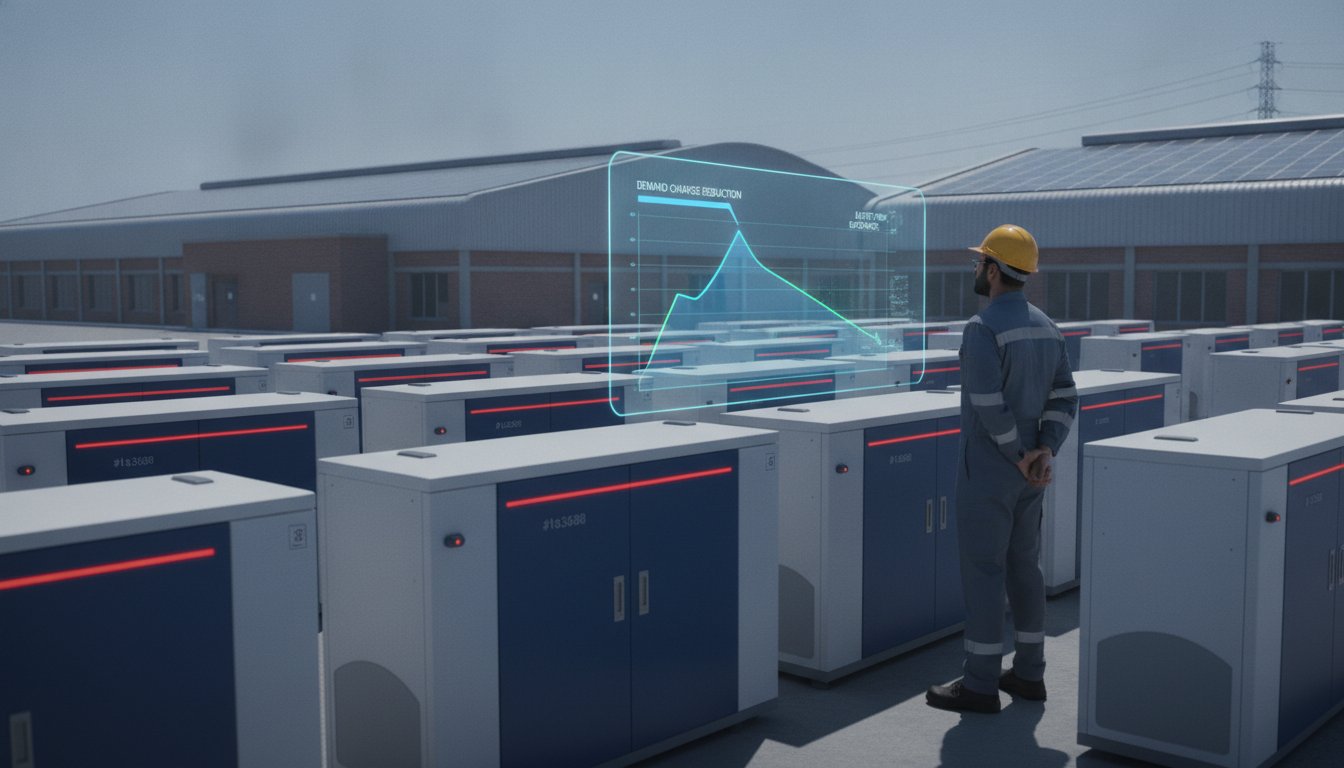
In 2026, the traditional model of industrial energy procurement in Pakistan has transformed from a predictable overhead into a volatile financial risk. With the National Electric Power Regulatory Authority (NEPRA) transitioning to a net billing system and buyback rates dropping to approximately Rs. 11-13 per kWh, relying on grid exports is no longer a viable strategy for cost recovery. Achieving demand charge reduction with battery storage pakistan is now the primary mechanism for industrial facilities to protect their margins against surging Maximum Demand Indicator (MDI) charges. Most industrial operators recognize that these unpredictable spikes represent an avoidable tax on production efficiency that directly impacts the bottom line.
This guide explores how advanced lithium-ion battery storage serves as a sophisticated financial instrument for peak shaving and load management. We'll examine the technical architecture required to mitigate the upcoming two-part industrial tariff and how these systems deliver a measurable return on investment within three to five years. You'll gain a clear understanding of the engineering protocols needed to secure energy independence and stabilize operational expenditures in this rapidly evolving regulatory environment.
Key Takeaways
- Analyze the financial mechanics of the 2026 industrial tariff structure to identify how Maximum Demand Indicator (MDI) spikes inflate monthly DISCO obligations.
- Implement peak shaving strategies to achieve demand charge reduction with battery storage pakistan by systematically clipping load spikes during high-intensity production cycles.
- Compare the technical superiority of lithium-ion systems over lead-acid alternatives, focusing on the 95% round-trip efficiency required for high-frequency industrial cycling.
- Calculate the accelerated ROI and 3-5 year payback period by utilizing an avoided-cost model that factors in rising fuel price adjustments and peak-hour tariffs.
- Explore how integrated architectures like NipponHev and Smart AI Inverters orchestrate energy flows to ensure thermal resilience and long-term grid independence.
Understanding Demand Charges and MDI in Pakistan’s 2026 Energy Landscape
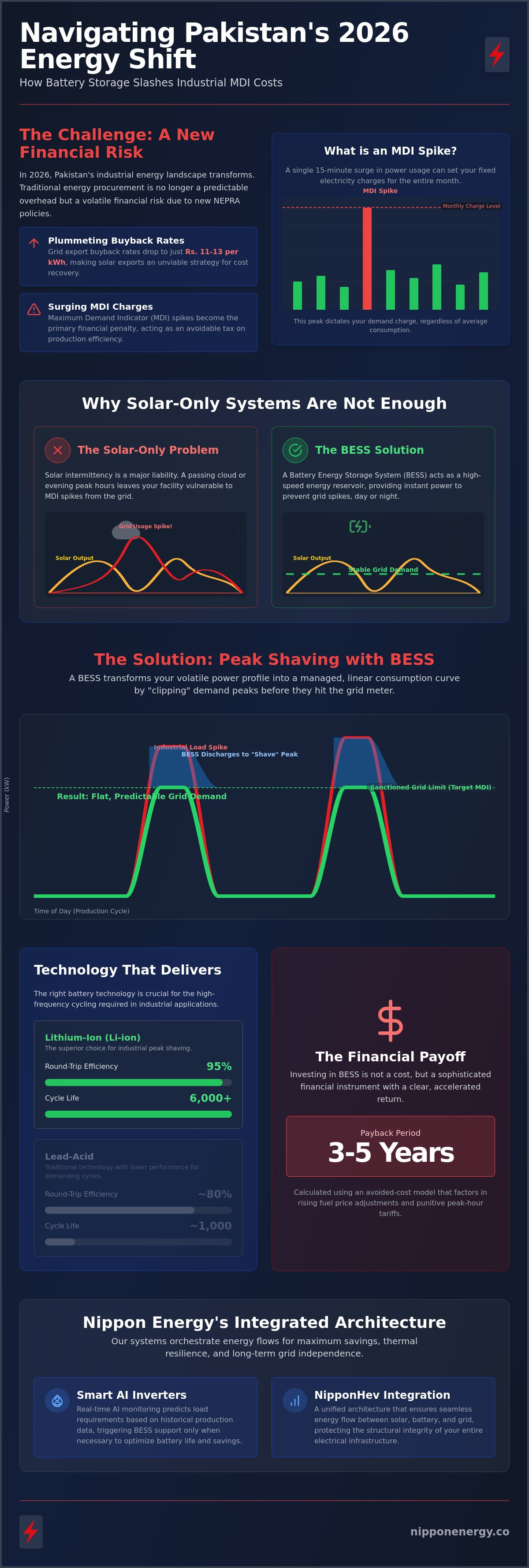
Industrial electricity billing in Pakistan has evolved into a complex two-part structure. For B2 and B3 consumers, the Maximum Demand Indicator (MDI) represents the highest average load recorded in a single 15 or 30-minute interval during the billing cycle. While energy charges reflect total consumption in kilowatt-hours, demand charges are a fee for the capacity the grid must reserve for your facility. NEPRA's 2026 policies have intensified the financial penalties for high MDI readings. This regulatory shift aims to discourage industrial consumers from placing sudden, heavy loads on a national grid that is increasingly focused on stability and capacity management.
The Financial Impact of MDI Spikes
A single 15-minute load spike can dictate the fixed charge component of an industrial invoice for 30 days. When heavy machinery starts up simultaneously, the resulting surge creates a peak that the DISCO records as your monthly MDI. This "Fixed Charge" often accounts for a significant portion of the total bill, regardless of whether that peak was sustained for an hour or just a few minutes. Industrial production cycles often involve high-torque equipment that demands massive power in short bursts. Without a mitigation strategy, these cycles lead to peak demand penalties that directly erode profit margins. The correlation between production intensity and these penalties has become a primary concern for plant managers across the country.
Why Solar-Only Systems Aren't Enough
Traditional solar installations lack the responsiveness required to manage MDI volatility. Solar intermittency is a primary failure point; a passing cloud causes an immediate drop in generation, forcing the grid to pick up the load instantly. This transition triggers an MDI spike that solar panels alone cannot prevent. Additionally, the most expensive peak-hour tariffs occur in the evening when solar output is non-existent. Achieving effective demand charge reduction with battery storage pakistan requires a buffer that can discharge power during these critical windows.
A Battery Energy Storage System (BESS) provides this intelligence. It functions as a high-speed energy reservoir, storing excess solar or off-peak grid energy to "clip" demand peaks whenever they occur. By using stored energy to handle the initial surge of heavy machinery, industries can maintain a flat grid-demand profile. This approach ensures that the facility's MDI remains at a controlled, lower level, shielding the business from the financial impact of NEPRA’s punitive peak-load synchronization charges.
The Mechanics of Peak Shaving: How BESS Reduces MDI
The deployment of a Battery Energy Storage System (BESS) transforms a facility's power profile from a series of volatile peaks into a managed, linear consumption curve. Peak shaving functions as the primary mechanism for this transformation. When industrial machinery initiates high-torque operations, the instantaneous power demand often exceeds the facility's sanctioned load or previous MDI thresholds. A BESS detects these imminent surges within milliseconds. It then injects stored energy to meet the local demand, ensuring that the grid meter never registers the spike. This strategy is essential for demand charge reduction with battery storage pakistan, as it decouples production intensity from punitive utility billing.
Effective management requires balancing discharge depth with operational longevity. While deep discharges maximize immediate savings, maintaining a disciplined state-of-charge protocol ensures the lithium-ion cells achieve their full 6,000+ cycle potential. Real-time AI monitoring facilitates this balance by predicting load requirements based on historical production data and triggering support only when necessary. This level of precision doesn't just save money; it protects the structural integrity of the entire electrical infrastructure.
MDI Clipping Strategies for Industry
MDI Clipping is the proactive use of BESS to prevent grid draw from exceeding a pre-set kilowatt limit. By establishing these threshold limits within the system controller, operators can automate energy flows. During the startup of large industrial motors, which can draw six to ten times their running current, the battery system provides the necessary buffer. This immediate response prevents the DISCO from recording a new, higher MDI for the month. To optimize these parameters, many firms consult with experts in Solar Project Development and EPC to align battery discharge rates with specific machine duty cycles.
Arbitrage: Exploiting Time-of-Use (TOU) Tariffs
The financial viability of BESS is further strengthened by energy arbitrage. In the 2026 landscape, the price differential between off-peak and peak hours is substantial. Industrial consumers typically face import rates between Rs. 40 and Rs. 60 per kWh during peak windows. By charging batteries during off-peak hours (11 PM to 5 PM) and discharging them during the expensive evening peak (5 PM to 11 PM), facilities can bypass the highest electricity costs. An IEEFA report on battery storage in Pakistan highlights that these economic drivers are making self-consumption increasingly attractive. The margin between these rates, often exceeding Rs. 30 per unit, creates a significant monthly saving that accelerates the system's payback period. This dual-action approach, combining MDI clipping with TOU arbitrage, provides the most robust path toward demand charge reduction with battery storage pakistan.
Lithium-Ion vs. Lead Acid: The 2026 Efficiency Verdict
For industrial facilities targeting demand charge reduction with battery storage pakistan, selecting the correct battery chemistry is a foundational engineering decision. Lead-acid technology, while historically accessible, lacks the technical specifications required for high-frequency peak shaving. Daily MDI clipping requires a system capable of sustaining deep discharges without rapid degradation. Nippon Lithium-ion Battery Storage Systems provide over 6,000 cycles at high depths of discharge, ensuring a decade of reliable service. In contrast, lead-acid alternatives typically fail within 1,200 to 1,500 cycles when subjected to the same industrial rigors.
Round-trip efficiency represents another critical performance delta. Lithium-ion systems achieve approximately 95% efficiency, which means only a 5% energy loss occurs during the charge and discharge cycle. Lead-acid systems often lose up to 30% of their energy to heat and internal resistance. For a factory in a high-tariff environment, this 25% efficiency gap translates directly into thousands of rupees in wasted electricity every month. Precision engineering ensures that every kilowatt stored is a kilowatt available for MDI management.
Physical footprint and thermal resilience are equally important for urban industrial zones. Factories in Korangi or Kot Lakhpat often operate in space-constrained environments where every square meter is valuable. Lithium-ion's high energy density allows for a compact installation that delivers massive power. These systems are specifically designed to maintain structural integrity during Pakistan's 45°C+ summers. While lead-acid performance plateaus or fails in extreme heat, advanced lithium-ion cells remain stable, ensuring that your demand charge reduction with battery storage pakistan strategy remains operational during the hottest months of the year.
Total Cost of Ownership (TCO) Analysis
Initial capital expenditure for lithium-ion technology is higher than traditional options, but the 10-year operational savings are vastly superior. Lead-acid batteries carry hidden costs, including regular watering, specialized ventilation for outgassing, and frequent replacements. As highlighted in the GIZ policy brief on BESS in Pakistan, the technical integration of storage is essential for managing grid flexibility and cost. High C-ratings are also mandatory for industrial applications; lithium-ion can discharge the massive current required for motor startups, a task that lead-acid struggles to perform without damaging its internal plates.
Future-Proofing with Nippon Technology
Nippon's architecture focuses on modularity and intelligent protection. The integrated Battery Management System (BMS) monitors every cell to prevent overcharging and thermal runaway. This modular approach allows industries to scale their storage capacity as production lines expand. When paired with Nippon HJT Solar Panels, the system achieves maximum charging efficiency, creating a high-performance energy ecosystem. This integration ensures that your facility is not just reacting to current tariffs but is prepared for the next decade of energy evolution.
ROI and Payback Analysis for Pakistani Commercial Sectors
The financial justification for industrial energy storage has shifted from simple backup power to a sophisticated "Avoided Cost" model. This framework calculates the total savings generated by preventing MDI spikes and bypassing peak-hour electricity imports, which can reach Rs. 60 per kWh in the 2026 tariff environment. When demand charge reduction with battery storage pakistan is integrated into a facility's strategy, the ROI is no longer theoretical. It's a precise calculation of reduced DISCO obligations and the mitigation of monthly Fuel Price Adjustments (FPA). As grid volatility increases, the delta between the cost of stored energy and grid-supplied power continues to widen, shortening the payback window for industrial adopters.
A typical 500kW industrial setup in Pakistan currently follows a 3.5-year payback path. This timeline is accelerated by aggressive tax incentives, including accelerated depreciation benefits for renewable energy assets. By reducing the taxable income through these capital investments, businesses effectively lower the net cost of the system. This combination of operational savings and fiscal incentives transforms a Battery Energy Storage System (BESS) into a high-yield asset rather than a sunk cost.
Mitigating the Impact of Duties and Surcharges
The 2026 duty structure on lithium cells in Pakistan has seen adjustments, but the rising trajectory of grid power costs consistently outpaces these battery surcharges. While initial import duties affect CAPEX, the long-term operational expenditure (OPEX) remains stable compared to the unpredictable nature of utility billing. Financing these projects has become more accessible through State Bank of Pakistan (SBP) renewable energy schemes, which provide low-interest credit specifically for industrial decarbonization. These facilities allow manufacturers to preserve cash flow while immediately capturing the benefits of demand charge reduction with battery storage pakistan.
Operational Longevity and Warranty Security
Securing a 10-year ROI requires more than just high-quality hardware; it demands localized technical support and rigorous upkeep. Professional Solar System Maintenance and Monitoring is essential to ensure that battery temperature and discharge cycles remain within optimal parameters. A well-maintained BESS in Pakistan can retain 80% capacity after 10 years of daily peak-shaving cycles. This longevity ensures that the system continues to deliver financial value long after the initial investment has been recouped. To begin your transition toward a more resilient energy profile, consult with our experts in Solar Project Development and EPC to design a system tailored to your specific load requirements.
Nippon Energy’s Integrated Solution for Demand Reduction
Nippon Energy provides a unified ecosystem where advanced hardware and predictive intelligence converge to solve the MDI challenge. The core of this system is energy orchestration. Smart AI Solar Inverters act as the central nervous system, managing millisecond-level transitions between solar generation, BESS discharge, and grid import. This coordination ensures that the facility utilizes the most cost-effective electron at any given moment. By prioritizing self-consumption and clipping peaks, this orchestration is the primary driver for demand charge reduction with battery storage pakistan.
For environments prone to extreme heat, the integrated solar architecture known as NipponHev offers a resilient structural framework. This system is engineered to maintain peak performance during the thermal peaks of Pakistan's summer, preventing component derating and ensuring that storage reserves remain ready. Our turnkey EPC model simplifies the transition for industrial stakeholders, managing every phase from initial feasibility studies to the complexities of NEPRA net-metering licensing. Real-time performance monitoring via cloud-based platforms provides transparent data, allowing plant managers to track MDI savings as they occur.
The Role of AI in Energy Management
AI-driven management moves beyond reactive clipping to predictive demand forecasting. By analyzing historical load patterns, the system anticipates high-intensity production cycles and prepares the battery reserve in advance. This intelligence allows for automated responses to grid frequency fluctuations, protecting sensitive industrial electronics from instability. We customize discharge profiles for specific industrial machinery, ensuring that high-torque motor starts are fully buffered by the BESS. This granular control prevents the grid meter from ever registering a surge, maintaining the facility's MDI within a strictly controlled envelope.
Partnering for Energy Independence
Nippon Energy maintains a robust technical footprint in Karachi and Lahore to provide immediate, on-ground support for our industrial partners. Our Solar EPC services are designed for the high-density requirements of industrial parks, where reliability and efficiency are paramount. We don't just install hardware; we architect long-term financial stability. Every project begins with a comprehensive demand charge audit to identify specific optimization opportunities. This methodical approach ensures that your investment in demand charge reduction with battery storage pakistan delivers the maximum possible impact on your operational bottom line.
Future-Proofing Industrial Energy Architecture in Pakistan
The 2026 energy landscape necessitates a transition from passive consumption to active energy orchestration. As grid tariffs and MDI penalties escalate, the integration of high-performance lithium-ion systems provides the only viable path to long-term cost stability. By utilizing proprietary Smart AI Inverter technology and adhering to rigorous Japanese engineering standards, industrial facilities can decouple their production cycles from volatile utility pricing. Achieving demand charge reduction with battery storage pakistan is now a technical necessity that ensures operational resilience and financial predictability.
Nippon Energy’s localized EPC presence in Karachi and Lahore provides the engineering authority required to manage this transition successfully. Our integrated solutions deliver a structured pathway to energy independence, transforming power infrastructure into a high-yield asset for the next decade. It's time to move beyond grid dependency and take control of your facility's load profile. Request a Demand Charge Audit and BESS Feasibility Study from Nippon Energy to optimize your facility's energy profile and secure your operational margins.
Frequently Asked Questions
What is MDI in Pakistani electricity bills and how does it affect my costs?
MDI stands for Maximum Demand Indicator, which measures the highest average load recorded during any 15 or 30-minute window in a billing month. This value determines the fixed cost component of your industrial tariff. A single production surge can inflate your entire monthly invoice regardless of your total consumption. Controlling this indicator is the primary goal for industries seeking demand charge reduction with battery storage pakistan.
Can battery storage really reduce my demand charges if I already have solar?
Battery storage is essential because solar generation is intermittent and cannot respond to sudden load surges or cloud cover. While solar reduces total energy consumption, a BESS provides the instantaneous power required to "clip" peaks that solar panels cannot cover. This synergy ensures that your grid-recorded MDI remains low even when production ramps up or sunlight fluctuates during the day.
How long is the payback period for industrial lithium-ion batteries in Pakistan?
The typical payback period for industrial-scale lithium-ion systems in Pakistan currently ranges between 3.5 and 5 years. This timeline is driven by the high cost of peak-hour grid electricity and the avoidance of punitive MDI charges. As fuel price adjustments continue to rise, the "avoided cost" model demonstrates that the system often pays for itself well before the end of its 10-year warranted life.
Is lithium-ion storage safe for high-temperature regions like Multan or Karachi?
Modern lithium-ion systems are engineered specifically for thermal resilience in extreme environments like Multan or Karachi. These units utilize advanced Battery Management Systems (BMS) and cooling architectures to maintain structural integrity even when ambient temperatures exceed 45°C. This high-temperature stability ensures consistent performance and safety throughout the intense Pakistani summer without risking premature cell degradation or thermal runaway.
Do I need NEPRA approval to install a battery storage system?
You don't generally require separate NEPRA approval for a standalone battery storage system used behind the meter for load management. However, if the BESS is part of a hybrid solar system intended for net metering, the standard licensing process for the entire installation applies. It's best to consult with an EPC partner to ensure all grid-tie configurations meet current DISCO and NEPRA technical regulations.
Can I use BESS for load shifting during peak hours (5 PM - 11 PM)?
A BESS is highly effective for load shifting during the expensive peak hours from 5 PM to 11 PM. By charging the batteries during cheaper off-peak windows or via excess solar, you can power your facility during peak times without drawing from the grid. This strategy bypasses the highest TOU rates, which can reach approximately Rs. 60 per kWh in the 2026 tariff environment.
What is the difference between peak shaving and load shifting for business?
Peak shaving focuses on "clipping" the short-duration power spikes that set your monthly MDI to lower your fixed charges. Load shifting involves moving large blocks of energy consumption from high-tariff peak periods to lower-cost off-peak hours. Both strategies are critical components of demand charge reduction with battery storage pakistan, but they target different cost centers on your electricity bill.
How much space does a commercial-scale Nippon Lithium-ion system require?
Commercial-scale lithium-ion systems are remarkably compact, requiring significantly less space than traditional lead-acid battery banks. A typical industrial storage unit can be housed in a small, climate-controlled container or a dedicated indoor area. This high energy density is particularly beneficial for space-constrained factories in industrial zones like Korangi or Kot Lakhpat, where every square foot of floor space is valuable for production.


