
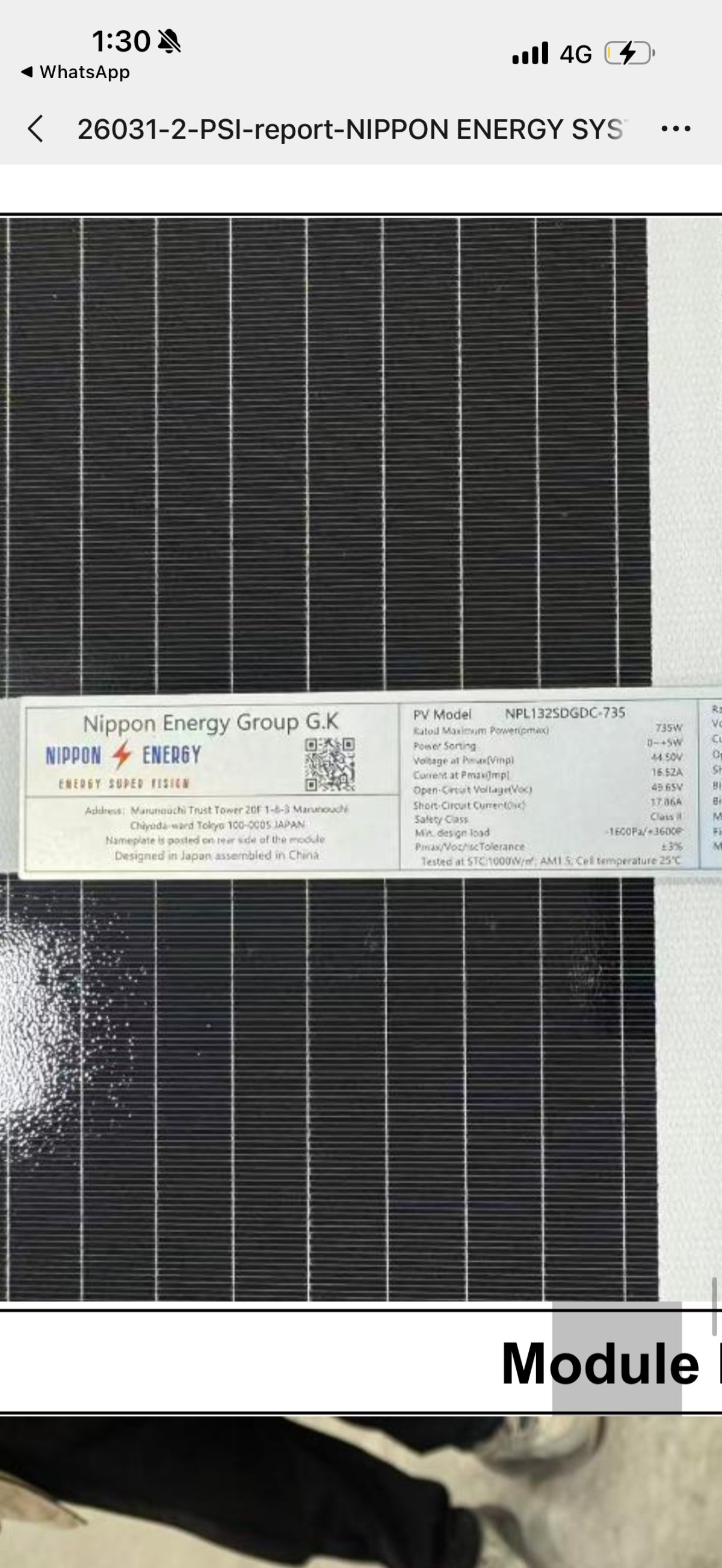
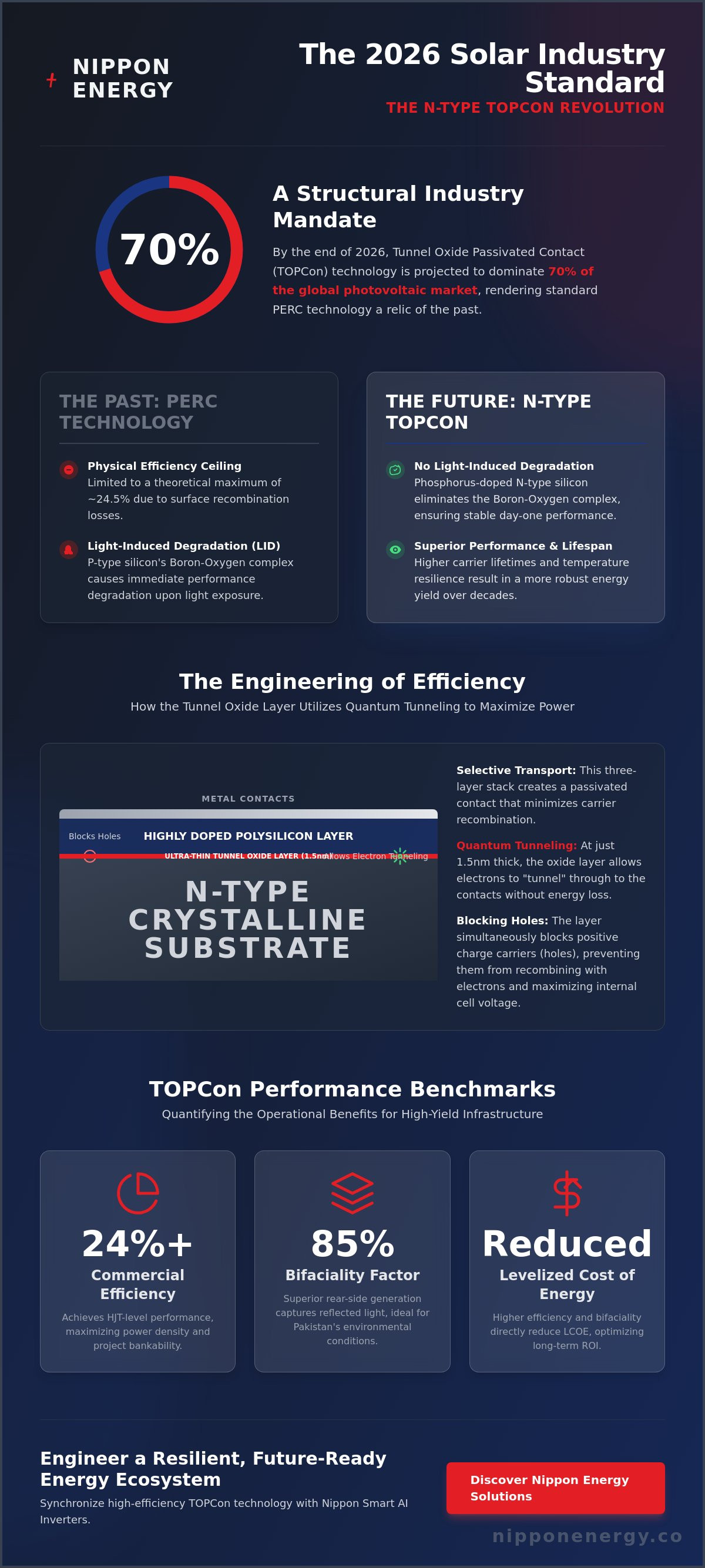
By the end of 2026, 70% of the global photovoltaic market is projected to be dominated by a single cell architecture, effectively rendering standard PERC technology a relic of the past. You likely recognize that the rapid shift toward N-type modules is no longer a trend but a structural industry mandate for any large-scale energy project. Choosing topcon solar panels represents a calculated move to capture HJT-level performance while maintaining the scalability required for the Pakistan market.
It's understandable to feel cautious about technical jargon like 'tunnel oxide' or 'carrier selectivity' when the long-term reliability of your infrastructure is at stake. This article will provide a clear, engineering-focused breakdown of the TOPCon mechanism and its superior performance in high-temperature regions. You'll gain a data-backed justification for your 2026 procurement strategy and understand how a bifaciality factor of up to 85% directly reduces your Levelized Cost of Energy (LCOE). We'll examine the specific technical advantages that allow these modules to achieve commercial efficiencies of 24% and explain why this technology has become the new global standard for resilience.
Key Takeaways
- Identify the physical limitations of PERC technology and why TOPCon’s N-type architecture has established a new efficiency benchmark for 2026 solar projects.
- Explore the technical mechanism of the tunnel oxide layer and how it utilizes quantum tunneling to minimize carrier recombination and maximize power output.
- Quantify the operational benefits of topcon solar panels, featuring bifaciality ratings of up to 85% for superior rear-side generation in Pakistan's environmental conditions.
- Compare the manufacturing scalability and cost-efficiency of TOPCon against HJT and PERC alternatives to optimize your infrastructure's long-term ROI.
- Learn to synchronize high-efficiency cell technology with Nippon Smart AI Inverters to build a resilient, future-ready energy ecosystem through NipponHev.
The Evolution of Photovoltaics: Why TOPCon is the 2026 Industry Standard
The photovoltaic industry has reached a definitive inflection point. For the past decade, Passivated Emitter and Rear Cell (PERC) technology served as the global benchmark. However, the physical constraints of P-type silicon have now become a bottleneck for global energy goals. As we progress through 2026, the transition to advanced types of solar cells has centered on N-type architecture. TOPCon, or Tunnel Oxide Passivated Contact, has emerged as the primary bridge to this high-efficiency future, offering a sophisticated solution to the recombination losses that once limited the potential of solar infrastructure.
The Death of the PERC Era
The decline of PERC is dictated by the laws of physics. Surface recombination at the metal contacts of a PERC cell creates a theoretical efficiency ceiling of approximately 24.5%. Once this limit is reached, further investment in the architecture yields diminishing returns. In Pakistan’s solar market, where maximizing power density is vital for project bankability, PERC is rapidly losing its commercial appeal. Manufacturers have recognized this shift, choosing to retrofit existing production lines for topcon solar panels rather than constructing entirely new facilities. This industrial pivot is the reason TOPCon is expected to command 70% of the market share by the end of 2026. P-type silicon is structurally inferior to N-type for 2026 standards because its reliance on boron doping makes it susceptible to immediate performance degradation upon light exposure.
N-Type Silicon: The Foundation of TOPCon
The technical superiority of topcon solar panels begins at the wafer level. While P-type cells use boron-doped silicon, N-type cells utilize phosphorus-doped silicon. This chemical adjustment is transformative for long-term reliability. By removing boron from the equation, engineers have successfully eliminated the Boron-Oxygen complex, which is the root cause of Light-Induced Degradation (LID). This advancement ensures that the asset's performance remains stable from the moment of installation.
- Higher Carrier Lifetimes: N-type wafers allow electrons to remain active for longer periods, increasing the probability of successful energy conversion.
- Reduced Degradation: The absence of LID means that the significant power drop typically seen in the first weeks of a PERC installation is avoided.
- Temperature Resilience: N-type silicon maintains higher voltage levels in heat, a critical advantage for infrastructure in regions like Sindh and Punjab.
The move to N-type silicon ensures that solar assets maintain their structural and operational integrity for decades. This foundation allows for higher minority carrier lifetimes, which directly translates to a more robust energy yield and lower maintenance costs over the system's operational life.
The Engineering of Efficiency: How Tunneling Oxide Technology Works
The efficiency of topcon solar panels is not the result of a marginal upgrade. It's a fundamental redesign of the cell's rear architecture. Traditional cells suffer from significant energy losses where metal contacts meet the silicon. TOPCon solves this through a sophisticated three-layer stack: the crystalline N-type substrate, an ultra-thin tunnel oxide layer, and a highly doped polysilicon layer. This combination creates a passivated contact that allows current to flow while preventing the recombination of charge carriers. It's a precise structural solution to a long-standing engineering bottleneck.
At the heart of this technology is the phenomenon of quantum tunneling. In classical physics, an insulator like silicon oxide should stop all electron flow. However, at a thickness of just 1.5nm, quantum mechanics allows electrons to tunnel through the barrier. This happens without energy loss. The mechanism is highly selective. It permits electrons to pass toward the contacts but effectively blocks holes, which are the positive charge carriers. By separating these carriers, the cell maintains a higher internal voltage. This selective transport directly translates to superior performance in the field, especially when utilizing Nippon TOPCon Solar Panels designed for high-yield infrastructure.
Surface passivation is the process of neutralizing traps. These are microscopic defects on the silicon surface that steal energy. By applying the tunnel oxide and polysilicon layers, the cell's rear surface is effectively passivated. This reduction in energy traps leads to a significant increase in Open Circuit Voltage (Voc). High Voc is a primary indicator of cell quality. It's also a focal point of current Department of Energy TOPCon research, which seeks to push these voltage limits toward their theoretical maximum.
The Role of the Ultra-Thin Oxide Layer
The 1.5nm silicon oxide layer acts as a structural buffer. It prevents the metal contacts from touching the silicon substrate directly. Without this layer, the metal-silicon interface would become a site for massive recombination. This precise engineering ensures that the interface remains passive. The result is a more stable voltage profile across the entire module. It works because the layer is thin enough for tunneling but thick enough for passivation.
Doped Polysilicon and Contact Selectivity
The doped polysilicon layer works in tandem with the oxide to create a powerful electric field. This field assists in electron collection while minimizing resistive losses. While some early designs experimented with front-side applications, 2026 modules primarily utilize rear-side TOPCon layers. This configuration maximizes light absorption on the front. The rear handles the complex task of carrier extraction. It's a balanced approach to high-performance energy generation.
Benchmarking TOPCon Performance: Efficiency, Bifaciality, and Temperature
While the quantum tunneling mechanism provides the theoretical framework, the real-world value of topcon solar panels is found in their performance benchmarks. In laboratory settings, these cells have demonstrated efficiencies between 24% and 26%, with some prototypes pushing toward 28%. For commercial deployments in 2026, module efficiencies typically range from 22.1% to 23.7%. This represents a significant leap over PERC, but the raw efficiency percentage only tells part of the story. The true advantage lies in how these modules maintain that efficiency under the environmental stressors common in South Asia and the Middle East.
Heat Resilience in Desert and Tropical Climates
Heat is the primary enemy of photovoltaic efficiency. Standard PERC modules typically feature a temperature coefficient of -0.40%/°C, meaning they lose significant power as cell temperatures rise. In contrast, topcon solar panels achieve a superior temperature coefficient of approximately -0.30%/°C. This delta is critical for projects in regions like Sindh or Punjab, where ambient temperatures frequently exceed 40°C. A lower coefficient ensures that the system's actual yield remains closer to its rated capacity during peak sunlight hours. This thermal stability doesn't just improve daily energy harvest; it also reduces the rate of thermal degradation in the module's encapsulation. By operating at lower relative temperatures, the structural integrity of the panel is preserved over a 30-year lifecycle.
Bifacial Gain and Albedo Optimization
The transition to TOPCon technology has redefined the expectations for bifacial performance. While PERC bifaciality factors hover around 70%, TOPCon routinely achieves ratings between 80% and 85%. This allows the rear side of the panel to capture significantly more reflected light from the ground. In a comprehensive TOPCon technology review, industry experts highlight how this high bifaciality factor drastically reduces the Levelized Cost of Energy (LCOE) for utility-scale farms. When installed over high-albedo surfaces like light-colored sand or concrete, the rear-side gain can contribute up to 20% additional power. This synergy makes TOPCon the preferred choice for commercial EPC projects in 2026, as it maximizes the energy density of the available land. Low-light performance also sees a measurable improvement, with N-type architecture providing better spectral response during dawn, dusk, and overcast periods, ensuring a longer daily generation window.
TOPCon vs. HJT vs. PERC: Choosing the Right Technology for 2026
By 2026, the selection of a cell architecture has shifted from a technical preference to a core financial strategy. While PERC remains available for budget-sensitive projects, its 24.5% efficiency ceiling makes it a liability for long-term ROI in a market moving toward high-density power. Heterojunction (HJT) offers the highest theoretical performance, but the capital expenditure required for entirely new production lines keeps its price point elevated. topcon solar panels occupy the strategic middle ground. They deliver the efficiency and temperature resilience of N-type silicon without the prohibitive cost of HJT’s complex manufacturing process. This balance has made TOPCon the definitive standard for utility-scale and commercial infrastructure.
The TOPCon vs. HJT Debate
HJT cells often boast a 0.5% efficiency advantage over TOPCon, yet this marginal gain typically carries a 15% price premium. For most large-scale developments in Pakistan, this cost-to-performance ratio heavily favors TOPCon. While HJT maintains a slight edge in extreme heat, TOPCon’s commercial viability is unmatched because manufacturers can retrofit existing PERC lines rather than building from scratch. Both technologies offer superior longevity compared to older P-type cells. TOPCon modules generally feature a 30-year power warranty with an annual degradation rate of approximately 0.4%, which is nearly identical to the degradation profile of HJT modules. This parity in durability makes the lower entry cost of TOPCon a decisive factor for project bankability.
Investment ROI and LCOE Analysis
High-efficiency modules reduce the physical footprint of a solar project. This reduction directly lowers balance-of-system (BOS) costs, including cabling, racking, and land preparation. When analyzing the 25-year internal rate of return (IRR), the 0.4% annual degradation of TOPCon provides a significant advantage over the 0.6% or higher rates seen in legacy PERC systems. This stability makes TOPCon the preferred choice for debt-financed utility projects in 2026. Lenders and investors prioritize assets with predictable yield profiles and established manufacturing scales. By choosing topcon solar panels, developers secure a technology that is both high-performing and highly scalable.
As the industry looks toward the next decade, TOPCon is positioned as the ideal bottom-cell substrate for Perovskite-Silicon tandems. Investing in this technology today ensures that your infrastructure remains compatible with the next wave of solar innovation. You can future-proof your energy portfolio by integrating Nippon TOPCon Solar Panels into your next project development phase.
Nippon Energy’s TOPCon Solutions: Engineering High-Yield Infrastructure
Nippon Energy integrates high-performance topcon solar panels into a cohesive energy ecosystem known as NipponHev. This framework represents a shift from isolated hardware to a unified, intelligent energy strategy designed for the 2026 market. By combining N-type cell architecture with Nippon Smart AI Inverters, we create a closed-loop system where hardware performance is continuously optimized by computational analysis. This integration ensures that the technical advantages of tunneling oxide layers translate into measurable financial outcomes for infrastructure owners.
The Nippon Energy Advantage
The synergy between advanced cell technology and AI-driven management is vital for capturing maximum yield in Pakistan’s volatile climate. Our Smart AI Inverters don't just convert current; they actively manage the system's power curve to account for the high bifaciality of TOPCon arrays. By analyzing real-time albedo effects and irradiance patterns, the system adjusts electrical parameters to ensure the rear-side gain is fully utilized. This level of precision is fundamental to our commitment to Japanese reliability and long-term asset management. Our modules are specifically engineered to maintain structural integrity under the thermal stress of high-ambient-temperature regions, providing a resilient foundation for your energy portfolio.
Scaling with Nippon Energy EPC
Our global EPC services bridge the gap between Nihonbashi engineering standards and the operational realities of Karachi. We provide turnkey solutions for commercial and industrial (C&I) projects that prioritize structural integrity and future-proofed design. Through our Solar Project Development and EPC division, we handle every phase of the transition to topcon solar panels. This comprehensive approach allows us to deliver the lowest LCOE in the market by optimizing balance-of-system costs and maximizing the lifetime energy harvest of the array.
Maintaining a 30-year performance profile requires more than just high-quality hardware. It demands rigorous Solar System Maintenance and Monitoring. Our professional teams utilize the diagnostic data from the NipponHev platform to perform predictive maintenance, ensuring that the 0.4% annual degradation rate remains a reality rather than a projection. This methodical approach to asset care protects your capital investment and guarantees stable energy costs for decades. We don't just install panels; we architect long-term energy security through technical excellence.
You can consult with Nippon Energy's engineers for your 2026 TOPCon project to begin the technical evaluation of your site's potential and secure your infrastructure's future.
Future-Proofing Your Energy Infrastructure with TOPCon
Adopting N-type architecture is no longer a luxury for specialized projects; it's a structural requirement for any solar asset intended to perform through 2050. The transition to topcon solar panels provides a definitive solution to the efficiency ceilings and degradation risks of the previous generation. By leveraging quantum tunneling and superior surface passivation, this technology ensures your infrastructure captures maximum energy even in the most challenging environmental conditions.
Nippon Energy brings Japanese Engineering Standards to every deployment, ensuring that your system is specifically optimized for high-temperature climates like those found across Pakistan. Our integrated Smart AI Management through the NipponHev platform allows for real-time optimization of bifacial gains, turning technical potential into consistent financial yield. This methodical approach to energy architecture guarantees that your investment remains resilient, efficient, and technologically relevant for its entire operational lifespan.
Take the next step in securing your energy independence with a partner focused on precision and longevity. Explore Nippon TOPCon Solar Solutions for Your Next Project and build a foundation for sustainable growth.
Frequently Asked Questions
What is the primary difference between TOPCon and PERC solar panels?
The fundamental distinction lies in the cell architecture and the type of silicon wafer used. PERC cells utilize P-type silicon and suffer from efficiency ceilings due to surface recombination at the metal contacts. TOPCon technology employs N-type silicon and integrates an ultra-thin tunnel oxide layer that passivated the contacts, allowing for higher voltages and significantly lower energy losses.
Are TOPCon solar panels better for hot climates like Pakistan or the UAE?
Yes, TOPCon modules are engineered for superior thermal stability in extreme environments. They feature a temperature coefficient of approximately -0.30%/°C, which is significantly better than the -0.40%/°C typical of PERC modules. This means topcon solar panels maintain higher power output during peak sunlight hours in regions where ambient temperatures frequently exceed 40°C.
How much more efficient are TOPCon panels compared to standard ones in 2026?
In the 2026 commercial market, TOPCon modules typically achieve efficiency ratings between 22% and 24%. This is a measurable increase over standard PERC panels, which generally plateau around 20% to 21%. This higher efficiency allows for greater energy density, which is critical for maximizing yield on space-constrained residential or commercial rooftops.
What is the expected lifespan and degradation rate of a TOPCon solar module?
TOPCon modules are designed for long-term structural integrity and typically carry a 30-year power warranty. They exhibit an annual degradation rate of approximately 0.4%, compared to the 0.6% or higher seen in legacy P-type technologies. Because N-type silicon is phosphorus-doped, it is immune to Light-Induced Degradation (LID), ensuring more stable performance during the first years of operation.
Can TOPCon solar panels be used for residential installations or only utility-scale?
They are highly effective for both applications. While their high bifaciality makes them a favorite for utility-scale ground mounts, their superior efficiency is a major advantage for residential owners who want to maximize power from limited roof space. topcon solar panels provide the high wattage required to support modern lithium-ion battery storage systems and smart home infrastructure.
How does bifaciality work in TOPCon technology?
Bifaciality in TOPCon technology is achieved through a symmetrical cell design that allows the rear side to capture reflected irradiance from the ground. TOPCon cells reach a bifaciality factor of 80% to 85%, which is much higher than the 70% factor of PERC. This allows the system to generate up to 20% additional power when installed over reflective surfaces like sand or concrete.
Is TOPCon more expensive than other N-type technologies like HJT?
TOPCon is currently the more cost-effective N-type solution because it is compatible with existing PERC manufacturing infrastructure. While Heterojunction (HJT) offers slightly higher theoretical efficiency, it requires entirely new production lines, which often results in a higher price premium. TOPCon provides a balanced ROI by offering HJT-level performance at a more accessible commercial scale.
Why is N-type silicon used in TOPCon instead of P-type?
N-type silicon is utilized because it is doped with phosphorus rather than boron. This chemical foundation eliminates the formation of boron-oxygen complexes that cause initial power loss in P-type cells. N-type wafers also offer higher minority carrier lifetimes, which results in better spectral response and improved performance in overcast or low-light conditions.


