
Did you know that structural changes in global export policies have triggered a 9% to 11% increase in the solar battery storage cost for 2026? While many anticipated a steady price drop, the current market demands a more sophisticated approach to calculating your return on investment. You're likely concerned about opaque pricing and whether a lithium system can truly withstand a decade of operation in Pakistan's demanding environment. It's difficult to commit to energy independence when the technical variables of battery degradation and system integration remain unclear.
This guide provides a rigorous framework to help you navigate these economic shifts and evaluate technical quotes with confidence. You'll discover how LFP chemistry and HJT technology influence lifetime throughput, ensuring your infrastructure is built for durability rather than just a low entry price. We'll examine the specific factors driving costs this year and provide a clear roadmap for achieving reliable energy autonomy. Our analysis moves from macro-economic trends to a granular breakdown of the engineering standards that define a high-performance energy system.
Key Takeaways
- Identify the three critical pillars of system expenditure, including hardware, balance of system (BOS), and EPC services, to eliminate hidden costs in your energy transition.
- Learn why calculating the Levelised Cost of Storage (LCOS) provides a more precise financial outlook than the initial solar battery storage cost by measuring total lifetime throughput.
- Discover how the integration of HJT solar technology and LFP battery chemistry enhances round-trip efficiency to mitigate Pakistan's specific grid challenges.
- Master a practical ROI framework that audits peak demand and benchmarks storage performance against projected grid electricity inflation rates.
- Explore the engineering standards required to achieve a 15-year operational lifespan; this ensures your infrastructure remains a resilient asset in a volatile global market.
Understanding the Components of Solar Battery Storage Cost
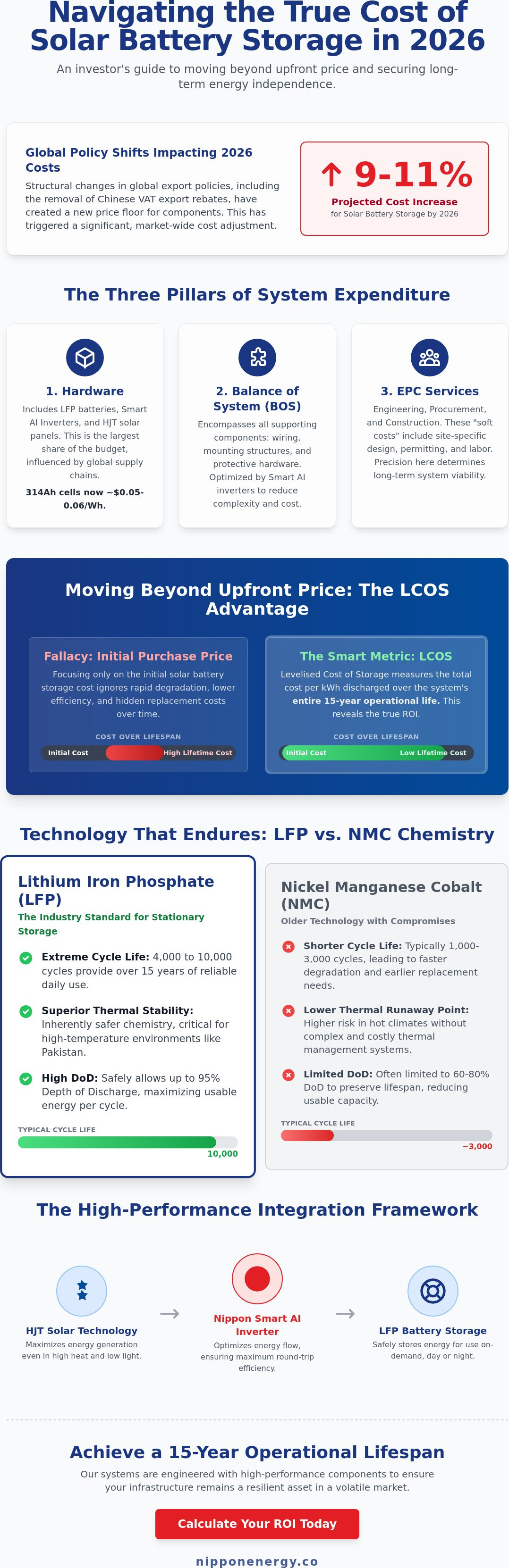
Solar battery storage cost is the sum of hardware procurement and lifecycle integration. This comprehensive figure encompasses three primary pillars: the physical hardware, the balance of system (BOS) components, and the engineering, procurement, and construction (EPC) services required for deployment. In the Pakistan market, hardware typically accounts for the largest share of the budget, yet the precision of EPC services determines the system's long-term viability. When evaluating home energy storage systems, stakeholders must distinguish between the initial capital expenditure and the technical architecture that supports energy independence.
Battery chemistry serves as the fundamental driver of both price and performance. While Nickel Manganese Cobalt (NMC) cells once dominated due to high energy density, Lithium Iron Phosphate (LFP) has become the industry standard for stationary storage in 2026. LFP offers superior thermal stability and a cycle life often ranging from 4,000 to 10,000 cycles, which is critical for the high-temperature environments found across Pakistan. Although the initial price point for LFP reflects current global material pressures, the reduced degradation rate ensures a lower cost per kilowatt-hour over the system's operational life. The choice of inverter architecture, whether string, micro, or hybrid, further influences the budget by determining how efficiently the battery integrates with the existing PV array.
Hardware vs. Soft Costs: Where the Money Goes
Hardware costs are heavily influenced by the global supply chain, where 314Ah energy storage cells have seen price increases to approximately $0.05 to $0.06 per Wh in early 2026. This trend is exacerbated by the removal of Chinese VAT export rebates, which has created a structural price floor for imported components. In Pakistan, soft costs such as permitting and grid interconnection fees are influenced by NEPRA regulations and site-specific engineering requirements. While local labor costs for installation are often lower than in European markets, the logistical complexity of transporting high-capacity lithium systems to remote industrial sites can offset these savings. Detailed site-specific engineering ensures that the system is optimized for local grid conditions, preventing costly post-installation adjustments.
The Inverter Factor: Smart AI and Cost Efficiency
The selection of an inverter architecture significantly impacts the total solar battery storage cost and overall system efficiency. Nippon Smart AI Inverters utilize advanced algorithms to manage the flow of electricity, which helps reduce BOS costs by optimizing energy distribution and minimizing the requirement for additional protective hardware. These high-efficiency units maintain maximum performance by preventing energy loss during the DC-to-AC conversion process. For existing solar arrays, integrating a hybrid inverter system allows for a seamless transition to storage without the expense of a complete system overhaul. This ensures that every watt generated by Nippon HJT or TOPCon panels is utilized or stored with maximum precision, directly improving the system's economic profile.
Moving Beyond Upfront Price: The Levelised Cost of Storage (LCOS)
Evaluating the financial viability of energy infrastructure requires a shift from superficial capital expenditure to a more rigorous metric: the Levelised Cost of Storage (LCOS). This calculation represents the total cost per kilowatt-hour of energy discharged throughout the system's entire operational lifespan. While the initial solar battery storage cost often dominates the decision-making process, focusing solely on the purchase price ignores the long-term economic performance of the asset. High-performance systems are engineered to provide consistent throughput over thousands of cycles, making them a more stable financial instrument compared to lower-tier alternatives that degrade rapidly under operational stress. According to NREL cost projections for battery storage, technological maturity is increasingly favoring systems that prioritize lifetime energy delivery over low entry costs.
Depth of Discharge (DoD) is a critical technical variable in this equation. A battery that allows for a 95% DoD without accelerating electrochemical degradation provides more usable energy per cycle than a unit limited to 60% or 80%. This increased efficiency directly reduces the cost per delivered kilowatt-hour. When the usable capacity is maximized, the owner extracts more value from every charging event, which shortens the effective payback period despite a higher initial investment. Choosing a system with superior DoD capabilities ensures that the hardware remains an active contributor to energy independence rather than a depreciating liability.
Cycle Life and its Financial Impact
The disparity between a standard 3,000-cycle consumer battery and a 10,000-cycle industrial unit creates a significant divergence in long-term value. A system with a lower cycle life may require a full replacement within seven years, effectively doubling the solar battery storage cost over a fifteen-year horizon. This premature failure disrupts the return on investment and increases the total cost of ownership. LCOS is the only accurate way to compare different battery chemistries because it accounts for these variations in durability and energy throughput. Investing in high-cycle hardware ensures that the year-over-year depreciation of the asset remains minimal, preserving capital for other operational needs.
Degradation Rates and Future Capacity Requirements
Pakistan's high ambient temperatures present a specific challenge to electrochemical stability, as heat accelerates the internal degradation of lithium cells. Systems engineered with advanced thermal management and AI monitoring can maintain cell health by regulating charge rates based on environmental conditions. This technical precision protects the initial investment by ensuring that the capacity purchased today remains viable in 2036. While some owners consider "oversizing" their systems to account for future energy needs, a more efficient strategy involves utilizing intelligent monitoring to extend the health of current cells. To understand how these engineering standards apply to your specific energy profile, you can explore the technical specifications of Nippon Lithium-ion Battery Storage Systems. This proactive approach to cell health transforms energy storage from a simple backup solution into a resilient, long-term asset.
Factors Influencing Solar Battery Prices in 2026
The global energy landscape in 2026 is defined by a complex interplay between technological maturity and supply chain volatility. While manufacturing efficiencies continue to improve, the solar battery storage cost is currently experiencing a structural increase of 9% to 11%. This shift is largely driven by the April 2026 change in Chinese export policy, which reduced VAT rebates for battery products and increased the price floor for international markets. Simultaneously, the rising cost of raw materials like lithium and cobalt has pushed energy storage cell prices to approximately $0.05–$0.06 per Wh. For large-scale projects in Pakistan, these macro-economic factors necessitate a precise engineering approach to ensure that upfront capital remains a productive investment.
Technological synergy plays a vital role in mitigating these rising costs. Integrating Nippon HJT Solar Panels with storage systems creates a high-efficiency ecosystem where the panels' superior temperature coefficient ensures maximum power generation during peak sunlight. This increased energy harvest allows the battery to reach full charge faster and more consistently, even in Pakistan's intense heat. High-efficiency charging reduces the strain on the electrochemical cells, which preserves the system's health and improves the overall round-trip efficiency. Furthermore, scaling effects provide significant advantages; commercial and industrial EPC projects often achieve a lower price-per-kWh compared to residential installations due to bulk procurement and streamlined balance of system (BOS) requirements.
Chemistry Trends: LFP Dominance in 2026
Lithium Iron Phosphate (LFP) has firmly established itself as the 2026 industry standard for safety and longevity. Unlike older chemistries, LFP offers a cycle life of 4,000 to 10,000 cycles, providing a much lower cost-per-cycle over the system's life. While solid-state research continues to attract speculative interest, LFP remains the most cost-effective solution for immediate deployment. Its inherent thermal stability is particularly valuable in regional climates where ambient temperatures frequently exceed 40°C, as it reduces the need for expensive, high-energy-consumption active cooling hardware.
Regional Incentives and Net Metering Policies
Pakistan's regulatory environment significantly impacts the economic feasibility of storage. Current NEPRA regulations regarding net metering are evolving, making on-site storage increasingly attractive for maintaining energy autonomy during grid instability. Unlike Australia's STC program or European tax credits, Pakistan's market relies heavily on the delta between rising grid tariffs and the fixed LCOS of a private system. Implementing Nippon Smart AI Inverters allows owners to capitalize on these conditions by intelligently shifting loads to battery power during peak tariff hours, which accelerates the system's return on investment despite the lack of direct federal subsidies.
Practical ROI Calculation: Is Battery Storage Worth It?
Determining the financial viability of an energy asset requires a structured five-step audit. First, you must establish a technical baseline by auditing peak demand and base-load consumption patterns. This data allows for a direct comparison between projected grid electricity inflation rates and the fixed LCOS discussed in previous sections. In Pakistan, where grid tariffs are subject to frequent adjustments, the solar battery storage cost becomes a strategic hedge against future price volatility. By fixing your energy costs today, you insulate your operations from the unpredictability of traditional utility markets. This transition ensures that your energy expenditure remains a predictable line item rather than a variable risk.
The "Reliability Premium" for Commercial Entities
Industrial entities must quantify the Reliability Premium to understand the true value of energy autonomy. For data centers, textile mills, or manufacturing plants in Pakistan, power interruptions result in immediate productivity losses and potential hardware damage. Lithium storage systems serve as a superior alternative to traditional diesel generators. They eliminate fuel procurement challenges and provide instantaneous response times. Case studies indicate that industrial parks utilizing peak-shaving strategies can reduce their maximum demand charges, which effectively lowers the total solar battery storage cost over the system's life. This shift from reactive backup to proactive energy management creates a more resilient operational foundation for large-scale success.
Sizing Your System for Optimal ROI
Sizing the system correctly is essential to avoid the trap of diminishing returns. Over-sizing storage leads to unused capacity, which inflates the initial investment without providing a proportional increase in self-consumption. The technical relationship between your Nippon HJT solar array and the battery capacity must be balanced to ensure the system reaches full charge during daylight hours. Nippon Smart AI Inverters automate this sizing logic in real-time by analyzing historical consumption data and weather patterns. This precision ensures that you only pay for the capacity you actually use, maximizing your round-trip efficiency. To begin your technical audit and receive a precise performance forecast, consult with our specialists for Solar Project Development and EPC services.
The final step in your ROI calculation involves assessing the impact of Virtual Power Plants (VPP) and enhanced self-consumption. While VPP programs are emerging in various global markets, the primary driver for Pakistani businesses remains the maximization of self-generated energy. By aligning your discharge cycles with peak tariff hours, you ensure that the system provides the highest possible economic yield. This methodical approach transforms energy storage from a simple capital expense into a high-performance financial asset designed for long-term impact.
The Nippon Solution: High-Performance Lithium-Ion Storage
Nippon Lithium-ion Battery Storage Systems are engineered for a minimum 15-year operational lifecycle. This durability directly influences the long-term solar battery storage cost by ensuring the asset remains productive well beyond the initial payback period. In the 2026 market, where material costs have seen structural increases, the ability to extract maximum energy throughput is a critical financial requirement. These systems integrate seamlessly with Nippon HJT and TOPCon panels to achieve superior round-trip efficiency. This means less energy is lost as heat during the charge and discharge cycles, which maximizes the utility of every generated kilowatt and improves the overall economic profile of the installation.
The Nippon EPC advantage addresses the soft costs that often consume a significant portion of the project budget. By managing project development from initial site engineering to final grid interconnection, we eliminate the inefficiencies typically associated with fragmented service providers. This end-to-end oversight ensures that the hardware is installed according to strict technical specifications, which preserves the manufacturer's warranty and optimizes system health. Global support and advanced monitoring capabilities provide a layer of security that is essential for industrial and commercial stakeholders who require absolute reliability. Our project development framework is designed to move your facility from energy dependence to a state of resilient autonomy with minimal friction.
Engineering for Extreme Climates
Thermal management is the most significant challenge for energy storage in regions like Karachi, Riyadh, and Dubai. High ambient temperatures can accelerate electrochemical degradation, leading to a rapid decline in usable capacity and increasing the effective solar battery storage cost. Nippon systems utilize advanced cooling architectures to manage this thermal stress, maintaining the cells within their optimal temperature range. This proactive thermal regulation is vital for maintaining a low LCOS in high-heat zones. Without these engineering safeguards, the cost of storage would effectively double due to premature cell replacement and reduced efficiency. You can explore the full technical specifications of Nippon Lithium-ion Battery Storage Systems to see how we future-proof our hardware for Pakistan's climate.
Turnkey EPC and Maintenance
Effective Solar System Maintenance and Monitoring acts as a protective shield for your capital investment. Our AI-driven predictive maintenance protocols analyze real-time data to detect minute deviations in cell performance. By identifying these issues early, we prevent minor imbalances from escalating into full-scale system failures. This level of oversight reduces the total cost of ownership by extending the health of the lithium cells and ensuring consistent performance. Professional O&M ensures that the system continues to perform at its peak efficiency, which is necessary for achieving the ROI targets established in your initial audit. Our team provides the technical expertise required to navigate the complexities of modern energy infrastructure. Request a comprehensive LCOS analysis for your project to understand the true value of high-performance storage.
Architecting a Resilient Energy Infrastructure
Achieving energy independence in Pakistan requires a transition from viewing storage as a simple hardware purchase to managing it as a high-performance financial asset. By prioritizing the Levelised Cost of Storage over the initial solar battery storage cost, you ensure your infrastructure remains viable for decades. It's essential to integrate Japanese engineering standards with proprietary Smart AI Inverter technology to create a system capable of withstanding extreme thermal stress while maximizing every kilowatt generated.
Nippon Energy provides end-to-end EPC services across five global regions, delivering the technical precision needed to navigate evolving export policies and raw material volatility. Our methodical approach to system design and maintenance protects your investment from premature degradation. You have the opportunity to transform your operational efficiency through advanced material science and intelligent energy management. Consult with a Nippon Energy engineer for a tailored storage cost breakdown to secure your facility's energy autonomy. We're ready to lead your transition to a more stable and sustainable power structure.
Frequently Asked Questions
How much does a 10kWh solar battery cost in 2026?
A typical 10 kWh residential battery system in 2026 ranges between $11,000 and $15,000 before any local incentives are applied. This solar battery storage cost covers the primary hardware, balance of system components, and standard installation. For commercial or high-capacity industrial systems, the total expenditure depends on specific engineering requirements and the complexity of the project development.
What is the average payback period for a commercial solar battery?
The average payback period for a commercial battery system is estimated to be between 7 and 10 years. This timeline is determined by your facility's peak demand charges and the rising cost of grid electricity. By implementing peak-shaving strategies, industrial entities can reduce their monthly utility bills, which shortens the effective return on investment period for the storage asset.
Does a solar battery increase the ROI of my HJT solar panels?
Integrating storage with high-efficiency Nippon HJT Solar Panels significantly enhances ROI by capturing excess energy that would otherwise be exported at lower rates. HJT technology maintains superior performance in high temperatures, ensuring a consistent energy harvest for the battery. This synergy maximizes self-consumption and improves the overall round-trip efficiency of your energy infrastructure.
Is LFP or NMC battery chemistry better for cost-efficiency?
Lithium Iron Phosphate (LFP) is the more cost-effective choice for long-term deployment due to its superior cycle life and thermal stability. While NMC cells offer high energy density, LFP systems provide 4,000 to 10,000 cycles, making them a more durable asset. In Pakistan's climate, the inherent safety of LFP chemistry is critical for maintaining performance during extreme heat events.
How do smart AI inverters reduce the overall cost of solar storage?
Nippon Smart AI Inverters reduce the total solar battery storage cost by optimizing energy distribution and minimizing the requirement for additional protective hardware. These units use advanced algorithms to prevent energy loss during DC-to-AC conversion and automate load shifting. This technical precision lowers the balance of system (BOS) expenses and ensures the system operates at maximum efficiency.
Can I add a battery to my existing solar system, and what are the costs?
You can integrate a battery into an existing PV array through AC-coupling or by replacing your current unit with a hybrid inverter. The costs associated with retrofitting depend on the age of your system and the necessary electrical upgrades. A comprehensive technical audit is required to identify the most efficient integration path and ensure compatibility with your existing panels.
What government incentives are available for solar batteries in 2026?
In Pakistan, the primary financial incentive for battery storage is the growing delta between high grid tariffs and the fixed Levelised Cost of Storage (LCOS). While direct federal tax credits for homeowner-owned systems expired in late 2025, evolving NEPRA regulations continue to make energy autonomy attractive. Businesses often find that the "Reliability Premium" of avoiding grid downtime provides a stronger economic case than direct subsidies.
How does temperature affect the long-term cost of a lithium-ion battery?
High ambient temperatures accelerate the electrochemical degradation of lithium cells, which can lead to premature capacity loss and higher replacement costs. Systems without advanced thermal management will experience a faster decline in energy throughput, increasing the effective cost per kilowatt-hour. Nippon systems utilize specialized cooling architectures to maintain optimal cell health, ensuring the hardware remains a productive asset for over 15 years.


