

The profitability of a renewable energy asset in 2026 is no longer determined by the scale of the land, but by the precision of the semiconductor choice at the point of inception. In an era where median prices for high-efficiency TOPCon modules have stabilized at $0.285 per watt, the margin for error in solar project development has narrowed significantly. You're likely facing the dual pressure of predicting long-term technology degradation while navigating the complex regulatory hurdles unique to the Pakistan energy market. This environment demands a shift from standard modules to high-efficiency N-type architectures to ensure long-term bankability.
This article provides the technical framework required to master the end-to-end development lifecycle, from site feasibility to the integration of HJT hardware for maximum asset longevity. You'll learn how to produce a bankable feasibility study that accounts for modern LCOE variables and grid interconnection requirements. We'll analyze the transition toward N-type architectures and provide a clear path to commissioning high-yield infrastructure that remains future-proof for decades.
Key Takeaways
- Understand why the global market has pivoted from PERC to N-type technologies, establishing HJT and TOPCon as the essential baseline for modern asset bankability.
- Learn to navigate the five critical pillars of solar project development, ensuring every phase from site identification to environmental impact assessment meets stringent investment standards.
- Identify the specific technical advantages of HJT versus TOPCon modules in high-temperature environments like Karachi to optimize long-term energy yield.
- Discover strategies to mitigate regulatory risks and financial volatility by navigating local content requirements and performance-based procurement models.
- Master the transition from development to execution through a turnkey EPC approach that maintains engineering integrity from the initial design to final commissioning.
The Evolution of Solar Project Development in 2026
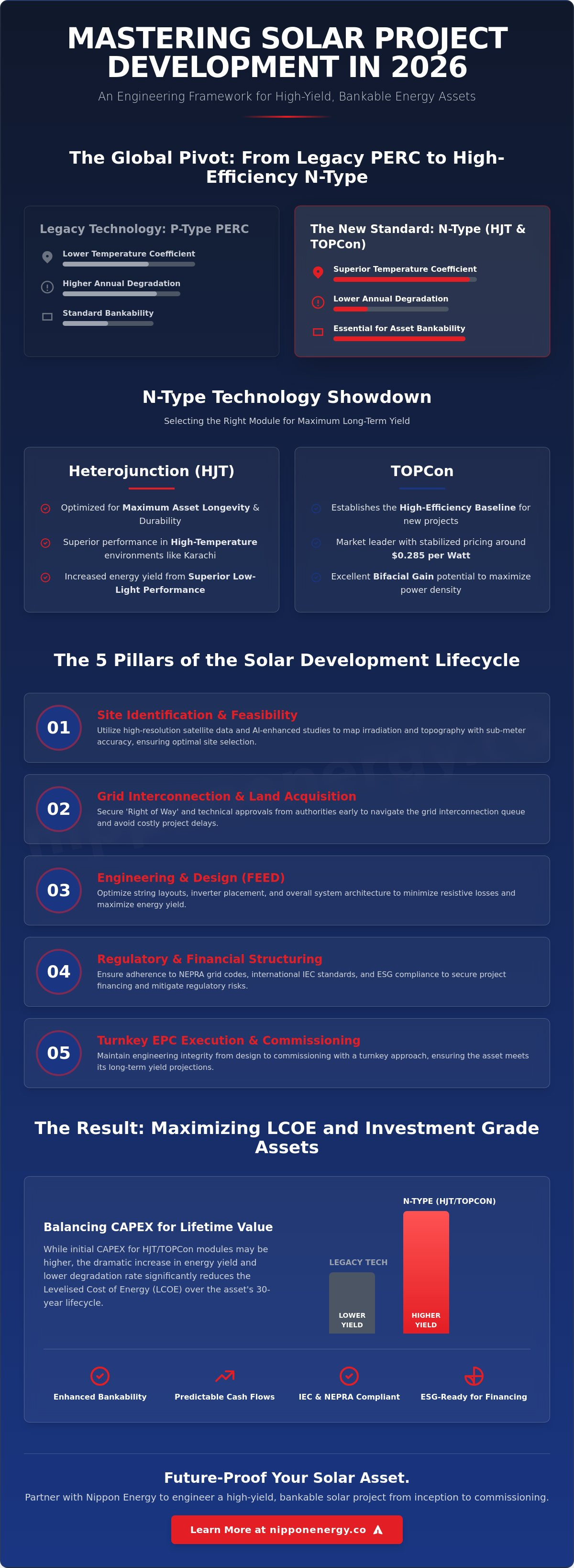
Modern solar project development in 2026 has matured beyond simple construction; it's now the sophisticated engineering of a high-yield financial asset. The industry has decisively moved past the limitations of legacy p-type PERC modules. N-type architectures, specifically Heterojunction (HJT) and Tunnel Oxide Passivated Contact (TOPCon), now represent the global baseline for utility-scale projects. This shift is driven by the necessity for superior temperature coefficients and lower annual degradation rates. For any modern photovoltaic power station, these technical specifications directly translate to higher bankability and more predictable cash flows.
Developers must now employ a Digital Twin approach during the pre-feasibility phase of solar project development. This involves creating a high-fidelity virtual replica of the plant to simulate real-world performance under Pakistan’s specific irradiance and thermal profiles. By integrating real-time meteorological data with hardware degradation models, developers can predict clipping losses and inverter efficiency with 99% accuracy before ground-breaking. Utilizing high-efficiency hardware like Nippon HJT Solar Panels also reduces the project's physical footprint. Higher power density allows for greater capacity on smaller land parcels, which significantly lowers site preparation costs and simplifies land acquisition processes.
Key Stakeholders and Global Standards
Successful execution requires a synchronized relationship between developers, off-takers, and EPC contractors. In the Pakistan market, projects must strictly adhere to the latest NEPRA grid codes and international IEC standards to ensure long-term system stability. Adherence to these protocols is critical for seamless grid interconnection. Additionally, ESG compliance has become a non-negotiable requirement for securing international project financing. Global investors now demand transparent supply chain data and environmental impact assessments that prove the asset's sustainability over a 30-year lifecycle.
The Impact of LCOE on Development Strategy
Levelised Cost of Energy (LCOE) acts as the primary metric for project bankability in 2026. This metric dictates every decision from initial site selection to the final procurement of high-performance components. While the initial CAPEX for HJT modules may be higher than legacy technology, the increased energy yield and lower degradation significantly reduce the LCOE over time. Developers must balance the initial cost of hardware with the projected revenue generated by superior low-light performance and bifacial gain. In 2026, the strategy has shifted from minimizing upfront costs to maximizing the total energy harvested per square meter of land.
The 5 Pillars of the Solar Development Lifecycle
The execution of a resilient solar asset requires a methodology that prioritizes data-driven precision over speculative estimates. In 2026, solar project development follows a non-linear but highly structured five-pillar lifecycle. This process ensures that every technical decision supports the project's ultimate financial performance. While competitors often treat development as a regulatory checklist; a high-tech architecture approach treats it as the phase where maximum value is engineered into the system. Each pillar serves as a critical checkpoint to verify that the asset will meet its long-term yield projections.
Phase 1 & 2: Laying the Foundation
The initial stages rely on high-resolution satellite data and AI-enhanced feasibility studies. We don't depend on historical averages; instead, we utilize machine learning to map irradiation and topographical variations with sub-meter accuracy. This precision is vital in Pakistan, where micro-climates significantly impact the performance of a Solar Energy Industries Association recognized asset. Navigating the grid interconnection queue remains a primary challenge. Developers must secure 'Right of Way' and technical approvals from local authorities early to avoid costly delays. Land acquisition also requires a strategic choice between outright purchase and long-term lease structures, which directly affects the project's balance sheet.
Phase 3 & 4: Designing for Bankability
Engineering and Design (FEED) represents the transition from theory to infrastructure. This phase optimizes string layouts and inverter placement to minimize resistive losses across the site. Integrating Nippon Smart AI Inverters at this stage ensures the system can handle the grid fluctuations common in emerging markets. Financial closing hinges on the Power Purchase Agreement (PPA) structure. In volatile economies, these agreements must mitigate inflation and currency risks, often by pegging tariffs to the USD. Tier-1 technical advisors provide the 'Bankability Reports' that institutional lenders require before releasing capital. A well-structured solar project development plan ensures these reports reflect the highest standards of technical integrity.
The final pillar is the transition to Construction (EPC) and Rigorous Commissioning. This is where the theoretical design becomes a physical reality. Every connection is tested against its digital twin to ensure the nameplate capacity is met. Rigorous commissioning protocols verify that the hardware, such as HJT modules, performs to its specified efficiency under local thermal conditions. This methodical progression ensures the asset isn't just built; it's optimized for a thirty-year operational life. By treating construction as the final validation of the development phase, we eliminate the performance gaps that plague less disciplined projects.
Technical Feasibility: Integrating HJT and TOPCon Technology
In the current landscape, hardware selection is no longer a secondary procurement task; it's a Day 1 development variable that dictates the entire site layout. Failing to integrate specific module characteristics into the initial design often leads to sub-optimal land use and lower-than-projected energy yields. High-performance semiconductors like HJT and TOPCon have different thermal responses and degradation profiles. These differences must be modeled during the early stages of EPA's Solar Project Development Pathway to ensure the asset's financial model remains robust over a 30-year operational lifespan.
The decision between Nippon HJT and TOPCon technologies is largely influenced by the local thermal environment. In high-temperature regions like Karachi or Dubai, the temperature coefficient becomes the most critical metric for long-term productivity. While standard N-type modules perform well, HJT technology offers a superior power temperature coefficient, typically around -0.26%/°C. This allows the system to maintain higher output during peak irradiance hours when ambient temperatures exceed 40°C. By reducing thermal-induced power loss, developers can achieve a more consistent energy profile and a more attractive Internal Rate of Return (IRR).
HJT (Heterojunction) in Large-Scale Development
HJT modules utilize a symmetrical cell structure that combines crystalline silicon with thin-film amorphous silicon layers. This advanced architecture minimizes electron recombination and maximizes light absorption across a broader spectrum. Nippon HJT solar panels utilize a symmetrical cell structure that minimizes electron recombination, resulting in conversion efficiencies that exceed standard N-type benchmarks. Furthermore, HJT's lower annual degradation rate, often as low as 0.25%, ensures that the project's energy yield remains high well into the second and third decades of operation. This longevity is essential for securing long-term debt financing from institutional lenders who prioritize asset durability.
Inverter and Storage Synergy
Modern solar project development requires a holistic approach to the electrical balance of system (BOS). Transitioning to Nippon Smart AI Inverters provides the reactive power support and grid stability required by modern utility codes. These systems use machine learning to optimize the DC/AC ratio based on regional irradiation profiles, ensuring that clipping losses are minimized during peak hours. Incorporating Nippon Lithium-ion Battery Storage Systems into the initial design allows for energy shifting and frequency regulation. This synergy between high-efficiency hardware and intelligent storage creates a "firm" power asset that can meet the rigorous demands of the Pakistan national grid.
Bifacial gains also play a transformative role in ground-mount utility project layouts. By capturing reflected light from the underside of the panel, bifacial HJT modules can increase total energy harvest by up to 25% depending on the ground albedo. This additional yield allows for wider row spacing or reduced tilt angles without sacrificing total site capacity. When these technical advantages are integrated from the start, the resulting infrastructure is not just a power plant; it's a future-proof energy asset engineered for maximum performance.
Mitigating Risk: Regulatory and Financial Structuring
A resilient solar project development strategy in 2026 relies on the successful mitigation of regulatory and financial variables before the first module is installed. Risk management is no longer an overlay; it's the fundamental structure that makes a renewable asset bankable. In volatile markets, developers must address the primary objection of performance uncertainty by utilizing hardware with proven low-degradation profiles. Securing long-term stability requires a calculated approach to procurement that accounts for fluctuating import duties and local content requirements (LCR) in the Pakistan market. By aligning technical specifications with financial safeguards, developers create an asset that remains attractive to institutional investors throughout its lifecycle.
Regulatory Navigating in Global Markets
The regulatory landscape in South Asia is currently defined by the transition between 'Net Metering' and 'Gross Metering' frameworks. This shift fundamentally alters the ROI calculations for industrial and commercial off-takers. Developers must also account for the European Union (EU) carbon border adjustment mechanisms, which increasingly influence the carbon-accounting standards of global supply chains. Securing a timely Interconnection Agreement remains a critical milestone. Delays in grid approval from local DISCOs or the NTDC can stall a project for months, making early-stage technical engagement a mandatory component of the development timeline.
Financial Instruments for Solar Infrastructure
Funding for utility-scale solar has evolved toward green bonds and sustainability-linked loans. These instruments offer competitive interest rates for projects that demonstrate high-efficiency hardware integration and ESG compliance. Lenders prioritize the Debt Service Coverage Ratio (DSCR) as the primary indicator of project health. To satisfy these requirements, developers often engage Export Credit Agencies (ECAs) to provide political risk insurance and long-term financing stability. A robust financial model must also factor in currency volatility, typically by structuring Power Purchase Agreements (PPAs) in USD to protect against local currency depreciation.
Technical due diligence in 2026 involves more than just verifying nameplate capacity. Lenders now require comprehensive EL (Electroluminescence) testing and third-party flash test reports to identify micro-cracks or manufacturing defects before the asset is commissioned. Implementing these rigorous diagnostics ensures the system meets the performance thresholds required by insurance providers. Modern insurance strategies must also include coverage for business interruption caused by catastrophic weather events, such as the extreme monsoons or heatwaves prevalent in Pakistan. For those seeking to minimize these risks through high-tech architecture, our expert solar project development services provide the technical foundation required for long-term asset security.
Execution and Asset Management: The Nippon Energy EPC Advantage
The transition from the planning phase to physical construction represents the most critical juncture in the solar project development lifecycle. Integrity in design must be matched by precision in execution to ensure the projected financial returns become a reality. Nippon Energy employs a turnkey approach that bridges the gap between Tokyo-standard engineering and local execution in Pakistan. This methodology ensures that every technical specification identified during the feasibility stage is implemented without compromise. By maintaining a single point of accountability, we eliminate the communication gaps that often occur between separate developers and contractors.
The EPC Excellence Framework
Success in large-scale construction depends on the seamless management of global supply chains. We coordinate the delivery of Nippon hardware to ensure that project timelines remain on schedule despite logistical complexities. During the construction phase, we utilize AI for real-time monitoring and quality control, allowing for immediate identification of installation variances. Our commissioning process includes rigorous testing protocols such as EL imaging and IV curve tracing. These diagnostics verify that every module is free of micro-cracks and performs at its peak efficiency before the asset is energized. We prioritize local workforce training to ensure that international safety standards are upheld across all global project sites.
O&M and Performance Monitoring
Post-commissioning, the focus shifts to long-term yield optimization through sophisticated Operations and Maintenance (O&M) programs. We implement predictive maintenance by analyzing data from Nippon Smart AI Inverter data to identify potential failures before they impact production. In the arid regions of Pakistan, soiling from dust and particulate matter can reduce energy harvest by up to 30% if left unmanaged. Our systems incorporate automated soiling detection to trigger cleaning cycles only when necessary, which optimizes water usage and reduces operational costs. This data-driven approach ensures the asset maintains its high-yield status for its entire 30-year lifespan.
The combination of world-class engineering and intelligent asset management transforms a standard power plant into a high-performance financial vehicle. Secure your investment by choosing a partner that understands the technical nuances of modern infrastructure. Partner with Nippon Energy for end-to-end Solar EPC and Project Development to ensure your next asset is built for maximum longevity and efficiency.
Securing High-Yield Energy Infrastructure for the Next Decade
Successful energy infrastructure in 2026 requires a convergence of high-efficiency hardware and disciplined engineering protocols. We've established that the shift toward N-type semiconductors and a rigorous 5-pillar lifecycle determines the long-term viability of any renewable asset. Mastering solar project development today means prioritizing technical precision from the initial feasibility study through to post-commissioning O&M. By integrating smart AI diagnostics and resilient hardware, developers can ensure their projects remain bankable in volatile markets.
Nippon Energy stands as a world-class partner with a global footprint across 4 continents, providing the Tier-1 bankable hardware and EPC expertise required for large-scale success. Our Japanese-engineered HJT technology offers the structural integrity and performance benchmarks necessary for the Pakistan energy sector. Scale your energy infrastructure with Nippon Energy's specialized EPC services to secure an asset that delivers monumental impact. The path to a resilient, high-performance energy future is built on the foundation of technical excellence.
Frequently Asked Questions
What is the typical timeline for solar project development in 2026?
The typical timeline for solar project development in 2026 ranges from 12 to 24 months, depending on the project's scale and jurisdiction. This duration encompasses site acquisition, environmental permitting, and the increasingly complex grid interconnection queue process. Early engagement with technical advisors is necessary to navigate these stages efficiently. Projects in Pakistan often face specific regulatory timelines that require proactive management to ensure commissioning deadlines are met without incurring financial penalties.
How does HJT technology affect the financial bankability of a solar farm?
HJT technology significantly strengthens financial bankability by offering a lower annual degradation rate and superior bifaciality. Institutional lenders prioritize HJT-equipped assets because the technology ensures more predictable long-term cash flows compared to legacy p-type modules. By reducing the Levelised Cost of Energy (LCOE), HJT modules improve the Debt Service Coverage Ratio (DSCR). This technical advantage makes it easier for developers to secure low-interest project financing and green bonds for high-yield infrastructure.
What are the most common risks during the solar feasibility study phase?
The most common risks during the feasibility phase include inaccurate irradiation modeling and unforeseen grid capacity constraints. Relying on generic meteorological data rather than site-specific satellite analysis can lead to performance shortfalls. Additionally, topographical anomalies or underground soil conditions can significantly increase site preparation costs. A rigorous feasibility study must identify these variables early to prevent capital expenditure overruns during the construction phase of any utility-scale renewable energy asset.
Can Nippon Energy handle solar project development in Pakistan and the Middle East?
Nippon Energy maintains a robust presence in Pakistan and the Middle East, offering specialized solar project development and EPC services. Our engineering standards are designed to handle the extreme ambient temperatures of regions like Karachi and Dubai. We leverage our global footprint across four continents to ensure that high-performance hardware and Tokyo-standard engineering are delivered to every local project site, ensuring maximum asset longevity in harsh desert climates.
What is the difference between a solar developer and an EPC contractor?
A solar developer focuses on the pre-construction phases, including land rights, PPA structuring, and financial closing. In contrast, an EPC contractor is responsible for the technical execution, covering engineering, procurement, and construction. While these roles are often separate, Nippon Energy provides an integrated turnkey model. This model ensures that the original design intent is maintained throughout the construction process, reducing the risk of technical performance gaps after commissioning. For residential and commercial property owners in the UK, MarGav Solar offers similar expertise through their professional consultancy and installation services.
How does AI improve the ROI of utility-scale solar projects?
AI improves the ROI of utility-scale projects by enabling predictive maintenance and optimizing energy harvest through smart diagnostics. By analyzing real-time data from Nippon Smart AI Inverters, operators can identify and rectify faults before they lead to significant downtime. This proactive approach reduces long-term O&M costs and maximizes the total energy delivered to the grid. Consequently, the increased efficiency directly enhances the asset's internal rate of return (IRR) and long-term profitability.
What permits are generally required for a commercial solar project?
Commercial projects in Pakistan generally require a NEPRA generation license, environmental impact assessments (EIA), and structural building permits. In addition to these, a comprehensive grid interconnection study is mandatory to ensure compliance with local grid codes. Navigating these requirements involves coordination with multiple government agencies and utility providers. Securing these permits early in the development lifecycle is essential to avoid project delays and ensure the asset's long-term legal and operational compliance.
How do I choose between TOPCon and HJT for my specific project site?
Selecting between TOPCon and HJT depends on the project’s specific thermal profile and CAPEX requirements. HJT technology is the superior choice for high-temperature environments due to its lower temperature coefficient and higher bifacial gain. TOPCon remains a highly efficient N-type alternative for projects where initial cost sensitivity is balanced against the need for high performance. A detailed site analysis during the feasibility phase will determine which technology provides the lowest LCOE for your specific geographic coordinates.


