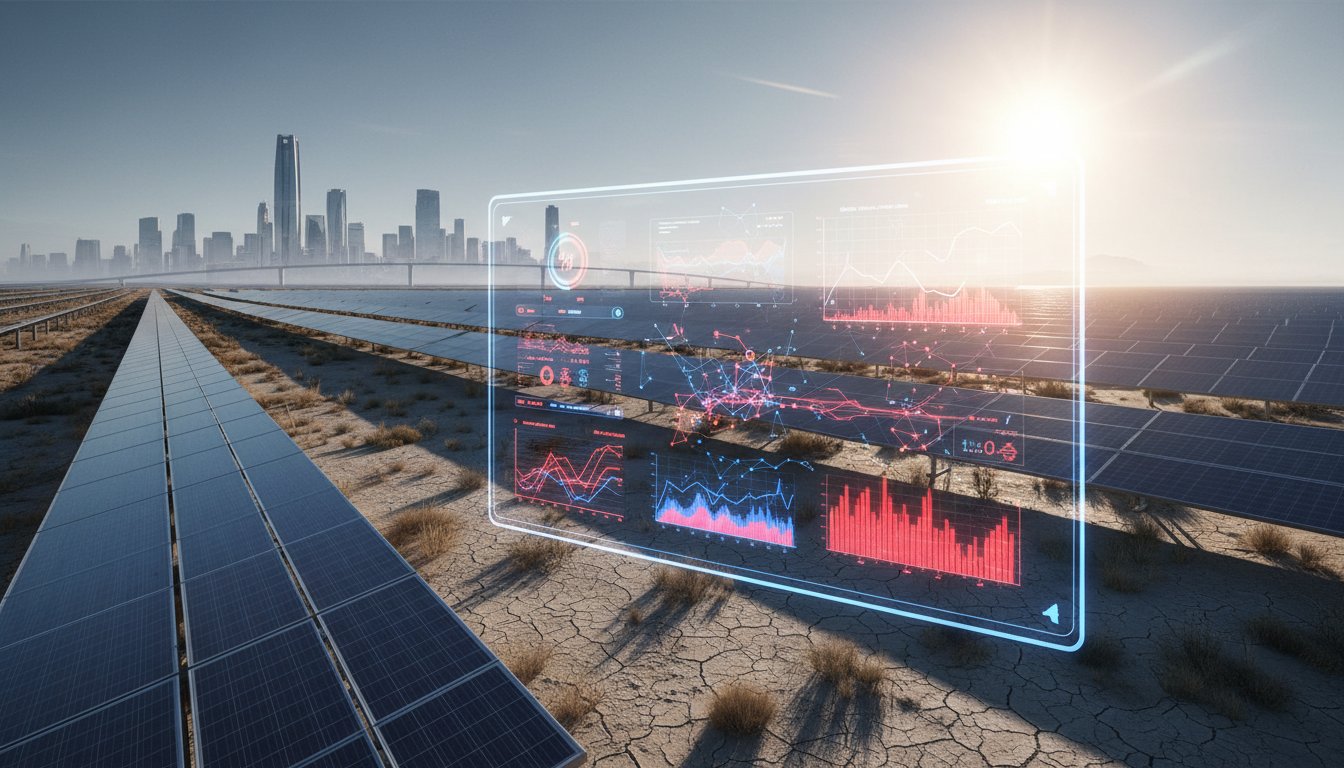
A solar asset operating without high-granularity monitoring isn't a secured investment; it's a blind liability. In Pakistan's volatile, high-temperature climate, unseen thermal degradation can silently erode your returns while basic solar panel performance monitoring via standard inverters often provides a false sense of security. You likely recognize that reactive maintenance is a primary driver of inflated O&M costs, yet achieving true transparency requires more than a standard dashboard. High-level asset management demands a shift from simple visibility to predictive, data-driven intelligence.
This article provides the technical frameworks and AI-driven strategies required to secure maximum ROI through precision monitoring. We'll examine how to leverage automated fault detection and Performance Ratio (PR) optimization to transform your infrastructure into a high-yield asset. By aligning with IEC 61724 standards and utilizing AI that can improve yields by 5-15%, you'll gain the precision needed to eliminate hidden energy losses and future-proof your energy portfolio in 2026.
Key Takeaways
- Transition from passive data logging to real-time, AI-driven asset management to secure the long-term structural integrity of your solar infrastructure.
- Utilize Performance Ratio (PR) and Specific Yield as objective benchmarks to quantify system health and optimize your financial ROI.
- Implement advanced solar panel performance monitoring to mitigate yield losses caused by high-temperature clipping and localized soiling across Pakistan.
- Shift from traditional preventive maintenance to predictive O&M frameworks that use AI to forecast component failure before it impacts generation.
- Integrate high-performance HJT hardware with the NipponHev ecosystem for unified, intelligent control over production, storage, and consumption.
What is Solar Panel Performance Monitoring in the AI Era?
The evolution of solar energy management has reached a critical inflection point. Traditional data logging, which merely recorded historical output, is now obsolete. Modern solar panel performance monitoring has transitioned into a real-time, intelligent asset management strategy that uses machine learning to protect the structural and financial integrity of an installation. This shift is particularly vital in Pakistan's energy market, where extreme ambient temperatures and high dust density require immediate, automated responses to maintain peak efficiency. It's no longer enough to know what your system produced yesterday; you must know what it's capable of producing right now.
There's a fundamental distinction between hardware-level telemetry and software-level analytics. While Nippon Smart AI Inverters act as the primary gateway for data acquisition, the analytical software layer interprets these signals to identify subtle patterns of degradation. Standard inverters might report that a system is "online," but they often fail to detect micro-cracks, PID (Potential Induced Degradation), or partial shading that reduces the overall Photovoltaic system performance. By 2026, industry standards for utility-scale and commercial projects demand module-level transparency to ensure that every individual component contributes to the calculated yield.
The Core Components of a Monitoring Ecosystem
A robust monitoring framework relies on a synchronized stack of hardware and cloud intelligence. Nippon Smart AI Inverters serve as the central nervous system, capturing high-frequency voltage and current data. This is supplemented by environmental sensors, such as pyranometers for solar irradiance and back-of-module temperature probes, which provide the baseline data needed to compare actual output against theoretical potential. Cloud-based management platforms then aggregate this data, allowing operators to oversee multi-site portfolios from a single interface and ensuring consistency across diverse geographical regions.
Why Real-Time Visibility is Non-Negotiable
The "Silent Failure" syndrome is a major risk for large-scale arrays in regions like Sindh and Punjab. A single failed string or a malfunctioning combiner box can go unnoticed for weeks if monitoring is only performed through monthly billing cycles. In commercial Power Purchase Agreements (PPAs), even 24 hours of downtime can result in significant financial penalties and lost revenue. Performance monitoring is a systematic process of data acquisition and AI analysis to ensure yield integrity. This proactive approach eliminates the guesswork, allowing technical teams to address faults before they escalate into systemic failures that threaten your ROI.
Key Metrics for Advanced Solar Performance Analysis
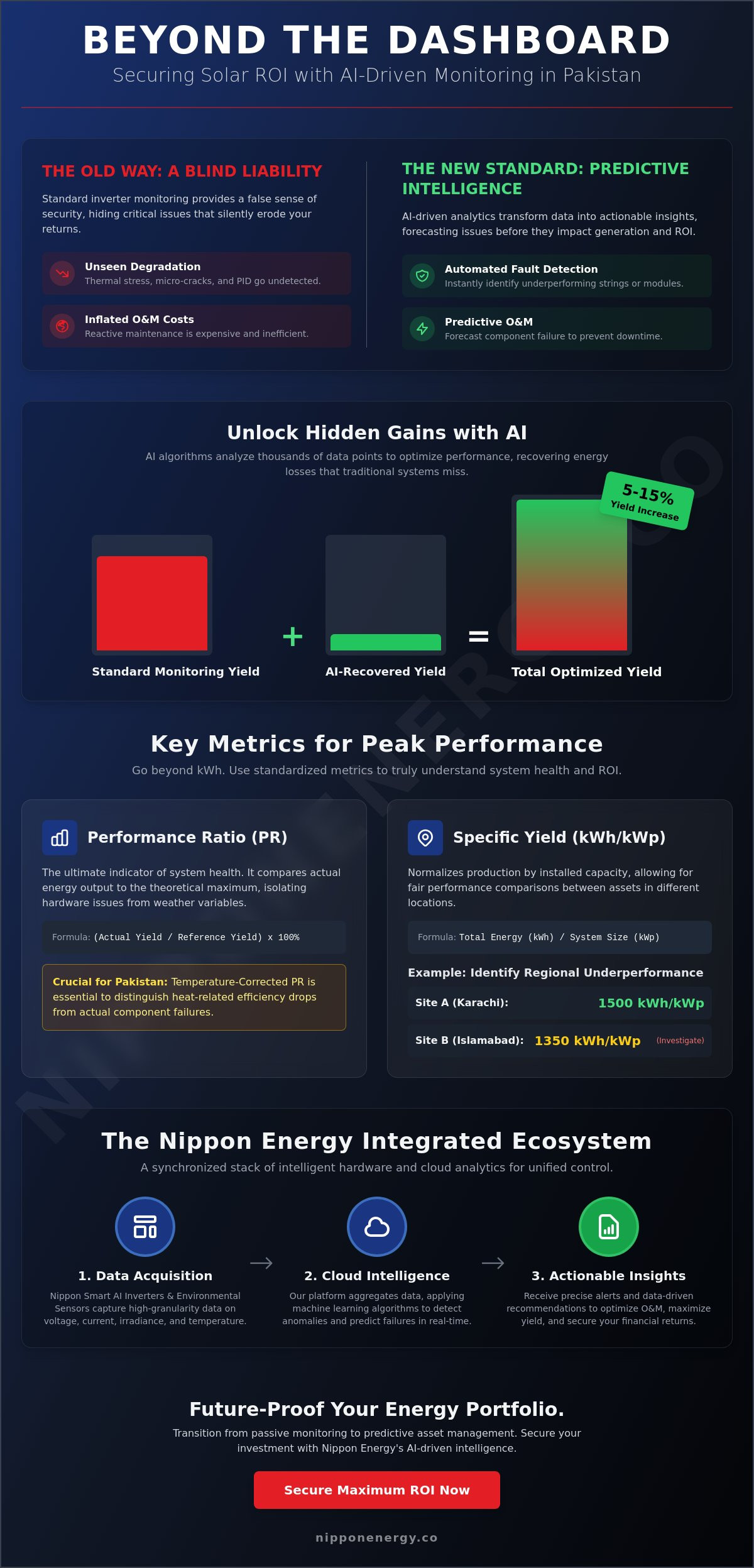
High-level asset management requires a shift from viewing total energy production to analyzing standardized efficiency metrics. Relying on simple kilowatt-hour totals is insufficient; these figures don't account for daily irradiance fluctuations or seasonal shifts. Advanced solar panel performance monitoring utilizes the Performance Ratio (PR) as the primary indicator of system health. This metric compares actual output against the theoretical maximum, effectively isolating internal system faults from external weather conditions. For commercial operators in Pakistan, maintaining a high PR is the only way to ensure that the hardware is meeting its engineering specifications regardless of the season.
Specific Yield, measured in kWh/kWp, provides a secondary benchmark for cross-site comparison. By normalizing production based on the installed capacity, you can evaluate the performance of diverse arrays across different geographical regions like Karachi and Islamabad. This data allows for the identification of regional underperformance, which often points to localized issues such as grid instability or specific soiling patterns. Tracking these metrics through digital platforms significantly enhances operations and maintenance returns by reducing the time required for manual diagnostic site visits.
Understanding the Performance Ratio (PR)
While standard PR is a useful baseline, temperature-corrected PR is essential for the Pakistan market. High ambient temperatures can cause standard modules to lose efficiency, often masking actual hardware failures as simple heat-related drops. Temperature-corrected PR adjusts the benchmark based on real-time cell temperature data, providing a more accurate reflection of system integrity. Nippon HJT panels, with their superior temperature coefficients, consistently maintain higher PR ratings in extreme heat compared to traditional PERC technology. You can explore our high-resilience Nippon HJT Solar Panels to see how advanced cell architecture stabilizes these critical benchmarks.
Degradation and Yield Variance
Monitoring software must also track Light Induced Degradation (LID) and Light and Elevated Temperature Induced Degradation (LeTID), particularly during the first 12 months of operation. These phenomena can cause a sharp initial drop in output if not properly managed through high-quality N-type wafers.
- LID Tracking: Validating that initial stabilization stays within the 1% threshold.
- Linear Warranty Mapping: Comparing actual annual degradation (typically 0.5% or lower) against manufacturer guarantees.
- AI Diagnostic Layers: Distinguishing between temporary soiling losses and permanent cell-level degradation.
Monitoring in Extreme Climates: Heat, Dust, and Humidity
Operating a solar asset in Pakistan presents a unique set of atmospheric challenges that standard monitoring systems often fail to address. In regions like Sindh and Punjab, ambient temperatures frequently exceed 45°C, causing significant drops in string voltage and triggering inverter clipping. Without advanced solar panel performance monitoring, these efficiency losses are often misdiagnosed as permanent hardware degradation. By utilizing high-resolution telemetry, operators can distinguish between temporary thermal throttling and actual component failure, ensuring that the system's energy harvest remains aligned with its theoretical potential.
The technical resilience of Heterojunction (HJT) and TOPCon architectures is best observed through these extreme conditions. According to the U.S. Department of Energy, environmental factors play a decisive role in long-term photovoltaic reliability. Nippon HJT panels feature a superior temperature coefficient, which monitoring data proves by showing lower power loss per degree Celsius compared to traditional PERC modules. This data-backed evidence is crucial for commercial stakeholders who require certainty regarding their energy yields in the heat-intensive corridors of southern Pakistan.
Optimizing Cleaning Cycles via Data
In high-soiling environments like Karachi and Lahore, dust accumulation can reduce system output by over 20% in just a few weeks. Modern monitoring platforms calculate the specific 'Soiling Rate' by comparing the performance of reference cells against the main array. This allows O&M teams to determine the exact day when the cost of cleaning is outweighed by the value of the recovered energy. Automated alerts trigger immediately following dust storms or localized pollution spikes, moving maintenance from a rigid calendar schedule to an intelligent, profit-maximizing model.
Thermal Management and Inverter Health
Extreme heat doesn't just affect panels; it puts immense stress on the power electronics. Nippon Smart AI Inverters use internal thermal sensors to provide historical heat maps of the system's core components. By monitoring these trends, the software can predict fan failures or ventilation obstructions before they lead to a full system shutdown.
- Thermal Throttling Detection: Identifying when the inverter limits output to protect its internal circuitry.
- PID Identification: Using voltage-to-ground monitoring to detect Potential Induced Degradation, especially in high-humidity coastal areas.
- Ventilation Analytics: Correlating internal temperatures with external ambient data to ensure optimal airflow around the power conversion units.
Predictive vs. Preventive: The Future of Solar O&M
Traditional preventive maintenance relies on rigid, calendar-based 'check-ups' that often occur either too late or when they aren't technically necessary. In contrast, predictive solar panel performance monitoring utilizes real-time telemetry to forecast equipment failure before it disrupts energy generation. By shifting to a data-driven model, operators in Pakistan can mitigate the high costs associated with reactive repairs and localized grid-instability issues. This transition is powered by Digital Twins, which are virtual replicas of your physical assets that simulate optimal performance under varying irradiance and temperature profiles. These simulations allow for the identification of underperformance at the earliest stages, effectively lowering the Levelized Cost of Energy (LCOE) by reducing the frequency of manual, site-wide inspections.
The integration of Digital Twins allows for a rigorous comparative analysis between the 'ideal' system state and the 'actual' telemetry captured in the field. If a specific string in a project deviates from its Digital Twin's predicted output by even a small margin, the system flags a localized anomaly immediately. This granularity prevents minor issues, such as a loose connection or a failing bypass diode, from compounding into systemic failures. By maintaining this level of oversight, owners ensure that their infrastructure operates as a high-performance machine rather than a passive collection of hardware.
AI-Driven Fault Detection
Modern software platforms perform automated string-level analysis to pinpoint the exact location of module failures. These AI algorithms are trained to filter 'nuisance alarms', which are temporary fluctuations caused by passing clouds or minor grid transients, from critical system faults. This precision ensures that technical teams only deploy when a genuine intervention is required, preserving operational resources. Nippon’s integrated software specifically identifies arc faults and ground faults in real-time, preventing potential fire hazards and securing the structural integrity of the entire array during peak production hours.
Maximizing ROI Through Strategic O&M
Remote monitoring fundamentally changes the cost-benefit analysis of solar ownership by replacing expensive, routine on-site technician visits with targeted, data-backed deployments. Intelligent cycling through Nippon Lithium-ion Battery Storage systems further extends the lifecycle of your energy storage assets by managing depth-of-discharge based on predictive usage patterns and grid demand forecasts. Industry data indicates that transitioning to these advanced predictive analytics can reduce total O&M overhead by up to 25%. Secure your investment with professional Solar System Maintenance and Monitoring to ensure your asset operates at peak technical capacity for its entire functional lifespan.
The Nippon Energy Advantage: Integrated Monitoring & Hardware
The integration of advanced hardware with intelligent software creates a closed-loop system where efficiency is guaranteed by design. Nippon Energy achieves this synergy through the precise alignment of Nippon Smart AI Inverters with high-performance HJT and TOPCon modules. This architectural approach ensures that solar panel performance monitoring is not merely an external layer but a fundamental component of the system's DNA. By embedding telemetry capabilities directly into the power conversion units, we eliminate the data latency and inaccuracies often found in third-party monitoring configurations. This technical cohesion allows for the capture of high-fidelity data that standard systems simply cannot replicate.
Our global EPC expertise dictates that monitoring frameworks are established during the initial engineering phase. We don't wait for the commissioning date to consider data acquisition; instead, we design the array layout and string configuration to maximize the granularity of future analytics. This foresight allows for the creation of a unified ecosystem through NipponHev, a proprietary platform that provides a single point of control for generation, battery storage, and load consumption. This level of vertical integration is what distinguishes a professional-grade asset from a standard installation, providing the transparency required for large-scale energy management in Pakistan's evolving grid.
Professional O&M services extend beyond simple data visualization. Our technical teams provide a dual-layered support structure that combines remote AI-driven analysis with on-ground technical expertise. This ensures that any anomaly detected by the solar panel performance monitoring software is addressed with the correct technical response, whether that involves a remote firmware update or a targeted site visit by a qualified engineer. This systematic approach preserves the structural integrity of the system while maximizing its operational lifespan.
Nippon Smart AI Inverter Integration
Nippon Smart AI Inverters feature direct cloud-link capabilities, facilitating instant performance reporting without the need for complex external gateways. These units provide high-fidelity telemetry that feeds into user-centric dashboards designed for both residential stakeholders and utility-scale operators. This integration extends seamlessly to Nippon Lithium-ion Battery Storage systems. The AI optimizes charging cycles based on predicted solar harvest and real-time consumption trends, ensuring that your stored energy is utilized with maximum efficiency during peak demand periods.
Securing Your Solar Investment
Maintaining long-term system reliability requires a partner with a global reach and deep technical roots. Nippon Energy provides comprehensive support across major energy corridors, from Tokyo and Dubai to Karachi, ensuring that your asset is monitored by world-class experts. Our commitment to precision engineering and proactive maintenance secures your ROI for the decades to come. Optimize your solar asset with Nippon Energy’s monitoring solutions to ensure your energy infrastructure remains a high-yield, future-proof investment.
Future-Proofing Your Solar Infrastructure
Securing long-term yields in Pakistan's energy market requires a transition from passive observation to active, data-driven intelligence. You've seen how precision solar panel performance monitoring isolates system faults from environmental variables, ensuring that heat and dust don't silently erode your ROI. By leveraging predictive AI and digital twins, you move beyond the limitations of traditional maintenance into a model of total asset preservation. This shift ensures every kilowatt-hour is accounted for and every component operates at its peak technical specification.
Nippon Energy brings Japanese engineering precision to every project, combining AI-integrated Smart Inverters with a global EPC track record in high-temperature climates. This technical foundation ensures your infrastructure remains resilient against the most aggressive atmospheric conditions. It's time to transform your solar array into a high-performance engine that delivers predictable, monumental impact. Request a Professional Performance Audit from Nippon Energy to verify your system's integrity today. Your path to maximum energy independence is secured through technical excellence and unwavering precision.
Frequently Asked Questions
How do I monitor my solar panel performance remotely?
Remote oversight is achieved through cloud-integrated platforms like NipponHev, which connect directly to your Smart AI Inverters. These systems transmit real-time telemetry via Wi-Fi or cellular networks to a centralized dashboard accessible on mobile devices or desktop portals. This architecture allows you to verify generation metrics and system health from any location, ensuring full transparency without the need for physical site presence.
What is a good Performance Ratio (PR) for a commercial solar system?
A high-performance commercial installation typically targets a PR between 0.80 and 0.90. This metric indicates that 80% to 90% of the available solar irradiance is effectively converted into usable power after accounting for inevitable thermal and conversion losses. If your solar panel performance monitoring software reports a PR below 0.75, it typically signals a need for immediate technical diagnostics or cleaning.
Can AI really predict when my solar panels will fail?
AI algorithms utilize historical data and digital twin simulations to identify subtle anomalies that precede hardware failure. By detecting irregular voltage patterns or abnormal thermal signatures, the system can forecast component fatigue weeks before a shutdown occurs. This predictive intelligence allows operators to schedule repairs during non-peak hours, effectively eliminating the risk of unexpected downtime and maximizing long-term yield.
Does weather monitoring integration improve solar data accuracy?
Integrating environmental sensors like pyranometers and module temperature probes is critical for normalizing performance data. Without real-time irradiance metrics, it's impossible to determine if a production drop is due to passing clouds or a technical fault. Weather integration provides the baseline data required for temperature-corrected PR calculations, which are essential for maintaining accuracy in Pakistan's diverse and extreme climates.
What is the difference between string-level and module-level monitoring?
String-level monitoring tracks the aggregate output of a group of panels, while module-level monitoring provides data for every individual unit. Module-level visibility is superior for pinpointing specific issues like micro-cracks, bypass diode failures, or localized shading that string-level data might obscure. This granularity ensures that a single underperforming module doesn't compromise the efficiency of the entire array without being detected.
How often should I check my solar performance monitoring app?
While most owners check their dashboards daily, AI-driven automation reduces the need for constant manual oversight through intelligent alert systems. You should configure the platform to send push notifications for critical faults or significant yield variances. For commercial assets, a weekly review of PR trends and specific yield benchmarks is sufficient to ensure the system remains aligned with its financial performance targets.
Will monitoring software help me claim my solar panel warranty?
Comprehensive data logs act as indisputable technical evidence during the warranty claim process. Manufacturers require documented proof of performance drops that are not related to external factors like soiling or grid instability. High-resolution solar panel performance monitoring provides timestamped evidence of voltage and current anomalies, which validates your claim and ensures that your hardware investment remains fully protected by the manufacturer.
How does dust affect solar panel performance monitoring in Pakistan?
High soiling rates in Pakistan create a specific data challenge where dust accumulation can be misdiagnosed as permanent cell degradation. Advanced monitoring software calculates the 'Soiling Ratio' by comparing actual output against reference data from clean sensors. This allows you to differentiate between temporary environmental losses and actual hardware issues, enabling you to optimize cleaning cycles based on real economic recovery rather than a fixed calendar.


