
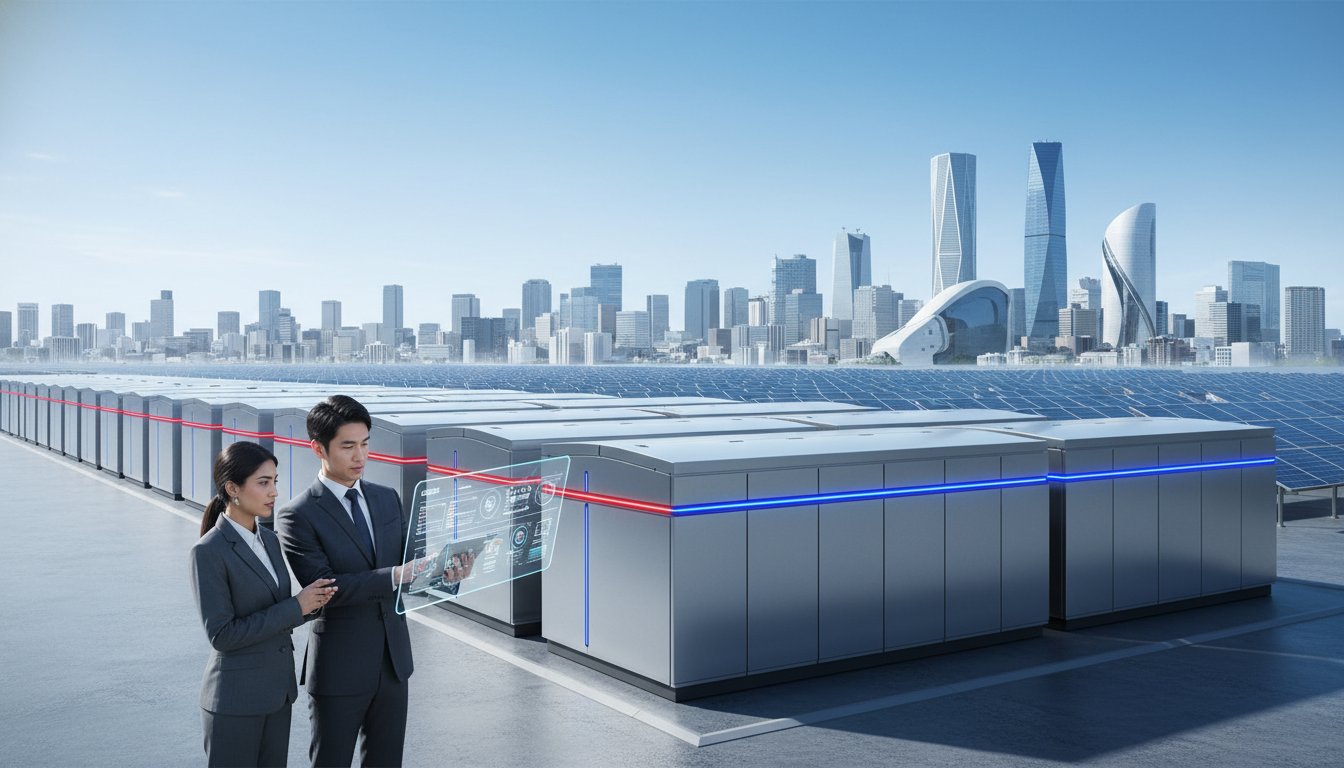
By 2026, the global energy sector is projected to add 353.4 GWh of new storage capacity, yet many organizations remain paralyzed by the technical complexities of lithium ion battery storage. It's logical to feel concerned about the volatility of thermal runaway or the confusion surrounding LFP versus NMC chemistry, especially when a single engineering oversight can compromise your long-term system reliability. You require a system that translates technical specifications into measurable resilience and reduced operational costs.
This guide provides the authoritative framework needed to master the technical and strategic foundations of modern energy architecture to achieve total energy independence. We'll move from a high-level analysis of the 2026 regulatory landscape, including mandatory state of charge limits and recycling mandates, to a granular breakdown of battery cycle life. You'll gain the precise insights required to architect a future-proofed infrastructure that leverages high-performance engineering to ensure monumental impact and permanent operational stability.
Key Takeaways
- Learn to transition from passive backup to active energy orchestration using peak-shaving and load-shifting protocols.
- Evaluate the technical superiority of LFP chemistry for stationary storage applications based on safety profiles and 2026 market economics.
- Calculate the total cost of ownership by analyzing the direct relationship between cycle life and depth of discharge.
- Architect a high-performance lithium ion battery storage system that matches precise daily load profiles for maximum ROI.
- Implement Japanese engineering standards to maintain system integrity and operational reliability in extreme high-temperature environments.
Defining the Role of Lithium-Ion Battery Storage in 2026 Energy Ecosystems
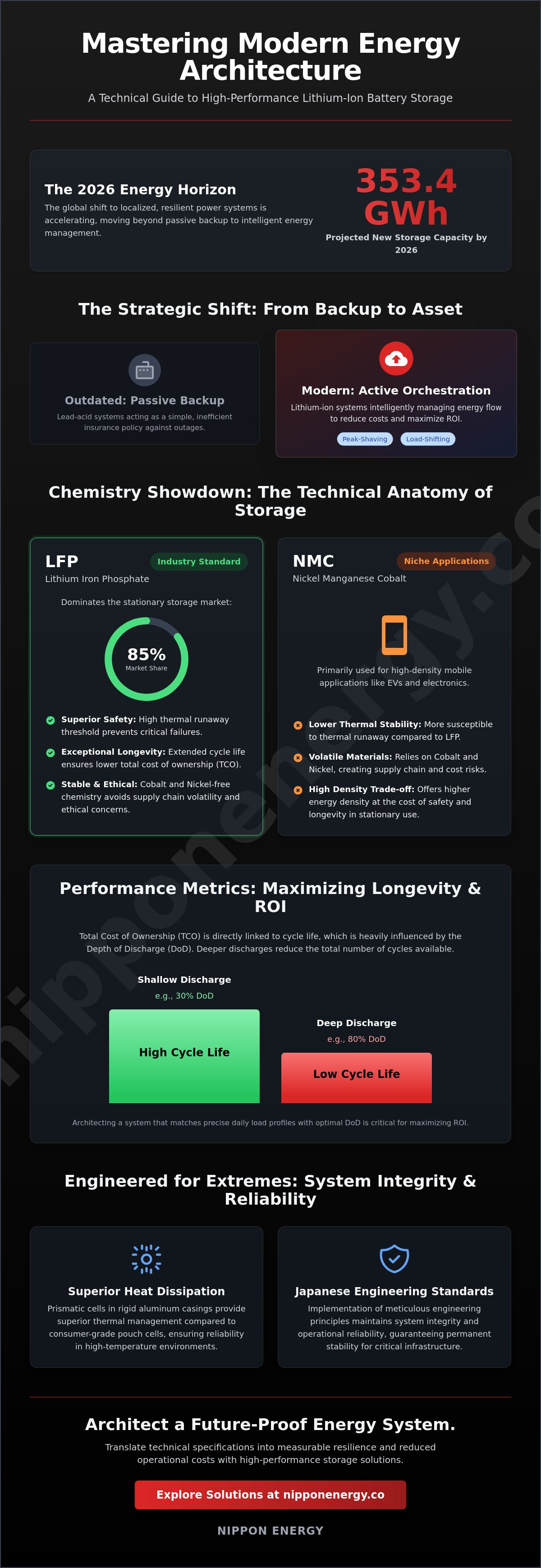
In the current industrial landscape, lithium ion battery storage has evolved from a secondary backup component into a high-density energy orchestration tool. This transition marks a fundamental shift in how global energy architecture is designed and managed. By 2026, the world is expected to add 353.4 GWh of new storage capacity, signaling a definitive move away from centralized, vulnerable grids toward localized, resilient power systems. This evolution is not merely about capacity; it is about the intelligent deployment of energy to ensure long-term system reliability and operational continuity.
The commercial and industrial sectors have largely abandoned lead-acid technology in favor of battery energy storage systems that utilize lithium-ion chemistry. This shift is driven by the superior energy density, lower maintenance requirements, and extended cycle life of lithium-ion cells. While lead-acid systems often require frequent replacement and extensive floor space, modern lithium-ion solutions provide a compact footprint and the technical precision necessary for high-demand environments. This architectural superiority allows businesses to treat energy as a manageable asset rather than an unpredictable overhead cost.
The Strategic Shift: From Backup to Primary Asset
Modern storage systems have redefined the utility of solar energy by enabling 24/7 utilization. Instead of functioning as a passive reserve, lithium ion battery storage now performs active energy orchestration through peak-shaving and load-shifting. Peak-shaving allows facilities to discharge stored energy during periods of high utility demand, which effectively reduces industrial electricity tariffs and lowers demand charges. This proactive management transforms the battery from a simple insurance policy into a primary asset that dictates the ROI of the entire solar ecosystem. In microgrid configurations, these systems provide the essential stability required to maintain frequency and voltage levels, ensuring that critical operations remain unaffected by external grid fluctuations.
Economic Drivers of Storage Adoption in 2026
The economic landscape of 2026 is defined by rising grid costs and increasingly stringent carbon neutrality mandates. These factors have elevated "Energy Independence" from a secondary goal to a critical business KPI. As utility prices become more volatile, the ability to store and deploy energy on-site provides a predictable cost structure that stabilizes long-term OPEX. The deployment of advanced storage systems allows organizations to meet sustainability targets while simultaneously shielding themselves from the inefficiencies of the traditional energy market. This dual benefit of environmental compliance and financial resilience makes high-performance storage the cornerstone of future-proofed energy infrastructure. To ensure your infrastructure meets these high standards of resilience, you can discover Santiban Services Group for expert installation of certified, high-performance energy solutions.
The Technical Anatomy of Advanced Storage: Chemistry and Safety
The operational success of lithium ion battery storage is dictated by the precise interaction between its chemical composition and its management architecture. In 2026, the industry has largely consolidated around two primary chemistries: Lithium Iron Phosphate (LFP) and Nickel Manganese Cobalt (NMC). While NMC remains relevant for high-density mobile applications, LFP has secured over 85% of the stationary storage market. This dominance is not accidental; it's a result of the chemistry’s inherent stability and the elimination of volatile materials like cobalt and nickel, which are subject to supply chain fluctuations and lower thermal stability thresholds.
Safety remains the paramount concern for large-scale energy infrastructure. Engineering teams must understand how to safely store lithium-ion batteries to prevent localized failures from escalating into system-wide events. This requires a shift from viewing a battery as a simple box of energy to seeing it as a precision-engineered thermal system. High-performance storage units now utilize prismatic cells housed in rigid aluminum casings, which provide superior heat dissipation and mechanical durability compared to the pouch cells often found in consumer electronics. This structural integrity is vital for maintaining performance in the demanding climates of South Asia and the Middle East.
LFP Chemistry: The Standard for Safety and Longevity
LFP chemistry provides a significantly higher thermal runaway threshold than its counterparts. While NMC cells can begin to fail at temperatures as low as 210°C, LFP cells typically remain stable until they exceed 270°C. This 60-degree margin is critical in high-ambient environments where cooling systems are already under heavy load. Furthermore, LFP cells don't release oxygen during a thermal event, which effectively removes the internal fuel source that drives aggressive battery fires. This chemical resilience is a core reason why modern architects choose this chemistry when evaluating lithium ion vs lead acid solar battery configurations for long-term industrial use.
BMS Architecture and Intelligent Monitoring
The Battery Management System (BMS) serves as the central intelligence of the storage unit, performing cell-level monitoring and balancing to ensure uniform degradation. In 2026, advanced BMS units integrate AI-driven predictive fault detection, which analyzes micro-fluctuations in voltage and internal resistance to identify potential cell failures before they occur. This proactive diagnostic capability allows for targeted maintenance and prevents minor imbalances from reducing the total system capacity. Effective energy orchestration also requires seamless communication protocols between the BMS and smart inverters. This integration ensures that the battery operates within its optimal state-of-charge (SoC) parameters, which directly extends the life of your Nippon Lithium-ion Battery Storage Systems.
- Cell Balancing: Distributes energy evenly across the string to prevent overcharging.
- Thermal Regulation: Triggers active cooling systems when internal temperatures deviate from 25°C.
- Predictive Analytics: Uses historical data to forecast remaining useful life (RUL) and optimize discharge cycles.
Performance Metrics: Quantifying Efficiency and System Longevity
Quantifying the architectural integrity of a lithium ion battery storage system requires a rigorous analysis of performance metrics that go beyond simple capacity ratings. In the 2026 energy landscape, the primary indicators of system value are Cycle Life, Depth of Discharge (DoD), and Round-Trip Efficiency (RTE). These metrics don't just describe electrical behavior; they dictate the total cost of ownership and the long-term reliability of the entire energy infrastructure. While legacy technologies often forced a compromise between performance and longevity, modern lithium-ion engineering allows for high-utilization strategies that maximize every kilowatt-hour stored.
Depth of Discharge has seen a monumental shift, with 90% to 100% now serving as the industry standard for commercial installations. This allows for a smaller physical footprint while delivering the same usable energy as much larger, older systems. High DoD ratings are supported by advanced cell chemistry that maintains structural stability even at low states of charge. This technical capability ensures that your investment remains a primary asset rather than a depreciating liability. Adhering to established protocols, such as the MIT Lithium-Ion Battery Safety Guidance, provides the necessary framework to maintain these high performance thresholds without compromising operational safety.
Understanding the Degradation Curve
The long-term viability of an installation depends on understanding the lithium ion battery cycle life and the factors that influence its decline. Cycle life is the number of full charge and discharge cycles a battery can complete before its remaining capacity drops to 80% of its original rating. It's vital to differentiate this from "calendar life," which refers to the natural degradation of the battery over time regardless of usage. High ambient temperatures and aggressive charge rates can accelerate chemical wear, making precision thermal management essential for preserving the degradation curve. By maintaining optimal internal environments, systems can achieve thousands of cycles before any significant loss in capacity occurs.
Efficiency Metrics for Industrial Applications
Round-Trip Efficiency measures the energy recovered from a battery relative to the energy used to charge it. Lithium-ion systems typically achieve an RTE of 95% or higher, whereas lead-acid alternatives often struggle to reach 80% due to internal resistance and heat loss. For industrial machinery, C-rates are equally critical as they define the speed at which a battery can be charged or discharged relative to its total capacity. A 1C rate means the battery can be fully discharged in one hour, providing the high-burst power required for heavy industrial starts. To accurately value an installation, engineers use a framework to calculate the solar battery storage cost per cycled kWh. This calculation accounts for the initial capital expenditure divided by the total energy throughput over the system's life, providing a true metric for energy independence and ROI.
Strategic Implementation: Sizing and Integrating Storage for Maximum ROI
Strategic implementation of lithium ion battery storage transforms a collection of hardware into a high-performance energy asset. In 2026, the industry focus has shifted from generic capacity estimates to a rigorous architectural design that matches storage to the specific load profile of a facility. This methodical approach ensures that every kilowatt-hour of capacity contributes directly to operational resilience and financial ROI. Achieving this requires a deep understanding of how storage integrates with existing solar arrays and the broader facility infrastructure.
Sizing Methodology for Commercial Facilities
Determining the required kWh capacity begins with an analysis of interval load data. By examining power consumption in 15 or 30 minute increments, engineers can identify the exact peaks that storage must mitigate. This data-driven sizing prevents over-capitalization, where excess storage sits idle, while ensuring the system can handle the facility's maximum demand. For critical infrastructure, the concept of "Autonomy Days" is central to the design. This metric defines how many days the system can sustain critical loads without any solar input or grid support. While increasing autonomy improves security, it also increases capital expenditure; therefore, the final architecture must strike a balance between absolute resilience and capital efficiency.
AC vs. DC Coupling: Choosing the Right Architecture
Choosing between AC-coupled and DC-coupled architectures is a pivotal decision in system design. DC coupling is the preferred choice for new installations featuring high-efficiency panels. In this configuration, solar energy remains in DC form as it charges the battery, which eliminates unnecessary conversion steps and maximizes round-trip efficiency. Conversely, AC coupling offers the flexibility required for retrofitting existing commercial solar projects. Since the storage unit connects to the AC side of the facility, it can be added to any existing array without rewiring the solar string. Nippon Smart AI Inverters manage these connections with technical precision, using automated orchestration to decide when to charge, discharge, or bypass the storage based on real-time electricity prices and load demands.
Industrial energy needs rarely remain static, making modularity a non-negotiable feature for future-proofed systems. Scalable rack designs allow organizations to start with a baseline capacity and expand as their operational footprint grows. This modular approach protects the initial investment and ensures the system remains relevant for its entire lifespan. To begin designing a system tailored to your specific load profile, you can explore the technical specifications of Nippon Lithium-ion Battery Storage Systems.
- Modular Expansion: Add capacity in increments to match business growth without replacing core components.
- AI-Driven Dispatch: Use predictive algorithms to discharge during peak tariff windows automatically.
- Retrofit Compatibility: Integrate storage into existing solar farms using AC-coupling to minimize downtime.
Nippon Lithium-Ion Battery Storage Systems: The Architectural Standard
Nippon Lithium-ion Battery Storage Systems represent the pinnacle of Japanese engineering, designed to serve as the structural foundation for large-scale energy independence. While many providers offer generic storage units, our systems are engineered as precision architectural components that prioritize longevity and safety above all else. This focus on structural integrity ensures that industrial and commercial operators can maintain total energy reliability, even when faced with the most demanding grid conditions or environmental stressors. By establishing a new benchmark for technical prowess, we provide the tools necessary for monumental long-term impact.
The synergy between our storage solutions and Nippon HJT Solar Panels creates a high-efficiency energy loop that maximizes both power generation and retention. Pairing advanced Heterojunction technology with high-density lithium storage allows facilities to achieve a level of energy orchestration that was previously unattainable. Our Solar Project Development and EPC teams provide the end-to-end support necessary to design, install, and maintain these complex systems. This comprehensive approach ensures that every project meets the rigorous standards of 2026 energy architecture from initial feasibility to long-term operation.
Engineering for Extreme Climates
Reliability in South Asian and Middle Eastern climates requires more than standard specifications; it demands advanced thermal insulation and active cooling architectures. Nippon systems are built with specialized thermal management layers that protect the LFP cells from external heat soak, which maintains internal temperatures within the optimal range even during peak ambient heat. Rigorous testing protocols ensure high IP ratings for dust and humidity ingress, allowing these units to function as a "High-Tech Architect" in desert and tropical environments. This resilience prevents the accelerated degradation curves often seen in lesser systems, securing your investment for its entire rated cycle life.
The Integrated NipponHev Advantage
The NipponHev system optimizes the battery-inverter-panel loop by creating a unified communication protocol across all components. This integrated approach eliminates the inefficiencies often found in multi-vendor setups, where mismatched hardware leads to energy loss or monitoring gaps. A single-vendor ecosystem simplifies Solar System Maintenance and Monitoring, providing a transparent view of the entire energy flow through a centralized interface. This cohesion ensures that your lithium ion battery storage operates at peak efficiency while reducing long-term OPEX through intelligent automation.
To achieve total energy independence and future-proof your infrastructure, professional site feasibility studies are essential. Contact our engineering team for a consultation to begin architecting your 2026 energy solution and securing your facility's operational future.
Architecting Your Path to Permanent Energy Security
The transition toward a decentralized, resilient power system requires more than just high-capacity hardware. It demands a sophisticated understanding of how lithium ion battery storage functions as a strategic orchestration tool. By prioritizing LFP chemistry for its thermal stability and utilizing AI-driven inverters for automated peak-shaving, organizations can transform their energy infrastructure into a primary asset that dictates long-term operational costs. Mastering these technical foundations is the only way to ensure system reliability in the face of 2026 regulatory changes and increasing grid volatility.
Nippon Energy maintains a global EPC presence across Tokyo, Dubai, and Lahore, ensuring that every installation adheres to the highest Japanese engineering standards. Our proprietary Smart AI Inverter integration allows for seamless energy management that maximizes both performance and safety. We invite you to Consult with a Nippon Energy Architect for your Storage Infrastructure to begin your journey toward total energy independence. The monumental impact of a well-architected system begins with technical precision and ends with permanent energy security. We're ready to build that future with you.
Frequently Asked Questions
How long does a lithium-ion battery storage system last in 2026?
A high-performance lithium ion battery storage system typically maintains operational efficiency for 10 to 15 years. This longevity is measured by cycle life, which often exceeds 6,000 full charge and discharge cycles before capacity degrades to 80% of its original rating. Proper thermal management and adherence to recommended state-of-charge parameters are essential to preserving this lifespan and ensuring long-term system reliability.
Is lithium-ion storage safe for indoor residential or commercial use?
Modern storage systems are engineered for safe indoor installation when they utilize stable chemistries and integrated safety protocols. Using Lithium Iron Phosphate (LFP) chemistry significantly reduces the risk of thermal runaway compared to older technologies. Compliance with safety standards like UL 2580 ensures the unit can withstand mechanical and electrical stress, while advanced battery management systems provide real-time fault detection to maintain structural integrity.
What is the difference between LFP and NMC battery storage?
LFP (Lithium Iron Phosphate) is the industry standard for stationary storage because of its superior thermal stability and longer cycle life. NMC (Nickel Manganese Cobalt) offers higher energy density, which is suitable for mobile applications, but it lacks the chemical resilience required for stationary industrial use. LFP systems are particularly effective in high-temperature environments where safety and durability are the primary architectural requirements for the energy ecosystem.
Can I add more batteries to my system later if my energy needs grow?
Scalability is a core feature of modern energy architecture, allowing you to expand your capacity as energy demands grow. Modular systems, such as Nippon Lithium-ion Battery Storage Systems, permit the addition of new battery modules to existing racks. It's essential that the integrated inverter and management software support this expansion to ensure balanced charging and uniform degradation across the entire battery string as you scale your infrastructure.
How much maintenance does a lithium-ion solar battery require?
Lithium-ion systems are virtually maintenance-free because they don't require fluid refills or periodic equalization. The primary maintenance involves remote monitoring of cell health and software updates for the management system. Utilizing professional Solar System Maintenance and Monitoring ensures that any minor voltage imbalances are identified and corrected through automated cell-balancing protocols before they impact total system performance or longevity.
What happens to the battery storage system when the solar panels are not producing energy?
When solar production ceases during the night or overcast periods, the storage system discharges its accumulated energy to maintain facility operations. This seamless transition is managed by the smart inverter, which draws from the lithium ion battery storage to cover the load. This process, known as load-shifting, ensures that you utilize your own generated solar energy instead of relying on expensive grid power during peak hours.
Is lithium-ion storage cost-effective for industrial peak-shaving?
Lithium-ion storage is highly cost-effective for industrial peak-shaving due to its ability to discharge high amounts of power rapidly. By discharging during periods of maximum facility demand, the system reduces the peak load seen by the utility provider, which lowers demand charges on your electricity bill. This strategic deployment stabilizes operational costs and provides a predictable ROI by mitigating the most expensive components of industrial utility tariffs.
Can lithium-ion batteries be recycled at the end of their life cycle?
Lithium-ion batteries are increasingly recyclable as new infrastructure and regulations, such as the Responsible Battery Recycling Act, come into effect in 2026. Modern recycling processes can recover critical materials like lithium, copper, and aluminum for reuse in new battery production. This closed-loop approach reduces the environmental footprint of the storage system and aligns with global sustainability mandates that prioritize extended producer responsibility for industrial components.


