
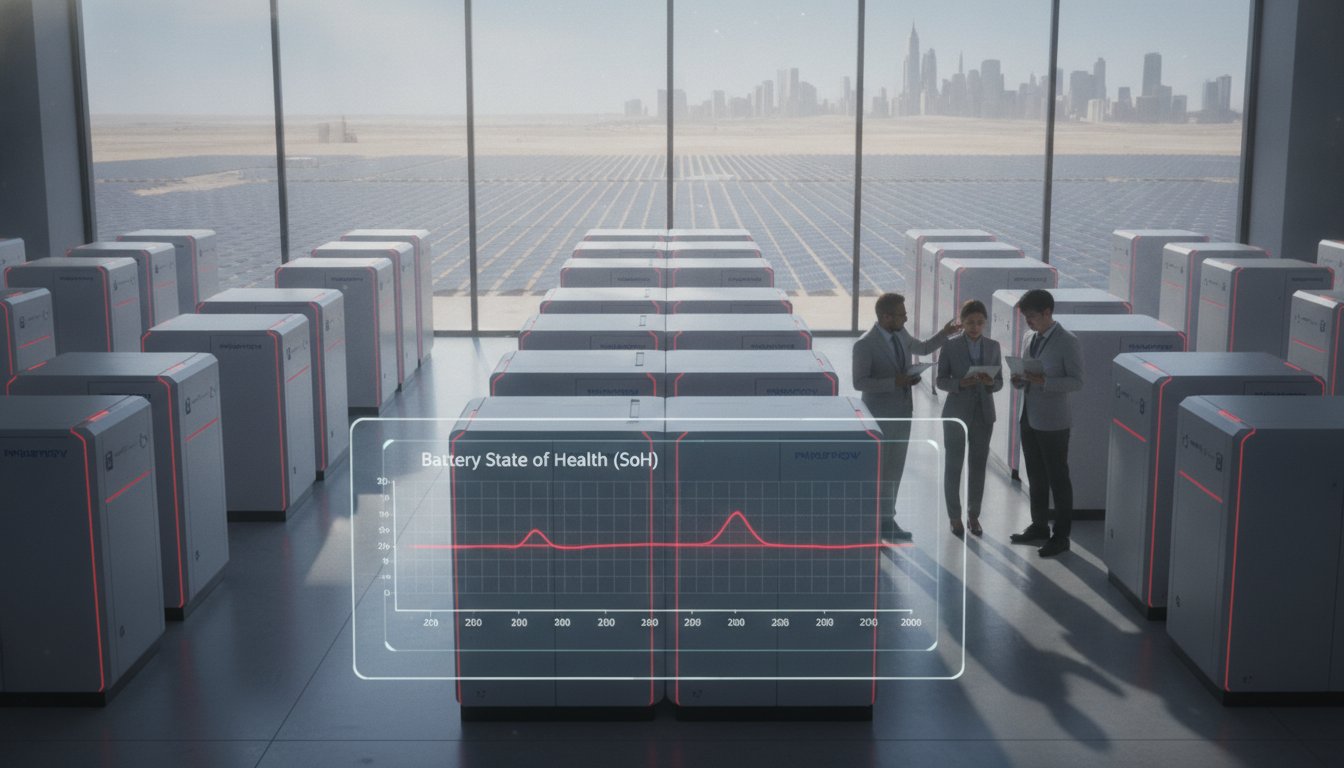
A battery's rated cycle life is not a static specification; it is an engineered outcome of thermal, chemical, and digital orchestration. While many manufacturers provide optimistic laboratory figures, the reality of lithium ion battery cycle life in high-demand solar environments often involves rapid capacity fade and unpredictable degradation. You're likely dealing with opaque manufacturer ratings that don't translate to field performance, making it nearly impossible to calculate a precise total cost of ownership for your storage assets.
We understand that institutional investors and project developers require technical certainty over guesswork. This guide provides the framework to master the dynamics of battery degradation and engineer maximum ROI for your solar storage systems. We'll examine the 2026 shift toward Lithium Iron Phosphate (LFP) chemistry, which currently averages 81 dollars per kWh, and analyze how the latest EU Regulation 2023/1542 impacts your compliance strategy. From the impact of 2026 IATA state-of-charge limits to the precision of modern Battery Management Systems, you'll gain the data required to secure the longevity of your energy infrastructure.
Key Takeaways
- Define the 80% State of Health (SoH) threshold as the critical industry benchmark for determining the functional end-of-life in industrial storage applications.
- Identify the specific chemical mechanisms of degradation, such as SEI layer formation and lithium plating, to better forecast and extend your lithium ion battery cycle life.
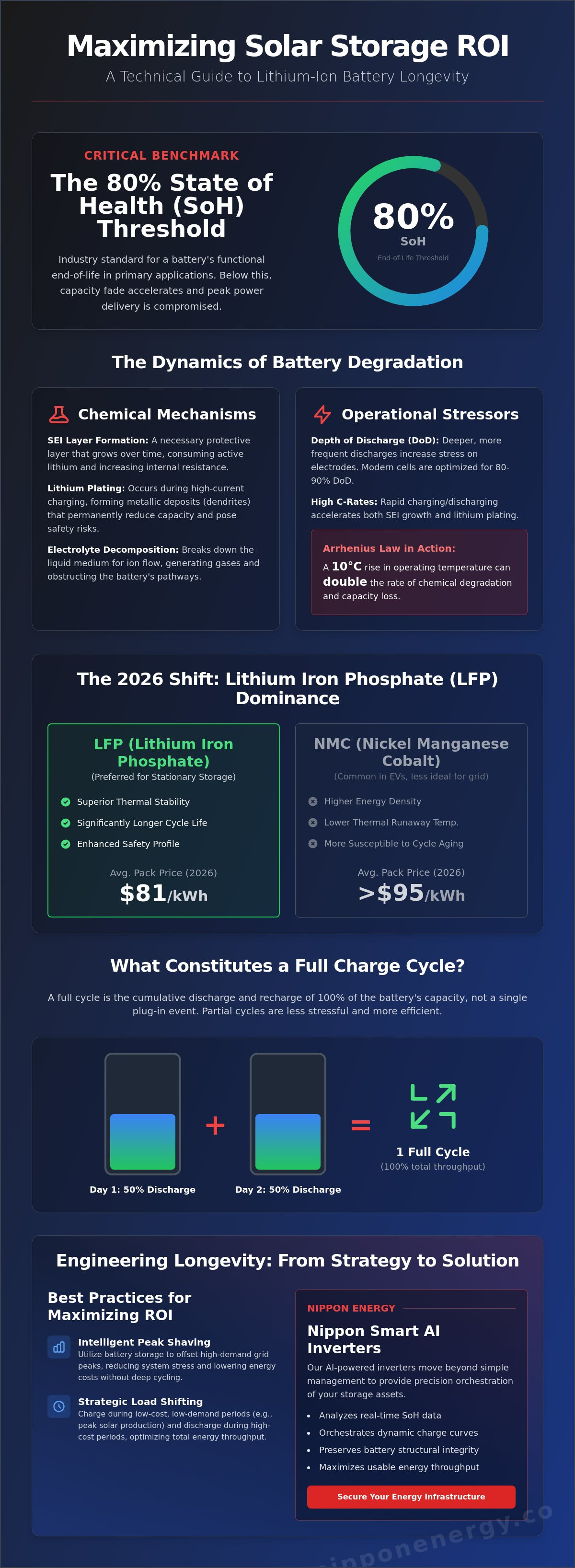
- Apply the Arrhenius Law to thermal management protocols, acknowledging that a 10°C rise in operating temperature can effectively double the rate of capacity loss.
- Implement intelligent peak shaving and load shifting strategies to optimize cycle distribution and enhance the total energy throughput of solar assets.
- Discover how Nippon Smart AI Inverters utilize real-time health data to orchestrate charge curves and preserve the structural integrity of your storage system.
Defining Lithium-Ion Battery Cycle Life: The Performance Metric of 2026
Understanding the durability of energy assets requires a precise technical vocabulary. In the context of modern energy storage, lithium ion battery cycle life refers to the total number of complete charge and discharge cycles a cell can perform before its available capacity falls below a specified percentage of its original rating. This metric differs fundamentally from calendar life, which tracks degradation based on the passage of time regardless of usage. While calendar life is an inevitable chemical reality, cycle life is an operational variable influenced by usage patterns and thermal management. A standard Lithium-ion battery in 2026 is often rated for thousands of cycles, but these figures are contingent upon strict adherence to manufacturer parameters. In the current market, the shift toward Lithium Iron Phosphate (LFP) for stationary solar storage has accelerated. LFP chemistries offer superior thermal stability and significantly longer cycle lives compared to Nickel Manganese Cobalt (NMC) alternatives. With LFP pack prices reaching approximately $81 per kWh in early 2026, the ROI for solar storage systems is increasingly driven by these high-cycle, low-cost chemistries.
What Constitutes a Full Charge Cycle?
A full charge cycle is defined by the cumulative movement of 100% of the battery's rated capacity, not by a single plug-in event. If an operator discharges a system by 50% on Monday and another 50% on Tuesday, this equates to exactly one cycle. Partial charging doesn't waste a cycle; instead, it's the total energy throughput that dictates wear. Depth of Discharge (DoD) plays a critical role here. Systems engineered for high DoD can utilize a larger portion of their capacity without compromising structural integrity. By 2026, high-quality cells are designed to handle 80% to 90% DoD, providing greater functional energy per cycle than older technologies. This cumulative approach allows for flexible energy management without the "memory effect" found in legacy battery types.
The 80% Threshold and State of Health (SoH)
State of Health (SoH) serves as the primary indicator of storage system reliability. It represents the ratio of the battery's current capacity to its original factory rating. The industry standard designates 80% SoH as the pivot point for system replacement or "second-life" usage in primary stationary applications. Once capacity drops below this threshold, internal resistance typically increases, and the battery may no longer meet the peak power demands of a solar microgrid. These units aren't necessarily discarded at this stage. Instead, they often transition into secondary applications, such as grid-stabilization or backup power, where high energy density is less critical. State of Health (SoH) is the primary indicator of storage system reliability.
The Chemical and Physical Dynamics of Battery Degradation
The longevity of a storage asset is dictated by microscopic interactions at the molecular level. Primary among these is the formation of the Solid Electrolyte Interphase (SEI) layer. This passivation layer, while necessary for stabilizing the electrode, consumes active lithium ions as it thickens over time. Understanding the chemical and physical dynamics of battery degradation allows engineers to predict capacity loss with greater accuracy. Beyond SEI growth, lithium plating occurs during high-current charging events when ions fail to intercalate into the anode, instead forming metallic deposits. These deposits can grow into dendrites, which pose significant safety risks and permanently reduce the lithium ion battery cycle life.
Electrolyte decomposition further compounds these issues by increasing internal resistance. As the liquid electrolyte breaks down, it generates gaseous byproducts and solid precipitates that obstruct ion flow. High-purity electrolyte compositions (Feature) minimize these parasitic reactions (Action), which ensures maximum system uptime and predictable performance (Result). For those seeking to stabilize their energy infrastructure, exploring modern storage architectures is the first step toward mitigating these chemical stressors.
Depth of Discharge (DoD) and Stress Factors
Operating a battery at 100% Depth of Discharge (DoD) subjects the internal chemistry to extreme voltage stress at both the upper and lower limits. Research indicates that high-quality industrial LFP batteries can deliver more than 3,000 full-depth cycles at 80% DoD, yet this number drops significantly when pushed to a consistent 100% discharge. Shallow cycles reduce the mechanical strain on the electrode lattice, effectively doubling the total energy throughput over the system’s lifespan. By maintaining a buffer at the top and bottom of the charge state, operators can exponentially increase the total lithium ion battery cycle life.
C-Rate: The Velocity of Degradation
C-Rate defines the speed of charge or discharge relative to the battery's total capacity; a 1C rate means a full discharge in one hour. High C-Rates accelerate thermal stress and cause mechanical expansion and contraction within the electrodes, leading to micro-cracking and loss of active material. This mechanical fatigue is a primary driver of premature capacity fade in utility-scale environments. For optimal utility-scale solar storage longevity, the system should ideally operate at a continuous rate of 0.5C or lower to minimize thermal and structural degradation.
Evaluating Environmental and Operational Stressors on Longevity
Environmental conditions act as a force multiplier for chemical degradation within any storage asset. The Arrhenius Law provides a mathematical foundation for this reality, establishing that for every 10°C increase in operating temperature, the rate of internal chemical reactions effectively doubles. This exponential acceleration of decay is why thermal management is a non-negotiable component of modern engineering. While standard lead-acid units suffer catastrophic capacity loss in high-temperature environments, Nippon Lithium-ion Battery Storage Systems utilize advanced thermal architectures to maintain performance consistency. In high-temperature climates like the Middle East or South Asia, the synergy between external ambient heat and internal resistance can rapidly deplete the lithium ion battery cycle life if not managed by active cooling protocols. Beyond temperature, the State of Charge (SoC) maintained during long-term storage or idling periods determines the baseline of chemical stress on the cell's electrodes.
Thermal Management and Ambient Impact
Active cooling systems utilize liquid or forced-air mechanisms to maintain the cell's thermal equilibrium (Feature). This precise regulation prevents the localized hotspots that lead to electrolyte breakdown (Action), resulting in a more predictable and extended operational lifespan (Result). Advanced Battery Management Systems (BMS) act as the primary defense against thermal runaway by monitoring cell-level data in real-time. In solar-plus-storage environments, the integration of n-type cell technology provides a lower temperature coefficient, which reduces the thermal load on the accompanying battery system during high-output periods.
SoC Windows and Buffer Zones
Maintaining a state of charge within the "Goldilocks Zone" of 20% to 80% SoC is essential for maximizing chemical stability. Operating at 100% SoC for extended periods increases voltage stress on the cathode, while dropping below 10% can lead to irreversible copper dissolution at the anode. Adopting research-backed best practices for lithium-ion battery lifetime extension involves using automated energy management systems to enforce these buffer zones. These intelligent systems ensure that the battery never resides at voltage extremes for longer than necessary. For a detailed comparison of how these discharge profiles differ from legacy technology, refer to our guide on Lithium Ion vs Lead Acid Solar Battery. High-efficiency architectures use these software-defined buffers to protect the lithium ion battery cycle life without requiring manual intervention from the operator.
Engineering Best Practices for Maximizing Storage ROI
Maximizing the return on investment for energy storage requires shifting from passive monitoring to active, data-driven orchestration. Engineers must implement peak shaving to reduce high-current stress during demand spikes and load shifting to distribute energy throughput across optimal thermal windows. These strategies directly preserve the lithium ion battery cycle life by ensuring cells operate within their chemical comfort zones. Regular State of Health (SoH) audits are mandatory for industrial operators. Identifying a single underperforming module early prevents localized resistance from stressing the entire string. Routine maintenance should focus on the integrity of electrical connections and the precision of thermal sensors to ensure the Battery Management System receives accurate data. For those looking to secure their energy future, exploring advanced storage architectures is the first step toward professional-grade asset management.
Intelligent Energy Management Systems (EMS)
AI-driven orchestration is no longer optional in 2026. By integrating weather forecasting, systems can pre-cool the battery bank before a predicted heatwave or pre-charge during periods of high solar irradiance. This predictive capability (Feature) minimizes the need for rapid, high-C-rate charging (Action), which results in lower mechanical strain on the electrodes (Result). These systems prevent unnecessary micro-cycles that accumulate over time to degrade the lithium ion battery cycle life. For a comprehensive look at these technologies, explore our guide on Smart AI Solar Inverters.
System Sizing and Over-Provisioning
Strategic over-provisioning serves as a structural hedge against future capacity fade. By installing a battery bank 20% larger than the required capacity, operators can maintain a lower Depth of Discharge (DoD) while meeting the same energy demands. This reduced utilization (Feature) significantly extends the functional lifespan of the cells (Action), which lowers the total cost of ownership (TCO) over a 15-year horizon (Result). While the initial capital expenditure is higher, the long-term ROI is secured through deferred replacement costs. Over-provisioning is a calculated hedge against future capacity fade that ensures system reliability remains high as the asset ages.
- Maintain a 20% capacity buffer to keep daily cycles within the 20% to 80% SoC range.
- Automate thermal regulation through EMS to stay within 20°C to 25°C.
- Schedule semi-annual SoH audits to verify that degradation rates align with financial models.
The Nippon Energy Approach: Precision Orchestration for Perpetual Power
Nippon Energy functions as a High-Tech Architect, constructing energy environments where structural integrity and future-proofing are paramount. Our Nippon Lithium-ion Battery Storage Systems represent the pinnacle of 2026 engineering, offering a level of technical precision that transforms storage from a depreciating asset into a long-term energy fortress. It doesn't just store energy; it orchestrates it. By integrating these systems with Nippon Smart AI Inverters, we bridge the critical gap between inverter intelligence and battery health. This unified approach is further reinforced by professional Solar System Maintenance, ensuring that every thermal and electrical variable is optimized for maximum endurance throughout the system's operational life.
AI-Driven Charge Optimization
Our longevity advantage is rooted in AI-driven charge optimization. Nippon AI algorithms monitor ambient temperature and real-time State of Health (SoH) to modulate charge currents with extreme granularity. This intelligent modulation (Feature) eliminates the chemical stressors that typically shorten lithium ion battery cycle life (Action), which results in a significantly improved Internal Rate of Return (IRR) for large-scale solar projects (Result). The "Self-Healing" logic embedded in our BMS balances cell voltages automatically. This proactive balancing prevents the localized degradation that often triggers premature system failure in less sophisticated architectures.
Hardware Synergy: HJT Panels and Lithium Storage
Superior performance is the result of hardware synergy. The low-degradation characteristics of Nippon HJT Solar Panels provide a resilient energy source that aligns perfectly with the extended lifespan of our storage units. This integration is fully realized in the NipponHev System, which functions as a unified performance architecture. By synchronizing high-efficiency generation with intelligent storage, we provide the tools for large-scale success in a demanding energy market. We encourage you to Explore Nippon Energy Storage Solutions to experience the next evolution of energy orchestration and secure the lithium ion battery cycle life your infrastructure demands.
Securing Energy Resilience Through Technical Orchestration
Achieving maximum ROI for solar storage requires a shift from passive observation to active engineering. We've established that lithium ion battery cycle life is a dynamic variable influenced by thermal regulation, Depth of Discharge (DoD) windows, and the precision of digital management systems. By prioritizing high-efficiency LFP chemistry and implementing intelligent peak shaving, operators can defer replacement costs and stabilize their energy infrastructure for the long term. These technical dynamics are the foundation of a reliable microgrid.
Nippon Energy stands as your world-class partner in this transition. We combine 2026 High-Efficiency LFP Chemistry with integrated AI energy orchestration to ensure your assets withstand the rigors of extreme climates. Our global EPC expertise provides the structural integrity needed for large-scale success. It's time to transition from standard storage to a future-proof energy architecture that prioritizes longevity and precision above all else. We're ready to provide the tools for your monumental impact.
Architect Your Energy Future with Nippon Lithium Storage. We look forward to engineering your long-term success.
Frequently Asked Questions
What is the average cycle life of a lithium-ion solar battery in 2026?
High-quality Lithium Iron Phosphate (LFP) cells typically deliver 3,000 to 6,000 cycles at an 80% Depth of Discharge. This performance varies significantly by chemistry; Nickel Manganese Cobalt (NMC) packs often reach their 80% State of Health threshold sooner. Standardized testing protocols in 2026 now provide greater transparency, allowing operators to compare these ratings with higher technical accuracy across different manufacturers.
Can I extend my battery life by not charging it to 100%?
Yes, maintaining a state of charge between 20% and 80% reduces the voltage stress applied to the cathode. Avoiding the upper voltage limits prevents the electrolyte decomposition and SEI layer thickening that accelerate capacity fade. Most modern energy management systems now automate these buffer zones to preserve the lithium ion battery cycle life without requiring manual intervention from the system operator.
How does high temperature affect lithium-ion battery cycle life?
High temperatures accelerate internal chemical reactions according to the Arrhenius Law, which states that every 10°C rise can effectively double the degradation rate. Thermal stress leads to rapid SEI layer growth and increased internal resistance. Active thermal management is essential in extreme climates to prevent localized hot spots from compromising the system's longevity and causing premature capacity loss.
What is the difference between cycle life and calendar life?
Cycle life measures the total number of full charge and discharge iterations a battery performs before its capacity drops below the 80% benchmark. Calendar life refers to the inevitable degradation that occurs over time regardless of how the system is used. While usage patterns dictate cycle counts, ambient temperature and storage voltage are the primary drivers of calendar aging in stationary assets.
Is it better to discharge a battery fully before recharging?
No, lithium-ion chemistries don't suffer from the memory effect found in legacy nickel-cadmium systems. Frequent full discharges to 0% increase mechanical strain on the electrodes and can lead to irreversible copper dissolution at the anode. Shallow discharges are far more beneficial for maintaining chemical stability and extending the operational lifespan of your energy storage infrastructure.
How does Depth of Discharge (DoD) impact the number of available cycles?
Depth of Discharge has an inverse and often exponential relationship with total cycle count. A battery rated for 3,000 cycles at 100% DoD may achieve over 6,000 cycles if the discharge depth is limited to 50% per cycle. Reducing the depth of each cycle lowers the physical expansion and contraction of the battery's internal structure, which preserves its mechanical integrity.
What happens to a lithium-ion battery at the end of its cycle life?
Reaching the end of cycle life means the battery's capacity has dropped below the 80% State of Health threshold required for primary solar applications. At this stage, the battery is typically decommissioned and transitioned into second-life applications, such as grid-stabilization or backup power. These secondary roles utilize the remaining capacity where high energy density and rapid cycling are less critical.
Do Nippon Smart AI Inverters actually increase battery longevity?
Yes, Nippon Smart AI Inverters utilize real-time health data and predictive algorithms to optimize charge and discharge curves based on ambient conditions. By adjusting the current to match the battery's internal resistance and temperature, these inverters minimize the chemical stressors that degrade lithium ion battery cycle life. This digital orchestration ensures the hardware operates within its peak performance window for maximum ROI.


