
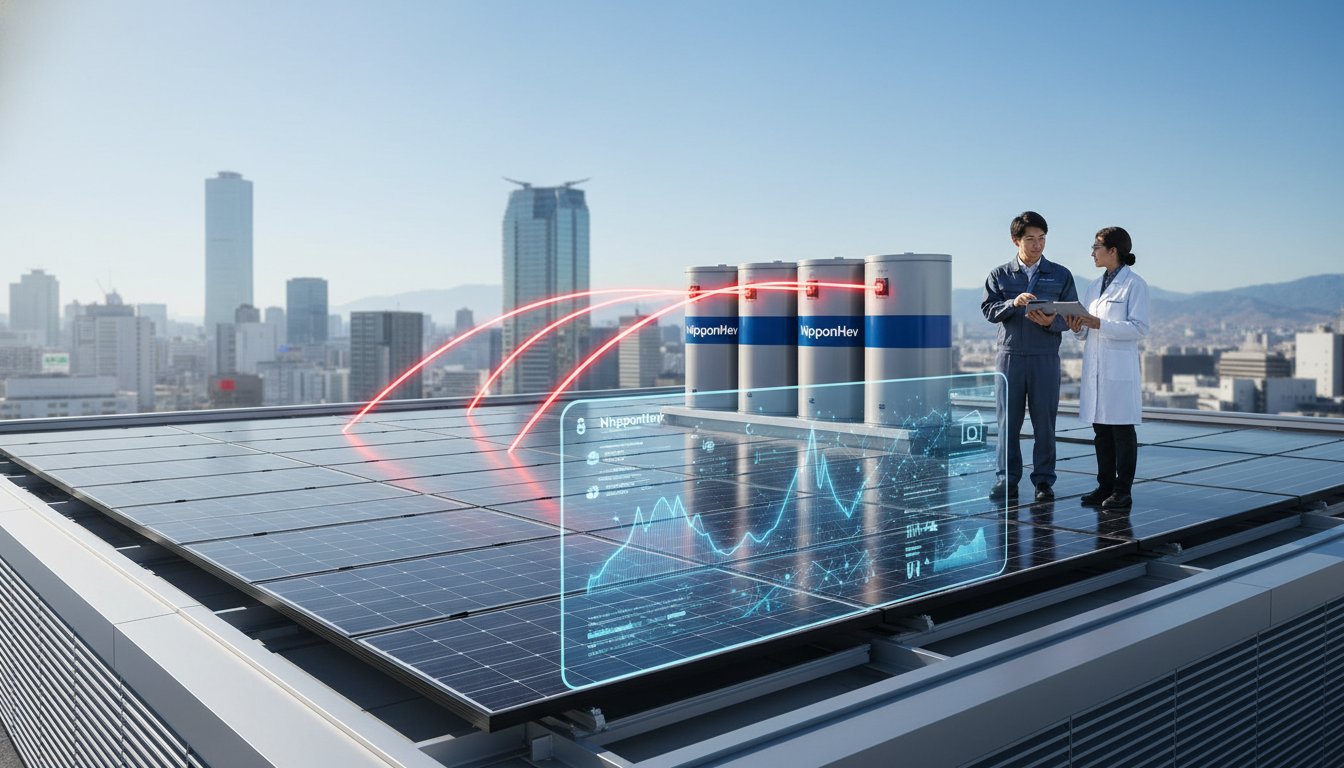
Why do most solar installations fail to reach their theoretical maximum output despite using premium hardware? Many engineers and developers recognize that high-efficiency panels are often throttled by fragmented system architectures. When inverters and batteries from different brands fail to communicate with precision, the result is avoidable energy loss and a maintenance burden that spans several vendors. The nipponhev system addresses these systemic vulnerabilities by synthesizing Nippon HJT solar panels and AI-driven intelligence into a single, high-performance energy ecosystem.
You understand that true energy independence requires more than just hardware; it demands a synchronized technical stack. This guide provides a comprehensive analysis of how integrated architecture eliminates interoperability issues and maximizes efficiency in high-temperature climates. We'll examine the transition from component-based setups to unified systems that meet Japan's 2026 building energy standards. This ensures your infrastructure remains both resilient and future-proof in an era of mandatory emissions trading and stricter efficiency benchmarks.
Key Takeaways
- Transition from fragmented hardware procurement to a unified architecture that eliminates communication gaps between energy assets.
- Explore how the nipponhev system synthesizes HJT hardware and AI intelligence to eliminate the 'fragmentation penalty' common in commercial solar projects.
- Identify the specific efficiency gains achieved by pairing topcon solar panels with high-voltage lithium storage and AI-driven inverters.
- Apply a structured framework for sizing and deploying integrated stacks to ensure commercial site compatibility and long-term energy independence.
- Understand the role of continuous monitoring and AI optimization in maintaining peak performance across the entire system lifecycle.
The Evolution of Solar Integration: Why the NipponHev System is Necessary
The global solar industry has reached a technical tipping point where individual component efficiency is no longer the primary bottleneck. For decades, commercial projects relied on a fragmented procurement model. Developers sourced panels, inverters, and batteries from disparate manufacturers, hoping that standard protocols would ensure seamless operation. This "best-of-breed" approach often resulted in systemic friction. The nipponhev system marks a definitive shift from these disconnected PV arrays toward intelligent energy ecosystems. By 2026, hardware-software synchronization has become the baseline requirement for industrial resilience, particularly in high-growth markets like Pakistan and the UAE. In these regions, extreme thermal loads and grid volatility demand a level of precision that mismatched hardware simply cannot provide.
Modern energy strategy now prioritizes the holistic performance of the stack over the peak rating of a single module. As urban environments become more dense, the adoption of Building-integrated photovoltaics (BIPV) has accelerated the need for systems that function as a single, cohesive unit. This evolution isn't just about generating power; it's about the sophisticated management of that power in real-time.
The Hidden Costs of Fragmented Solar Setups
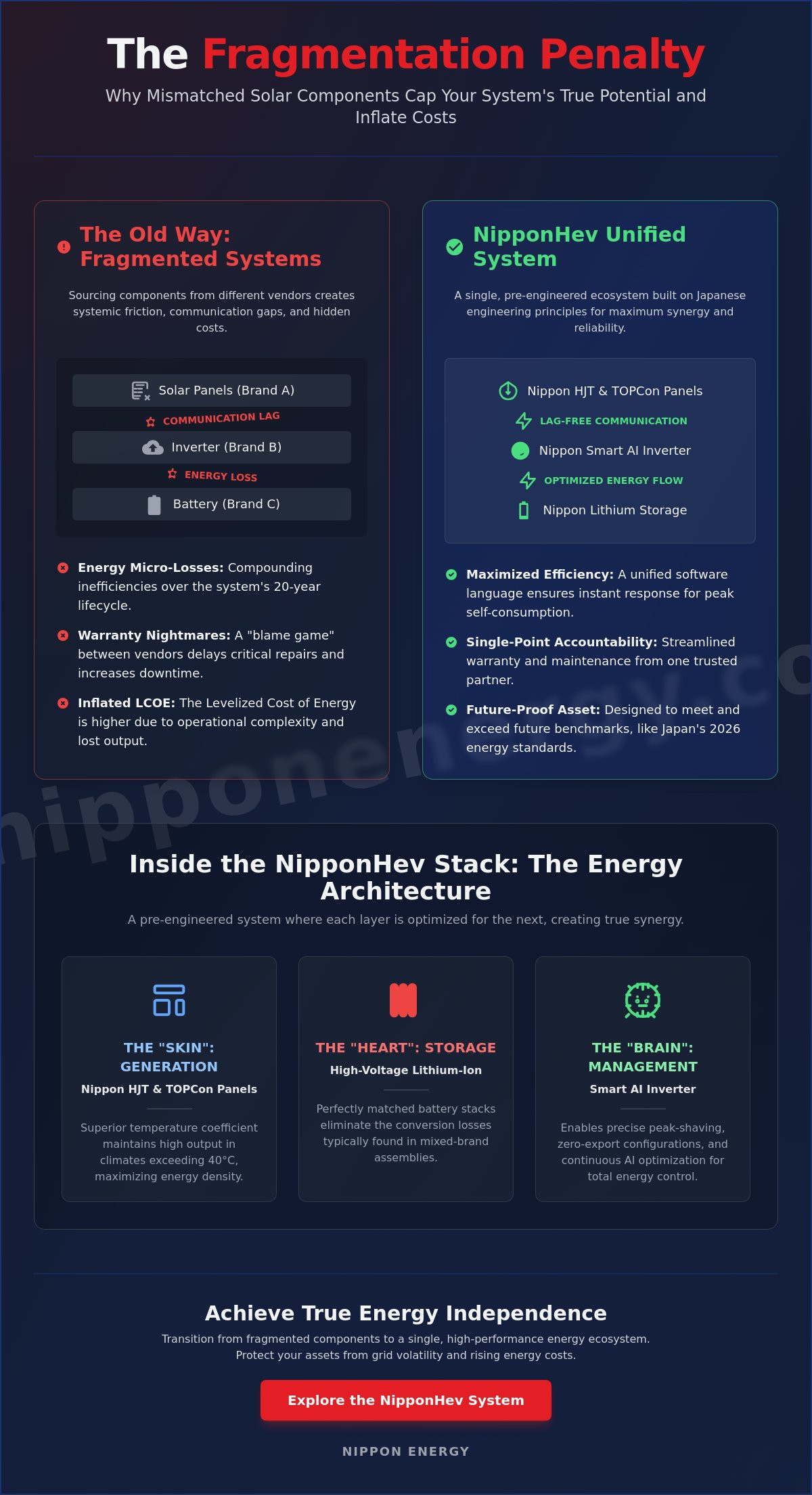
Fragmented systems suffer from "communication lag" between third-party inverters and Battery Management Systems (BMS). When these components don't share a native software language, response times to load spikes slow down. This latency leads to micro-losses in energy harvesting that compound over a twenty-year lifecycle. Warranty management also becomes a logistical nightmare. If a site underperforms, owners often face a "blame game" between multiple vendors, delaying critical repairs. These inefficiencies directly inflate the levelized cost of energy (LCOE), eroding the project's internal rate of return. A mismatched component stack doesn't just lose power; it loses money through increased operational complexity.
Defining the NipponHev Philosophy
The nipponhev system is built on the principle of "Energy Architecture" rather than simple hardware sales. This philosophy treats the entire installation as a single machine. Drawing on a Japanese engineering heritage that prioritizes reliability and structural integrity, Nippon Energy ensures that every HJT panel and AI inverter is pre-configured for maximum synergy. This unified stack is designed to provide industrial assets with true grid independence. It's a methodical approach to energy security. By controlling the entire technical stack, the system eliminates the interoperability risks that plague traditional installations. The result is a stable, future-proof asset that performs predictably under the harshest environmental conditions.
Technical Architecture: Inside the NipponHev System Stack
The nipponhev system operates as a pre-engineered technical stack where each layer is optimized for the next. This architecture moves beyond simple compatibility; it achieves true synergy. By integrating Nippon HJT and topcon solar panels with high-voltage battery stacks, the system eliminates the conversion losses typically found in mixed-brand assemblies. It functions through three critical layers: the "Skin" of HJT panels for generation, the "Heart" of lithium-ion storage for reserves, and the "Brain" of the Smart AI Inverter for management. Using a unified technical framework ensures that system-wide communication protocols remain lag-free. This technical guide to BIPV illustrates how such deep integration is vital for modern building performance. These protocols facilitate zero-export configurations and precise peak-shaving, allowing for maximum self-consumption of generated energy.
High-Efficiency Generation: HJT and TOPCon Integration
Nippon Energy prioritizes Heterojunction (HJT) technology within the nipponhev system because of its superior temperature coefficient. In climates where ambient temperatures exceed 40 degrees Celsius, HJT panels maintain higher output levels compared to standard PERC modules. We utilize topcon solar panels to maximize efficiency across various installation types, ensuring a high energy density for limited rooftop spaces. The hardware configuration leverages bifacial gain, capturing reflected light from the rear surface to increase total yield based on the surface albedo. Our engineering team pre-calculates the DC-to-AC ratio for every deployment. This ensures the inverter operates at its peak efficiency curve without clipping valuable energy during peak solar hours.
Intelligence and Storage: AI Inverters and LiFePO4 Batteries
The Smart AI Inverter serves as the central processing unit of the stack. It uses machine learning to analyze historical consumption data and weather forecasts, allowing it to predict load patterns with high accuracy. This intelligence dictates when the Nippon Lithium-ion Battery Storage Systems should charge or discharge, prioritizing peak-shaving to reduce demand charges. We utilize Lithium Iron Phosphate (LiFePO4) chemistry for its inherent thermal stability and extended cycle life, which is essential for industrial duty cycles. Real-time diagnostics are delivered via a unified software interface, providing a single point of truth for system health. If you're planning a large-scale deployment, you can explore our full range of integrated hardware solutions to see how these components align with your project goals.
Integrated vs. Fragmented: The Strategic ROI of NipponHev
Asset owners often assume that procuring the highest-rated individual components guarantees the best return on investment. However, a "best-of-breed" fragmented assembly frequently incurs a Fragmentation Penalty, which is a measurable loss in system efficiency caused by voltage window mismatches and communication latencies. The nipponhev system replaces this uncertainty with a pre-engineered stack where every component is matched for electrical and digital synergy. Research indicates that capital expenditures for custom modules in Building Integrated Photovoltaics are typically 15-25% higher than standard panels. Our architecture offsets this initial premium by eliminating technical friction, ensuring that performance guarantees are backed by a single technical standard rather than a web of conflicting vendor warranties.
Project timelines are a secondary but vital component of ROI. Implementing the nipponhev system allows developers to streamline solar epc services by eliminating the complex on-site configuration required for third-party hardware. Pre-configured communication protocols mean the system is effectively ready for immediate deployment at the industrial scale. This reduces commissioning hours and accelerates the transition from capital expenditure to revenue generation. Because the hardware is designed to communicate natively, the risk of delays during the testing phase is virtually eliminated.
Efficiency Gains and Performance Ratios
The core advantage of a unified stack lies in matched voltage windows. When HJT panels and AI inverters share a native DC architecture, conversion losses are minimized. This is particularly critical in high-ambient-temperature regions like the UAE and Pakistan, where standard components often struggle with thermal throttling. This precision directly impacts the Performance Ratio (PR) of the site. Industrial data suggests that integrated systems achieve a higher yield compared to fragmented setups by maintaining an optimal efficiency curve throughout the day. By tightening the PR, the system ensures that the energy harvested reaches the battery or the load without being dissipated as heat.
Maintenance and Operational Simplicity
Operational complexity is a significant risk to long-term solar ROI. Fragmented systems require multiple firmware updates from different vendors, which can lead to system-wide security vulnerabilities if one component lags behind. The nipponhev system utilizes a unified firmware environment, allowing for simultaneous updates and predictive diagnostics across the entire energy chain. This simplifies solar system maintenance by providing a single point of truth for performance data. Facility managers don't need to coordinate between panel, inverter, and battery technicians. A single diagnostic report identifies and resolves issues before they impact the bottom line, ensuring the asset remains productive for its entire lifecycle.
Operational Implementation: Sizing and Deploying NipponHev
Successful deployment of the nipponhev system requires a transition from general solar installation to precise energy engineering. This process begins with a site-specific analysis that aligns with both Japanese JISC and German DIN engineering benchmarks. Selecting the correct configuration—whether grid-tie, off-grid, or hybrid—depends on the local regulatory environment and the specific energy security needs of the industrial asset. In regions like Japan, where the transition from FIT to market-linked FIP systems is now mandatory for projects over 50 kW, the ability to accurately size lithium storage against HJT generation is critical for maintaining project bankability. Our engineering teams prioritize a balanced DC-to-AC ratio to ensure the Smart AI Inverter operates within its most efficient thermal window.
Site Assessment and Feasibility
The engineering audit for a nipponhev system deployment transcends basic surface-area measurements. We conduct a granular analysis of shadow profiles and structural load-bearing capacities to ensure HJT panel arrays are positioned for maximum bifacial gain. This is particularly vital for urban industrial sites where surrounding infrastructure may create complex shading patterns. Environmental stress testing is a core component of our feasibility phase. We engineer for specific regional challenges, such as the high coastal humidity of Karachi or the extreme ambient heat of Riyadh. This ensures that the electrical infrastructure, specifically the high-voltage battery integration points, remains resilient against local atmospheric conditions.
The Deployment Roadmap
The deployment roadmap follows a methodical three-stage progression designed to minimize site downtime. During the engineering and design phase, we customize the modular architecture of the system to match the facility's specific load curves. Logistics management then takes over, coordinating the global supply chain to move precision components from Tokyo to local project hubs with surgical timing. The final stage is commissioning, where the focus shifts to AI calibration. Technicians perform system-wide performance testing to verify that the predictive algorithms are correctly interpreting local weather data and consumption patterns. For a detailed feasibility study on your specific site, you can consult with our solar project development and EPC experts to begin the transition to integrated architecture.
This structured approach ensures that the "Integration Premium" discussed in previous sections translates into tangible performance. By following a rigorous deployment framework, asset owners avoid the technical debt associated with poorly planned, component-based installations. Each step is designed to secure the long-term structural and electrical integrity of the energy ecosystem.
The Future of Energy Independence with Nippon Energy
Energy infrastructure shouldn't be a static investment. The nipponhev system is designed as an evolving architecture that accommodates advancements in battery chemistry and software intelligence without requiring a total overhaul. As next-generation storage technologies emerge, the modular nature of our lithium-ion stacks allows for seamless capacity expansion. This future-proof capability ensures that the initial capital expenditure remains productive for decades. Nippon Energy serves as a dedicated lifecycle partner rather than a simple hardware vendor. We provide the technical continuity required to maintain peak performance as grid conditions and energy prices fluctuate. In the 2026 energy market, integrated architecture is the only viable path for industrial leaders who prioritize long-term asset value over short-term procurement savings.
Scaling an existing installation is a core feature of our modular philosophy. Industrial facilities can increase their generation or storage capacity as their operational demands grow, ensuring the system remains aligned with the site's load profile. This methodical approach to scaling prevents the technical debt often associated with attempting to expand fragmented, mixed-brand setups. By controlling the entire technical stack, we ensure that new modules integrate perfectly with the existing "Brain" and "Heart" of the system.
Global Support and Local Expertise
Maintaining a high-performance energy ecosystem requires a combination of global data and local technical presence. Our operational footprint in Lahore, Karachi, and Dubai ensures that local maintenance teams provide rapid support tailored to regional environmental stresses. Every nipponhev system is connected to the Nippon Energy global control centre, which provides remote monitoring and predictive diagnostics. This centralized intelligence allows us to identify potential issues before they cause downtime. We invest heavily in training and certification for local engineers, ensuring that the precision of Japanese engineering is matched by expert local execution. This localized support network is essential for the structural and electrical longevity of your energy assets.
Conclusion: Securing Your Energy Future
The shift toward integrated energy solutions represents a monumental change in how industrial power is managed. It's no longer enough to simply install solar panels; you must deploy a synchronized ecosystem that manages generation, storage, and consumption with AI-driven precision. By eliminating the fragmentation penalty and optimizing the performance ratio, you transition from being a passive energy consumer to an active energy architect. The technical prowess of the nipponhev system provides the tools for large-scale success in an increasingly volatile energy market. It's a disciplined, methodical approach to achieving true grid independence. To begin your transition to high-performance energy architecture, consult with Nippon Energy's engineers to design your NipponHev system.
Architecting a Resilient Energy Future
The transition to integrated solar architecture is no longer a luxury for industrial leaders; it's a technical necessity for maintaining a competitive edge. By replacing fragmented component assemblies with the nipponhev system, asset owners eliminate the communication latencies and efficiency losses that traditionally erode ROI. This unified approach synthesizes Proprietary HJT & AI Technology into a single, high-performance ecosystem. It ensures that your infrastructure remains resilient against extreme thermal loads while providing the modularity required for future expansion. Our commitment to Japanese Engineering Excellence and a Global EPC Presence in 5+ Regions guarantees that every deployment meets the highest international standards for reliability and performance. You have the opportunity to transform your facility from a passive energy consumer into a self-sustaining power plant. Secure your operational longevity by aligning with a partner that prioritizes precision and technical integrity.
Request a Technical Consultation for the NipponHev System to begin your transition toward true energy independence. We look forward to engineering your success.
Frequently Asked Questions
What exactly is included in a standard NipponHev system configuration?
A standard nipponhev system configuration includes Nippon HJT or TOPCon Solar Panels, Nippon Smart AI Inverters, and Nippon Lithium-ion Battery Storage Systems. These components are pre-engineered to function as a single, cohesive technical stack. The package also includes integrated system monitoring software that manages the energy flow across both the generation and storage layers. This ensures that every component communicates without the latency issues found in mixed-brand setups.
How does the NipponHev system perform in extreme high-temperature climates like Pakistan?
The nipponhev system utilizes Heterojunction (HJT) technology, which features a superior temperature coefficient compared to traditional modules. This allows the panels to maintain higher output during peak thermal loads in regions like Pakistan or the Middle East. Additionally, the AI inverters are engineered with advanced thermal management to prevent performance throttling when ambient temperatures rise above 40 degrees Celsius, ensuring reliable operation in high-heat zones.
Can I integrate existing solar panels from another brand into a NipponHev system?
Integration of third-party panels is technically possible but discouraged because it reintroduces the fragmentation penalty. The architecture achieves its peak efficiency through matched voltage windows and native communication protocols between Nippon-branded components. Using external hardware often limits the AI's ability to perform precise peak-shaving and predictive diagnostics across the entire energy chain. A unified stack is essential for maintaining the performance guarantees associated with the system.
What is the expected lifespan and warranty for the NipponHev integrated stack?
The system is designed for a 25-year operational lifecycle, with specific components having individual performance guarantees. Nippon HJT panels typically maintain over 90% of their rated output after two decades of service. Because it's a unified architecture, warranty claims are streamlined through a single point of contact. This eliminates the complexity of dealing with multiple hardware vendors and ensures that your long-term energy security remains intact.
How does the AI in the NipponHev system actually reduce electricity costs?
The AI reduces costs by executing automated peak-shaving and load-shifting strategies. It analyzes historical consumption patterns and real-time weather data to decide when to store energy in the lithium-ion batteries and when to discharge it. This intelligence minimizes high-tariff grid consumption and avoids demand charges. It's a critical advantage for industrial assets with volatile load profiles that need to optimize their energy spend in real-time.
Is the NipponHev system suitable for residential use or only commercial?
While the architecture is highly effective for commercial and industrial projects, it's also available for high-end residential applications that require total energy independence. The modular nature of the system allows it to be scaled for residential properties that have high consumption or require critical backup power. It provides the same level of AI-driven optimization regardless of the installation scale, making it a versatile choice for various property types.
What are the maintenance requirements for a system as complex as NipponHev?
Maintenance is simplified through the Solar System Maintenance and Monitoring service, which utilizes predictive diagnostics. The system self-monitors for performance deviations and alerts technicians to potential issues before they cause downtime. Standard requirements include periodic cleaning of the HJT panels and firmware updates that are deployed remotely via the global control center. This proactive approach ensures system-wide security and maintains peak efficiency without requiring constant on-site intervention.
How does Nippon Energy handle EPC and installation for NipponHev in different countries?
Nippon Energy manages the entire implementation through our Solar Project Development and EPC division. We coordinate the global supply chain to move precision components to project sites in regions like the UAE and South Asia. Local certified teams then execute the installation according to strict Japanese engineering standards. This ensures that the system is properly calibrated for the specific environmental conditions and grid requirements of the host country.


