
The highest upfront hjt solar panel price in your procurement spreadsheet isn't a liability; it's the most reliable indicator of long-term asset performance. As silver prices surged over 30% in 2025, the 2026 market has seen a necessary correction in module costs, leaving many developers hesitant to commit capital. You likely recognize that the transition from P-type PERC to N-type technologies is inevitable, yet the volatility of the current market makes timing your investment difficult. High capital expenditure remains a primary concern, especially when coupled with the fear that rapid technology shifts might render today's hardware obsolete.
This guide masters the commercial landscape of Heterojunction technology to help you secure the highest energy yield for your 2026 solar investment. We provide a structured ROI calculation that accounts for HJT's 24% plus efficiency and its industry-leading resistance to thermal degradation. You'll gain the technical assurance needed to integrate Nippon hardware into your portfolio, ensuring your infrastructure remains resilient and profitable for decades. We'll examine the specific durability metrics of HJT, analyze the impact of silver market fluctuations on procurement, and outline the direct path to securing Nippon's advanced solar systems.
Key Takeaways
- Evaluate the HJT price-to-performance ratio to understand how N-type wafer quality justifies the initial capital expenditure for large-scale power assets.
- Analyze the technical architecture of Heterojunction technology and how its four-step manufacturing process contributes to long-term pricing stability and factory efficiency.
- Perform a precise commercial comparison of the hjt solar panel price against TOPCon alternatives to determine which technology delivers superior ROI in regions exceeding 35°C.
- Secure a streamlined procurement path in Pakistan and the Middle East by navigating 2026 market trends and logistics for Japanese-engineered solar hardware.
- Optimize lifecycle energy yields by integrating proprietary Nippon HJT modules with Smart AI Inverters for advanced system-wide performance monitoring.
Understanding the HJT Price-to-Performance Ratio in 2026
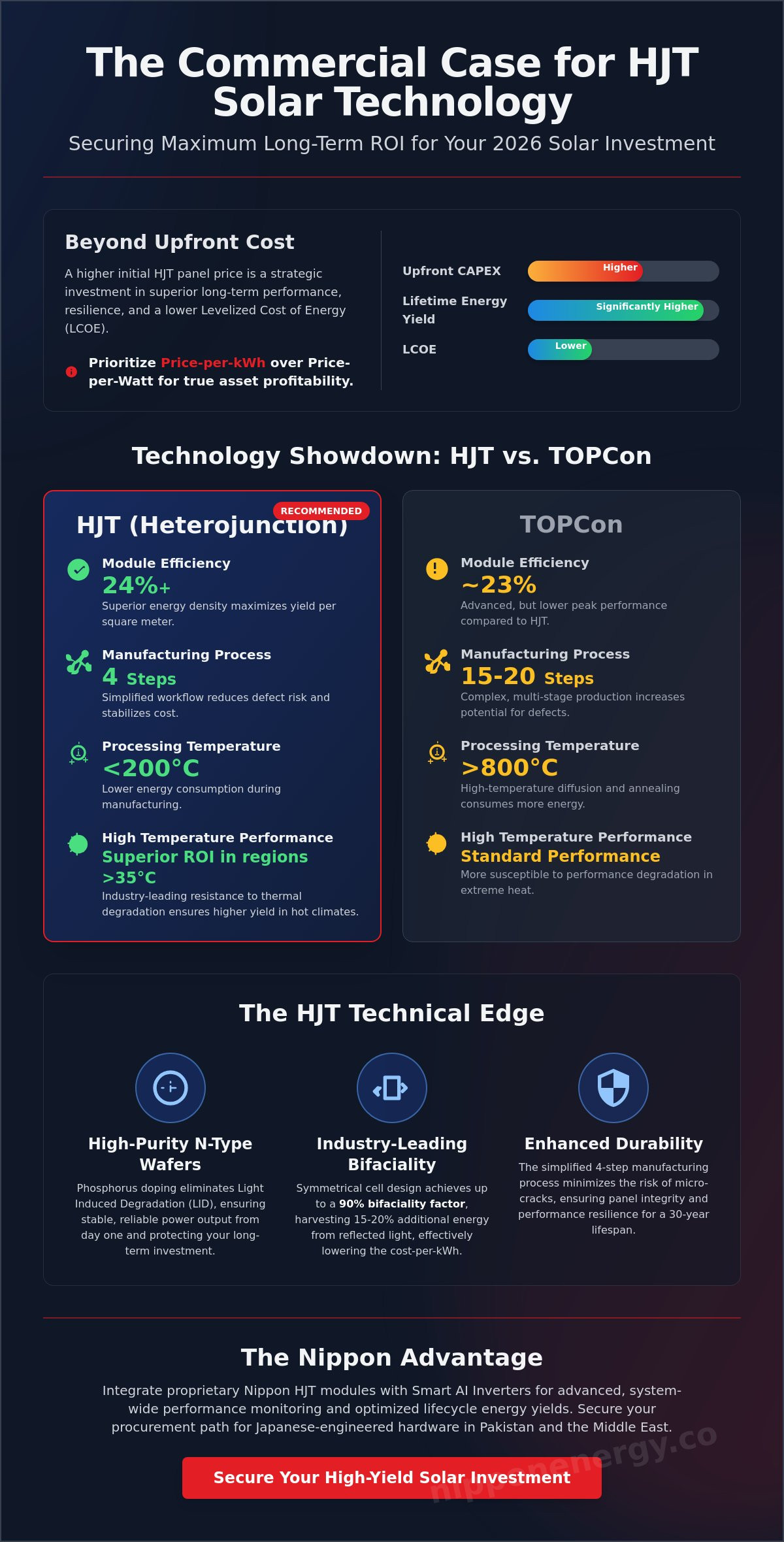
The hjt solar panel price represents a strategic allocation of capital toward high-density energy production rather than a simple hardware expense. While legacy technologies like PERC or even advanced TOPCon modules offer lower entry points, Heterojunction (HJT) technology provides a superior efficiency benchmark, often exceeding 23.5% to 24% in premium 2026 production models. This performance advantage stems from the combination of crystalline silicon and amorphous silicon thin films, which creates a high-performance cell with minimal energy loss. The 2026 market landscape has been influenced by a 30% surge in silver prices, which disproportionately affects HJT cells due to their double-sided metallization requirements. Choosing HJT means prioritizing the price-per-kWh over the price-per-watt, a metric that more accurately reflects the long-term profitability of a solar asset.
Developers often find that the initial capital expenditure is offset by the module's resilience. HJT's simplified manufacturing process reduces the risk of micro-cracks during production, which preserves the structural integrity of the panel before it even reaches the site. This reliability ensures that the premium paid at procurement translates into a lower Levelized Cost of Energy (LCOE) over the system's 30-year lifespan. By focusing on the energy density per square meter, commercial projects can achieve higher yields on limited roof or ground space, making the higher upfront cost a logical choice for maximizing land value.
The Economics of High-Efficiency N-Type Wafers
High-purity monocrystalline N-type wafers serve as the foundational core of every Nippon HJT module. These wafers require more intensive refinement processes than P-type alternatives, which naturally elevates the initial procurement cost. However, the adoption of thinner wafers, now reaching 130 to 140 microns, helps mitigate these costs by reducing raw silicon consumption without sacrificing performance. N-type silicon's phosphorus doping eliminates the boron-oxygen complexes responsible for Light Induced Degradation, ensuring stable power output from the first hour of exposure. This purity results in a significantly lower degradation rate, protecting the initial investment from the performance drop-offs common in lower-tier hardware.
Bifaciality Gains: Unlocking Hidden Value
The symmetrical design of HJT cells allows for an industry-leading bifaciality factor of up to 90%. Most standard bifacial modules struggle to exceed 70% to 80%, leaving significant energy unharvested. By capturing reflected light from the rear surface, Nippon HJT panels generate additional power that effectively lowers the real-world hjt solar panel price per unit of energy produced. When factoring in a conservative 15% to 20% bifacial gain from ground-reflected light, the effective cost of the module is distributed across a much larger volume of energy. This secondary generation makes HJT particularly effective in utility-scale projects where albedo effects from sand or specialized ground covers can be fully exploited to maximize ROI.
Technical Architecture: What Determines HJT Solar Panel Manufacturing Costs?
The streamlined manufacturing process of Heterojunction technology represents a significant departure from the complex, multi-stage production lines of legacy P-type cells. While PERC and TOPCon architectures require between 15 and 20 distinct processing steps, HJT manufacturing requires only four primary stages. This simplified workflow minimizes the probability of process-induced defects, which directly stabilizes the hjt solar panel price by improving factory throughput and reducing yield losses. A detailed manufacturing cost analysis confirms that while equipment costs are higher, the reduction in operational complexity provides a long-term hedge against labor and energy inflation.
Energy consumption during production serves as a critical variable in the final hardware cost. HJT cells are processed at temperatures below 200°C, whereas TOPCon cells require high-temperature diffusion and annealing reaching 800°C or higher. This low-temperature environment preserves the structural integrity of the thin N-type wafers and reduces the factory's carbon footprint. To combat the 30% surge in silver prices seen in 2025, Nippon utilizes advanced silver-coated copper technology. This innovation replaces a portion of the expensive silver paste with high-conductivity copper, allowing us to maintain competitive pricing without compromising the electrical conductivity of the cell's metallization layers. Transparent Conductive Oxide (TCO) layers further enhance the architecture by providing a protective barrier that prevents moisture ingress, ensuring the cell remains durable in high-humidity environments.
Symmetry and Stress: Preventing Micro-cracks
The symmetrical cell structure of hjt solar cell efficiency provides a balanced mechanical profile that resists the stresses of thermal expansion. Unlike asymmetrical cells that warp under heat, HJT's uniform layers reduce the risk of micro-cracks during transportation and installation. Nippon reinforces this resilience by utilizing double-glass encapsulation for all HJT modules. This design protects the active layers from PID (Potential Induced Degradation) and ensures that the hjt solar panel price you pay today is protected by a hardware shell designed for a 30-year operational life. Strategic procurement managers often pair these modules with Nippon Smart AI Inverters to maximize the efficiency of the entire electrical architecture.
SMBB and Busbar Evolution in 2026
The transition from 12BB (Busbar) to Super Multi-Busbar (SMBB) designs has redefined the internal economics of the HJT module. By utilizing 16 or more micro-wires, SMBB technology reduces the distance that electrons must travel to reach a busbar, which significantly lowers internal resistance. This configuration also reduces shading on the cell surface, effectively increasing the value-per-watt of the hardware. These metallization innovations allow for a higher energy density within the same physical footprint, ensuring that every square centimeter of the panel contributes to your project's ROI.
Commercial Analysis: HJT vs. TOPCon Pricing and Long-Term ROI
Evaluating the hjt solar panel price requires a shift from short-term procurement logic to long-term asset management. While the initial capital requirement for a hjt vs topcon installation differs, the performance gap widens every year the system remains in operation. TOPCon modules currently dominate the mid-market due to their lower manufacturing costs, yet they suffer from a steeper annual degradation rate of approximately 0.4%. In contrast, Nippon HJT modules maintain a superior degradation profile of only 0.25% per year. This 0.15% annual delta might seem marginal in year one, but it compounds into a significant power generation advantage by year twenty five.
Levelized Cost of Energy (LCOE) calculations demonstrate that HJT often provides a lower cost per unit of electricity despite the higher hardware price. This outcome is driven by the superior bifaciality and the architecture's inherent stability. When investors analyze the total energy harvested over the 30-year warranted life of a Nippon system, the higher hjt solar panel price is frequently offset by the sheer volume of additional kilowatt-hours delivered. High-purity N-type silicon ensures the system doesn't succumb to the same degradation curves as lower-tier P-type alternatives.
Thermal Performance and Yield in High-Heat Climates
Real-world performance in regions like Karachi or Riyadh exposes the limitations of Standard Test Conditions (STC). STC ratings are measured at 25°C, a temperature rarely seen during peak production hours in desert environments. HJT technology features a temperature coefficient of -0.26%/°C, which is notably more resilient than the -0.30%/°C typical of TOPCon modules. As ambient temperatures climb above 35°C and cell temperatures reach 65°C, HJT panels retain a higher percentage of their rated power. This thermal stability ensures that energy harvest gains remain consistent during the most demanding summer months, providing a more reliable revenue stream for utility-scale developments.
Lifecycle ROI: The 25-Year Financial Outlook
The bankability of a solar project depends on predictable long-term yields and the strength of the underlying hardware warranties. Nippon HJT modules offer a 30-year power output warranty, providing a decade of additional security beyond legacy standards. HJT modules can produce up to 10% more lifetime energy than PERC. This increased cumulative yield simplifies the path to project financing by reducing the risk of premature power loss. By integrating these high-performance modules with Nippon Smart AI Inverters, operators can ensure that every percentage point of efficiency is captured and converted into commercial value.
Regional Procurement: Buying HJT Solar Panels in Pakistan and the Middle East
The regional hjt solar panel price in 2026 reflects a complex interplay between global silver volatility and localized import dynamics. In Pakistan, the market has transitioned rapidly toward N-type architectures, with current benchmarks for high-efficiency bifacial modules hovering around 42 PKR per watt for established brands as of May 2026. Developers in the Middle East are seeing CIF (Cost, Insurance, and Freight) prices between $0.09 and $0.13 per watt peak, driven by the massive scale of ground-mounted projects in the region. Navigating these procurement channels requires a sophisticated understanding of import duties and the logistical requirements for Japanese-engineered hardware. Nippon Energy streamlines this process by maintaining a robust operational presence in Lahore, Karachi, and Dubai, ensuring that monumental technology is accessible to local developers.
Bankability remains the primary hurdle for utility-scale solar farms. Lenders and international financiers prioritize Tier 1 certified hardware to mitigate technical risks over a 25-year term. Because HJT modules utilize a more complex manufacturing process than standard TOPCon, verifying the origin and quality of every cell is essential for project approval. Nippon's commitment to transparency allows developers to secure financing more easily, as our hardware meets the rigorous standards required by global banking institutions. By providing a direct procurement path, we eliminate the middleman markups that often inflate the hjt solar panel price for regional buyers.
Logistics and Quality Control in South Asia
The South Asian market is frequently clouded by confusion over "A-Grade" and "B-Grade" hardware, a distinction that often masks sub-par performance or micro-cracks. Nippon Energy eliminates this ambiguity through stringent quality assurance protocols for every shipment arriving in Lahore or Karachi. We coordinate closely with local solar epc services to ensure that the transition from container to mounting structure is handled with engineering precision. This integrated approach reduces installation overheads and prevents the costly delays associated with damaged or counterfeit hardware.
Utility-Scale vs. Residential Pricing Structures
Volume-based pricing tiers allow industrial parks and large-scale solar farms to achieve significant economies of scale. While residential users pay a premium for the high efficiency of HJT in limited spaces, utility-scale projects benefit from bulk procurement agreements that lower the per-unit cost. Lenders in 2026 show a clear preference for high-yield N-type technology because the superior energy density translates to faster debt servicing. To achieve maximum energy independence, many commercial clients are now integrating their HJT arrays with Nippon Lithium-ion Battery Storage Systems, creating a resilient microgrid that functions independently of volatile utility rates.
Ready to secure high-performance hardware for your next project? Contact Nippon Energy today to receive a tailored procurement quote for your 2026 solar investment.
The Nippon Advantage: Engineered for Monumental Performance
Nippon's proprietary HJT architecture is designed to exceed the specifications found on standard industry data sheets. While competitors focus on peak wattage in controlled environments, our engineering team prioritizes the actual energy harvest in volatile climates. This approach ensures that the hjt solar panel price you pay reflects a precision instrument rather than a commodity. By integrating our modules with Nippon Smart AI Inverters, operators benefit from real-time yield optimization that adjusts to environmental shifts. This synergy between hardware and intelligence maximizes the efficiency of the entire N-type array and ensures that every photon is converted with minimal loss.
Protecting a 30-year asset requires more than just high-quality glass and silicon. Our comprehensive solar system maintenance protocols are designed to safeguard your investment against the environmental stressors common in South Asia and the Middle East. Regular performance audits and automated monitoring ensure that any deviation from expected output is addressed before it impacts your ROI. This total asset management philosophy transforms a simple procurement into a long-term partnership for energy security, allowing developers to focus on growth while we manage the structural integrity of the generation source.
Japanese Engineering Excellence
The philosophy of "Quiet Power" defines our approach to research and development. We prioritize technical reliability and structural integrity over marketing hype, focusing on the metrics that matter to utility-scale investors. Our Tokyo-based R&D center continuously refines regional hardware specifications to meet the specific requirements of desert environments and high-humidity coastal zones. This commitment to excellence extends to our NipponHev systems, which are engineered to future-proof your energy infrastructure against evolving grid requirements and technological shifts. By choosing Nippon, you are investing in a legacy of precision that ensures long-term resilience.
Next Steps: Securing Your 2026 Allocation
Securing a 2026 allocation for high-efficiency modules requires early coordination with our technical team. Our consultation process for commercial and industrial solar projects begins with a granular analysis of your site's specific irradiance and thermal profiles. We provide detailed performance simulations that illustrate how the hjt solar panel price translates into a competitive LCOE for your specific application. Once installed, our technical support teams provide ongoing performance monitoring to ensure your system operates at peak capacity throughout its entire operational life.
Ready to elevate your energy strategy with monumental performance? Contact Nippon Energy for a comprehensive HJT procurement proposal and secure your path to high-yield energy independence.
Architecting Long-Term Resilience in the 2026 Solar Market
The 2026 solar landscape demands a transition from simple commodity procurement to strategic asset architecture. High-performance energy systems require a calculated balance of efficiency and durability to withstand the volatile climate conditions of the next decade. Investing in Japanese-engineered HJT architecture ensures that your project maintains industry-leading yields while benefiting from Tier 1 bankability. Although the upfront hjt solar panel price is influenced by advanced metallization and N-type refinement, the long-term Levelized Cost of Energy remains the most accurate metric of financial success.
Nippon Energy provides the technical prowess and global scale necessary to future-proof large-scale solar farms. Our established presence in Tokyo, Dubai, and Karachi allows for seamless logistics and direct support during every phase of project development. It's our mission to provide the structural integrity and performance monitoring required to turn visionary goals into stable, high-yield assets. We're ready to empower your next large-scale venture with engineering excellence.
Request a Custom HJT Procurement Quote for Your 2026 Project
Frequently Asked Questions
What is the current average HJT solar panel price per watt in 2026?
The average hjt solar panel price in Pakistan is approximately 42 PKR per watt as of May 2026. In the Middle East market, procurement costs for high-efficiency modules typically range between $0.09 and $0.13 per watt peak CIF. These figures reflect the market correction following the 30% surge in silver prices during 2025.
Why is HJT technology more expensive than TOPCon?
HJT modules require high-purity N-type silicon wafers and specialized low-temperature manufacturing equipment that differs from standard production lines. The architecture also utilizes double-sided metallization, which traditionally consumes more silver paste. Nippon mitigates these costs by utilizing silver-coated copper technology to maintain high conductivity while reducing precious metal reliance.
Can I use HJT panels for small residential systems, or are they only for solar farms?
HJT panels are suitable for both residential rooftops and utility-scale solar farms. While the upfront investment is higher, residential users with limited roof space benefit from efficiency ratings exceeding 24%. This high energy density allows for a smaller physical footprint while delivering the power output of a much larger conventional array.
How much extra energy does an HJT panel produce in high-temperature climates like Pakistan?
HJT modules provide a significant yield advantage in high-heat environments due to a superior temperature coefficient of -0.26%/°C. Conventional TOPCon modules typically degrade at a rate of -0.30%/°C or higher. In regions like Karachi or Multan, where cell temperatures frequently exceed 65°C, HJT panels retain more of their rated power to ensure consistent energy harvest.
What is the typical payback period for the HJT price premium?
The payback period for the HJT premium is typically shortened by the module's 10% higher lifetime energy yield compared to PERC technology. Because Nippon HJT panels feature a lower annual degradation rate of 0.25%, the system produces more electricity over its 30-year warranted life. This increased cumulative generation lowers the Levelized Cost of Energy (LCOE) and accelerates the return on capital.
Is Nippon Energy an HJT manufacturer or an EPC provider?
Nippon Energy functions as a comprehensive technology partner that sells Nippon HJT Solar Panels and provides integrated Solar Project Development and EPC services. We manage the entire lifecycle of the solar asset, from the initial procurement of Japanese-engineered hardware to long-term system maintenance and monitoring. This ensures that the technical specifications of the modules are perfectly aligned with the project's engineering requirements.
Do HJT panels require special inverters or mounting structures?
HJT modules are compatible with standard mounting structures but perform best when integrated with Nippon Smart AI Inverters. These inverters are specifically designed to manage the high current and bifacial gains inherent in N-type architectures. Using an integrated power string ensures that the intelligence of the inverter can optimize the high-efficiency output of the HJT cells.
How does the bifaciality of HJT panels affect the total system price?
The high bifaciality factor of up to 90% reduces the effective hjt solar panel price when measured by total energy produced over time. By capturing reflected light from the rear surface, the panels generate additional power that standard mono-facial modules ignore. This secondary energy stream lowers the cost-per-kWh, making the system more profitable in utility-scale applications with high-albedo ground covers.


