

A single percentage point in conversion efficiency represents the divide between a standard asset and a high-performance energy infrastructure. By April 2026, the record for hjt solar cell efficiency reached 28.13%, confirming that heterojunction technology is a fundamental structural evolution rather than a marginal gain. You're likely balancing the higher initial capital expenditure against the degradation risks inherent in high-temperature regions. It's a complex calculation that demands precise technical validation before you commit to utility-scale projects.
This analysis provides the clarity required to master HJT’s technical advantages, including its symmetrical architecture and its industry-leading bifaciality of up to 95%. We'll explore 2026 efficiency benchmarks, evaluate the physics behind a -0.24%/°C temperature coefficient, and deliver the metrics necessary to secure your next-generation energy portfolio. By understanding the interaction between amorphous and crystalline silicon layers, you'll gain the technical foundation to choose the most resilient platform for long-term power generation.
Key Takeaways
- Analyze the "sandwich" architecture of HJT cells to understand how multi-layer passivation and Transparent Conductive Oxide (TCO) layers drive superior conversion rates.
- Master the 2026 benchmarks for hjt solar cell efficiency to evaluate the long-term ROI of high-performance N-type photovoltaics versus mainstream alternatives.
- Quantify the real-world energy yield benefits of HJT’s thermal stability, focusing on how reduced degradation rates preserve asset value in high-heat environments.
- Distinguish between the theoretical efficiency ceilings of HJT and TOPCon to make data-driven decisions for utility-scale solar project development.
- Learn how to integrate Nippon HJT Solar Panels with advanced AI-driven monitoring systems to ensure peak operational performance across the entire system lifecycle.
The Engineering of HJT: Defining the Next-Generation Efficiency Standard
Heterojunction technology represents the convergence of two distinct photovoltaic disciplines: crystalline silicon and thin-film silicon. Unlike traditional homojunction P-type cells that rely on a single material structure, HJT utilizes a high-performance hybrid architecture. This design eliminates many of the electrical losses inherent in standard monocrystalline designs, positioning Heterojunction solar cell technology as the premier platform for utility-scale energy production. In 2026, mass-produced HJT modules have established a commercial efficiency baseline of 24% to 26%, providing a significant performance delta over legacy technologies.
Standard P-type cells are limited by their asymmetrical homojunction structure, which creates high surface recombination and restricts voltage potential. HJT's symmetrical design facilitates a streamlined manufacturing process while maximizing photon capture across a broader spectrum. This architecture isn't just an incremental update; it's a visionary platform. It provides the essential bottom-cell foundation for perovskite tandem structures, which are projected to push efficiencies beyond 30% in the coming decade. By adopting this structure, Nippon Energy ensures that large-scale infrastructure remains compatible with future technological shifts.
The Hybrid Advantage: Crystalline Meets Thin-Film
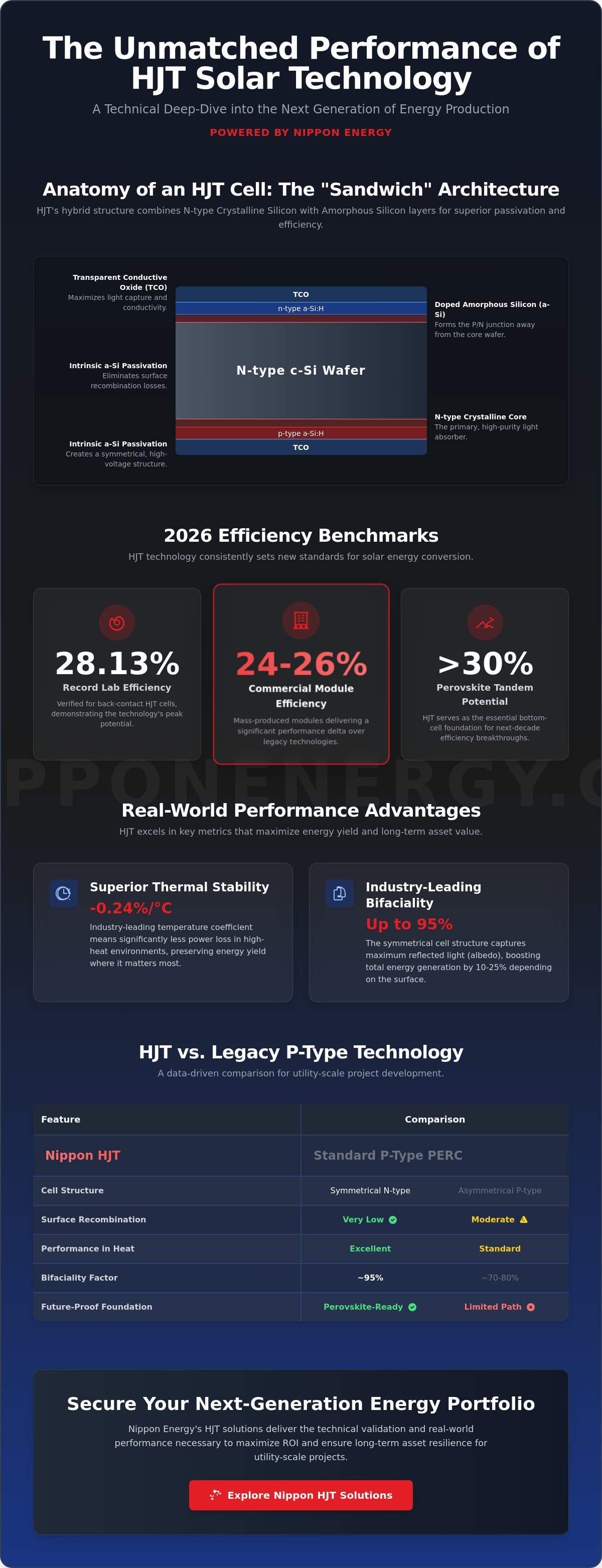
At the core of every HJT cell is an N-type monocrystalline silicon wafer. This core is encapsulated between layers of intrinsic and doped amorphous silicon (a-Si). These thin-film layers provide near-perfect surface passivation, which reduces surface recombination and allows the cell to maintain a higher open-circuit voltage than standard PV. This hybrid approach enables the cell to exceed the theoretical limits of pure crystalline silicon, ensuring that hjt solar cell efficiency remains resilient even as environmental stressors increase.
Efficiency Milestones and 2026 Projections
The gap between laboratory potential and commercial reality has narrowed significantly. In April 2026, researchers verified a record 28.13% efficiency for back-contact HJT cells, while standard configurations achieved 27.08%. Under current 2026 metrics, hjt solar cell efficiency is defined as the precise ratio of total incident solar energy converted into usable electrical power, with mass-produced modules now consistently delivering between 24% and 26%. The roadmap toward a 28% commercial average is already in motion, driven by advanced metallization and the transition to wafers as thin as 100 micrometers.
Anatomy of an HJT Cell: How Multi-Layer Passivation Drives Conversion Rates
The structural integrity of a Heterojunction cell relies on a sophisticated sandwich architecture that transcends the limitations of traditional photovoltaics. At the center of this stack lies an N-type monocrystalline silicon wafer, which acts as the primary absorber. Unlike standard cells where metal contacts touch the silicon directly, HJT encapsulates the core within ultra-thin layers of amorphous silicon. This specific arrangement creates a high-performance barrier that prevents energy leakage. By isolating the crystalline core from the metallic grid, the architecture achieves a level of electrical precision that is impossible with older homojunction designs.
This multi-layer approach is the fundamental reason why hjt solar cell efficiency consistently outperforms P-type alternatives in 2026. The symmetry of the cell doesn't just improve carrier collection; it simplifies the manufacturing sequence into a streamlined, low-temperature process. This avoids the thermal stress associated with traditional diffusion, preserving the high quality of the silicon wafer. Selecting Nippon HJT Solar Panels ensures your infrastructure benefits from this high-durability, low-degradation engineering while maximizing energy density per square meter.
Passivation Excellence: Eliminating Recombination
Recombination remains the primary obstacle to maximizing energy conversion. In standard PERC cells, surface defects allow charge carriers to recombine before they can be harvested as electricity. HJT solves this through advanced passivation. Thin layers of intrinsic amorphous silicon neutralize surface defects, leading to an exceptionally high Open-Circuit Voltage (Voc) often exceeding 750mV. This superior Voc is a critical driver of hjt solar cell efficiency, allowing the system to maintain high power output even when solar irradiance is suboptimal.
Transparent Conductive Oxide (TCO) and Light Management
Because amorphous silicon layers have low electrical conductivity, HJT cells require a Transparent Conductive Oxide (TCO) layer to facilitate charge transport. Typically composed of Indium Tin Oxide (ITO), the TCO acts as a bridge between the silicon and the metal electrodes. It's engineered for maximum optical transparency, ensuring that photons reach the absorber without being reflected or absorbed by the conductive layers. According to the NREL efficiency chart, the evolution of these carrier-selective contacts has been the catalyst for recent record-breaking N-type performance. Modern 2026 designs further optimize this by utilizing Zero-Busbar (0BB) technology. This configuration replaces traditional wide silver busbars with a dense mesh of ultra-thin wires, reducing shading losses and silver consumption simultaneously.
Structural Durability and PID Resistance
The HJT architecture provides inherent resilience against Potential Induced Degradation (PID). The insulating properties of the amorphous silicon layers, combined with the TCO, prevent the leakage currents that typically cause performance drops in high-voltage utility-scale arrays. This structural stability ensures that the high conversion rates achieved on day one remain consistent over a 30-year operational lifecycle, providing a secure foundation for large-scale energy investments.
HJT vs. TOPCon: Efficiency Benchmarks and Performance Divergence in 2026
The transition from P-type to N-type photovoltaics has reached its maturity in 2026, centering on the competition between TOPCon and Heterojunction (HJT). While TOPCon has secured the majority of the market share due to its lower manufacturing complexity, HJT has emerged as the definitive choice for high-yield energy infrastructure. This divergence is rooted in the theoretical efficiency ceilings of each technology. TOPCon approaches its practical limit near 28.7%, whereas HJT, supported by continuous HJT solar cell efficiency research, provides a roadmap toward 29% and beyond when integrated with back-contact designs.
Choosing between these platforms involves a trade-off between upfront CAPEX and long-term energy density. TOPCon serves as a cost-effective mainstream solution, but HJT represents a calculated investment in superior energy yield. The structural symmetry of HJT cells minimizes mechanical stress during thermal cycling, ensuring the system remains stable over a 30-year operational lifecycle. This "quiet power" of HJT is what makes it the preferred architectural foundation for projects where longevity and maximum performance are non-negotiable.
Conversion Efficiency and Power Output
In 2026, peak module wattage for HJT has consistently outpaced TOPCon in commercial deployments. While TOPCon modules typically offer efficiencies around 22.5% to 23%, HJT modules are now delivering 24% to 26% in standard configurations. A primary driver of this performance gap is the bifaciality factor. HJT cells achieve a bifaciality of up to 95%, significantly outperforming the 80-85% seen in TOPCon. For a detailed technical breakdown of these two architectures, consult our guide on HJT vs TOPCon: Comparing the Pinnacle of N-Type Solar Technology in 2026. This increased rear-side capture ensures that hjt solar cell efficiency translates into higher total kilowatt-hours per kilowatt-peak installed.
Degradation and Lifespan Reliability
Reliability is where HJT establishes its most significant lead. Because HJT uses N-type wafers, it's inherently immune to Light Induced Degradation (LID), a common failure mode in older P-type systems. The annual degradation rate for HJT is just 0.25%, compared to the industry standard of 0.45% for TOPCon and PERC. Over a 30-year period, this delta results in substantially higher residual asset value. The symmetrical structure of the cell also provides enhanced resistance to mechanical stress, reducing the risk of micro-cracks during extreme weather events. By maintaining hjt solar cell efficiency over decades, these panels provide a more predictable and resilient energy output for large-scale utility projects.
Real-World Energy Yield: Temperature Coefficients and Bifaciality in Practice
Laboratory benchmarks establish a baseline for potential, but real-world energy yield determines the actual return on investment for large-scale infrastructure in Pakistan. In environments where ambient temperatures regularly exceed 40°C, the theoretical advantages of HJT architecture translate into measurable power retention. This isn't merely about peak efficiency; it's about the resilience of that efficiency under extreme thermal stress. By maintaining a stable output when other technologies falter, hjt solar cell efficiency ensures a more predictable and higher total energy harvest over the project's lifecycle.
The performance delta becomes most apparent when analyzing the specific climates of regions like Sindh and Southern Punjab. In cities like Karachi, Multan, or Sukkur, solar assets must endure prolonged exposure to high heat and high albedo environments. HJT is engineered to thrive in these conditions, utilizing its hybrid structure to minimize the internal resistance that typically plagues standard photovoltaics. To secure the maximum yield from these high-performance assets, integrating Nippon HJT Solar Panels into your EPC strategy provides a calculated advantage in long-term power generation.
Thermal Resilience in Extreme Environments
The physics of HJT’s thermal stability is rooted in its low temperature coefficient, which is typically rated at -0.26%/°C. To quantify the impact, consider a utility-scale array operating in the intense heat of Multan with a cell temperature of 65°C. At this temperature, a standard PERC panel with a coefficient of -0.40%/°C suffers a 16% power loss relative to its nameplate capacity. In contrast, an HJT panel loses only 10.4%. This 5.6% difference in power retention directly increases the kilowatt-hours produced per kilowatt-peak installed, making HJT the superior architectural choice for high-temperature energy infrastructure in Pakistan.
Bifacial Gain: Capturing Reflected Efficiency
HJT’s symmetrical design allows for a bifaciality factor of up to 95%, which is the highest in the current commercial market. The near-perfect symmetry of the HJT architecture transforms the rear side of the panel into a high-efficiency generator, allowing it to harvest reflected irradiance with nearly the same precision as the front surface. In environments with high-albedo surfaces like light-colored soil, gravel, or concrete common in industrial zones, this rear-side contribution can boost total energy yield by an additional 10% to 15%. This synergy between ground reflection and cell symmetry maximizes the utility of the entire module area, ensuring that hjt solar cell efficiency isn't limited to direct sunlight alone.
Low-Light Performance and Grid Stability
Beyond peak sun hours, HJT demonstrates exceptional performance during dawn, dusk, and the monsoon-related overcast conditions frequent in regions like Lahore or Islamabad. The amorphous silicon layers respond more effectively to diffuse and low-intensity light than traditional crystalline silicon. This extends the daily generation window, providing a smoother power curve that eases the burden on grid management systems. When paired with Nippon Lithium-ion Battery Storage Systems, this extended production window ensures a more reliable and consistent energy supply, reinforcing the stability of large-scale power portfolios.
Nippon Energy HJT Solutions: Implementing High-Efficiency Infrastructure
Transitioning from theoretical benchmarks to industrial implementation requires a partner capable of executing high-density energy projects across Pakistan. Nippon Energy bridges the gap between laboratory potential and commercial reality by merging Japanese precision engineering with local deployment expertise. Our 2026 hjt solar cell efficiency standards are operational realities integrated into every Nippon HJT Solar Panel. These modules are designed to serve as the high-performance anchor for utility-scale portfolios, providing the stability and energy density required for the evolving national grid.
Maximum system performance is achieved through the technical synergy of HJT modules and Nippon Smart AI Inverters. These inverters utilize advanced machine learning algorithms to track the specific voltage curves of heterojunction cells, ensuring the Maximum Power Point (MPP) is maintained even during rapid irradiance fluctuations. This intelligence, paired with our Nippon Lithium-ion Battery Storage Systems, creates a resilient energy ecosystem. By stabilizing output and optimizing discharge cycles, we ensure that the high conversion rates of HJT technology are fully captured and utilized for industrial and commercial users.
The Nippon HJT Advantage
Our 2026 product line incorporates proprietary cell enhancements that focus on long-term durability and cost-efficiency. We've optimized the metallization process to reduce silver consumption without compromising electrical conductivity, ensuring that hjt solar cell efficiency remains economically viable for massive deployments. While HJT represents our premium architectural standard, we also offer Nippon TOPCon Solar Panels as a versatile alternative for project scopes with different capital expenditure requirements. Every module undergoes rigorous zero-defect manufacturing protocols, ensuring that every cell meets our stringent internal reliability benchmarks before reaching the field.
EPC and Maintenance for High-Efficiency Assets
Implementation excellence is the final safeguard for your energy investment. Because HJT cells utilize ultra-thin wafers and delicate amorphous silicon layers, they require specialized handling during the construction phase. Our Solar EPC Services optimize HJT performance from day one by employing methodical installation protocols that prevent mechanical stress and micro-cracking. This structured approach guarantees that the structural integrity of the array is preserved throughout the installation lifecycle.
Post-commissioning, our Solar System Maintenance and Monitoring services utilize AI-enhanced protocols to track performance at the string level. This allows for the real-time detection of any deviation from expected efficiency benchmarks, facilitating rapid corrective action. By combining high-tech architecture with disciplined maintenance, we protect the residual value of your solar assets over their 30-year operational lifespan. If you are ready to modernize your energy portfolio with the world's most advanced photovoltaic technology, partner with Nippon Energy for your next utility-scale project.
Architecting the Future of Global Energy Infrastructure
The evolution of N-type photovoltaics has clarified the choice for developers seeking the highest possible energy density in the region. Heterojunction architecture is no longer just a laboratory curiosity but the structural standard for assets requiring a 30-year operational horizon. By integrating these technical benchmarks into your procurement strategy, you ensure that hjt solar cell efficiency translates into a lower Levelized Cost of Energy (LCOE) across your entire portfolio. This shift represents a final move toward future-proofing energy infrastructure against the rising costs of maintenance and degradation.
Nippon Energy delivers Japanese engineering precision through a dedicated local EPC footprint serving the specific needs of Pakistan's industrial and utility sectors. We adhere to Tier 1 manufacturing standards to ensure every deployment meets the rigorous demands of the local climate. This methodical approach to technology and implementation provides the stability required for large-scale success. Explore Nippon HJT Solar Panel Specifications to secure the most advanced photovoltaic platform for your next project. The transition to high-efficiency energy begins with a commitment to structural excellence.
Frequently Asked Questions
What is the current theoretical limit for HJT solar cell efficiency?
The theoretical efficiency limit for a single-junction silicon HJT cell is approximately 29.4%. As of April 2026, laboratory records have reached 28.13% using back-contact architectures. This indicates that the technology is rapidly approaching its thermodynamic ceiling, leaving minimal room for further single-junction gains before transitioning to tandem structures.
How does HJT technology compare to TOPCon in terms of temperature coefficient?
HJT provides a superior temperature coefficient of -0.24%/°C to -0.26%/°C, while TOPCon typically ranges from -0.29%/°C to -0.30%/°C. This lower coefficient ensures that HJT modules maintain higher power output as cell temperatures rise during peak daylight hours. This thermal stability is a critical factor in reducing energy loss in utility-scale deployments.
Is HJT solar technology compatible with bifacial module designs?
HJT technology is inherently compatible with bifacial designs and currently achieves the industry's highest bifaciality factor of up to 95%. The symmetrical architecture of the cell allows the rear side to harvest reflected irradiance with nearly the same conversion precision as the front surface. This symmetry maximizes total energy yield when installed on high-albedo surfaces.
What are the primary materials used in the HJT cell 'sandwich' structure?
The HJT architecture consists of an N-type monocrystalline silicon wafer encapsulated by ultra-thin layers of intrinsic and doped amorphous silicon. A Transparent Conductive Oxide (TCO) layer, typically Indium Tin Oxide, is applied to facilitate charge carrier transport. This multi-layer stack prevents the metal contacts from touching the silicon directly, which significantly reduces electrical recombination losses.
Why is HJT considered more efficient in low-light conditions than PERC?
HJT outperforms PERC in low-light environments because its amorphous silicon layers respond more effectively to diffuse and low-intensity irradiance. The wider bandgap of these layers allows the cell to begin generating power earlier at dawn and continue later into dusk. This characteristic extends the daily operational window, resulting in a higher cumulative energy harvest over the year.
What is the expected degradation rate of an HJT solar panel over 30 years?
The expected annual degradation rate for HJT modules is approximately 0.25%, which is significantly lower than the 0.45% industry average for P-type panels. Over a 30-year lifecycle, this stability ensures that the system retains roughly 92% of its original nameplate capacity. This long-term resilience is a primary driver for the bankability of large-scale HJT energy infrastructure.
Can HJT efficiency be further improved using perovskite tandem structures?
HJT is the premier candidate for the bottom cell in perovskite tandem structures, which are engineered to push hjt solar cell efficiency beyond the 30% threshold. The low-temperature manufacturing process of HJT is essential for this integration. It prevents thermal damage to the sensitive perovskite layers during the stacking sequence, creating a stable, high-performance dual-junction device.
Why is HJT technology preferred for solar projects in hot climates like Pakistan or the UAE?
HJT is preferred in hot climates because its low temperature coefficient minimizes the power drop-off that occurs when ambient temperatures exceed 40°C. In regions like Pakistan or the UAE, where thermal stress is a constant operational challenge, the resilience of hjt solar cell efficiency ensures maximum energy density. This performance stability directly translates into a more predictable and higher return on investment.


