A utility-scale solar facility isn't a construction event; it's a 25-year high-performance energy asset that requires total technical foresight long before the first module is commissioned. You likely recognize that the complexity of EPC coordination and the looming risk of technology obsolescence can jeopardize even the most robust financial models. This reality makes a disciplined approach to the solar project lifecycle essential for maintaining a competitive edge as North American PPA prices reach an average of $64.49/MWh.
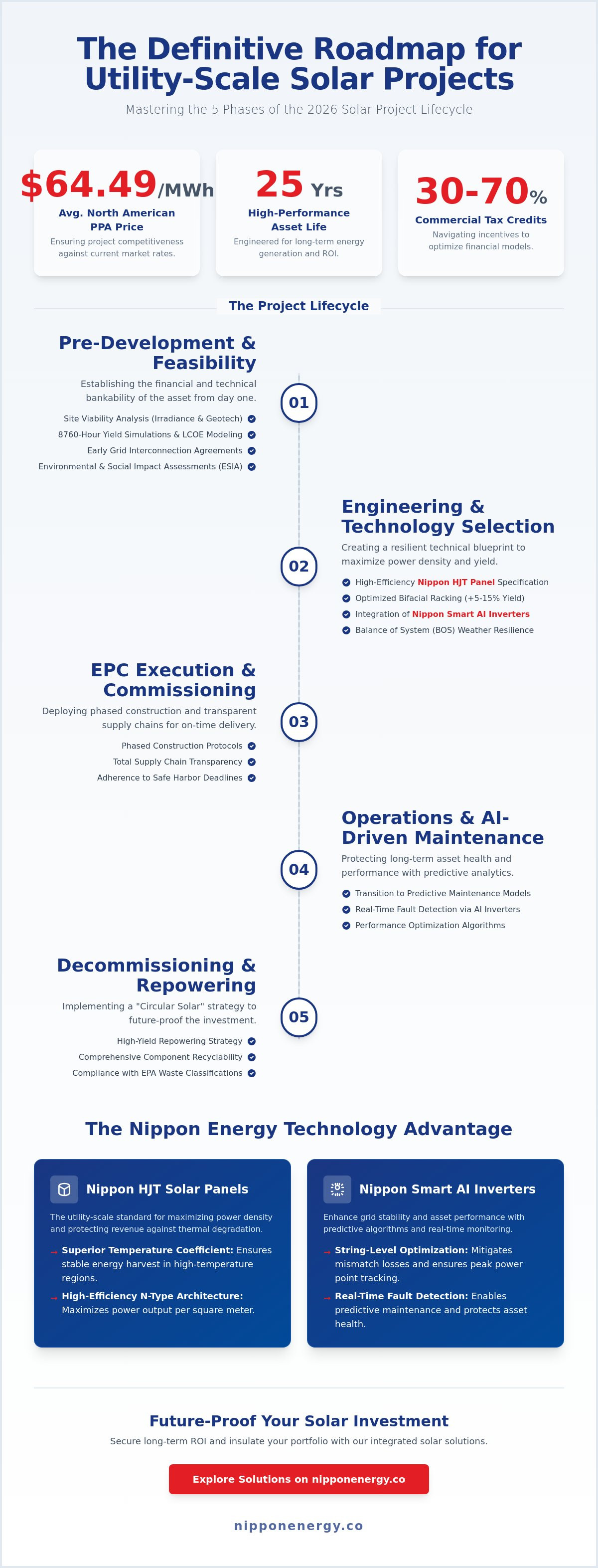
This article provides the definitive roadmap for project execution, designed to help you master the engineering and financial milestones necessary for success in 2026. You'll learn how to navigate the 30% to 70% commercial tax credit landscape, manage the July 4 safe harbor deadline, and integrate advanced technologies like perovskite-silicon tandem cells. We'll preview the entire trajectory from initial feasibility through to the new EPA universal waste classifications for decommissioning. By the end of this reference, you'll have the clarity needed to secure long-term ROI while insulating your portfolio against grid interconnection delays and shifting domestic content requirements.
Key Takeaways
- Establish a robust foundation by integrating irradiance data and geotechnical conditions into your initial financial modeling to ensure site viability.
- Enhance project yield through technical selection, utilizing Nippon HJT panels and optimized bifacial racking configurations to mitigate temperature-related losses.
- Master the complete solar project lifecycle by implementing phased construction protocols and ensuring total supply chain transparency during EPC execution.
- Protect long-term asset health by transitioning to predictive maintenance models and utilizing Nippon Smart AI Inverters for real-time fault detection.
- Future-proof your investment with a "Circular Solar" strategy that prioritizes high-yield repowering and comprehensive component recyclability at the end of the asset's term.
Phase 1: Pre-Development and Feasibility Architecture
Phase 1 represents the critical juncture where site viability, grid capacity, and financial modeling converge to determine an asset's long-term bankability. In the 2026 energy market, this foundational stage dictates the trajectory of the entire solar project lifecycle. Site selection isn't merely about land availability; it requires a granular analysis of high-resolution irradiance data and local geotechnical conditions. For projects in high-temperature regions like the Middle East or South Asia, understanding how heat affects various solar power technologies is paramount. High ambient temperatures can significantly degrade performance, making the selection of resilient hardware a pre-development priority rather than a construction-phase afterthought.
Securing early grid interconnection agreements is the primary defense against the 'Zombie Project' risk. These are stalled developments that consume capital but lack a clear path to energization. Additionally, Environmental and Social Impact Assessments (ESIA) have transitioned from optional compliance to a mandatory prerequisite for securing international financing. Lenders now demand evidence of minimal ecological disruption and positive social integration before committing capital to utility-scale ventures. This phase ensures that the project's structural integrity aligns with global investment standards from day one.
Techno-Economic Feasibility Studies
Precision in financial forecasting requires conducting 8760-hour yield simulations. These models predict annual energy production (AEP) by accounting for hourly weather variations and equipment degradation rates. Analysts must evaluate the Levelized Cost of Energy (LCOE) using current 2026 hardware pricing to ensure the project remains competitive against rising PPA rates, which hit $64.49/MWh in early 2026. This assessment must also integrate local regulatory incentives, such as the 30% to 70% commercial tax credits available in the U.S., to optimize the internal rate of return. A well-structured feasibility study transforms raw data into a reliable investment roadmap.
Grid Interconnection and Permitting
Successful grid integration depends on identifying substation proximity and the thermal capacity of existing transmission lines. In high-demand regions like the Middle East, managing the multi-year queue for grid access is a strategic necessity that requires early engagement with utility providers. Developers must secure land rights and zoning permits early to prevent mid-cycle legal delays that can derail a project's timeline. Without these established rights, even the most technically advanced facility remains a stranded asset. Project architects focus on securing these approvals as a primary milestone to ensure a seamless transition into the engineering and design phase.
Phase 2: Engineering, Design, and Technology Selection
Phase 2 translates initial feasibility into a rigorous technical blueprint. This engineering stage is where the long-term bankability of the solar project lifecycle is solidified. In 2026, the industry has pivoted toward high-efficiency N-type architectures to maximize power density. Specifically, Nippon HJT solar panels have become the standard for utility-scale assets due to their superior temperature coefficients. This technical feature ensures that energy harvest remains stable even as ambient temperatures rise; this directly protects the project's revenue stream against thermal degradation.
Engineering for bifaciality is another critical requirement for modern asset architecture. Designers must optimize site albedo and racking height to capture reflected light on the rear side of the module. This optimization can increase total energy yield by 5% to 15% depending on ground cover and row spacing. To manage this increased complexity, integrating Nippon Smart AI Inverters allows for string-level optimization and enhanced grid stability. These systems use predictive algorithms to mitigate mismatch losses and ensure the entire array operates at its peak power point. The Balance of System (BOS) engineering must also account for extreme weather resilience. Selecting high-durability mounting structures that can withstand increased wind loads is essential for a 25-year operational life. You can explore our full range of integrated solar solutions to see how these components work in unison.
Advanced Hardware Specification
The choice between TOPCon solar panels and HJT modules depends heavily on regional climate profiles and specific budget constraints. While TOPCon offers excellent efficiency for standard deployments, HJT is often preferred for its lower degradation rates and better performance in extreme heat. We also specify Nippon Lithium-ion Battery Storage Systems to provide peak-shaving and energy firming, which allows the asset to participate in ancillary service markets. Designers must prioritize low Light Induced Degradation (LID) to protect the long-term value throughout the solar project lifecycle and the broader lifecycle of photovoltaic systems.
Detailed Engineering Design (DED)
Detailed engineering moves beyond general concepts to create high-fidelity electrical schematics and site layouts using 3D modeling software. This process allows for precise shading analysis and cable routing; this minimizes resistive losses across the array. Engineers focus on optimizing DC-to-AC ratios to maximize inverter throughput without causing thermal clipping during peak production hours. Finally, the integration of SCADA (Supervisory Control and Data Acquisition) systems provides the necessary infrastructure for remote oversight. This digital layer is the backbone of modern asset management, enabling the transition from reactive to proactive maintenance protocols.
Phase 3: EPC Execution and Commissioning Protocols
Execution is the most capital-intensive phase of the solar project lifecycle, where theoretical designs transform into a physical energy asset. Success in this stage depends on a disciplined, phased construction approach that begins with civil works, including site grading and road infrastructure. Mechanical installation follows, involving the precise mounting of trackers and modules. Finally, electrical integration links the array to the inverters and substation. Executing solar epc services requires more than just labor management; it demands absolute supply chain transparency to ensure that every component meets the rigorous performance standards established during the design phase.
Quality assurance (QA) protocols are particularly vital when handling high-efficiency HJT or TOPCon modules. These advanced cells are sensitive to micro-cracking if handled improperly during the mounting process. Managing logistics for turnkey solar projects in remote locations adds another layer of complexity. Project managers must coordinate multi-modal transport and on-site storage to protect hardware from environmental exposure before installation. This execution phase aligns with the broader solar project development process, ensuring that the transition from a construction site to an energized power plant is seamless and documented.
Procurement and Supply Chain Management
Procurement in 2026 is defined by the need to mitigate lead-time risks for high-capacity AI inverters and transformers. Developers must also navigate new domestic content requirements; projects seeking the 10% Domestic Content Bonus Credit must source at least 40% of the system cost from non-foreign entities of concern (FEOC). We prioritize Tier 1 hardware verification to satisfy the stringent requirements of project lenders and insurers. Effective inventory management prevents costly delays, ensuring that large-scale solar farm components are available exactly when the construction sequence demands them.
The Commissioning Sequence
The commissioning sequence is the final technical hurdle before commercial operation. It begins with cold commissioning, where we test communication systems and protection relays without energization. Once safe, hot commissioning involves final grid synchronization and Performance Ratio (PR) testing to verify that the system meets its modeled output. Our engineers perform IV curve tracing and thermal imaging on every string to verify module integrity post-installation. This meticulous verification process ensures a clean project handover and establishes the performance baseline for the remainder of the solar project lifecycle.
Phase 4: Operations, Maintenance, and AI-Driven Monitoring
The operational stage of the solar project lifecycle represents the longest and most critical period for generating a return on investment. While legacy systems relied on reactive repairs, modern asset architecture demands a transition to solar system maintenance powered by predictive AI. Nippon Smart AI Management provides real-time fault detection by analyzing millions of data points across the array. It's a system that identifies underperforming strings and isolates anomalies before they impact the facility's total energy yield. This proactive approach ensures that minor technical issues don't escalate into systemic failures.
In arid environments, soiling losses can reduce efficiency by up to 20% in a single month. To combat this, we implement robotic dry-cleaning cycles that operate autonomously. These robots maintain peak transmissivity without the need for water; this is a vital consideration for sustainability in desert regions. Active module-level monitoring also allows operators to manage the 25-year degradation curve. By tracking the specific performance of N-type cells, we ensure the asset meets its promised power output throughout the entire solar project lifecycle.
Predictive vs. Preventive Maintenance
Machine learning algorithms now identify failing string components weeks before they go offline. This foresight allows for "just-in-time" repairs that minimize downtime. We also utilize drone-based thermography during scheduled inspections to pinpoint hot spots that are invisible to the naked eye. These thermal signatures often indicate localized cell defects or bypass diode failures. Managing spare parts inventory becomes a data-driven exercise; we stock components based on historical failure rate data to ensure rapid restoration of service.
Asset Management and Performance Optimization
Transparency is essential for maintaining investor confidence. Our reporting systems compare actual financial performance against the 8760-hour yield projections established in Phase 1. We also optimize Nippon Lithium-ion Battery Storage Systems by scheduling discharge cycles to capture peak energy prices. This strategy maximizes revenue while providing essential grid-firming services. Maintaining high availability above 99% is our standard, achieved through rapid-response field engineering teams. You can optimize your energy asset today with our Solar System Maintenance and Monitoring solutions.
Phase 5: Decommissioning, Recycling, and Repowering
The final stage of the solar project lifecycle is no longer viewed as a simple exit strategy but as a strategic pivot toward asset renewal or circular recovery. A "Circular Solar" approach mandates planning for 95% component recyclability from the initial design phase. This foresight ensures that at the end of the project's 30-year operational life, the site can be restored through rigorous land remediation and soil stabilization. Decommissioning requires significant financial assurance; average costs in 2026 have reached approximately $93,000 per megawatt. Managing this phase involves the safe dismantling of Nippon Lithium-ion Battery Storage Systems and the handling of hazardous materials according to ISO standards and evolving federal mandates.
Regulatory scrutiny has intensified as the first generation of utility-scale projects nears retirement. The U.S. Environmental Protection Agency (EPA) issued a Notice of Proposed Rulemaking in February 2026 to classify discarded solar panels as "universal waste" under the Resource Conservation and Recovery Act. This classification streamlines the recycling process while imposing stricter standards on the separation of high-value materials like silicon, silver, and aluminum. For developers, this means that end-of-life logistics must be integrated into the original asset architecture to avoid unforeseen compliance costs at the conclusion of the solar project lifecycle.
Repowering for Enhanced Yield
Repowering offers a high-ROI alternative to full decommissioning by replacing 15-year-old legacy PERC panels with high-efficiency Nippon TOPCon or HJT technology. This strategy allows owners to reuse existing racking, cabling, and grid infrastructure; this significantly reduces the CAPEX required for a secondary life cycle. By upgrading to 2026-era modules, a facility can often double its energy density within the same physical footprint. Our engineers manage these transitions through phased hardware swaps to prevent significant grid downtime, ensuring the asset continues to generate revenue while undergoing a technical rebirth.
Sustainable Decommissioning Protocols
Sustainable decommissioning focuses on industrial-grade recycling streams that reclaim raw materials for future manufacturing. Specialized waste streams now handle the complex chemistry of lithium-ion batteries, ensuring that rare earth metals are recovered rather than landfilled. In 2026, many regions have implemented mandatory recycling targets; for instance, Louisiana's revised decommissioning rules became effective on July 1, 2026. We verify all dismantling activities against these state-level and international standards to provide owners with a certified "green exit" that satisfies both environmental regulators and institutional investors.
Architecting the Future of Utility-Scale Assets
Managing a modern energy portfolio requires a shift from viewing solar as a construction event to treating it as a 25-year high-performance asset. Mastering the solar project lifecycle demands a fusion of technical foresight and operational discipline. You've seen how integrating N-type HJT modules and AI-driven monitoring systems can mitigate the risks of technology obsolescence while maximizing long-term yields. By addressing everything from grid interconnection bottlenecks to circular decommissioning protocols, you ensure your portfolio remains resilient against shifting regulatory and market conditions.
Nippon Energy brings Japanese engineering excellence to every phase of development. With a global EPC footprint spanning Dubai, Tokyo, and Karachi, we combine proprietary HJT hardware with advanced AI technology integration to deliver monumental results. We invite you to Partner with Nippon Energy for Your Next Utility-Scale Project to secure the structural integrity and future-proof performance of your energy assets. The potential for large-scale success is vast; we provide the tools to achieve it.
Frequently Asked Questions
What is the typical duration of a solar project lifecycle in 2026?
A utility-scale solar project lifecycle typically spans 25 to 30 years of active energy production. This operational period is preceded by a pre-development and construction phase that often lasts between two and five years depending on grid interconnection timelines. Modern engineering standards and high-performance hardware ensure that assets remain structurally sound and electrically efficient throughout this multi-decade term.
How do HJT solar panels impact the long-term lifecycle ROI?
Nippon HJT panels maximize long-term ROI by providing a superior temperature coefficient and lower annual degradation rates compared to legacy modules. These technical attributes ensure higher energy harvest in extreme climates; this results in a lower Levelized Cost of Energy (LCOE) over the 25-year lifespan. By maintaining peak performance longer than standard technologies, HJT modules protect the asset's revenue stream against thermal losses.
What are 'Zombie Projects' in the solar development queue?
'Zombie Projects' refer to solar developments that have secured land and permits but remain stalled in the grid interconnection queue without a clear path to energization. These projects consume capital and occupy queue positions without contributing to the energy mix. Developers mitigate this risk by conducting early substation capacity studies and securing firm interconnection agreements before major CAPEX commitments are finalized.
When should a solar farm consider repowering instead of decommissioning?
Asset owners should consider repowering when the cost of maintaining aging modules exceeds the revenue gain from upgrading to high-efficiency technology. Repowering allows for the reuse of existing grid infrastructure and racking systems while installing 2026-era HJT or TOPCon panels. This transition typically occurs around year 15 or 20 of the solar project lifecycle to capture higher yields without the expense of a new greenfield development.
What is the role of AI in the operations and maintenance phase?
AI transforms operations and maintenance from a reactive model to a predictive one. Nippon Smart AI Inverters and management systems analyze real-time data to identify string-level faults and potential component failures before they cause downtime. This intelligence enables automated fault detection and optimizes battery discharge cycles to capture peak energy prices; this ensures the asset maintains 99% availability throughout its life.
How much of a solar panel can be recycled at the end of its life?
Modern "Circular Solar" protocols allow for the recovery of approximately 95% of a solar panel's components by weight. Industrial-grade recycling processes successfully separate glass, aluminum frames, and high-value materials like silver and silicon for reuse in new manufacturing streams. Effective decommissioning strategies prioritize these recovery rates to comply with the February 2026 EPA universal waste classifications and minimize long-term environmental liability.
What is the difference between EPC and O&M in the project lifecycle?
EPC (Engineering, Procurement, and Construction) focuses on the initial delivery of the project from design through grid synchronization. O&M (Operations and Maintenance) begins once the asset is commissioned and covers the ongoing technical management for the remainder of its lifespan. While EPC is a capital-intensive construction event, O&M is a long-term service phase dedicated to yield optimization and asset preservation over 25 years.
Can Nippon Energy provide turnkey solutions for the entire lifecycle?
Nippon Energy provides comprehensive turnkey solutions that cover the entire solar project lifecycle from initial feasibility to high-yield decommissioning. Our services integrate Solar Project Development and EPC with proprietary HJT hardware and Smart AI monitoring systems. This unified approach ensures technical consistency and superior performance across every engineering and financial milestone of the energy asset.


