
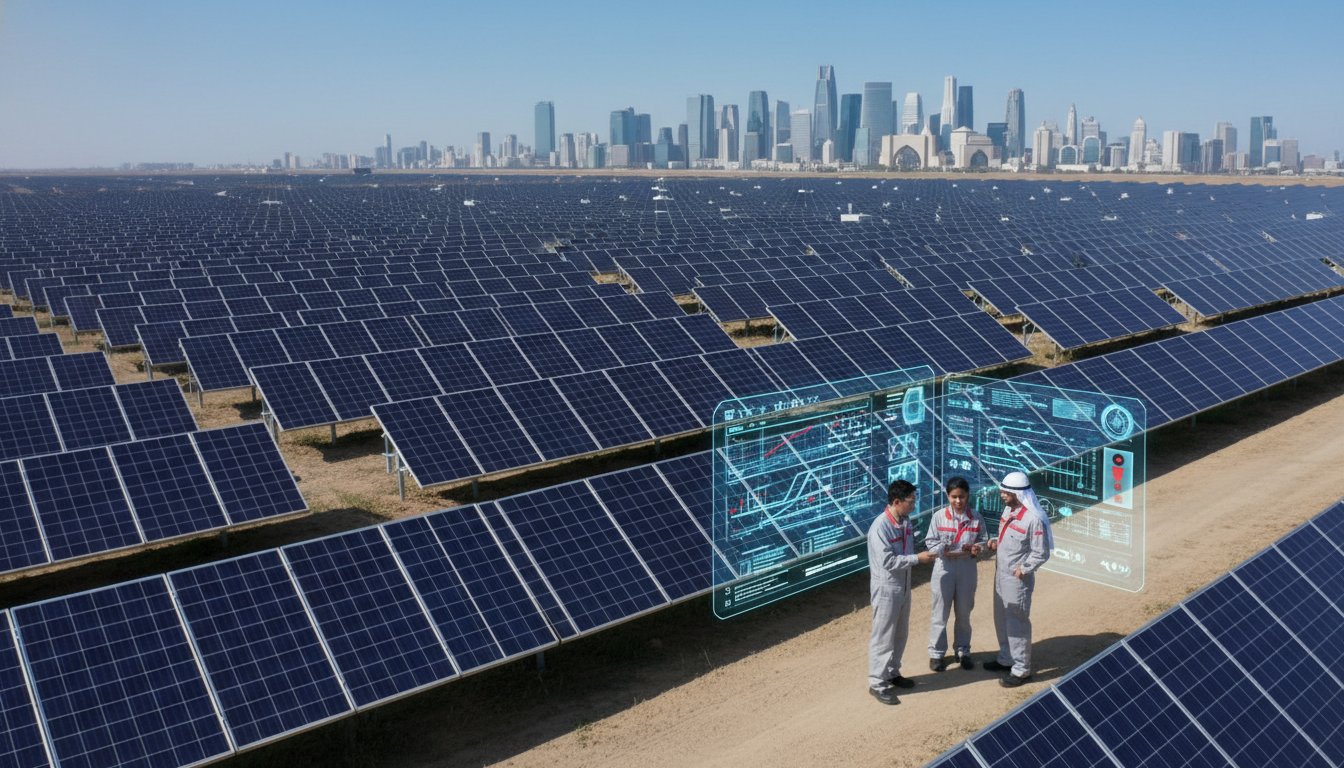
The traditional multi-vendor model for utility-scale energy is no longer a viable strategy in a regulatory environment defined by the July 4, 2026 safe harbor deadlines and strict Foreign Entity of Concern (FEOC) compliance. You recognize that fragmented procurement often leads to vendor finger-pointing and hidden logistical costs that erode your projected ROI. Transitioning to turnkey solar projects provides the single-point accountability required to navigate the complexities of the 2026 National Electrical Code and new domestic content requirements for the 30% Investment Tax Credit.
This guide demonstrates how integrated EPC frameworks and proprietary HJT technology eliminate project risks while maximizing industrial solar performance. You'll learn how to move beyond obsolete PERC hardware toward high-efficiency Nippon HJT systems that secure guaranteed performance ratios. We provide a technical roadmap for achieving long-term reliability through AI-driven monitoring and smart inverter integration, ensuring your infrastructure remains a high-performing asset for decades.
Key Takeaways
- Understand the evolution of turnkey solar projects from basic installation to comprehensive, single-point accountability frameworks that eliminate vendor fragmentation.
- Discover how advanced feasibility studies and custom site-specific engineering ensure precise solar yield forecasting and system optimization.
- Learn why integrating proprietary HJT solar panels with Smart AI Inverters provides a technical performance advantage over generic, vendor-agnostic EPC models.
- Evaluate the financial impact of Lithium-ion battery storage and AI-driven monitoring in reducing downtime and stabilizing long-term industrial power costs.
- Gain insights into the Nippon Energy framework, which combines Japanese engineering standards with localized execution across global energy hubs.
The Evolution of Turnkey Solar Projects: Beyond Simple Installation
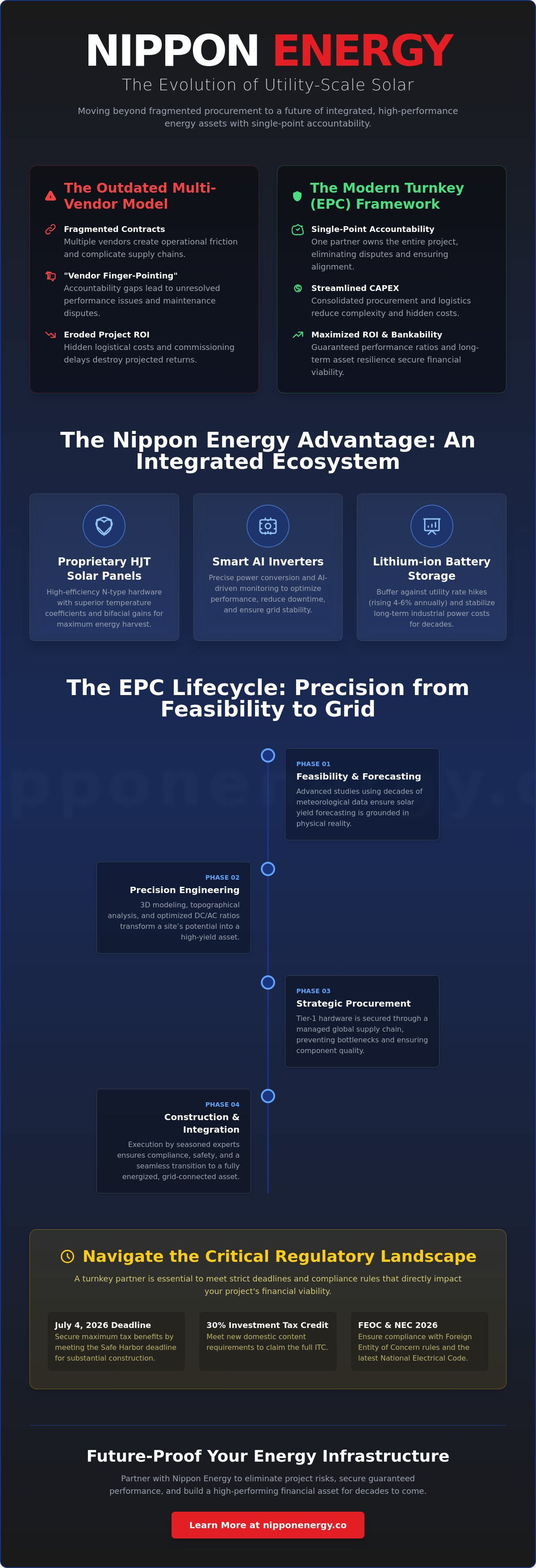
The landscape of industrial energy has moved beyond the era of simple component assembly. Successful utility-scale deployment now requires a comprehensive systems integration mindset. The 2026 standard for Engineering, procurement, and construction (EPC) demands a level of technical oversight that traditional contractors can't provide. This evolution has birthed the role of the High-Tech Architect. It's a partner that doesn't just install hardware but designs a resilient ecosystem. Modern turnkey solar projects represent a shift toward unified project ownership. Every technical variable, from initial irradiance mapping to the nuances of the 2026 National Electrical Code (NEC) compliance, falls under a single authority.
Turnkey vs. Traditional: The Accountability Gap
Traditional installation models rely on fragmented contracts that create significant operational friction. This often leads to "vendor finger-pointing" during performance drops. When a multi-megawatt site fails to meet its performance ratio, the panel supplier might blame the inverter logic, while the installer cites a design error. This accountability gap erodes ROI and complicates maintenance. Single-point accountability eliminates these disputes. By consolidating project ownership, the EPC partner ensures that the engineering phase perfectly aligns with the procurement of specific hardware. This alignment prevents the design-execution mismatches that cause expensive commissioning delays. Because projects larger than 1.5 MW must begin substantial construction by July 4, 2026, to secure maximum tax benefits, any delay caused by vendor misalignment is a direct threat to the project's viability.
The Strategic Advantage for Industrial Stakeholders
Industrial sectors are abandoning fragmented models to prioritize long-term bankability and asset resilience. Streamlining CAPEX through consolidated procurement reduces the logistical complexities of managing multiple supply chains. It also ensures that the technology deployed is cohesive. For example, integrating Nippon HJT Solar Panels with Nippon Smart AI Inverters creates a technical synergy that generic EPCs often miss. This integration maximizes energy harvest through precise power conversion and intelligent monitoring. A turnkey approach also simplifies the addition of Nippon Lithium-ion Battery Storage Systems. These systems allow industrial users to buffer against utility rate hikes, which continue to rise at a rate of 4-6% annually in many markets. By choosing a unified framework, stakeholders future-proof their assets against technological obsolescence. This ensures that their energy infrastructure remains a high-performing financial asset for its entire lifecycle.
The EPC Lifecycle: Engineering Precision from Feasibility to Grid
The execution of turnkey solar projects requires a methodical transition from conceptual vision to energized reality. This lifecycle isn't a linear checklist; it's a synchronized engineering operation. It begins with advanced feasibility studies where solar yield forecasting uses decades of meteorological data to predict performance within a narrow margin of error. Phase 1 ensures the financial model is grounded in physical reality before a single component is ordered. This technical foundation prevents the ROI erosion often seen in projects that rely on generic estimates.
Engineering: The Foundation of Performance
Precision engineering transforms a site's raw potential into a high-yield asset. We utilize 3D modeling and topographical analysis to inform land grading strategies, which minimizes civil engineering costs and environmental disruption. Engineers must optimize DC/AC ratios to ensure the system operates at peak efficiency during varying irradiance levels, preventing clipping while maximizing energy harvest. Mounting structures aren't generic. They're customized for specific environmental stressors, such as high-wind zones or corrosive desert climates, to guarantee structural integrity for 25 years or more.
Procurement and Logistics Management
Strategic procurement focuses on high-efficiency N-type hardware to ensure long-term viability. Utilizing Nippon HJT Solar Panels allows the system to benefit from superior temperature coefficients and bifacial gains. The turnkey supply chain prioritizes Tier-1 hardware, but the real value lies in managing global logistics to prevent site-level bottlenecks. Quality control happens at the manufacturing source. This ensures every module and Nippon Smart AI Inverter meets the rigorous standards required for utility-scale bankability. Coordinating these deliveries with construction milestones keeps the project on schedule for critical 2026 tax credit deadlines.
Phase 4 involves precision construction and rigorous commissioning protocols. Every string and connection is tested against the design specifications to verify performance before the final handover. The final phase involves seamless grid coordination. This ensures the site meets utility interconnection requirements and complies with the latest National Electrical Code (NEC) 2026 standards. Explore our Solar Project Development and EPC services to see how this technical precision applies to your next site. This methodical approach ensures that the transition from construction to operation is invisible to the stakeholder, resulting in a reliable, grid-ready asset.
Integrated Hardware vs. Generic EPC: The Nippon Advantage
Generic EPC providers often operate as logistics managers rather than technical architects. They select components based on the lowest immediate procurement cost, which frequently sacrifices the long-term Levelized Cost of Energy (LCOE). This fragmented approach creates a performance gap as systems age and warranties are tested. In contrast, turnkey solar projects developed with an integrated hardware strategy ensure that every component is engineered to work in unison. By controlling the manufacturing and specifications of the primary assets, we eliminate the compatibility issues that plague generic installations. This technical cohesion is the only way to guarantee the performance ratios required for modern industrial bankability.
HJT and TOPCon: The New Efficiency Benchmarks
The transition from PERC to advanced N-type cell architectures is a requirement for 2026 asset resilience. HJT solar technology provides a distinct advantage by utilizing a symmetrical cell structure that significantly reduces annual power degradation. This resilience is critical in high-temperature environments like Pakistan and the UAE, where standard modules suffer from severe thermal efficiency losses. Additionally, the adoption of bifacial topcon solar panels allows for higher energy density on utility-scale sites. This maximizes land usage by capturing reflected light from the rear side, which is essential when utility-scale land requirements average 5 to 10 acres per MW. Linking this proprietary hardware to a 30-year performance framework ensures the project remains a productive asset long after the initial CAPEX is recovered.
Smart AI Inverters and Energy Management
Hardware synergy extends directly to the power conversion stage. Nippon Smart AI Inverters use machine learning algorithms for real-time string monitoring and rapid fault detection. This intelligence allows for proactive maintenance before a minor string failure impacts the total site yield. Integrating these inverters with high-efficiency modules creates a grid-forming capability that stabilizes industrial power supplies. Automated energy steering ensures that self-consumption is prioritized, reducing reliance on the grid where utility rates are rising by 4-6% annually in many markets. It's not just about producing power; it's about the intelligent management of that power to maximize ROI. This level of integration isn't possible with vendor-agnostic models that prioritize short-term savings over long-term technical excellence.
Risk Mitigation and ROI: Financial Evaluation of Turnkey Partners
Financial viability in turnkey solar projects is often miscalculated by focusing exclusively on upfront capital expenditure. True return on investment is a function of system availability and the mitigation of energy market volatility. A project that lacks integrated risk management often suffers from cascading technical failures that generic warranties don't cover. Evaluating a partner's financial and technical stability is essential for assets with 30 year lifecycles. You must prioritize partners that provide a unified balance sheet for both the hardware and the execution. This structural stability ensures that performance guarantees are backed by technical reality rather than contractual loopholes.
Energy Independence through Integrated Storage
Stabilizing industrial power costs requires more than just generation. It demands a strategy for energy arbitrage. Scaling Nippon Lithium-ion Battery Storage Systems for industrial parks allows operators to implement peak shaving and load shifting strategies. These systems capture excess generation during low-tariff periods and discharge it when utility rates spike. With utility rates rising by 4-6% annually in many markets, integrated storage provides a hedge against inflation. The bankability of these integrated PV and Storage turnkey solutions is significantly higher because they provide a predictable, dispatchable energy profile that lenders favor for utility-scale projects, which average 74 MW in size.
Long-Term Performance Monitoring
Mitigating technical risk requires a shift from reactive to predictive maintenance. Remote monitoring for multi-MW farms uses AI to analyze string-level data, identifying thermal anomalies before they lead to component failure. This ensures the actual "Performance Ratio" (PR) stays within 1-2% of the feasibility forecast. Maintaining this precision is impossible with manual inspections. Local support teams are vital for global project development, providing the rapid response needed to minimize downtime. Performance isn't a static metric; it's a result of continuous optimization. You can secure your asset's longevity by utilizing Solar System Maintenance and Monitoring to ensure your infrastructure operates at its theoretical peak every day of the year.
Ultimately, the financial evaluation of a turnkey partner should focus on their ability to eliminate the performance gap. This is achieved through proprietary hardware synergy and a rigorous O&M framework. By reducing the frequency and duration of downtime, industrial stakeholders can accelerate their payback periods and ensure their solar infrastructure remains a resilient financial instrument in the 2026 energy market.
Global Standards, Local Execution: The Nippon Energy Framework
The successful deployment of turnkey solar projects in 2026 requires a sophisticated balance between global engineering standards and localized operational intelligence. Nippon Energy bridges this gap by applying rigorous Japanese engineering protocols to every stage of project development. Our framework isn't just about logistics; it's about maintaining technical integrity across diverse geographical landscapes. We operate through strategic regional hubs in Tokyo, Dubai, Karachi, and Berlin. This physical presence allows our teams to manage complex grid-connection requirements and regulatory nuances that generic providers often overlook. By centralizing our engineering expertise while decentralizing our execution, we ensure that every utility-scale asset meets the highest benchmarks for durability and performance.
A central pillar of our framework is the NipponHev product line. This integrated system serves as a blueprint for high-efficiency power, synchronizing Nippon HJT Solar Panels with Smart AI Inverters and Lithium-ion Battery Storage Systems. NipponHev represents the transition from fragmented component assembly to a unified energy architecture. This approach eliminates the compatibility risks that often lead to performance drops in multi-vendor setups. It's a calculated strategy designed to provide industrial stakeholders with a resilient, future-proof energy source that remains a productive financial asset for its entire 30-year lifecycle.
Regional Expertise: From Desert to Industrial Hubs
Customizing EPC solutions requires a granular understanding of local environmental stressors. In South Asia and the Middle East, extreme ambient temperatures represent a significant technical hurdle for standard energy assets. We address this by utilizing the superior temperature coefficients of HJT technology. These modules maintain high efficiency in environments where PERC systems experience severe thermal degradation. Navigating the specific interconnection protocols of different markets is equally vital. Whether we're optimizing land usage for a 74 MW farm or managing the logistics of non-FEOC compliant components, our regional expertise ensures that project timelines remain intact despite the July 4, 2026 substantial construction deadlines.
The Future of Turnkey: 2026 and Beyond
The evolution of energy infrastructure is increasingly defined by the integration of machine learning and autonomous energy steering. Nippon Energy is at the forefront of this shift, developing AI-driven solar project management tools that predict maintenance needs before failures occur. This commitment to sustainable, high-performance infrastructure ensures that our partners stay ahead of rapid technological shifts. Initiating your journey toward energy independence begins with technical evidence. Our engineering team conducts site-specific feasibility studies to provide the data-driven foundation required for large-scale success. By merging visionary ambition with grounded technical authority, we provide the tools for monumental energy achievements in the modern era.
Securing Your Energy Infrastructure for the Next Decades
Transitioning to a unified EPC model is the only way to meet the rigorous technical and regulatory demands of 2026. By integrating Tier-1 HJT and TOPCon hardware with intelligent power management, industrial stakeholders eliminate the performance gap inherent in fragmented systems. This transition shifts the focus from short-term CAPEX to long-term asset bankability and resilience. It's a strategic move toward energy independence that relies on technical cohesion rather than vendor-agnostic procurement.
Our framework applies Japanese Precision Engineering to every stage of development, ensuring that turnkey solar projects remain high-performing financial instruments. With a global EPC presence in Tokyo, Dubai, and Karachi, we provide the localized expertise required for complex utility-scale deployments. You're invited to Consult with our High-Tech Architects for your Turnkey Solar Project to initiate a site-specific feasibility study. Your transition to resilient, high-efficiency energy infrastructure starts with a partner focused on technical excellence and monumental impact.
Frequently Asked Questions
What is included in a turnkey solar project contract?
A comprehensive contract for turnkey solar projects covers the entire Engineering, Procurement, and Construction (EPC) lifecycle. This includes advanced solar yield forecasting, site-specific engineering, procurement of Nippon HJT or TOPCon hardware, and final grid interconnection. The scope ensures single-point accountability for every technical variable from initial feasibility to the final handover of a grid-ready asset.
How long does a typical utility-scale turnkey solar project take to complete?
Completion timelines for utility-scale assets typically range from 12 to 24 months, depending on the capacity and interconnection complexity of the site. Methodical project management is essential to meet critical 2026 tax credit deadlines. Our framework optimizes the procurement of Nippon Smart AI Inverters and modules to ensure construction milestones align with the projected development runway.
Why is a turnkey solution better for industrial projects than sourcing components separately?
Turnkey solutions eliminate the technical friction and accountability gaps inherent in multi-vendor models. Sourcing components separately often leads to design-execution mismatches and vendor finger-pointing during performance drops. Integrated EPC ensures that all hardware, such as Nippon HJT Solar Panels and battery systems, works in technical synergy to maximize the system’s performance ratio and long-term bankability.
Can Nippon Energy integrate battery storage into existing turnkey designs?
Yes, our engineering team scales Nippon Lithium-ion Battery Storage Systems within both existing architectures and new project designs. This integration allows industrial parks to implement sophisticated peak shaving and load shifting strategies. Adding storage stabilizes power costs and provides a resilient hedge against utility rate volatility, which remains a primary concern for high-load industrial stakeholders.
What performance guarantees are standard for turnkey solar projects in 2026?
Standard guarantees in 2026 focus on a 30-year performance framework, particularly for turnkey solar projects utilizing N-type cell architectures. These contracts ensure the actual Performance Ratio (PR) matches the feasibility forecast within a narrow margin of error. Such guarantees are backed by the superior temperature coefficients of Nippon HJT technology and the precision of AI-driven string monitoring.
How does Nippon Energy manage O&M after the turnkey project is commissioned?
We manage post-commissioning operations through our Solar System Maintenance and Monitoring service. This framework utilizes machine learning to analyze real-time data, allowing our teams to perform predictive maintenance before minor faults impact the total site yield. Localized support teams ensure rapid response times, maintaining the asset's structural and electrical integrity throughout its operational life.
Is turnkey solar more expensive than traditional installation?
Turnkey delivery may consolidate upfront costs, but it significantly reduces the Levelized Cost of Energy (LCOE) by eliminating hidden logistical expenses and project delays. Fragmented models often incur costs through vendor misalignment and system inefficiencies that erode ROI. A unified EPC approach ensures a faster payback period by maximizing energy harvest and reducing the frequency of unscheduled maintenance.
What regions does Nippon Energy cover for turnkey EPC services?
Our global EPC operations are managed through strategic regional hubs in Tokyo, Dubai, Karachi, and Berlin. This network allows us to provide localized technical expertise while maintaining the rigorous Japanese engineering standards our partners expect. We customize every project to navigate the specific regulatory, grid-connection, and environmental challenges of these diverse industrial markets.


