
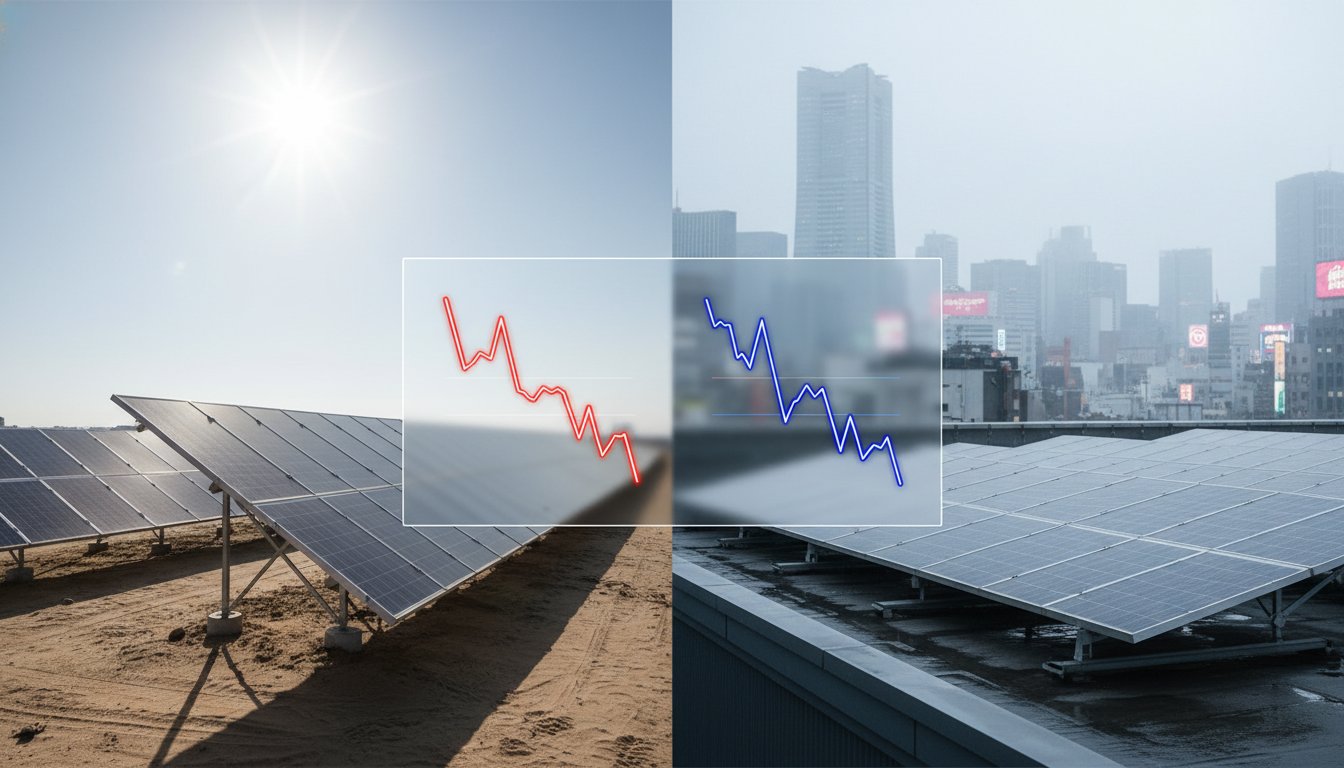
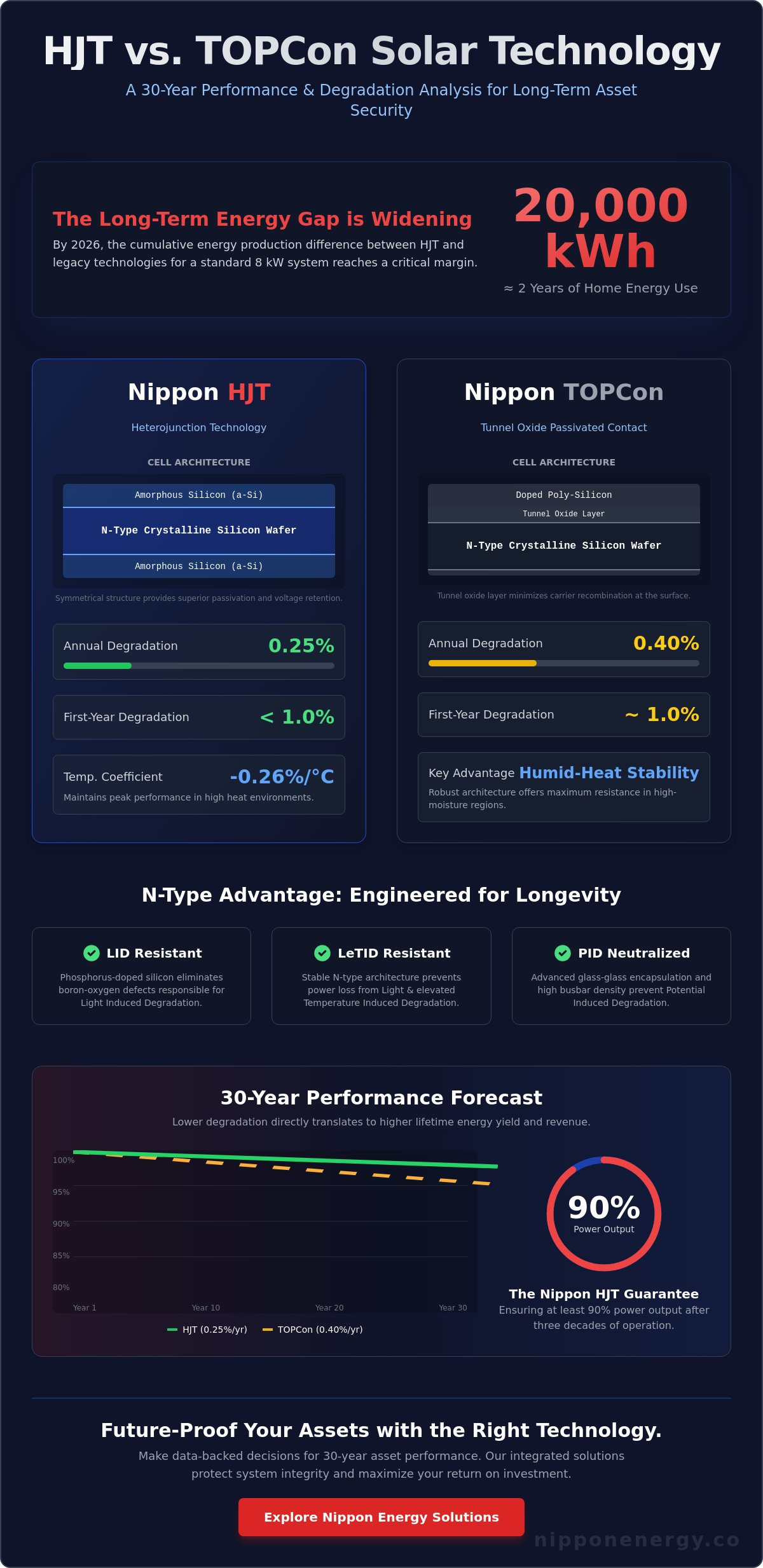
By 2026, the cumulative energy production gap between HJT and legacy technology has reached 20,000 kWh for a standard 8 kW system, a margin that represents two years of domestic energy consumption. You likely recognize that N-type modules are now the definitive global standard, yet the conflicting marketing data surrounding hjt vs topcon degradation makes long-term asset security feel like a moving target. It's difficult to commit to a 30-year project when desert heat or high humidity threatens to erode your projected internal rate of return.
This technical analysis clarifies the performance delta between these two cell architectures, providing the empirical evidence you need to secure 30-year solar asset performance. We'll examine LID, LeTID, and PID resistance across specific climates and detail how Nippon HJT and TOPCon panels leverage advanced passivation to meet 2026 warranty protections. You'll gain a clear understanding of which technology maximizes lifetime yield for your specific geography, whether you require the superior temperature coefficient of Nippon HJT Solar Panels or the robust humid-heat stability of Nippon TOPCon Solar Panels.
Key Takeaways
- Identify the structural differences between TOPCon’s tunnel oxide layers and HJT’s amorphous silicon to accurately predict long-term carrier recombination and power retention.
- Select the appropriate module technology for your geography by analyzing how climate-specific variables influence hjt vs topcon degradation in desert and tropical environments.
- Assess 2026 performance benchmarks and field data to move beyond theoretical specifications toward a data-backed 30-year asset strategy.
- Understand the technical parameters of the Nippon Guarantee, which ensures 90% power output after three decades of operation for premium HJT installations.
- Discover how Nippon Smart AI Inverters and advanced monitoring protocols protect system integrity by mitigating PID and mismatch losses in real-time.
The N-Type Evolution: Why Degradation is the New Efficiency Metric
The solar industry has transitioned from a race for peak efficiency to a rigorous focus on asset longevity. Longevity is now paramount. While P-type PERC dominated previous decades, its susceptibility to Light Induced Degradation (LID) and Light and elevated Temperature Induced Degradation (LeTID) created unpredictable power fades. By 2026, the shift to N-type substrates has fundamentally solved these oxygen-related defects. Phosphorus-doped silicon doesn't suffer from the boron-oxygen complexes that plague legacy cells. This structural shift ensures that modern utility-scale projects prioritize stability over momentary peak performance. Precision in hjt vs topcon degradation modeling is now the primary requirement for bankability. Even a 0.1% annual variance translates into significant revenue shifts over a 30-year lifecycle.
The LCOE Impact of Power Fade
Levelized Cost of Energy (LCOE) calculations are increasingly sensitive to cumulative power retention. A panel that maintains a linear degradation slope provides more predictable cash flows for project developers. N-type modules are inherently resilient because their chemical architecture minimizes carrier recombination. Heterojunction (HJT) technology takes this further by using a symmetrical structure that effectively eliminates many common degradation pathways. High bifaciality factors also play a critical role. When a module captures energy from both sides, the total energy yield remains high even as the primary front-side efficiency naturally declines over three decades.
N-Type Benchmarks in 2026
Current industry data establishes clear benchmarks for the next generation of solar assets. Standard N-type panels typically degrade at rates between 0.3% and 0.5% annually. However, precision engineering has pushed these limits lower. Nippon TOPCon Solar Panels target an annual degradation rate of approximately 0.40%. In contrast, Nippon HJT Solar Panels achieve a superior benchmark of 0.25%. By Q4 2025, N-type modules surpassed 60% of global production, largely due to these improved reliability metrics.
- First-year degradation: Often less than 1% for HJT; approximately 1% for TOPCon.
- Annual slope: 0.25% (HJT) vs 0.40% (TOPCon).
- PID Resistance: 2026 manufacturing processes utilize advanced encapsulation and glass-glass structures to neutralize Potential Induced Degradation.
The distinction between Year 1 and Year 2-30 degradation is vital. Early-life Potential Induced Degradation (PID) has been significantly reduced through improved cell-to-module integration. This ensures that the initial power drop is minimized. The long-term linear slope now dictates the asset's financial performance, making the choice of architecture a critical engineering decision.
HJT vs TOPCon: Comparing Degradation Mechanisms
The structural integrity of hjt vs topcon degradation profiles depends on how each architecture manages carrier recombination under environmental stress. While both technologies utilize N-type wafers, their passivating layers react differently to thermal and radiative loads. TOPCon architecture relies on a nanometer-scale tunnel oxide layer combined with a doped polycrystalline silicon layer. This configuration creates a physical barrier that prevents charge carriers from recombining at the silicon surface, which maintains high voltage even under intense field conditions. HJT employs a different strategy by sandwiching a crystalline silicon wafer between layers of amorphous silicon (a-Si). These a-Si layers provide a superior temperature coefficient of -0.24% to -0.26% per degree Celsius, ensuring that the cell maintains performance as ambient temperatures rise.
Modern glass-glass configurations have largely neutralized Potential Induced Degradation (PID) by preventing ion migration from the frame to the cells. High busbar density further enhances this resilience. By increasing the number of paths for current, these designs minimize the impact of micro-cracks that might otherwise lead to significant power loss. Engineers evaluating these structural metrics often review the technical specifications of Nippon TOPCon Solar Panels to ensure maximum humidity resistance in coastal or high-moisture regions.
LID and LeTID Resilience
N-type phosphorus doping eliminates the primary mechanism of LID found in legacy PERC cells by removing the boron-oxygen pairs that trigger power loss upon initial light exposure. This fundamental chemical advantage means that both HJT and TOPCon modules avoid the 2% to 3% "burn-in" losses common in older P-type technology. LeTID (Light and elevated Temperature Induced Degradation) is similarly mitigated. Because N-type cells don't rely on the same defect-prone dopants, they remain stable during the high-heat cycles typical of mid-day operation in tropical climates.
UV and Moisture Sensitivity
UV exposure remains a critical variable for HJT reliability. The amorphous silicon layers that provide such high efficiency are sensitive to high-energy photons. Detailed research into UV-induced degradation mechanisms suggests that prolonged exposure can destabilize the a-Si/c-Si interface if not properly shielded. TOPCon generally shows higher inherent resistance to UV and moisture when using standard EVA encapsulation. To counter this, Nippon HJT Solar Panels utilize specialized Polyolefin Elastomer (POE) encapsulation. This material provides a superior moisture barrier and UV filtering, protecting the sensitive heterojunction interface from the delamination risks often cited in earlier HJT field tests. This engineering choice ensures that the high bifaciality of HJT, often reaching 85-95%, remains a productive asset over the full 30-year lifecycle.
Climate-Specific Reliability: Desert vs. Tropical Environments
The operational environment dictates the long-term yield of any solar asset. Data from the Doha Field Test revealed that while N-type technologies generally outperform legacy modules, the specific nature of hjt vs topcon degradation becomes highly climate-dependent. In the extreme heat of Qatar, early HJT prototypes showed accelerated power loss, which competitors often attribute to cell architecture. However, technical post-mortems confirm these failures were primarily due to encapsulation delamination rather than intrinsic cell instability. By 2026, engineering advancements have addressed these vulnerabilities. Nippon Energy provides regional recommendations that align technology with local stressors, ensuring that projects in Riyadh or Karachi utilize the specific material sets required for 30-year reliability.
High-Temperature Performance Ratios
HJT technology excels in high-ambient environments like Lahore or Dubai. Its temperature coefficient of -0.26%/°C significantly offsets the higher degradation risks associated with desert heat. When temperatures exceed 40°C, the power output of Nippon HJT Solar Panels remains more resilient than TOPCon alternatives. This thermal stability results in a 3-5% increase in annual energy production in arid zones. Furthermore, the high-albedo sandy terrain of the Middle East maximizes the 85-95% bifaciality factor of HJT, capturing substantial rear-side gain that TOPCon modules cannot match. In contrast, for temperate climates like Berlin, the lower cost-per-watt of Nippon TOPCon Solar Panels often provides a more favorable return on investment where thermal derating is less severe.
Mitigating Delamination and Soiling
Tropical climates present a "humidity trap" that specifically challenges the thin-film amorphous silicon layers in HJT cells. Moisture ingress can lead to localized corrosion or interface instability. To mitigate this, glass-glass construction is non-negotiable for Nippon HJT Solar Panels. This rigid architecture prevents the micro-flexing that leads to seal failure. In arid regions, heavy soiling acts as a secondary catalyst for degradation by creating localized hotspots. Nippon's specialized anti-soiling coatings reduce dust adhesion, maintaining the optical clarity required for high-efficiency operation. These architectural solutions ensure that the cell's internal chemistry remains protected from the external environment.
- Desert Environments: High UV and heat favor HJT's low temperature coefficient and bifaciality.
- Tropical Environments: High humidity favors TOPCon's robust tunnel oxide layers or HJT modules with POE encapsulation.
- Coastal Regions: Salt-mist resistance is enhanced by glass-glass configurations and high-density busbars.
For large-scale project development, selecting between technologies requires a granular analysis of local meteorological data. Nippon Energy's Solar Project Development and EPC teams utilize these environmental profiles to guarantee that the selected hardware survives the specific chemical and thermal stressors of the site. This methodical approach ensures that the 0.25% annual degradation benchmark is a field reality rather than just a laboratory projection.
30-Year Performance Forecasts and Warranty Trends
By 2026, the 25-year industry standard for solar warranties has become obsolete. Premium manufacturers have transitioned to 30-year linear performance warranties to reflect the enhanced stability of N-type architectures. This shift is not merely a marketing adjustment; it is an engineering response to the superior hjt vs topcon degradation data gathered from global field deployments over the last five years. While legacy P-type PERC panels typically guaranteed 84% to 86% output at 25 years, modern N-type modules now offer significantly higher retention rates. The Nippon Guarantee sets a new benchmark for the industry, ensuring that Nippon HJT Solar Panels maintain 90% power output after 30 years of continuous operation. This level of precision provides the structural integrity required for large-scale financial modeling.
Understanding the distinction between product and performance warranties is essential for asset protection. A product warranty covers defects in materials or workmanship, typically ranging from 15 to 25 years for N-type modules. In contrast, the performance warranty guarantees the actual power output over time. To ensure project bankability, these warranties are often insurance-backed by third-party providers. This secondary layer of protection secures the investment even in the unlikely event of manufacturer insolvency, making these assets highly attractive to institutional investors.
Forecasting Year-30 Yield
The cumulative difference in energy production becomes most apparent in the final decade of a project's life. A TOPCon module with a 0.4% annual fade will retain approximately 87.4% of its original capacity at year 30. Conversely, an HJT module with a 0.25% annual fade maintains 91.75% capacity. This delta significantly impacts the Levelized Cost of Energy (LCOE) and the final Internal Rate of Return (IRR). Because the last five years of a power purchase agreement often represent pure profit after debt servicing, maximizing late-stage yield is a critical strategic priority. For a deeper analysis of the technical differences between these architectures, see our guide on HJT vs TOPCon: Comparing the Pinnacle of N-Type Solar Technology in 2026.
Bankability and Secondary Markets
Low degradation rates directly increase the resale value of solar farms in secondary markets. Buyers prioritize assets with verified performance history and transparent reliability data. Nippon Energy utilizes independent testing from organizations like PVEL and Kiwa to validate all degradation claims. This commitment to third-party verification ensures that the predicted hjt vs topcon degradation slopes match real-world outcomes. High-performance assets with documented low power fade command a premium price during divestment, providing developers with multiple exit strategies. To secure your long-term energy yields, review our technical warranty specifications for utility-scale deployments.
Future-Proofing Assets: The Nippon Integrated Solution
High-performance hardware represents only the initial phase of long-term asset security. Sustaining the 30-year yield benchmarks discussed in previous sections requires a sophisticated management layer that bridges the gap between cell chemistry and system-level output. While the structural differences in hjt vs topcon degradation are fixed at the point of manufacture, the operational environment remains dynamic. Nippon Smart AI Inverters provide the intelligent oversight necessary to manage the minute variations in power retention across thousands of individual modules. These units detect string-level anomalies that indicate premature carrier recombination or moisture ingress, allowing for surgical maintenance interventions rather than reactive repairs. This proactive approach prevents a single underperforming string from derating the entire array's performance.
The NipponHev advantage lies in its integrated architecture, where generation, inversion, and storage work in technical synchrony. By utilizing Nippon Lithium-ion Battery Storage Systems alongside N-type modules, developers create a resilient ecosystem designed for maximum longevity. Proactive maintenance protocols utilize real-time data to prevent accelerated degradation caused by localized hotspots or electrical mismatch. This holistic strategy ensures that the projected 0.25% to 0.40% annual fade remains a consistent reality throughout the asset's lifecycle.
AI-Enhanced Performance Monitoring
Modern performance monitoring has evolved beyond simple yield tracking to include granular, string-level analysis. Nippon's AI-driven systems identify panels with abnormal degradation slopes by comparing real-time output against historical meteorological data. These AI inverters optimize power output even as cells age unevenly across a large-scale site, mitigating the impact of mismatch losses. For a comprehensive look at how these systems integrate with site operations, review our Solar System Maintenance: The Definitive Guide to Performance Architecture in 2026.
Strategic Procurement with Nippon Energy
Selecting the optimal N-type technology requires precise alignment with your specific geographic coordinates and environmental stressors. Nippon Energy serves as a single-source provider, integrating Solar Project Development and EPC with world-class hardware and Solar System Maintenance and Monitoring. This unified approach eliminates the technical friction between disparate components, ensuring that your 30-year yield projections are backed by a single, authoritative partner. You can consult with Nippon Energy's engineers for a 30-year yield analysis to determine the ideal configuration for your next utility-scale deployment.
Securing the 30-Year Energy Horizon
The transition to N-type technology has fundamentally redefined solar asset longevity. As analyzed throughout this technical deep dive, the choice in hjt vs topcon degradation is no longer a theoretical debate but a site-specific engineering requirement. While TOPCon provides exceptional moisture resistance for tropical regions, the superior temperature coefficient and high bifaciality of HJT deliver unmatched yields in desert environments. Success in 2026 depends on matching these architectural strengths to your specific geographic stressors to ensure long-term bankability.
Nippon Energy bridges the gap between hardware durability and operational intelligence. Our Nippon HJT Solar Panels carry a 90% power guarantee at Year 30, ensuring your projected returns remain protected against late-stage power fade. By integrating AI-driven string-level optimization, we provide the tools to monitor and maintain these benchmarks in the most demanding Middle East and South Asia climates. It's time to move beyond standard 25-year projections and embrace a more resilient, data-backed energy future.
Secure your 30-year solar investment with Nippon N-Type technology and build with the confidence of global technical leadership.
Frequently Asked Questions
Does HJT solar technology degrade faster than TOPCon in high humidity?
HJT technology can exhibit higher sensitivity to moisture due to its amorphous silicon layers, but this risk is neutralized by advanced encapsulation. Using Polyolefin Elastomer (POE) instead of standard EVA provides a superior moisture barrier. Nippon HJT modules utilize this specialized material set to ensure that high-humidity environments don't compromise the cell interface over a 30-year lifecycle.
What is the typical annual degradation rate for N-type TOPCon panels in 2026?
In 2026, the standard annual degradation rate for N-type TOPCon panels is approximately 0.40%. This represents a significant improvement over legacy P-type PERC panels, which often degraded at 0.6% to 0.8% annually. First-year degradation for TOPCon is typically around 1%, followed by a stable linear decline that ensures reliable asset performance throughout the project duration.
Can AI inverters help mitigate the effects of solar panel degradation?
AI inverters mitigate degradation effects by utilizing string-level data to identify panels with abnormal performance slopes. Nippon Smart AI Inverters optimize energy harvest even as modules age unevenly, reducing the impact of mismatch losses. This intelligence allows for proactive maintenance, preventing localized issues like hotspots from accelerating the overall power fade of the array.
How does the temperature coefficient affect long-term degradation in desert climates?
A superior temperature coefficient reduces the thermal stress on solar cells during peak sunlight hours. HJT technology offers a coefficient of -0.24% to -0.26% per degree Celsius, which minimizes power loss as ambient temperatures rise. In desert climates like those in Riyadh or Karachi, this thermal stability leads to higher cumulative energy production and reduces the chemical degradation triggered by extreme heat cycles.
Is there a significant difference in PID resistance between HJT and TOPCon?
Both technologies offer high resistance to Potential Induced Degradation (PID) when compared to legacy P-type cells. The use of N-type wafers combined with glass-glass encapsulation significantly limits the ion migration that causes PID. While both are robust, the symmetrical structure of HJT provides an inherent chemical stability that further minimizes voltage-driven power loss in high-voltage utility-scale systems.
What should I look for in a 30-year solar performance warranty?
A bankable 30-year warranty should specify a linear degradation slope and a high final power retention percentage. Look for guarantees that ensure at least 87% to 90% output by the end of the third decade. It's also critical that the warranty is insurance-backed by a reputable third party to secure your investment against long-term manufacturer insolvency.
Why is glass-glass encapsulation critical for HJT reliability?
Glass-glass construction is essential for HJT because it provides a hermetic seal that protects the moisture-sensitive amorphous silicon layers. This rigid architecture prevents the micro-flexing of cells, which reduces the risk of micro-cracks and delamination. By eliminating the breathable backsheet used in older designs, glass-glass modules ensure that the hjt vs topcon degradation gap remains narrow even in high-humidity regions.
How does bifacial gain change as a solar panel ages?
Bifacial gain typically remains stable over time as long as the rear-side encapsulation maintains its optical clarity. While the front-side efficiency naturally declines, the high bifaciality factor of HJT panels allows the system to maintain a higher total energy yield. Regular cleaning to prevent rear-side soiling is vital to ensure that the bifacial contribution continues to offset front-side power fade over 30 years.


