
In 2026, selecting a lead-acid battery for solar storage isn't a cost-saving measure; it's a technical liability that compromises the structural integrity of your energy architecture. With the expiration of the 30% federal tax credit, the financial margin for inefficient hardware has disappeared. When evaluating a lithium ion vs lead acid solar battery for your home, the decision must move beyond initial hardware costs to focus on long-term system resilience, cycle life, and round-trip efficiency.
We understand that achieving true energy independence requires a balance of sophisticated engineering and fiscal precision. This guide delivers a rigorous technical framework for calculating the Levelized Cost of Storage (LCOS), providing the necessary validation for a 15 year investment. You'll gain a clear perspective on how modern LFP chemistry, AI-driven management systems, and 2026 NEC standards dictate the future of high-performance energy storage.
Key Takeaways
- Identify why the 6,000+ cycle life of modern lithium systems provides a superior architectural foundation compared to the 500-cycle limitation of legacy lead-acid units.
- Learn to calculate the Levelized Cost of Storage (LCOS) to reveal the true long-term ROI of a lithium ion vs lead acid solar battery beyond the initial purchase price.
- Understand how advanced LFP chemistry ensures thermal stability and maintains operational resilience in high-temperature environments that compromise lead-acid integrity.
- Discover the performance advantages of integrating Nippon Lithium-ion Battery Storage Systems with high-efficiency HJT and TOPCon solar modules for a unified energy ecosystem.
The Evolution of Energy Storage: Beyond the Lead-Acid Legacy
The transition to a decentralized energy grid in 2026 has transformed battery storage from a passive component into an active energy management asset. Traditional energy storage relied on the basic chemical reactions of lead and sulfuric acid. Modern requirements for energy independence demand intelligence, resilience, and high-speed response times. The technical debate regarding lithium ion vs lead acid solar battery isn't based on legacy loyalty but on measurable performance as developers prioritize Levelized Cost of Storage (LCOS) over initial capital expenditure. This paradigm shift marks the end of simple "holding tanks" for electricity and the beginning of software-defined energy architecture.
Understanding Lead-Acid (FLA and AGM) Basics
Lead-acid technology relies on heavy lead plates submerged in an electrolyte solution to facilitate energy transfer. This Deep-cycle battery technology has served as the industry standard for decades, yet it faces inherent mechanical limitations in high-demand solar applications. Flooded Lead-Acid (FLA) systems require consistent maintenance, including the manual addition of distilled water and regular equalization charges to prevent sulfation. Absorbed Glass Mat (AGM) variants offer a sealed, maintenance-free alternative, but both chemistries suffer from a low depth of discharge (DoD). Discharging these units beyond 50% causes irreversible plate degradation, which drastically shortens the operational lifespan. In 2026, lead-acid remains a viable choice only for emergency backup scenarios where cycles are infrequent and environmental conditions remain strictly controlled.
The Rise of Lithium-Ion (LFP) Technology
Nippon Energy prioritizes Lithium Iron Phosphate (LFP) as the primary chemistry for its energy storage solutions due to its superior thermal and chemical stability. LFP chemistry eliminates the use of cobalt, which reduces environmental impact and significantly raises the thermal runaway threshold. This shift toward high-voltage battery architecture allows for more efficient power conversion and integration with Nippon Smart AI Inverters. By increasing the system voltage, installers can utilize smaller conductor sizes while reducing resistive losses. Each Nippon Lithium-ion Battery Storage System incorporates a sophisticated Battery Management System (BMS). This digital layer monitors cell-level voltage and temperature in real-time, which ensures balanced charging and protects the hardware from over-discharge. It's the new standard for 2026 energy infrastructure, moving beyond the limitations of legacy chemical storage.
Technical Benchmarking: Cycle Life, Efficiency, and Depth of Discharge
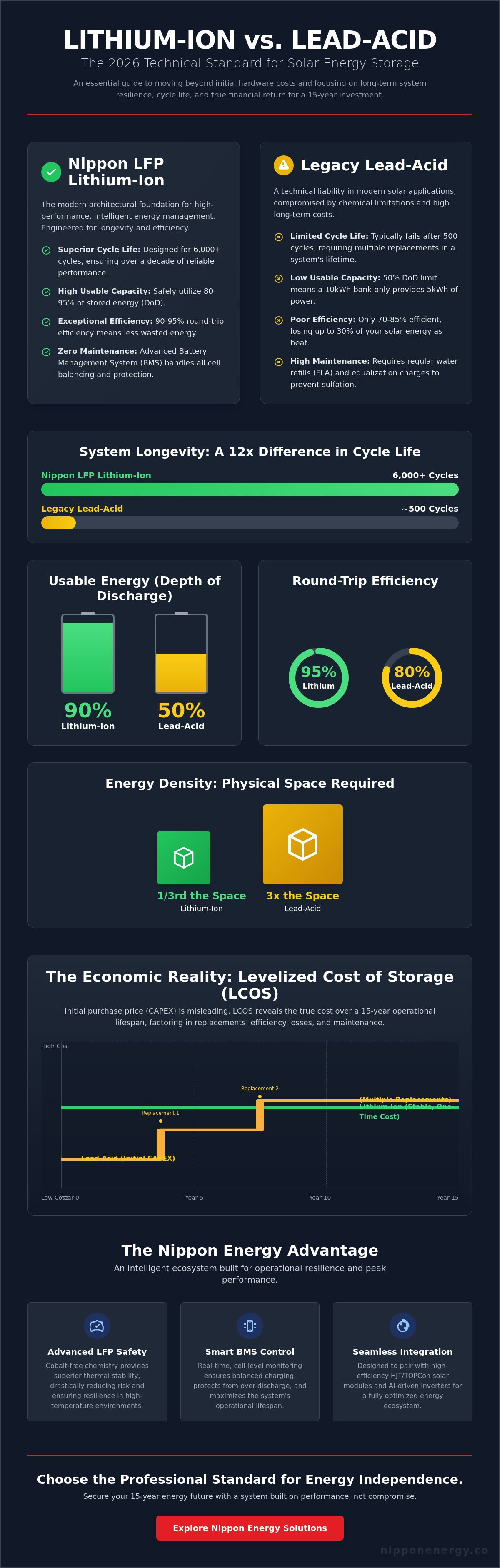
Engineering a resilient energy system requires a granular analysis of electrochemical performance. When comparing a lithium ion vs lead acid solar battery, the disparity in cycle life represents the most significant divergence in long-term reliability. A standard lead-acid unit typically provides 500 cycles before reaching its end-of-life, whereas Nippon Lithium-ion Battery Storage Systems are engineered for 6,000+ cycles. This 12-fold increase in longevity ensures that the energy architecture remains stable for over a decade without the need for hardware intervention.
Efficiency metrics further validate the shift toward modern chemistries. Lead-acid systems suffer from substantial energy loss during the charge and discharge process, often peaking at a round-trip efficiency of only 70-85%. In contrast, lithium-ion technology operates at 90-95% efficiency. This reduction in heat-related loss means more of the energy harvested by your solar array is available for consumption, which optimizes the overall system footprint. Energy density also plays a critical role in site planning. Lithium-ion cells store significantly more energy per unit of volume, allowing for a compact installation that requires approximately one-third the physical space of legacy lead-acid banks.
Depth of Discharge (DoD) and Useable Capacity
The usable capacity of a storage system is dictated by its Depth of Discharge (DoD) threshold. Lead-acid batteries require a 50% DoD limit to prevent accelerated plate degradation, meaning a 10kWh bank only offers 5kWh of practical energy. Technical Benchmarking of Solar Batteries confirms that lithium-ion systems safely operate at 80-95% DoD. This capability allows users to install smaller, more energy-dense banks that provide equivalent power without the hidden cost of oversizing legacy infrastructure. When evaluating a lithium ion vs lead acid solar battery, the actual cost per usable kilowatt-hour is often lower for lithium due to this increased capacity utilization.
Charge Rates and System Responsiveness
Modern solar projects utilizing high-efficiency TOPCon solar panels generate massive amounts of power during peak sunlight hours. Lithium-ion batteries possess the high charge-acceptance rates necessary to absorb this energy rapidly. Lead-acid batteries enter a prolonged "absorption" phase as they reach full charge. This slow chemical process often wastes valuable sunlight, as the battery cannot accept current as fast as the panels can produce it. For commercial operators, this bottleneck limits the ability to maximize self-consumption. You can review our Nippon Lithium-ion Battery Storage Systems to see how these technical benchmarks facilitate a more responsive energy profile.
The Economic Reality: Upfront CAPEX vs. Levelized Cost of Storage (LCOS)
Evaluating a lithium ion vs lead acid solar battery solely on initial Capital Expenditure (CAPEX) is a fundamental error in energy procurement. While lead-acid systems present a lower entry price, they carry an architectural "replacement trap" that compromises the long-term fiscal viability of a solar project. In 2026, sophisticated developers prioritize the Levelized Cost of Storage (LCOS). This metric quantifies the total cost of energy stored and discharged over the battery's entire operational life, including maintenance and replacement cycles. CAPEX is a deceptive metric because it ignores the reality that a lead-acid bank will likely require six replacements to match the lifespan of a single Nippon Lithium-ion system.
Operational overhead further separates these two chemistries. Flooded lead-acid batteries demand active manual maintenance, such as the consistent addition of distilled water and the cleaning of terminal corrosion. These systems also require specialized ventilation infrastructure to manage hydrogen gassing, which adds to the initial facility costs. Lithium-ion systems eliminate these requirements. By removing the need for regular physical intervention, lithium technology reduces the total cost of ownership and ensures that the system remains a hands-off asset rather than a maintenance liability.
The 10-Year Cost Projection
A decade-long financial model reveals the stark contrast in energy asset value. Lead-acid batteries, averaging only 400 cycles, typically fail within 1.5 to 2 years under daily cycling conditions. Over ten years, the labor and hardware costs of repeated installations far exceed the initial solar battery storage cost of a high-performance lithium system. Furthermore, the 70-85% round-trip efficiency of lead-acid means 15-30% of your generated power is lost as heat. This degradation of energy value compounds over time, directly inflating the cost per kilowatt-hour of usable electricity.
ROI and Financial Future-Proofing
Precision engineering leads to faster payback periods. The 90-95% efficiency of lithium-ion ensures that nearly all harvested solar energy is available for use, which maximizes self-consumption and reduces grid reliance. Financial institutions and insurers now favor lithium-ion for large-scale solar EPC services due to its predictable performance and lower risk of premature failure. Investing in advanced chemistry isn't just a technical upgrade; it's a strategic move to secure energy assets against the rising costs of legacy hardware maintenance and the absence of previous federal tax incentives.
Operational Resilience: Safety, Maintenance, and Climate Adaptability
Operational resilience in 2026 is defined by a system's ability to maintain peak performance under environmental stress. When analyzing lithium ion vs lead acid solar battery architectures, thermal stability emerges as a critical differentiator. Lithium Iron Phosphate (LFP) chemistry provides an inherently high thermal runaway threshold, which ensures safety in high-density installations. Lead-acid batteries are notoriously sensitive to temperature fluctuations. Industry data confirms that lead-acid life expectancy drops by 50% for every 8°C rise in ambient temperature above 25°C. This thermal fragility makes legacy lead-acid systems a liability in regions experiencing extreme heat, such as South Asia or the Middle East.
Nippon Lithium-ion Battery Storage Systems utilize advanced cell chemistry to mitigate these risks. These units integrate seamlessly with Nippon Smart AI Inverters to provide real-time data streaming and predictive thermal management. This level of oversight allows for megawatt-scale storage deployment in constrained industrial environments where space is a premium. Because lithium-ion systems possess superior energy density, they achieve the same storage capacity as lead-acid in approximately 30% of the physical footprint. This architectural efficiency reduces site preparation costs and simplifies thermal regulation requirements.
Maintenance-Free Operations
Transitioning to lithium technology eliminates the human error factor inherent in traditional battery upkeep. Flooded lead-acid banks require manual electrolyte checks and equalization, whereas lithium systems are essentially maintenance-free. The integrated Battery Management System (BMS) balances individual cells automatically, which prevents premature failure and extends the hardware's operational life. This automation significantly reduces long-term O&M costs within standard solar system maintenance protocols. By removing the need for physical intervention, operators ensure higher uptime and more reliable energy delivery.
Environmental Impact and Sustainability
Sustainability is a core pillar of Nippon Energy's global vision. Lead-acid batteries contain toxic materials that pose significant disposal risks if not managed with absolute precision. Lithium-ion, particularly LFP, offers a cleaner lifecycle that aligns with modern corporate ESG goals. The extended lifespan of lithium ion vs lead acid solar battery options means fewer units enter the waste stream over a 20-year project duration. Choosing advanced storage solutions demonstrates a commitment to technical excellence and environmental responsibility. You can explore our full range of Nippon Lithium-ion Battery Storage Systems to see how we are engineering a more resilient future.
Strategic Implementation: Why Nippon Lithium-Ion is the Professional Standard
The decision between a lithium ion vs lead acid solar battery is no longer a matter of simple preference; it's a strategic choice that defines the structural integrity of your energy infrastructure. Nippon Energy approaches storage through the lens of a High-Tech Architect, treating every installation as a long-term energy asset rather than a consumable purchase. This engineering-first philosophy ensures that storage systems are not isolated components but are fully integrated with high-efficiency hardware. By aligning storage chemistry with the advanced power curves of Nippon HJT Solar Panels and TOPCon modules, we eliminate the bottlenecks that typically plague legacy systems.
Global EPC expertise allows us to deploy these resilient architectures across diverse and demanding climates. From high-temperature industrial zones to remote utility sites, our systems maintain operational continuity where traditional lead-acid banks fail. Investing in advanced lithium technology provides the technical validation required for large-scale energy independence, ensuring that your capital is protected against the rapid obsolescence of 20th-century chemical storage. This transition from "buying a battery" to "investing in an energy asset" is the hallmark of modern energy procurement.
Nippon Lithium-ion Battery Storage Systems
Nippon Lithium-ion Battery Storage Systems represent the pinnacle of Japanese engineering, focusing on precision, safety, and extreme durability. These systems are designed for total scalability, allowing for seamless expansion from residential backup configurations to utility-scale grid stabilization projects. Every kilowatt-hour stored is managed by proprietary logic that optimizes cell health and discharge rates. This high-voltage architecture minimizes conversion losses and ensures that the system provides the high-surge capacity required for heavy industrial loads or modern smart homes.
Choosing Your Path: The Final Verdict
While lead-acid technology served the industry for decades, its application in 2026 is limited to specific, low-cycle backup scenarios where environmental conditions are strictly controlled and initial cost is the only metric. For every other application, the technical and economic evidence is clear. Use this final checklist to confirm your direction:
- Operational Frequency: If you cycle your system daily to maximize self-consumption, lithium-ion is the only viable choice.
- Thermal Environment: In regions with ambient temperatures exceeding 30°C, lead-acid degradation rates make it a financial liability.
- Space Constraints: Lithium-ion provides the energy density required for high-capacity storage in limited physical footprints.
- LCOS Requirements: If your objective is the lowest cost per delivered kilowatt-hour over 10 years, lithium-ion wins decisively.
Professional reliability requires hardware that matches your ambition. We invite you to contact our engineering team to conduct a custom storage audit and determine the optimal configuration for your project. Explore the full capabilities of Nippon Lithium-ion Battery Storage Systems and secure your energy future with technical precision.
Architecting Your 2026 Energy Independence
The technical benchmarking of a lithium ion vs lead acid solar battery confirms that legacy storage chemistries cannot sustain the demands of a high-performance 2026 energy grid. By prioritizing Levelized Cost of Storage (LCOS) over initial hardware costs, you secure an asset capable of 6,000+ cycles and 95% round-trip efficiency. Nippon Energy delivers this level of reliability through Japanese-engineered LFP chemistry and AI-driven battery management systems. Our Tier-1 EPC project execution ensures that your storage architecture is future-proofed against climate volatility and shifting regulatory standards. Establishing a resilient, self-sustaining power ecosystem requires hardware that matches the sophistication of modern solar modules. This transition marks the shift from temporary storage to permanent energy infrastructure. We invite you to Request a Technical Consultation for Nippon Lithium-Ion Storage to align your energy goals with professional-grade engineering and architectural precision. Your path to long-term energy independence is built on technical excellence and a commitment to visionary progress.
Frequently Asked Questions
Which battery lasts longer for solar: Lithium-ion or Lead-acid?
Lithium-ion batteries provide a significantly longer operational lifespan, often exceeding 10 to 15 years in daily use. While lead-acid units typically fail after 500 cycles, Nippon Lithium-ion systems are engineered for 6,000+ cycles. This extreme longevity ensures that your energy architecture remains a stable and productive asset throughout the entire life of your solar panels without requiring premature hardware replacement.
Is Lithium-ion worth the extra cost for a home solar system?
Investing in a lithium ion vs lead acid solar battery is economically justified through the Levelized Cost of Storage (LCOS). Lithium systems provide 90-95% round-trip efficiency and higher usable capacity, which directly offsets the higher initial capital expenditure. Over a 10 year period, the avoidance of multiple lead-acid replacements results in a lower total cost of ownership. It's a strategic move to secure your energy assets.
Can I replace my existing lead-acid batteries with Lithium-ion?
You can transition from lead-acid to lithium-ion, but it requires a comprehensive system audit. Modern lithium batteries operate at different voltages and require specific charge profiles that legacy inverters may not support. Upgrading to Nippon Smart AI Inverters ensures seamless integration and optimal communication with the new battery management system. This technical alignment is essential to prevent hardware damage and maximize the efficiency of your storage bank.
What is the safest type of solar battery for high-temperature climates?
Lithium Iron Phosphate (LFP) is the safest chemistry for extreme heat environments due to its high thermal runaway threshold. Unlike lead-acid, which experiences a 50% lifespan reduction for every 8°C rise above 25°C, LFP maintains structural integrity at higher temperatures. This resilience makes it the professional standard for energy storage in hot climates, ensuring that your system remains safe and efficient despite environmental stress.
How much maintenance do lead-acid solar batteries actually require?
Flooded lead-acid batteries require monthly physical interventions to ensure operational safety. This includes checking electrolyte levels, adding distilled water, and cleaning terminal corrosion to prevent resistive heating. You must also ensure that the battery room has specialized ventilation to manage hydrogen gassing. Lithium-ion systems eliminate these manual tasks, providing a maintenance-free solution that reduces long-term operational overhead and eliminates the risk of human error during upkeep.
What happens to Lithium-ion batteries at the end of their life?
Lithium-ion batteries enter a specialized recycling stream where up to 95% of key materials can be recovered for secondary use. The process extracts valuable elements like lithium, copper, and aluminum to be repurposed in new battery manufacturing. This creates a circular economy that aligns with modern sustainability goals and reduces environmental impact. It's a cleaner choice compared to the toxic disposal challenges associated with legacy lead-acid units.
Does the depth of discharge (DoD) really matter for my solar ROI?
Depth of Discharge (DoD) is a critical factor in determining the real-world value of your energy storage. A higher DoD allows you to access 80-95% of the battery's total capacity without causing damage, whereas lead-acid is limited to 50%. This means a smaller lithium bank can provide more usable energy than a larger, more cumbersome lead-acid array. Higher DoD utilization directly accelerates your return on investment by maximizing available power.
Can I mix different battery types in one solar storage bank?
Mixing different battery chemistries or brands within a single bank is not permitted due to mismatched charge profiles and internal resistance. Such a configuration leads to uneven energy distribution, which causes premature cell failure and potential safety hazards. The Battery Management System cannot accurately monitor a heterogeneous bank. Always maintain a uniform battery architecture to ensure the integrity and safety of your energy management system across its entire lifecycle.


