

Net billing changes the economics of commercial solar: exported surplus is credited separately, while electricity drawn from the grid is billed at the applicable import rate. Under the NEPRA regulations for commercial solar 2026, distributed generation is capped at 1 MW, and a system’s capacity cannot exceed the consumer’s sanctioned load.
For businesses, the key question is not only how much a solar system can generate, but how its exports are valued and which connection rules apply. The regulations also shape how new applications are assessed and define NEPRA’s role in overseeing prosumer connections.
This guide explains the shift from net metering to net billing, capacity and sanctioned-load limits, application requirements for commercial systems, and NEPRA’s powers. It also shows how these rules affect project planning, helping you assess the regulatory framework before moving forward.
Key Takeaways
- Understand why net billing values exported electricity separately from power drawn from the grid, and how that changes the financial case for commercial solar.
- Learn which existing agreements continue under their current terms and when the 2026 prosumer regulations took effect.
- Use the 1 MW cap and sanctioned-load rule to assess whether a proposed system fits the stated capacity limits.
- See how project size affects application requirements, including when technical studies and specific connection arrangements apply.
- Follow the approval process by understanding the review stages, NEPRA’s role, and the applicable timelines and charges.
Transition from net metering to net billing
Pakistan’s 2026 framework replaces the earlier net-metering arrangement with net billing for new prosumers. For commercial consumers, exported electricity earns a separate credit, while grid imports are charged at the applicable tariff.
Compared with earlier net-metering rules, how do commercial solar regulations differ in Pakistan? In a net-billing arrangement, exported electricity is credited separately from electricity drawn from the grid. What taxes, electricity tariffs, or fixed charges apply in 2026? Imported solar panels carry 10% GST, grid electricity costs Rs. 40 to Rs. 60 per unit, and fixed charges remain separate from export credits.
Net Metering and Net Billing Differences
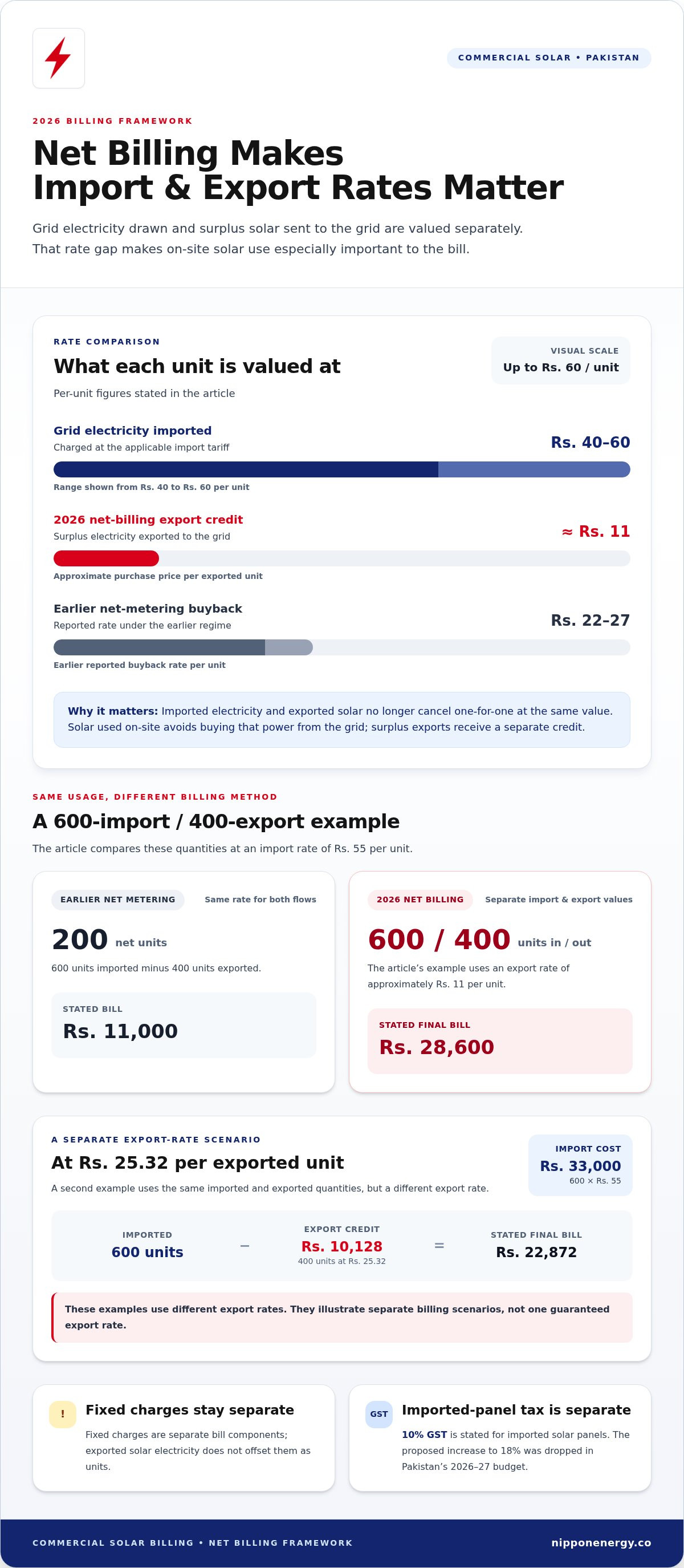
Net metering offsets exported electricity against electricity imported from the grid, while net billing values each flow separately. Under the earlier 2015 regime, both flows received the same rate, with a reported buyback rate of Rs. 22 to Rs. 27 per unit. Under 2026 net billing, the export purchase price is approximately Rs. 11 per unit, while grid imports cost Rs. 40 to Rs. 60 per unit. This difference matters because exported units no longer cancel imported units one-for-one.
For commercial planning, when you use electricity matters: solar power consumed on-site avoids buying that power from the grid, while surplus electricity exported to the grid receives a lower credit. The framework therefore gives self-consumption greater weight in the bill calculation. Distinguish electricity imported, electricity exported, and any separate fixed charges on your bill.
Billing Examples and Export Credits
A billing example makes the change clear: under the earlier net-metering model, importing 600 units and exporting 400 left 200 net units. At Rs. 55 per unit, the stated bill was Rs. 11,000. Under net billing, the same quantities produce different totals because imports and exports have separate prices. At an export rate of approximately Rs. 11 per unit, the stated final bill was Rs. 28,600.
A second example uses an export rate of Rs. 25.32 per unit: 600 imported units at Rs. 55 cost Rs. 33,000, and 400 exported units earn Rs. 10,128. Subtracting that credit gives the stated final bill of Rs. 22,872. These examples use different export rates, so they illustrate separate billing scenarios, not a single guaranteed rate.
Imported-panel tax is also distinct from electricity billing: the stated GST is 10%, and the proposed increase to 18% was dropped in Pakistan’s 2026-27 budget. The bill’s import tariff and export credit depend on their applicable rates; fixed charges are separate components, not units offset by exported solar electricity. Comparing monthly imported and exported units against their respective rates shows how the net-billing framework affects operating costs.
What Are the NEPRA Prosumer Regulations 2026?
Pakistan’s 2026 prosumer framework governs distributed generation connected through licensed distribution companies. Its effective date and treatment of existing agreements determine which rules apply to a commercial project.
Regulation Scope and Effective Date
The Alternative and Renewable Energy (ARE) Prosumer Regulations cover solar, wind, and biogas generation units up to 1 MW connected to the distribution network through licensed DISCOs. NEPRA’s Prosumer Regulations 2026, notified through SRO 251(I)/2026, took effect on February 9, 2026. This date matters because application timing and agreement status shape the transition between the previous arrangements and the new framework.
The agreement term can be an important part of planning for new prosumer connections. NEPRA issued a draft amendment on February 16, 2026, and opened a 30-day public consultation period. A draft is a proposal, so businesses should distinguish it from the regulations already in effect. For project planning, the operative date remains February 9, while the draft amendment signals a possible change.
Compliance Risks and Safety Requirements
Commercial compliance involves meeting the interconnection and electrical-safety requirements, not simply installing generation equipment. The stated approval requirements include surge protection devices on both DC and AC sides. An inverter must also have anti-islanding protection compliant with UL 1741 or IEC 62116. These safeguards address hazards associated with grid-connected operation and form part of the technical approval considerations.
Non-compliance can create technical-review or connection risks, so build the applicable safeguards into the system design. The regulatory facts provided here do not establish a specific penalty amount, so do not assume a fine. Align the design and application with the stated protection requirements, then follow the DISCO review process for the proposed connection.
Existing prosumers remain under their current agreements until those agreements expire. NEPRA’s draft amendment proposed that prosumers holding valid net-metering agreements as of February 9, 2026, could retain their previous rates through the agreement’s remaining term. During that period, the stated export compensation is around Rs. 25.32 per unit. This transition protection applies to qualifying existing agreements, rather than creating the same rate for new applicants.
Applications submitted before February 8, 2026, also received transitional consideration. Power Minister Awais Leghari said 5,165 applications covering 250.822 MW would be considered under Pakistan’s old net-metering policy. For a commercial applicant, the relevant distinction is therefore whether the application fell within that submitted-before-February-8 group or proceeded under the framework effective February 9.
NEPRA’s regulatory role includes issuing prosumer rules and setting the concurrence framework, while licensed DISCOs handle distribution-network connections. The distinction matters: regulatory approval does not remove technical interconnection requirements. A project’s agreement date, application status, connection design, and applicable framework together determine its treatment under Pakistan’s 2026 rules.
Solar system capacity and sanctioned-load limits
Pakistan’s rules apply two main constraints to a proposed distributed-generation facility: the 1 MW cap and the consumer’s sanctioned load. The distribution network can also affect whether an additional connection proceeds.
Under the NEPRA (Prosumer) Regulations, 2026, a facility cannot exceed 1 Megawatt (1MW), and its capacity cannot exceed the consumer’s sanctioned load. The 2025 regulations also state that a solar system cannot exceed sanctioned load. For commercial planning, the lower applicable limit is decisive: meeting the national cap alone does not permit a system larger than the load sanctioned for that connection.
Sanctioned load is the approved load associated with your electricity connection. It is different from the amount of electricity consumed during a billing period. When assessing solar capacity, compare the proposed system with the sanctioned-load figure in your connection records, rather than relying only on recent usage or the expected bill reduction.
For example, if a facility’s sanctioned load is below the 1 MW ceiling, the sanctioned load becomes the binding capacity limit. If its sanctioned load is higher, the 1 MW regulatory cap still applies. These are two separate tests, not alternative routes to a larger system. A proposal must satisfy both before network conditions are considered.
Network capacity adds a further practical constraint. Under Pakistan’s described interconnection framework, a DISCO may refuse additional connections when transformer loading reaches around 80%. This is not the same as the consumer’s sanctioned-load limit: one concerns the individual connection, while the other concerns the transformer serving the local distribution network.
That distinction matters for businesses planning a system near either limit. A compliant design at the consumer level can still face a network constraint if the relevant transformer is heavily loaded. Conversely, available transformer capacity does not allow a system to exceed the sanctioned load or 1 MW ceiling. Capacity planning therefore needs to consider the connection and the network separately.
Keep these checks distinct when evaluating a proposed system:
- Compare proposed generation capacity with the consumer’s sanctioned load.
- Apply the 1 MW maximum under the 2026 regulations.
- Account for the DISCO’s transformer-loading constraint, including the stated level of around 80%.
These limits determine the permissible system size, not the export tariff or the value of electricity used on-site. First establish which capacity ceiling applies, then assess how a system within that limit fits your demand and connection conditions. This keeps regulatory sizing separate from the financial comparison between self-consumption and exported electricity.
Rules for new solar connection applications
A commercial application brings together the consumer’s system design, DISCO technical review, and NEPRA concurrence. System size determines any additional studies and connection requirements.
Approval Fees and Timelines
The approval process has separate DISCO review and NEPRA concurrence stages, each with a stated timeline. A DISCO must acknowledge an application within 5 working days and complete its technical review within 15 days. NEPRA concurrence is to be issued within 7 working days. After payment, the DISCO must install the interconnection within 15 days.
The concurrence fee is Rs. 1,000 per kW under the 2026 regulations. These stages help commercial consumers map the approval sequence and understand when payment precedes interconnection. The timeline runs through distinct actions, rather than treating application submission as the only milestone.
Regional and DISCO Rule Variations
The 2026 prosumer framework applies across Pakistan, while the local connection assessment depends on the relevant DISCO and its distribution network. For a consumer, that distinction matters because technical feasibility is assessed at the connection point, not solely by the national framework.
Network conditions can affect the review: transformer loading, connection type, and proposed capacity all inform the technical assessment. The national framework sets out application timelines and the NEPRA concurrence stage, while local network conditions shape the engineering review.
Project size also changes the technical material required. Commercial and industrial solar projects of 250 kW or larger require load-flow studies under the described framework. These studies assess how the proposed solar energy system interacts with the network, supporting the DISCO’s review of connection conditions and system impact.
For systems above 25 kW, the stated requirements include an LT or HT connection and a full surge protection device chain on both DC and AC sides. These are design considerations, not optional additions to the approval timeline. Addressing them in the project design helps align the application with the connection requirements.
Applicants should organize the design information around the system’s capacity, connection arrangement, and protection equipment. A project at or above 250 kW adds load-flow study requirements; a system above 25 kW triggers the stated LT or HT connection and full SPD chain requirements. The thresholds apply to different technical checks, so one does not replace the other.
NEPRA concurrence and DISCO interconnection are separate stages. The application proceeds through acknowledgement, technical review, concurrence, payment, and installation milestones. Tracking them separately helps identify whether a delay concerns the DISCO’s technical assessment, NEPRA’s concurrence, or connection work after payment.
For payback analysis, distinguish the approval process from the price of electricity. Application requirements determine how a connection is reviewed; the net-billing framework determines how imported and exported electricity are valued. Assess both, but do not confuse approval-stage fees and technical studies with the recurring electricity tariff.
What are the NEPRA and DISCO fees, charges, and timelines for commercial solar approval?
Pakistan’s 2026 approval process separates NEPRA concurrence from DISCO technical review and interconnection. The stated fee and deadlines help commercial consumers plan each stage, from application acknowledgement through connection installation.
The concurrence fee is Rs. 1,000 per kW under the 2026 prosumer regulations. A 100 kW application, for example, would have a concurrence fee of Rs. 100,000. This is the NEPRA concurrence charge, not a complete estimate of every application or connection expense.
Other connection-related costs can include metering and installation. The stated typical net-metering connection estimate is Rs. 100,000-200,000, including processing fees, a smart meter, and installation. A PEPCO-approved bidirectional smart meter is listed at PKR 18,500 for a net-metering application. These figures describe connection-related costs, not the price of a commercial solar system.
Application handling follows separate deadlines. A DISCO must acknowledge a solar application within 5 working days, then complete its technical review within 15 days. NEPRA concurrence is to be issued within 7 working days. After payment, the DISCO must install the interconnection within 15 days.
These milestones occur in sequence but involve different responsibilities. Acknowledgement confirms receipt, not completion of the technical review. NEPRA concurrence is a separate approval stage, and interconnection installation follows payment. Tracking each milestone helps show where an application stands without treating the entire process as one review period.
The technical review can affect preparation and project sequencing. Commercial and industrial projects of 250 kW or larger require load-flow studies under the described framework. Systems above 25 kW require an LT or HT connection and a full surge protection device chain on both DC and AC sides. These requirements should be incorporated into the design and application materials.
For a project budget, separate regulatory charges from equipment, installation, and network-related expenses. The per-kW concurrence fee varies with the capacity submitted for approval; connection costs include distinct items such as metering and processing. Also distinguish the approval timeline from project construction time, which these regulatory deadlines do not define.
Use the applicable capacity and technical requirements to structure the application, then track acknowledgement, review, concurrence, payment, and interconnection separately. For a project-focused next step, map your commercial solar project requirements against these approval stages.
Nippon Energy: Nippon HJT Solar Panels
Nippon Energy helps commercial businesses turn solar regulations into a project plan through Solar Project Development and EPC. Use this service when assessing system design, capacity constraints, and the connection requirements covered in this guide.
Nippon HJT Solar Panels and Nippon TOPCon Solar Panels are available for solar projects, along with Nippon Lithium-ion Battery Storage Systems. The right configuration depends on the project’s energy needs, proposed capacity, and technical design. Aligning these decisions with the sanctioned-load limit and DISCO requirements supports a coordinated path from planning to application.
For a commercial project discussion, contact Nippon Energy.
Turn Regulatory Planning Into a Project Decision
The next step is to translate regulatory constraints into a commercial energy strategy. The nepra regulations for commercial solar 2026 make project design and business priorities inseparable: consumption patterns, available roof or site area, and the role of stored energy all shape the configuration worth evaluating.
Nippon Energy offers Nippon HJT Solar Panels and Nippon TOPCon Solar Panels for solar projects, alongside Nippon Lithium-ion Battery Storage Systems. These options can inform a discussion about generation and storage needs, without assuming one configuration suits every business. A clear project brief connects operational priorities with system design and the approval pathway.
Bring your commercial solar requirements into that planning conversation and identify the right next steps for your project. Contact Nippon Energy about commercial solar to move your assessment forward with clarity and purpose.
Frequently Asked Questions
What Is Net Billing in 2026?
Net billing records electricity imported from the grid separately from solar electricity exported to it. You pay for imports under the applicable tariff and receive a credit for exports at the applicable purchase price. For example, if a business exports surplus electricity at midday and draws power later, the bill records separate entries rather than offsetting units one for one. This makes on-site use central to evaluating a commercial system.
What Happens to Existing Solar Owners?
Existing prosumers keep their current agreement terms until those agreements expire. For a business with a valid agreement, the transition therefore depends on its contract status and expiry, not simply on being a solar owner. NEPRA’s draft amendment proposed retaining previous rates for agreements valid on February 9, 2026. It’s useful to keep the signed agreement and its expiry details with the site’s energy records.
What Has Changed?
The central change is how exported electricity is valued: the earlier arrangement offset imports and exports at the same rate, while net billing credits exports separately. The 2026 framework also defines a prosumer contract duration and application requirements for new connections. For a business reviewing a proposal, separate the system’s generation value from its export credit. That provides a clearer basis for comparing self-consumption with electricity supplied by the grid.
Who Is Affected?
The 2026 prosumer rules cover solar, wind, and biogas distributed-generation facilities connected to Pakistan’s distribution network through licensed DISCOs. They are relevant to commercial consumers applying under the new framework, as well as existing prosumers assessing their agreement status. A business considering a different renewable source should still assess its connection arrangement and capacity against the applicable rules. The regulations’ scope is not limited to rooftop solar installations.
Why Did NEPRA Abolish Net Metering?
The available policy rationale concerns how the cost of purchasing exported solar electricity is shared across the grid. Pakistan’s government said those costs were being shared among 38 million national-grid consumers. Net billing changes the way exported electricity is credited, rather than treating imports and exports as equivalent units. This explains the stated system-level concern without implying that every solar consumer caused the cost pressure or that individual projects have identical economics.
Why Did NEPRA Make This Move?
The shift changes how electricity purchased from the grid and prosumer exports are accounted for. A separate export credit means surplus electricity is valued differently from electricity bought at the consumer’s import tariff. This affects project economics, particularly when generation regularly exceeds on-site demand. For a commercial decision, compare expected self-consumption with likely exports and account for each under its own billing treatment, rather than relying on total solar generation alone.
Will Existing Net Metering Consumers Be Affected?
Existing consumers remain under their current agreements until those agreements expire, so the transition does not immediately replace every existing contract. A business should distinguish an active agreement from a new application, because each falls under a different transition situation. Applications submitted before February 8, 2026, were also identified for consideration under the old policy. Keep application and agreement records together to understand which transition treatment applies.
What NEPRA Regulations Apply to Commercial Solar Systems in Pakistan in 2026?
The nepra regulations for commercial solar 2026 cover distributed generation up to 1 MW, with system capacity also limited by the consumer’s sanctioned load. New projects must meet the relevant DISCO interconnection requirements, while NEPRA concurrence forms part of approval. Technical design also matters: protection equipment and, for larger commercial projects, network studies can be required. The applicable rules depend on system size, connection conditions, and whether an agreement already exists.


