

A fault on a solar panel doesn’t automatically qualify for warranty coverage. The outcome depends on the written terms, the cause of the fault, and the evidence available. If you’re searching for “solar panel warranty claim process pakistan,” begin by identifying the warranty for your panel and the claim channel named in its documents.
It can be difficult to know whether to approach the installer, seller, distributor, or manufacturer, especially when invoices, serial numbers, and installation records are stored in different places. This guide explains how product and performance warranties differ, which documents and fault evidence to gather, and how to follow the claim instructions. A claim may start with an installer or authorized dealer, but the route stated in your warranty documents should guide your next step.
You’ll also learn how to submit a traceable claim, follow up while a decision is pending, and keep useful records. Monitoring and maintenance history can help explain a suspected fault, but coverage depends on the warranty conditions and the evidence reviewed.
Key Takeaways
- Coverage depends on the written terms for your specific panel, including how product defects and performance commitments are defined.
- Build a clear fault record by noting when the issue began, how often it occurs, and the operating conditions when it appears.
- The solar panel warranty claim process pakistan readers follow starts with reviewing the warranty terms and submitting supporting records through the stated claim channel.
- If a claim is disputed, compare the stated reason and any cited exclusion with the warranty wording before responding.
- Track follow-ups by case reference and keep dated copies of requests, responses, and assessment outcomes.
What a solar panel warranty in Pakistan covers, and what it does not
A solar panel warranty sets out written terms for a specific product. It is not a universal promise that every fault will be repaired or that expected output will always be maintained. Coverage depends on the panel model and the warranty document issued for it. Pakistan’s solar market includes different technologies and suppliers, so check the product’s own terms rather than relying on general statements about solar warranties. The Solar power in Pakistan overview provides broader context about the country’s solar sector, but it cannot determine coverage for an individual panel.
Product warranty and performance warranty are different
A product warranty addresses eligible material or manufacturing defects; a performance warranty sets an output commitment measured under the conditions stated in its document. These are separate commitments. A panel may have a visible defect, or its measured output may raise questions about a performance threshold. Neither circumstance proves that a claim is covered. The warranty’s definitions, assessment method, and evidence requirements determine how it is reviewed.
Record the panel’s exact model, the version of the warranty document, and its effective date. If your system includes an inverter, keep its warranty terms separate. Panel coverage does not automatically describe inverter coverage. Keeping product records distinct helps ensure that a panel concern is assessed under the correct warranty.
Which document determines coverage in Pakistan?
Start with the warranty certificate and full terms supplied for your specific panel model. Check the stated start date, eligible faults, exclusions, evidence requirements, and claim route. A sales description or general warranty statement may not include the conditions needed to assess an individual claim.
Claim processes can differ by brand and by the roles of the seller, distributor, and manufacturer. The written terms identify the relevant channel. An installer may help route a claim, but that does not replace the stated procedure. Don’t assume that one warranty duration or claim route applies to every panel.
Look for conditions that affect how the fault will be evaluated. For a performance commitment, note the specified output threshold, measurement basis, and any testing conditions. Monitoring data can help show how the system has behaved, but it may not be equivalent to a formal warranty assessment. Keep the original data and record when and how it was collected.
- Identify the product: match the model and serial number to the warranty paperwork.
- Separate the claim type: distinguish a suspected product defect from an output-performance concern.
- Locate the controlling terms: check the relevant start date, conditions, exclusions, and claim channel.
This document-first approach gives the solar panel warranty claim process pakistan a reliable starting point. It helps you describe the issue against the applicable terms instead of assuming every fault qualifies. It also shows which records and evidence to prepare before filing.
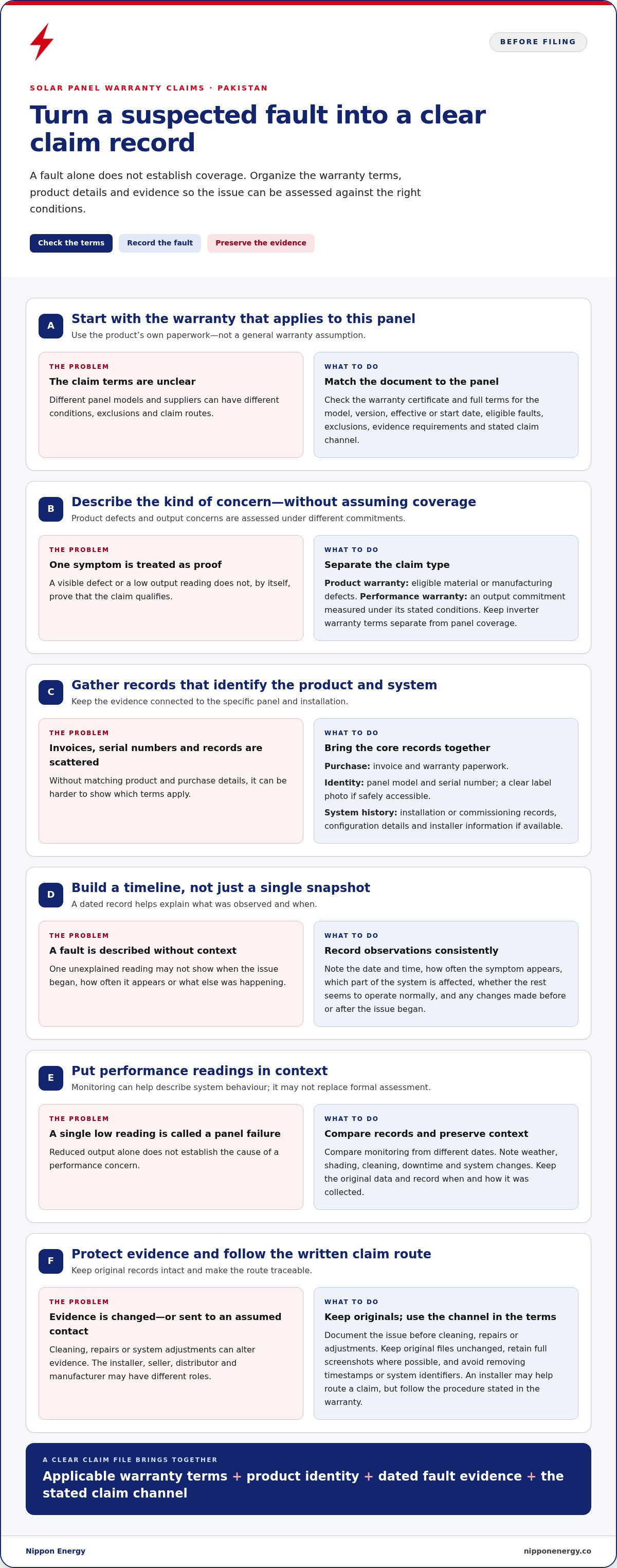
Before filing a solar panel warranty claim, document the fault
A well-organized claim file separates what you observed from what still needs technical assessment. Begin documenting the issue when you first notice a change, before cleaning, repairs, or system adjustments alter the evidence. Record the date and time, how often the symptom appears, which part of the system is affected, and whether the rest of the system seems to be operating normally. This creates a timeline for review rather than leaving a single unexplained reading.
Build a complete claim file
Match the purchase invoice and warranty paperwork to the panel model and serial number on its label. Add the installation or commissioning date, system configuration, and installer details if available. Keep the original files unchanged, then organize copies by date so the record follows the system from purchase to fault discovery.
- Purchase and warranty: invoice, warranty certificate, and applicable terms.
- Product identity: panel model and serial number, plus a clear photo of the label if it is safely accessible.
- System history: installation or commissioning records and available configuration details.
- Fault evidence: dated photographs, monitoring screenshots, and relevant error messages or logs.
- Timeline: when the issue began, how often it appears, and any changes made before or after it started.
Keep original files intact and make a separate folder for copies. Use filenames that describe the contents, such as the date followed by “monitoring reading” or “error message.” Retain full screenshots where possible. Avoid cropping out timestamps or system identifiers that may help show when the evidence was recorded.
Record performance concerns without jumping to conclusions
Compare monitoring records from different dates instead of treating one low reading as proof of a panel defect. Note relevant context, such as weather, shading, cleaning, downtime, and system changes. These details can help explain variations, but they do not establish the cause by themselves. Don’t diagnose a module failure from reduced output alone. Preserve the records and request a technical assessment through the claim route stated in the warranty.
Photograph visible damage from a safe distance and capture any displayed warning without opening electrical enclosures or disconnecting equipment. If inspection requires working near live components or at height, leave it to a qualified professional. Documenting a fault should never create an electrical or physical safety risk.
Maintenance records can add useful operational context. A solar system maintenance guide can help you plan what to record over time, while the Pakistan Solar Association provides wider industry context. Neither replaces the terms of your warranty or a technical assessment.
A consistent evidence file makes the solar panel warranty claim process pakistan easier to document and follow. Nippon Energy provides solar system maintenance and monitoring to support ongoing system records and oversight. These services do not determine warranty coverage.
How to file a solar panel warranty claim in Pakistan
Once you’ve assembled your fault records, follow the claim instructions for the specific panel and warranty. An installer in Pakistan may help route a claim, but the warranty terms identify the responsible channel and required submission method. Use that channel rather than assuming every seller, distributor, or manufacturer follows the same process.
Review the terms, organize the evidence, submit through the stated channel, and keep a dated record of every response.
- Review the warranty instructions. Find the applicable terms and check the required contact method, forms, documents, and instructions about inspection or repairs. Confirm that you’re using the process for the correct panel model and claim type.
- Assemble the claim file. Gather purchase evidence, warranty paperwork, model and serial numbers, installation records, and dated fault evidence. Make sure the files are readable and the product identifiers match the documents.
- Submit a factual claim. Describe what you observed, when it began, how often it occurs, and which records support your account. Separate observations, such as an error message or output change, from conclusions about the cause.
- Retain proof of submission. Save the submitted form or message, attachments, delivery confirmation, date sent, and any case reference. Keep follow-up messages with the same claim file.
Submit the claim through the channel named in the warranty
Use the contact method and forms specified in the product warranty documents. Include the panel serial number, purchase evidence, a concise description of the fault, and relevant dated records. If the installer helps route the claim, keep a copy of what was forwarded and to whom. Record the submission date and retain the case reference so follow-ups can be connected to the original claim.
Prepare for inspection and technical assessment
An assessment may require access to equipment or additional system information. Keep relevant records available and follow instructions from the claim channel named in the warranty. Before authorizing repairs, replacing components, or changing system settings, review the warranty instructions because these changes could affect the assessment. If there is a safety issue requiring urgent attention, prioritize safe operation and document the concern and any action taken.
During an assessment, provide an accurate system history, including known installation details, maintenance, downtime, and changes. Don’t guess at a technical cause or alter readings to make a fault appear clearer. If additional documents or access are requested, record the request date, what you supplied, and how it was delivered. This makes the solar panel warranty claim process pakistan traceable from submission through assessment.
Ongoing maintenance and monitoring records can preserve useful operational context. Nippon Energy provides solar system maintenance and monitoring to help maintain a record of system operation. That context can support documentation, but warranty decisions remain subject to the applicable written terms.
Why solar panel warranty claims are disputed or rejected, and how to respond
A disputed claim does not, by itself, prove that a panel is defective or that coverage has been correctly declined. Assess the decision against the specific warranty terms, the evidence about the fault, and any exclusion cited by the reviewer. Installation concerns, physical damage, system changes, or incomplete records are matters to investigate, not automatic reasons that every panel warranty is void.
Separate a product defect from installation or external damage
A technical assessment may consider whether symptoms point to a material or manufacturing concern, or relate to installation, wiring, earthing, surge protection, or another system condition. The evidence needs to be reviewed in context. For example, an event around the time a fault appeared may be relevant, but it does not establish the cause by itself. Compare the assessment findings and any cited exclusion with the warranty wording.
Storm or impact damage may be assessed differently from a product-defect claim because the cause and applicable terms can differ. Record visible conditions and relevant system history, but don’t assume that a grid event, missing component, or repair automatically voids coverage for every brand. The specific warranty and technical findings determine how those facts apply.
What if the installer is unavailable or the claim is declined?
If the installer can’t assist, return to the warranty paperwork and identify any manufacturer, distributor, or other designated claim route. Send a dated written follow-up using the case reference, summarize the steps already taken, and attach any requested documents that have not yet been supplied. Keep copies of each message and delivery record so the escalation remains traceable.
If the claim is declined, ask for the reason in writing, including the specific warranty clause applied and the findings behind the decision. Compare that explanation with the product terms and your dated evidence. If a detail appears incorrect or incomplete, respond with a concise correction and supporting record rather than speculation. A review may clarify the basis for the decision, but it cannot guarantee a different outcome.
Keep the exchange factual. Separate what you observed from an assessor’s conclusions, and note unresolved questions, such as whether a finding concerns the panel or a surrounding system condition. If new information is requested, record when it was provided and retain the response. This helps you track the solar panel warranty claim process pakistan without treating common dispute factors as universal exclusions.
- Installation or wiring: provide available installation details and relevant assessment findings.
- Surge protection or earthing: document the system condition without assuming it caused the fault.
- Physical damage or weather: record what is visible and distinguish it from a suspected internal defect.
- System changes: note what changed, when, and by whom, then compare it with the written terms.
- Missing records: identify what is unavailable and provide alternatives if you have them, such as dated monitoring history.
Nippon Energy’s solar system maintenance and monitoring services can help maintain records of system condition and operation over time. Those records may support fault documentation, while coverage remains subject to the applicable warranty terms.
After submission: track the claim and protect your solar system records
Submitting a claim begins the review, not the resolution. The claim channel may request more information, arrange an assessment, or issue an outcome under the applicable warranty. Keep the process traceable by using the case reference in follow-ups, recording dates, and saving every document you send or receive. There is no single resolution timeframe for every brand or case, so use the timeline, if any, provided by the relevant claim channel.
Follow up methodically while the claim is under review
Send concise status requests through the original claim channel. Include the case reference, submission date, and any outstanding request. If the reviewer asks for more evidence, provide organized copies and retain proof of delivery. A dated log shows what has been answered and what remains pending without relying on memory.
- Log each contact: record the date, channel, person or team, and key points discussed.
- Track requests: note what information was requested, any stated response deadline, and when you supplied it.
- Preserve confirmations: save acknowledgements, case updates, assessment arrangements, and the written decision.
Maintain clear records for future assessment
Keep the claim file with your system’s ongoing records instead of scattering documents across messages and devices. Retain panel details, purchase invoices, commissioning records, maintenance notes, monitoring data, service reports, and the final written claim decision. Consistent records make it easier to understand the system’s history if another assessment or service visit is needed.
- Product and purchase: model, serial numbers, invoice, and warranty documents.
- System history: commissioning information, maintenance notes, and recorded system changes.
- Claim history: submissions, case references, requests, responses, assessment notes, and outcome.
If the issue involves inverter readings or system operation rather than a panel symptom alone, solar inverter troubleshooting guidance may help you identify which operational details to preserve. Keep observations separate from diagnosis, and include dates or screenshots where available.
A consistent follow-up log and organized system records give the solar panel warranty claim process pakistan a clear audit trail. The warranty itself determines the assessment and possible outcome. Nippon Energy provides solar system maintenance and monitoring in Pakistan to support system oversight, not to guarantee warranty coverage or approval.
Explore Nippon Energy solar solutions and relevant maintenance support for your system.
Build a stronger foundation for your solar system
A warranty file can become part of your system’s long-term operating record, not just a response to one fault. Keep it current as equipment is serviced or system conditions change. A clear history can help future assessments and support informed decisions about maintenance, monitoring, and system planning. The solar panel warranty claim process pakistan owners follow is shaped by the written terms, while good records help keep decisions grounded in documented facts.
Nippon Energy supplies HJT and TOPCon solar panels and provides solar system maintenance and monitoring services in Pakistan, with locations in Lahore and Karachi. Ongoing oversight can give you a clearer view of system operation without replacing warranty requirements or determining claim outcomes.
Explore Nippon Energy solar solutions and maintenance support for your system. Keep your records organized and contact Nippon Energy to discuss solar solutions and ongoing maintenance support.
Frequently Asked Questions
What documents do I need for a solar panel warranty claim in Pakistan?
The exact list depends on the panel warranty and its submission instructions. Useful records often include the purchase invoice, warranty certificate, panel model and serial numbers, installation or commissioning records, dated photos or error screenshots, and monitoring history relevant to the symptom. If invoice details differ from the panel label, include both and explain the discrepancy. Keep readable copies and follow the named claim channel’s checklist rather than assuming every item is mandatory.
Can I claim a solar panel warranty if my installer is no longer available?
An unavailable installer does not, by itself, determine whether a claim is eligible. Check the warranty paperwork for a direct route through the manufacturer, distributor, or another designated service channel, where the terms provide one. Include evidence linking the panel to the purchase and site, such as invoice details and commissioning documents. State that the installer is unavailable, retain proof of submission, and follow the route specified for the product.
How long does a solar panel warranty claim take in Pakistan?
The solar panel warranty claim process pakistan owners encounter has no single standard duration. Timing depends on the provider’s procedure, the completeness of your evidence, assessment requirements, and the circumstances of the case. Record the submission date and case reference. If the review appears inactive, send a concise status request through the same official channel. Respond promptly to document requests and save a copy of each response.
What happens if my solar panel warranty claim is rejected?
A rejection should include a reason you can evaluate. Request the written decision and the exact warranty clause relied on, then compare that explanation with your records and the product terms. For example, if the decision cites missing commissioning information, provide it if available or explain what alternative record you can supply. Ask focused questions through the named channel. Follow-up may clarify the decision, but it does not guarantee reversal.
Does a power surge automatically void a solar panel warranty?
A power surge does not automatically void every solar panel warranty. The reported fault, system evidence, and any surge-related exclusion need to be assessed under the specific product terms. Preserve the event date if known, monitoring or inverter error records, installation details, and technical findings. Describe what happened without claiming a cause you can’t verify, then submit the information through the warranty’s stated route for review.
Can I repair or replace a panel before the warranty assessment?
Review the warranty instructions before authorizing repairs, removing a module, or changing wiring, because intervention can affect assessment of the original fault. If there is an immediate safety concern, prioritize safe isolation by a qualified professional rather than delaying necessary protection for a claim. Before work, if it is safe to do so, retain photographs and note the date and reason. Keep the technician’s report and details of any components handled or replaced.


