

A solar plant’s maintenance contract should define not only the work, but also how performance issues are identified, reported, and addressed. An annual maintenance contract for solar power plant operations should make those expectations clear. A list of routine tasks alone can leave plant owners unsure where preventive maintenance ends and corrective response begins.
That distinction matters. Plant owners need a practical scope that reflects site conditions and equipment, with clear reporting and response expectations. A well-defined framework makes responsibilities visible and supports timely decisions when monitoring data or inspections point to a concern.
This guide explains what a solar plant maintenance contract can cover, how to set performance requirements, and how to structure an annual service framework for a plant in Pakistan. It also outlines how Nippon Energy’s solar system maintenance and monitoring services support ongoing asset operations, alongside the company’s solar project development and EPC work.
Key Takeaways
- Define an annual maintenance contract for solar power plant operations around clear responsibilities, measurable expectations, and the plant’s operating priorities.
- Separate planned inspections, monitoring, and corrective work so inclusions, exclusions, and approval steps are easy to understand.
- Compare preventive-only, monitoring-led, and broader operations-and-maintenance models by their coverage, reporting, and allocation of responsibilities.
- Build the annual plan from an asset register and baseline review, then account for site conditions, access, and operating constraints when setting schedules.
- Nippon Energy’s solar system maintenance and monitoring services support ongoing plant operations alongside its solar project development and EPC work.
Purpose of Solar Plant Maintenance Contracts
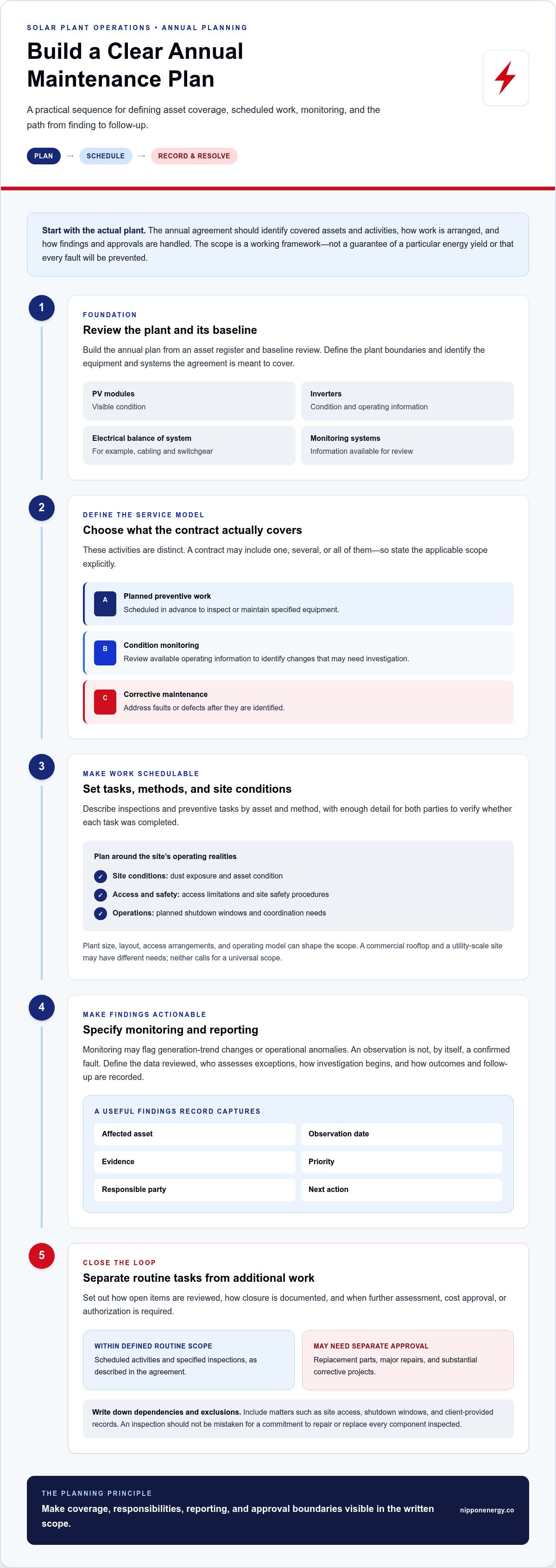
An annual maintenance contract for solar power plant operations is an agreement that defines recurring service responsibilities for a specified period. It identifies the covered assets and activities, how work is scheduled or requested, and how findings and approvals are handled. The contract sets a working framework; it does not, by itself, guarantee a particular energy yield or prevent every fault.
Maintenance scope can include different activities, which should not be treated as interchangeable. Planned preventive work is scheduled in advance to inspect or maintain specified equipment. Condition monitoring involves reviewing available operating information to identify changes that may need investigation. Corrective maintenance addresses faults or defects after they are identified. A contract may include one, several, or all of these, so the written scope should state exactly what applies.
Clear responsibilities help operators track work due, recorded observations, and issues requiring a decision. They also support planning by distinguishing routine tasks from unplanned interventions. For a general overview of how a solar power plant operates, consider how its generation and supporting systems function together. The maintenance scope should reflect the assets and operating needs of the actual site.
How a maintenance contract differs from occasional repair work
Occasional repair work is usually initiated after a fault, alarm, or performance change appears. Contracted oversight can establish recurring activities and documented processes before an issue arises, although coverage depends on the agreement. Its value rests on clear scope, asset coverage, and defined processes for recording findings, reporting issues, and authorizing additional work, not simply on the contract’s duration.
A maintenance agreement is also distinct from an equipment warranty or insurance policy. A warranty concerns specified product or workmanship terms, while insurance addresses covered risks under its policy conditions. A maintenance contract sets service responsibilities between the parties. Keeping these documents separate clarifies who is responsible for inspection, diagnosis, repair approval, and costs outside the agreed scope.
Which solar assets and operating needs shape the scope?
Start by identifying the equipment and systems the agreement is intended to cover. A plant’s scope discussion may include:
- PV modules and their visible condition
- Inverters and associated operating information
- Electrical balance-of-system components, such as cabling and switchgear
- Monitoring systems and the information available for review
Then tailor coverage to plant size, site conditions, asset condition, and the operating model. Dust exposure, access limitations, site safety procedures, and planned shutdown windows can affect how work is organized. A commercial rooftop and a utility-scale site may have different equipment layouts, access arrangements, and coordination needs. Neither calls for a universal scope: define plant boundaries and responsibilities around the site’s actual assets and operating constraints.
What an annual solar plant maintenance contract can cover
A practical scope names the covered assets, maintenance and monitoring activities, reporting responsibilities, and process for handling issues. For an annual maintenance contract for solar power plant operations, this detail distinguishes scheduled service from additional work requiring separate approval. The activities below are scope options, not a standard package. The agreement should reflect the plant’s equipment, operating priorities, and site conditions.
Planned maintenance, inspections, and corrective work
Define inspection and preventive-maintenance tasks by asset and method. For example, the scope might describe visual checks of PV modules, inspections of inverter condition, or examination of selected electrical balance-of-system components. Specify the areas covered, access requirements, inspection records, and any applicable safety or shutdown coordination. Each task should be precise enough that both parties can tell whether it was completed.
Give findings a clear path from detection to resolution. A useful workflow records the affected asset, observation date, evidence, priority, responsible party, and next action. The contract can also state how open items are reviewed and how closure is documented. This helps distinguish a minor observation from an issue requiring investigation or operational coordination.
Define the boundary between routine scope and corrective work. Routine tasks may be scheduled in the annual plan, while replacement parts, major repairs, and substantial corrective projects may require separate assessment, cost approval, and authorization before work proceeds. State dependencies such as site access, plant shutdown windows, or client-provided records, and identify exclusions explicitly. This prevents a listed inspection from being mistaken for a commitment to replace or repair every component inspected.
Monitoring, reporting, and performance indicators
Monitoring can help identify changes in generation trends or operational anomalies, but an observation is not the same as a confirmed fault. Specify which data sources are reviewed, who assesses exceptions, how an investigation is initiated, and how its outcome and follow-up action are recorded. If data is missing or unreliable, reports should flag that limitation rather than imply that plant performance has been fully assessed.
Candidate indicators include system availability and performance ratio. Define each metric’s calculation boundary before using it to assess service. For availability, specify the equipment covered, measurement period, and treatment of planned shutdowns or external interruptions. For performance ratio, document the relevant generation and irradiance data, plant boundary, calculation method, and treatment of missing data or exclusions. Without consistent definitions, results from different periods may not be comparable.
A useful report identifies its reporting period and data sources, then summarizes exceptions, findings, assigned actions, and unresolved items. Agree on the reporting cadence and response targets in the contract rather than leaving them open to interpretation. Nippon Energy provides solar system maintenance and monitoring services. These services can be structured around a project’s operating priorities. Learn more about solar maintenance and monitoring support.
How to compare contract models and set measurable expectations
Contract models are useful planning categories, not fixed packages. The right scope depends on the plant’s scale, asset condition, site risks, operating priorities, and the capability of its in-house team. An annual maintenance contract for solar power plant operations should translate that choice into named responsibilities, defined plant coverage, consistent reporting, and a clear route for approving corrective work.
Use this comparison to identify the level of oversight the site needs. The model names describe possible arrangements, not standard service inclusions.
| Conceptual model | Typical emphasis | Owner responsibilities and considerations |
|---|---|---|
| Preventive-only | Scheduled inspections and maintenance tasks for specifically listed assets. | The owner or its operations team generally needs a separate process for monitoring, fault investigation, and corrective-work decisions. |
| Monitoring-led | Review of agreed operating data, exception reporting, and an investigation workflow. | Field activities and repairs may remain with the owner or require separate authorization. Data access and quality are key dependencies. |
| Broader operations and maintenance | A wider combination of planned activities, monitoring, reporting, and defined corrective-work processes. | Responsibilities must be allocated across the owner and service team, including work approvals, exclusions, and operational coordination. |
Which contract model fits the plant’s operating needs?
A site with capable in-house staff may prioritize scheduled field activities while retaining internal responsibility for monitoring and follow-up. Where staff have limited time to review operating data, a monitoring-led scope can add visibility, provided investigation ownership is explicit. Plants with complex equipment, multiple operating interfaces, or assets needing closer oversight may require a broader framework. Plant size alone does not determine the answer. Site access, environmental exposure, asset condition, and operating constraints also shape the work plan.
How to make service levels measurable and accountable
Targets are meaningful only when the measurement method is agreed. For every performance indicator, define the measurement period, plant boundary, data source, calculation method, and treatment of planned outages or other agreed exclusions. For example, an availability target should specify which equipment is assessed and whether scheduled shutdowns count. State how missing or unreliable data is handled so reporting does not imply greater certainty than the records support.
Separate service stages rather than using one broad response promise. Acknowledgement records that an issue was received. Investigation covers assessment and diagnosis. Corrective action describes the agreed intervention, while resolution defines the condition for closing the item. Each stage can have its own target, owner, and evidence of completion. Targets, exclusions, escalation steps, and any remedies belong in project-specific contract terms, not generic assumptions. This structure makes performance review more objective and connects reported exceptions to accountable follow-up.
How to prepare an annual maintenance plan for a solar power plant
A useful annual plan turns the contract scope into a sequence of site-ready activities, assigned responsibilities, and review points. For an annual maintenance contract for solar power plant operations, begin with reliable asset information, then match each activity to the plant’s condition and operating constraints. This reduces ambiguity before scheduled work starts.
- Build the asset register. List covered PV modules, inverters, electrical balance-of-system equipment, and monitoring components. Record available model and location details, commissioning information, known defects, warranty documents, and the records available for each asset.
- Establish the operating baseline. Gather available monitoring data and recent maintenance or fault records. Note gaps, changes in equipment configuration, and existing issues so future reviews can distinguish known conditions from new observations.
- Translate needs into tasks. Link each planned inspection or maintenance activity to the relevant asset, its purpose, and the party responsible. Separate scheduled tasks from work requiring further investigation or approval.
- Build the maintenance calendar. Set planned activities around asset needs, safe access, operating conditions, and approved work windows. Account for location-specific exposure in Pakistan, such as dust, heat, rainfall, or coastal conditions where relevant to the site.
- Set coordination and records. Document site access arrangements, communication paths, approval authority, work records, and how open findings will be reviewed. Identify operational constraints, including shutdown coordination or restricted access, before scheduling field activity.
- Define reporting and review. Specify what each report should contain, how exceptions are raised, and how actions are tracked. Assign responsibility for reviewing findings and carrying unresolved items into the next planning cycle.
Build the baseline and maintenance calendar
Use the asset register and available records to determine which components need attention and when work can be performed. A site exposed to frequent dust may need a different inspection plan from one with different environmental conditions. Access rules and operating windows also affect feasible scheduling. Link each calendar entry to specific assets and activities instead of relying on broad labels such as “plant inspection.”
A documented baseline makes year-on-year performance review meaningful by providing a consistent reference for comparing results and interpreting changes. Record the data source and any limitations so comparisons remain transparent.
Review performance and refine the next contract year
At the end of the service period, compare reported results with the agreed baseline. Record material changes, recurring observations, completed actions, and data limitations. Use repeated findings to prioritize follow-up work or adjust planned activities, documenting the reason for each change. This creates a traceable link between plant history and the next annual plan.
For wider operations-and-maintenance planning, Nippon Energy’s solar system maintenance and monitoring services connect ongoing plant oversight with its project development and EPC work. Explore solar plant maintenance and monitoring as part of planning operations around your site’s assets, priorities, and maintenance records.
How Nippon Energy supports solar plant maintenance and monitoring
Solar assets need operational attention beyond project delivery. Nippon Energy provides solar system maintenance and monitoring services alongside solar project development and EPC. This connects the company’s work across the plant lifecycle, while the maintenance approach should be shaped around the site’s assets, operating context, and owner’s priorities.
A project-specific annual maintenance contract for solar power plant operations begins with clarity about what the plant owner needs to oversee. One site may prioritize visibility into operating data; another may need planned maintenance activities tailored to its equipment and access constraints. The contract discussion can translate those priorities into a defined scope, responsibilities, reporting expectations, and processes for reviewing issues. These are planning considerations, not assumed inclusions or standard terms.
Connect maintenance planning with long-term plant operation
Structured maintenance and monitoring form part of ongoing solar asset management. Planning should consider the plant’s equipment, site conditions, existing records, operating model, and how the owner uses performance information. This context helps determine which activities should be scheduled, what information is needed for review, and how observations are communicated for follow-up.
For owners whose projects are moving from development and construction into operation, project information can inform later maintenance planning. Equipment records, commissioning information, and known site constraints provide a useful starting point for organizing oversight. Nippon Energy’s solar project development and EPC work sits alongside its maintenance and monitoring services, connecting project delivery with longer-term plant operation without implying a guaranteed performance result or fixed service package.
Discuss a project-specific annual scope
Prepare a concise plant profile before discussing the maintenance plan. Include the plant’s capacity and location, key assets, current operating priorities, available monitoring and maintenance records, and existing arrangements for inspections or corrective work. Note site access limitations or operational windows that shape when work can take place. These details ground the discussion in the plant’s actual requirements rather than a generic template.
Use the discussion to set out the scope and its boundaries. Identify which assets and activities are under consideration, what reporting the owner needs to make operational decisions, and how findings should be documented and reviewed. Clarify responsibilities for approvals and work outside the planned scope. Define deliverables, reporting cadence, response targets, exclusions, and contract terms for the specific project rather than assuming them in advance.
A disciplined planning process gives plant owners a clearer basis for coordinating maintenance and reviewing operational information over time. Nippon Energy’s maintenance and monitoring services can be shaped around the plant’s operating priorities and project context. Read more about solar plant maintenance and monitoring with Nippon Energy.
Set the Next Year of Plant Operations on a Clearer Course
Turn maintenance planning into a living operating document. As equipment, site conditions, and priorities change, use each review cycle to keep responsibilities and decision paths aligned with the plant’s needs. A well-structured annual maintenance contract for solar power plant operations provides a clear basis for those discussions when its scope and expectations are specific to the project.
Before planning the next service period, bring together the asset information, operating priorities, and reporting needs that will guide the work. Then define what the owner needs to see, how findings should be handled, and which decisions require approval. This preparation makes the maintenance discussion more focused and useful.
Nippon Energy supports solar plant owners with maintenance and monitoring services, alongside solar project development and EPC. Discuss a project-specific solar maintenance and monitoring plan for your plant. A deliberate plan is a practical step toward more informed, consistent asset management.
Frequently Asked Questions
What does an annual maintenance contract for a solar power plant include?
It includes the services and responsibilities written into the agreement, which can vary by plant and scope. An annual maintenance contract for solar power plant operations might address selected inspections, monitoring, reporting, or fault-handling procedures. Check whether the plant’s equipment is identified individually or by defined system boundaries. For example, a contract covering inverter monitoring may not automatically include replacement parts or repairs. Clear boundaries make the scope easier to administer.
Is an annual maintenance contract necessary for a solar power plant?
Not every plant needs the same contract structure, but planned oversight can help owners manage maintenance responsibilities and retain consistent operating records. The decision depends on the owner’s in-house technical capability, equipment condition, operational priorities, and existing project obligations. A plant with an experienced operations team may need a different arrangement from one relying on external support. Review existing agreements and site requirements before deciding what ongoing coverage is appropriate.
How often should a solar power plant be inspected under a maintenance contract?
Inspection frequency should be set according to the equipment, site conditions, manufacturer guidance, operating history, and agreed maintenance scope. A calendar can combine scheduled inspections with event-based reviews after an unusual alarm, severe weather, or notable operating change. For example, repeated inverter alerts may justify a targeted assessment rather than waiting for the next routine visit. The contract should state which inspections are planned and how additional assessments are initiated.
How much does an annual solar plant maintenance contract cost?
There is no single price for every plant. Scope, capacity, equipment covered, site location, access requirements, monitoring needs, and allocation of corrective work all affect project-specific cost. A contract limited to planned activities differs from one with broader monitoring and operational responsibilities. Nippon Energy provides solar system maintenance and monitoring services, with the scope shaped around project needs before pricing is determined.
Can a maintenance contract cover monitoring as well as on-site work?
Yes. An agreement can combine monitoring with specified on-site activities when both are defined in its scope. The terms should identify which operating data is reviewed, who receives findings, and how an observation leads to investigation or a site visit. For example, monitoring may flag an output change, while an on-site assessment requires separate approval. This distinction connects data review with practical follow-up without assuming every alert requires field work.
What happens if a solar plant’s performance drops during the contract period?
The agreed process should guide the response: record the change, review relevant operating data, and determine whether further investigation is needed. Before treating a decline as an equipment fault, consider data gaps, planned shutdowns, operating changes, or external conditions that may affect the comparison. The contract should identify who evaluates the finding, how corrective work is approved, and how actions are documented. A reported performance change alone does not establish its cause or guarantee a particular outcome.
Does a solar maintenance contract replace equipment warranties?
No. A maintenance contract and an equipment warranty serve different purposes. The contract defines agreed service responsibilities, while a warranty applies under the equipment provider’s stated terms and conditions. Keep warranty documents and service records together, and record inspections, observed defects, and repair decisions. If an issue may involve a warranted component, the owner can use the relevant warranty process while following the maintenance agreement’s procedures for documenting and coordinating the issue.


