

The longest warranty may not provide the most useful protection. A thorough solar battery warranty comparison looks beyond the number of years to what the warranty covers, when its limits apply, and what you may need to document if a claim arises.
Warranty documents can be difficult to compare because they measure performance in different ways. Capacity retention, cycle limits, and energy throughput each describe a different boundary. Operating conditions and exclusions can also affect coverage. The headline term alone won’t show how those details fit your solar project in Pakistan.
This guide explains how to compare warranty terms consistently, identify conditions that could affect coverage, and organize records that may be relevant to a future claim. It also shows how to assess written protection alongside system design and operation. Nippon Energy supplies lithium-ion battery storage systems and provides solar project development, EPC, maintenance, and monitoring, so warranty review can be part of planning for the whole system.
Key Takeaways
- Use one comparison table to record each warranty’s coverage, performance measure, exclusions, and claim process.
- In a solar battery warranty comparison, compare metrics only when their definitions and test conditions match.
- Match warranty conditions to the battery’s expected role, whether it serves a residential or commercial project.
- Keep project documents and operating records organized so relevant evidence is available if you need to make a claim.
- Assess warranty terms alongside system design and project requirements to make a more informed battery decision.
Solar Battery Warranty Comparison: What Does a Warranty Actually Protect?
Battery warranty documents can describe protection in different ways, even when they appear to cover similar risks. One may separate product defects from performance commitments, while another groups them under a broader warranty heading. The headline duration is therefore an incomplete guide. A solar battery warranty is written coverage governed by stated conditions, limits, and procedures. Its practical value depends on what qualifies, what remedy is available, and what the owner must do to keep coverage in effect.
A battery storage system operates as part of a wider installation, alongside components such as power conversion and control equipment. The overview of a battery energy storage system provides useful context. For warranty review, identify which equipment and performance measures each document addresses instead of assuming one term covers the whole installation.
Warranty scope matters more than a headline term because coverage is useful only when the relevant event, remedy, and conditions are clearly defined.
Product warranty and performance warranty: how they differ
A product warranty addresses specified defects or product failures, as defined in the document. It may identify covered components, explain how a fault is assessed, and state the available remedy. A performance warranty relates to defined battery measures, such as minimum remaining capacity or a limit tied to energy delivered. These are distinct forms of protection, and one should not be assumed to replace the other.
Read the clauses themselves. The written terms determine what counts as a covered defect, how performance is measured, how long each commitment applies, and which conditions must be met. Remedies may also differ, so record whether the document describes repair, replacement, or another response. The word “covered” alone is not enough to understand the outcome.
Why the warranty headline cannot tell the whole story
A stated duration doesn’t show every operating requirement, exclusion, or claim step. Coverage may depend on installation, use, maintenance, or other conditions in the applicable document. The claim process matters too: notification requirements, technical records, and assessment procedures can affect how an issue is handled. Don’t infer these details from a summary if they aren’t stated there.
Headline terms may also rely on different measurement bases. One performance commitment might focus on remaining capacity, while another uses an energy-delivery limit or specified testing conditions. Those measures aren’t directly interchangeable. A sound solar battery warranty comparison starts with coverage categories and definitions, then assesses limits and conditions. Consistent definitions make comparisons more meaningful.
- Identify the equipment and events each warranty covers.
- Separate defect coverage from performance commitments.
- Record each remedy, duration, limit, and operating condition.
- Note claim instructions and required documentation.
This coverage-first review helps match battery documentation to project requirements. During system planning and EPC delivery, aligning battery selection and design with stated warranty conditions keeps those requirements visible. Nippon Energy supplies lithium-ion battery storage systems and provides solar project development, EPC, maintenance, and monitoring, connecting battery review to the wider system and its operation.
Solar Battery Warranty Terms Explained: Capacity, Cycles, and Throughput
Battery performance guarantees use several measures, each describing a different limit. Retained capacity indicates how much energy the battery can hold compared with its stated baseline. A cycle is a count of use, while throughput measures cumulative energy transferred. These figures make sense only alongside the warranty’s definitions and operating conditions. The U.S. Department of Energy Solar Energy Technologies Office provides broader context on solar technology, but the applicable warranty document defines the specific measurement rules.
Warranty duration sets a time boundary; performance thresholds define what the battery must meet within the stated terms and conditions.
How retained capacity and degradation language should be read
A warranty may state that a battery must retain at least a defined amount of its original capacity at a specified point. This is a threshold at that point, not a promise that capacity stays unchanged throughout the warranty period. Find the stated baseline, remaining-capacity threshold, assessment date, and test method. Note any operating conditions that shape the measurement, such as specified charging or discharging parameters. Don’t assume a degradation rate unless the document provides one.
Cycle limits, throughput limits, and stated duration
A cycle limit is a count-based measure when the warranty uses it. Check how a cycle is defined, since partial charging and discharging may be counted differently. Throughput is cumulative energy transferred over time, often defined as energy discharged, but the document must specify what it counts and how. A warranty may combine time and performance limits; its wording determines how those limits affect coverage.
Consider a hypothetical comparison: one warranty might state a cycle ceiling, while another sets a throughput ceiling. Neither figure is directly comparable without its definition. A cycle count doesn’t reveal how much energy was delivered per cycle, and a throughput total doesn’t show how usage was distributed. Likewise, a retained-capacity threshold measured under one test condition shouldn’t be treated as equivalent to a threshold assessed under different conditions.
For a useful solar battery warranty comparison, capture each measure in a consistent format:
- Capacity: baseline, threshold, assessment point, and test method.
- Cycles: counting definition and any stated limit.
- Throughput: energy counted, unit, and cumulative limit.
- Conditions: operating parameters that apply to each commitment.
Then consider how the battery is expected to operate. Frequent cycling may make the cycle definition especially relevant, while high energy demand can make a throughput ceiling important. Assess system design and operating plans alongside the written measures. Nippon Energy’s solar project development and EPC work can align battery selection and system design with project requirements. Explore solar battery storage systems as part of that planning.
How to Compare Solar Battery Warranties on an Equal Basis
A reliable comparison starts with the warranty documents, not a summary chart or sales description. Terms can differ in scope, definitions, and conditions, so record exactly which product and document each entry refers to. This prevents a term for one model, market, or document version from being mistaken for a promise that applies to another.
Build a like-for-like warranty comparison table
Create one column for each battery option and use the same rows for each. At the top, record the exact document name, product model, applicable market, and effective date. This makes the comparison traceable if documents are revised or a future claim depends on which terms applied to the installation.
Separate product coverage from performance commitments. Then add rows for duration, covered components or events, capacity threshold and test method, cycle or throughput limits, operating conditions, exclusions, remedy, and claim process. Copy technical terms accurately. If one document defines a metric differently, label it rather than placing its value beside another as if the two were equivalent. A concise table might include:
- Product coverage: specified defects, failures, components, and remedy.
- Performance terms: capacity measure, threshold, test basis, and applicable limits.
- Conditions: installation, operation, or maintenance requirements stated in the document.
- Claim details: notification steps, required records, and stated deadlines.
For example, if one document expresses a performance limit as a cycle count and another uses cumulative throughput, mark them as different measurement bases. Don’t rank them by the displayed number alone. The comparison is meaningful only when like terms are compared and differences remain visible.
Read exclusions, remedies, and claim procedures together
A coverage statement describes what may be protected; conditions and exclusions define circumstances that can affect eligibility. Review the exact wording for requirements related to installation, use, maintenance, or operating conditions. Record each requirement next to the coverage it qualifies. This helps distinguish the stated protection from the circumstances in which it applies.
Next, note the remedy and any conditions attached to it. Don’t assume a covered issue automatically means a particular repair or replacement outcome. The warranty document controls the available remedy and its limits. Record the wording without turning a conditional statement into an unconditional promise.
Finally, summarize the claim process in sequence: how notice must be submitted, what information or records are required, and whether the document specifies a notification period. Preserve caveats and qualifying phrases. If an instruction refers to another document or procedure, note that reference. In Pakistan, use the warranty terms for the relevant product and market, not language from a different market’s document.
Before selecting a system, use the completed comparison to identify material differences and unclear definitions. Nippon Energy’s solar project development and EPC work connects battery selection with system design, keeping documented requirements in view during project planning.
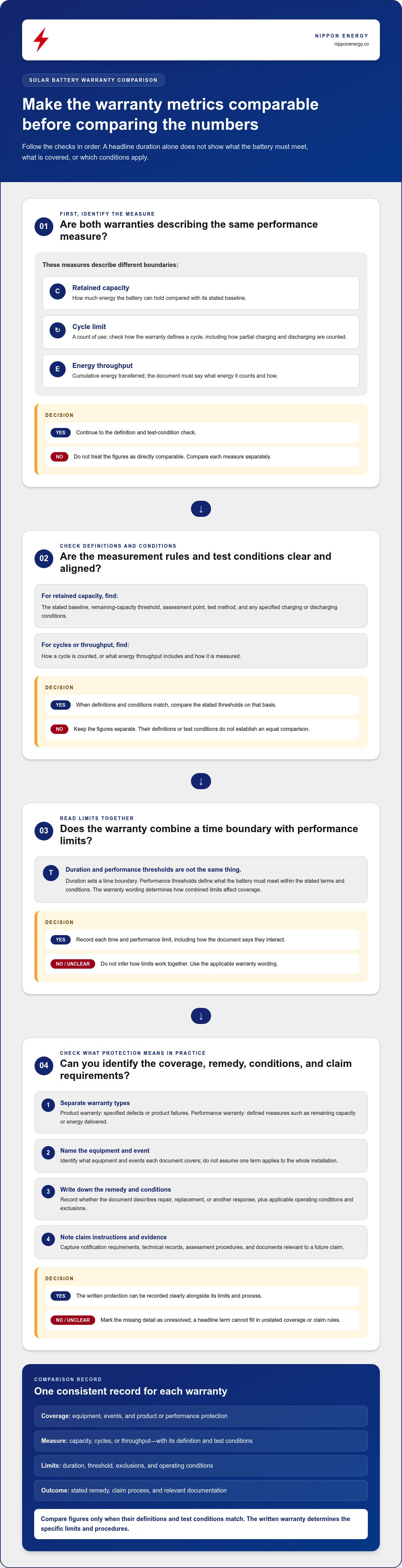
Solar Battery Warranty Checklist: Match the Terms to Your Project
A warranty comparison is useful only when it reflects how the battery will be used and how the full system is designed. In Pakistan, match the documents to the specific battery model and applicable market, then consider the intended storage role, expected operating pattern, and system configuration. A residential backup system and a commercial installation may place different demands on storage, so the same warranty condition can carry different weight for each project.
Use this sequence to make the review project-specific:
- Identify project needs. Define the storage role, expected operating profile, and system configuration.
- Match the documents. Confirm that the product model and warranty document apply to the project market.
- Compare limits. Record duration, capacity terms, and any cycle or throughput limits using the document’s definitions.
- Review conditions. Note operating, installation, and maintenance requirements that may affect coverage.
- Retain records. Organize product, commissioning, maintenance, and operating documents according to the warranty terms.
For system planning, the lithium-ion battery storage guide offers relevant context on storage systems. Use it alongside the project’s technical requirements, not as a substitute for the applicable warranty documentation.
Questions to answer before selecting a battery system
Clarify whether the battery is intended for backup, regular energy shifting, or another defined role. Then consider how often it may operate and how it connects with the rest of the system. Residential and commercial duty profiles can differ in usage patterns and priorities, making particular cycle, throughput, or operating conditions more relevant to one project than another. Compare the warranty terms against the planned profile.
Monitoring and maintenance records can help establish an accurate history of system operation. Nippon Energy provides solar system maintenance and monitoring, supporting an organized approach to long-term asset operation. Keep the records required by the relevant warranty rather than relying on assumptions about what a claim might need.
Create a clear record for future warranty administration
Keep product identification, the applicable warranty document, and commissioning records together. Add any maintenance and operating information required by the terms, retaining dates and relevant system details so the history remains traceable. Avoid editing the original warranty language in your notes; record clarifications separately and preserve the source document.
For practical maintenance context, consult the solar system maintenance guide. A structured file makes it easier to locate the applicable documents and records if warranty administration becomes necessary.
Aligning warranty review with design and project delivery helps keep operating requirements visible from the outset. Plan your solar battery system with Nippon Energy as part of a project-specific approach to storage, EPC, maintenance, and monitoring.
Choosing a Solar Battery System with Warranty Clarity
A useful warranty decision comes from matching written protection to the project, not selecting a system by headline duration alone. Coverage, performance limits, operating conditions, remedies, and claim evidence all affect a warranty’s practical value. The solar battery warranty comparison should end with a clear question: do the documented terms fit the system’s intended use and design?
For a project in Pakistan, use warranty documents that apply to the specific battery model and market. Then assess the battery as part of the complete system. Its configuration and expected operating profile shape which conditions matter most. Nippon Energy supplies lithium-ion battery storage systems and provides solar project development and EPC, connecting battery selection with system planning without treating any warranty term as universal.
How system design and operations relate to warranty review
Project configuration informs how you interpret coverage and performance conditions. A battery intended for one storage role may operate differently from one assigned another role, so use the expected duty profile when reviewing relevant limits. EPC planning can align battery selection and system design with project requirements. Nippon Energy’s solar EPC services bring project delivery into this planning process.
Operation continues after commissioning. Maintenance and monitoring can support disciplined system operation and create a more consistent record of system history. Keep records that correspond to the applicable warranty requirements; don’t assume a particular data point is required unless the terms say so.
A practical next step for storage buyers
Before choosing, compare the applicable product documents using the same project assumptions. Keep a short list of questions the documents or project plan leave open, then resolve how each point affects system fit and long-term operation:
- Does the warranty document match the battery model and market?
- Are performance measures defined for the expected operating profile?
- Which system design or operating conditions affect coverage or remedies?
- What product, commissioning, maintenance, and operating records should be retained?
These questions bring the comparison back to the project’s actual requirements. They also help distinguish a broadly stated commitment from documented protection that fits the intended system. Nippon Energy’s maintenance and monitoring services connect ongoing operation with system oversight, while project development and EPC bring design and delivery into the same planning process.
For a project-specific storage discussion, explore Nippon Energy solar solutions, including lithium-ion battery storage systems and solar project services. A clear view of the project, operating profile, and applicable documents gives buyers a stronger basis for evaluating system fit.
Make Warranty Clarity Part of Your Next Project Decision
Before finalizing a battery choice, turn your comparison into a concise project record. Note which product documents informed the decision, the operating assumptions used, and any questions to resolve during system planning. This creates a reference point if project requirements or system configuration change later.
A solar battery warranty comparison is most useful when it informs the whole project, not just equipment selection. Nippon Energy connects lithium-ion battery storage with solar EPC, maintenance, and monitoring, bringing system delivery and ongoing operation into the planning discussion. Consider how storage fits your project requirements and long-term operating plans.
Explore Nippon Energy solar storage solutions and take an informed step toward a system planned around your needs. Clear decisions today can support confident project planning ahead.
Frequently Asked Questions
What is the difference between a solar battery product warranty and a performance warranty?
A product warranty generally addresses specified defects or product failures, while a performance warranty relates to defined measures of battery operation. A fault in a covered component and a battery falling below a stated capacity threshold are different types of claims. The document may set different remedies or conditions for each, so identify which clause applies rather than relying on the warranty’s general title.
How do I compare solar battery warranties with different capacity guarantees?
Compare capacity figures only after confirming they use the same baseline and assessment method. Check whether the stated capacity refers to nominal or usable energy, if the document defines that distinction, and note any specified test conditions. A solar battery warranty comparison should label unlike measures instead of ranking their percentages directly. For example, a threshold measured under one discharge condition may not be equivalent to one tested under another.
Does a longer solar battery warranty always provide better coverage?
No. A longer stated term may still have narrower coverage, restrictive operating conditions, limited remedies, or performance limits that matter to your project. Compare what triggers protection and what the document provides if a qualifying issue occurs. A shorter warranty with clearly applicable terms may fit a particular duty profile better than a longer one with conditions that don’t match the system’s planned use.
What does a solar battery cycle warranty mean?
A cycle warranty uses battery cycling as a usage measure, but the document defines how cycles are counted. Don’t assume every partial charge and discharge is treated identically across warranties. Review whether the limit applies alongside a time period or another performance measure, and how reaching a limit affects coverage. This helps relate the stated cycle allowance to the system’s expected operating pattern.
Can operating conditions affect solar battery warranty coverage?
Yes. A warranty may make coverage conditional on specified installation, use, maintenance, or operating parameters. For a project in Pakistan, site conditions such as high ambient temperatures may be relevant if the applicable document sets temperature requirements. Compare those requirements with the planned installation and operating environment. Don’t assume a condition applies, or that it is irrelevant, without reading the specific terms.
What documents should I keep for a solar battery warranty claim?
Keep the warranty document, proof of purchase, battery model and serial identification, and commissioning or installation records. Also retain maintenance records and operating data if the applicable terms require them or if they help establish system history. Save relevant correspondence and note when an issue first appeared. The warranty defines claim requirements, so treat this file as an organized record, not a substitute for its stated procedure.
Are solar battery warranties the same in every country or market?
No. Warranty documents can differ by product model, market, and document version. Terms may specify territorial validity, claim channels, or conditions that apply to a particular sales market. For a system in Pakistan, use the warranty document applicable to that battery and market rather than relying on a similar model’s terms from elsewhere. Keep the document version with the project records so the applicable wording remains clear.


