

What keeps a battery fault from escalating into a fire: the battery alone, or the safeguards around the entire system? Thermal runaway can begin when a cell overheats. Potential triggers include manufacturing defects, improper installation, physical damage, and overcharging. Effective solar battery fire risk prevention therefore depends on more than a single safety feature.
It’s reasonable to want clear answers about how fires start, which protections matter, and what to do if a warning appears. This guide explains common fire-risk pathways in stationary battery storage and how layered controls can reduce the chance that a fault escalates. It covers equipment selection, system design, installation, monitoring, and emergency planning.
For projects in Pakistan, a safer storage plan accounts for the site, electrical installation, and the standards and authority requirements that apply to the project jurisdiction. Coordinated project development, EPC, lithium-ion storage, smart inverters, maintenance, and monitoring can all form part of system-level planning. The goal is a practical framework for assessing a complete solar-plus-storage system, not relying on broad safety claims.
Key Takeaways
- Use a lifecycle checklist to structure site review, commissioning, routine operation, and periodic maintenance.
- Compare safeguards by purpose, timing, responsible party, and limitations to see how each fits into the wider plan.
- For solar battery fire risk prevention, align equipment selection, installation, monitoring, and response planning rather than relying on one measure.
- Keep technical work within approved documentation and qualified personnel, and account for the standards and authority requirements that apply to the project in Pakistan.
- Coordinate project development, EPC, equipment selection, and ongoing monitoring so fire-risk management is part of the complete solar storage project.
Solar Battery Fire Risk: What Can Go Wrong and Why Prevention Matters
Solar battery fire risk is the possibility of ignition or fire involving battery storage equipment or connected electrical components. A hazard may arise from a cell fault, damaged cable, poor connection, or interaction between system components. Risk does not mean a fire is inevitable. Appropriate equipment selection, sound system design, correct installation, and attentive operation can reduce the likelihood of faults and limit their consequences. No battery system should be described as risk-free.
Battery chemistry influences how cells behave under stress, while system configuration determines how cells, modules, power conversion equipment, and controls work together. Heat, physical damage, electrical faults, and operation outside manufacturer limits can also affect risk. A fault does not automatically develop into a fire. A practical solar battery fire risk prevention plan considers how these factors combine instead of treating the battery as an isolated component.
How can a battery fault develop into a fire?
Thermal runaway is a chain reaction in which rising temperature inside a cell can trigger further heat-generating reactions and cell failure. An internal defect, physical damage, excessive heat, overcharging, or an electrical fault may initiate a problem. Whether it escalates depends on the fault, battery design, operating conditions, and system response. An initiating event is a hazard to manage, not proof that a fire will follow.
Prevention and emergency response address different stages. Fire prevention reduces the likelihood that a fault starts or escalates; emergency response limits harm once an incident occurs. Clear procedures for both help people understand what safeguards are intended to do and what they cannot guarantee.
Which parts of a solar battery system need consideration?
Assess the battery cells and modules, their enclosure, wiring and connections, the inverter, and control equipment. Each has a distinct function, but their combined behavior matters. Electrical compatibility, installation conditions, and how monitoring detects or reports abnormal operation can all affect how a fault is identified and managed. The Battery storage power station overview provides broader context on storage configurations and battery types.
- Cells and modules: Store energy and can be affected by internal defects, damage, or operating conditions.
- Enclosure: Houses battery components, so its placement and condition matter to the installation assessment.
- Wiring and connections: Carry electrical current; correct sizing, routing, and secure connections matter.
- Inverter and controls: Coordinate power conversion and system operation. Control equipment may support fault detection, depending on its design.
A battery’s fire risk can’t be assessed in isolation; the behavior and safeguards of the complete storage system matter. For projects in Pakistan, account for site conditions and the standards, fire codes, and authority requirements that apply to the project jurisdiction. This whole-system view provides the foundation for evaluating safeguards.
How Layered Safeguards Reduce Solar Battery Fire Risk
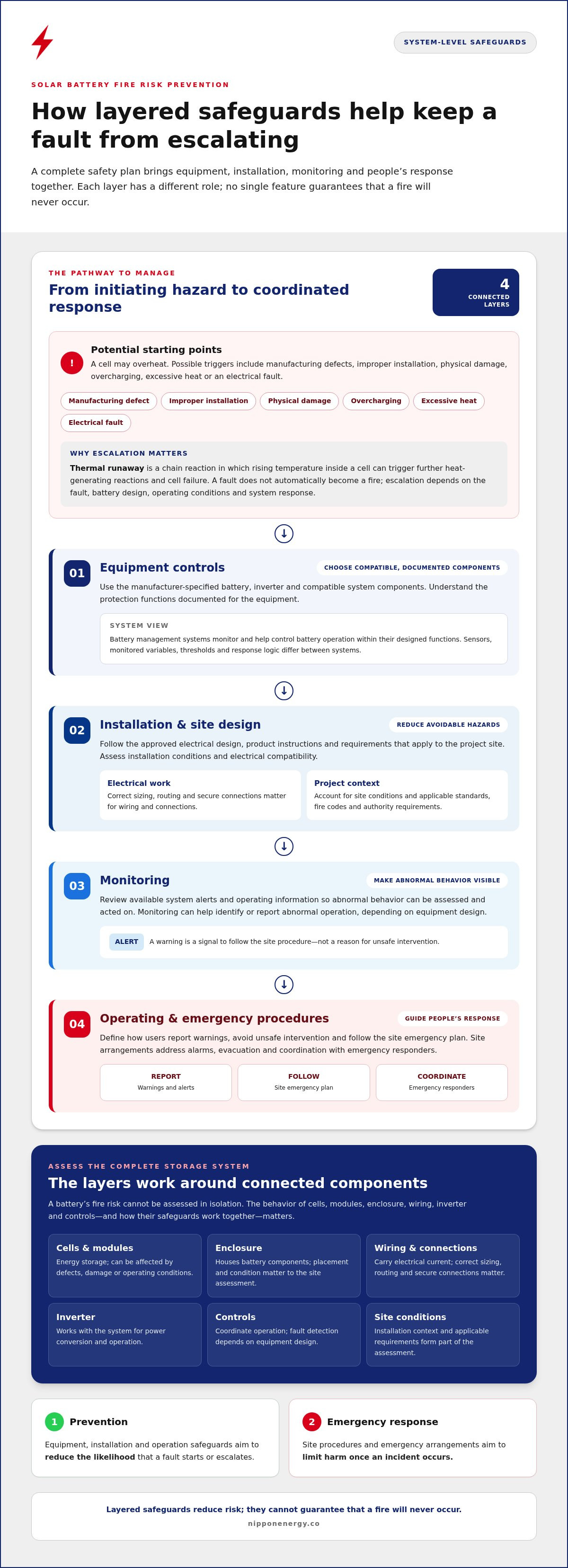
Effective solar battery fire risk prevention depends on safeguards that work together throughout the system’s lifecycle. Equipment controls can help manage abnormal operating conditions; sound installation reduces avoidable electrical and environmental hazards; monitoring can make developing problems visible; and operating procedures guide people responding to warnings. Each layer addresses a different failure pathway, so no single feature is a complete safety plan.
These layers can reduce the likelihood of a fault or limit its consequences, but they can’t guarantee that a fire will never occur. Battery-level protections serve a different purpose from site-level detection and emergency arrangements. A battery management system may monitor and control battery operation, while site procedures address alarms, evacuation, and coordination with emergency responders. The U.S. Department of Energy’s Fire Safety with Solar Systems guidance provides additional context on solar fire safety and responder considerations.
- Equipment controls: Use the manufacturer-specified battery, inverter, and compatible system components, and understand their documented protection functions.
- Installation: Follow the approved electrical design, product instructions, and requirements that apply to the project site.
- Monitoring: Review available system alerts and operating information so abnormal behavior can be assessed and acted on.
- Operating procedures: Define how users report warnings, avoid unsafe intervention, and follow the site emergency plan.
What role does the battery management system play?
A battery management system monitors and helps control battery operation within the functions designed for that system. Depending on the equipment, it may assess relevant operating conditions and initiate a protective response when it detects an abnormal state. Sensors, monitored variables, thresholds, and response logic differ between systems. Review the manufacturer’s documentation to understand the actual functions, alerts, and limitations of the equipment installed.
This distinction matters during planning. Battery controls operate within the battery system; they don’t replace site-level alarms, emergency procedures, or responder coordination. Monitoring is useful when the people responsible know what alerts mean and what actions the approved documentation calls for. Don’t assume that a dashboard or automated control detects every hazard or removes the need for inspection and safe operating practices.
How do enclosure, siting, and electrical design contribute?
Placement and installation conditions affect how equipment operates and how a fault can be managed. Follow manufacturer-specified clearances, environmental limits, and installation instructions. Qualified personnel should design system wiring and overcurrent protection. Apply ventilation or separation measures as required by equipment instructions and applicable design guidance. Fire protection measures depend on the equipment, site conditions, and local codes.
For a project in Pakistan, applicable standards, fire codes, and authority requirements must be addressed for the specific jurisdiction and installation. Include that review in engineering rather than treating it as a substitute for equipment controls or operating procedures. A coordinated project approach connects equipment selection, electrical design, installation, commissioning, and monitoring. Nippon Energy’s solar project development and EPC brings these planning stages into one project framework, alongside its battery storage, smart inverter, maintenance, and monitoring offerings.
Comparing Prevention Measures: Equipment, Installation, and Monitoring
Each safeguard addresses a different part of the risk pathway. Equipment controls and correct installation can reduce the chance of a fault; monitoring can flag abnormal operation for investigation; response planning prepares people to limit harm if an incident occurs. These measures complement one another, but none guarantees fire prevention. The comparison below shows what each layer does, when it matters, who typically manages it, and where its limits lie.
| Measure | Purpose | Lifecycle stage | Responsible party | Limitation |
|---|---|---|---|---|
| Equipment controls | Manage battery operation and reduce exposure to defined abnormal conditions. | Equipment selection, commissioning, and operation. | System designer, installer, and operator, within their roles. | Functions vary by equipment; controls cannot address every site hazard or prevent every incident. |
| Installation practices | Reduce risks from electrical design, connections, placement, and installation conditions. | Design, installation, and commissioning. | Qualified design and installation personnel. | Correct installation reduces risk but cannot eliminate equipment faults or later damage. |
| Monitoring | Make available alerts or abnormal operating information visible for assessment. | Commissioning and routine operation. | System operator, supported by maintenance personnel. | Monitoring depends on system capabilities, configuration, communications, and timely follow-up. |
| Response planning | Guide notification, evacuation, and coordination if an incident occurs. | Before operation and during emergency preparedness. | Site management and relevant emergency responders. | It limits potential consequences; it does not prevent a fault from starting. |
Which controls prevent faults, and which limit their consequences?
Design choices and installation practices reduce risk; they don’t guarantee that faults won’t occur. Monitoring adds a detection layer: an alert or unusual operating trend can prompt investigation, but it only helps if someone receives and acts on the information. Detection and response planning primarily manage consequences. They don’t replace sound equipment selection, installation, inspection, or operation. Response actions should follow approved site procedures.
How should readers assess standards and certifications?
A certification applies to a defined product or test scope, not automatically to every installation condition or the complete project. UL 9540 relates to an energy storage system, while UL 9540A is a test method for evaluating fire propagation; their relevance depends on the equipment and project requirements. NFPA 855 may also be relevant where adopted or required. The NFPA Energy Storage Systems and Solar Safety resource provides context on NFPA’s energy-storage work.
Standards and code requirements vary by system and jurisdiction, so no single standard should be treated as universally mandatory. For a project in Pakistan, identify the standards, fire codes, and authority requirements that apply to the specific location and system before relying on a certification or design assumption. This jurisdiction-specific review connects documented equipment scope with the actual installation, operating environment, and response plan.
Solar Battery Fire Prevention Checklist for Installation and Operation
A practical checklist turns solar battery fire risk prevention into repeatable actions, from early site review to routine operation. Assign technical tasks to qualified personnel, follow approved design documents and manufacturer instructions, and keep records showing what was checked and how issues were resolved. For projects in Pakistan, include the standards, fire codes, and authority requirements that apply to the project jurisdiction.
What should happen before a battery system is commissioned?
Before energising the system, review the site, equipment documentation, electrical design, and installation against the project requirements. Commissioning checks and protective functions should follow manufacturer procedures. Record the final configuration, operating instructions, and responsible contacts so the people responsible for the system can understand its operation and limits.
- Review the site and design. Confirm that the planned location and installation conditions align with equipment documentation and the approved design. Resolve discrepancies before work proceeds.
- Check installation records. Have qualified personnel verify wiring, connections, protective devices, and equipment placement against the approved plans and instructions.
- Complete commissioning checks. Follow the manufacturer’s procedures for system checks and protective functions. Record results and outstanding issues before the system enters routine service.
- Prepare operating information. Document the installed configuration, available monitoring methods, relevant contacts, and site-specific instructions. Make the information accessible to the people responsible for operation.
What should operators monitor and do when an alert appears?
During routine operation, use approved monitoring methods to review available system alerts and abnormal operating patterns. Don’t dismiss recurring alerts or attempt technical diagnosis beyond your training. Follow the manufacturer’s guidance and site procedures. Don’t open, repair, or modify battery equipment yourself.
- Record the alert or unusual condition, including when it appeared and any relevant system information.
- Follow documented instructions for reporting the issue and arranging assessment by qualified personnel.
- Document inspections, findings, corrective actions, and any follow-up needed before closing the record.
A consistent record helps identify recurring issues and gives maintenance personnel a useful history. Keep routine maintenance separate from emergency action: scheduled inspections and servicing follow approved procedures, while smoke, unusual heat, or signs of fire require an immediate emergency response. Move away from danger, follow the site emergency plan, and contact local emergency services. Don’t approach or intervene with affected battery equipment.
Use a consistent sequence to maintain the operating record: log the observation, report it to the responsible contact, document the assessment, record corrective work, and note any required follow-up. Nippon Energy’s solar project development, EPC, maintenance, and monitoring services support coordinated planning across project delivery and ongoing system oversight. Explore solar project and monitoring support as part of a structured storage plan.
Building Fire Risk Prevention into a Complete Solar Storage Project
Fire-risk planning is strongest when it begins before equipment is selected and continues through operation. Battery storage, inverter, electrical design, site conditions, and operating procedures form one system. A mismatch or unaddressed site constraint can create gaps between how equipment is intended to work and how it is installed or managed. Coordinating these decisions helps project teams identify assumptions early and carry them through installation, commissioning, and monitoring.
Why does system integration matter for battery safety?
Battery and inverter compatibility affects system operation; electrical design determines how components connect; and site conditions shape equipment placement and applicable project requirements. No single configuration suits every site or eliminates fire risk. Project-level coordination helps align equipment documentation, approved design, installation work, commissioning checks, and operating instructions, so responsibilities and safeguards don’t fall between project stages.
Nippon Energy supplies lithium-ion battery storage systems and smart inverters, and provides solar project development and EPC. In an integrated project, equipment selection and site engineering can be considered alongside installation and commissioning rather than as isolated decisions. Applicable standards, fire codes, and authority requirements should be addressed for the project’s jurisdiction in Pakistan. Design and documentation should reflect the actual site and selected equipment instead of relying on generic assumptions.
- Define site requirements: Document intended use, location constraints, and relevant authority requirements before finalising the system design.
- Coordinate equipment and engineering: Align battery and inverter documentation with the electrical design and site plan.
- Carry decisions into delivery: Use the approved plans and manufacturer instructions during installation and commissioning, then retain the final system records for operation.
How can maintenance and monitoring support long-term risk management?
Commissioning establishes a documented starting point; ongoing maintenance and monitoring help teams identify changes that may need assessment. Inspections can reveal visible damage or changes in equipment condition, while available system data and alerts can flag abnormal operation. These activities don’t guarantee that every fault will be detected. Their value depends on following approved procedures, recording findings, and ensuring that qualified personnel assess concerns.
Keep a service history that connects alerts, inspections, findings, and corrective actions. If a recurring alert or unusual condition appears, record it and follow the manufacturer’s guidance and site procedures. Don’t open or modify battery equipment during routine checks. Nippon Energy provides solar system maintenance and monitoring to support ongoing system oversight.
A practical next step is to define the site’s operating needs and constraints, then consider equipment selection, engineering, installation, commissioning, and ongoing monitoring as one project. Nippon Energy’s solar EPC and battery storage solutions support this coordinated approach. Let project requirements and applicable local guidance shape the final design.
Make Safety Part of Your Next Project Decision
For a solar-plus-storage project in Pakistan, turn general safety priorities into site-specific requirements before finalising equipment and design decisions. Define the system’s intended use, installation environment, applicable authority requirements, and operating responsibilities. This gives the project team a shared basis for assessing safeguards against actual site conditions rather than relying on broad claims or assumptions.
Effective solar battery fire risk prevention is an ongoing discipline, not a one-time design choice. Keep project records current, assign responsibility for reviewing alerts and maintenance findings, and revisit the plan if equipment, site conditions, or operating needs change. These steps help future assessments build on clear, documented decisions.
Nippon Energy supplies lithium-ion battery storage systems and smart inverters, with solar project development, EPC, maintenance, and monitoring services to support project planning and ongoing oversight. Explore Nippon Energy solar storage solutions as you define the requirements for your project. A deliberate, site-specific plan is a practical foundation for a more informed energy system.
Frequently Asked Questions
Can a solar battery catch fire?
Yes, a solar battery or connected equipment can catch fire, although a fault doesn’t always lead to ignition. A problem may remain contained, trigger a protective response, or escalate depending on the equipment and conditions. Before using a specific system, review its operating instructions and emergency guidance, and make sure the people responsible for the site know where to find them. No battery should be treated as entirely risk-free.
What causes lithium-ion solar batteries to catch fire?
A fire can start if a cell fault or other abnormal condition leads to excessive heat and escalating cell failure. Potential triggers include internal defects, physical damage, overheating, overcharging, and electrical faults such as a problematic connection. These are possible risk pathways, not a prediction that any one fault will cause a fire. After suspected damage or abnormal operation, keep clear of the equipment and follow the manufacturer’s instructions for reporting it.
How can I reduce the fire risk of a home solar battery?
Reduce risk by keeping the system within its approved design and operating conditions. Don’t alter wiring, relocate equipment, or change settings unless the manufacturer’s documentation and qualified personnel support that work. Keep operating instructions and alert-reporting details accessible, and ensure household members know whom to notify about a warning. This practical approach supports solar battery fire risk prevention without relying on a single protective feature or assuming every hazard can be anticipated.
Is it safe to install a solar battery indoors?
Indoor installation may be suitable for some equipment and sites, but it can’t be judged safe as a blanket rule. The battery’s installation instructions, environmental limits, required clearances, and building conditions all affect whether a proposed location is appropriate. Have the design assessed against the equipment documentation and applicable local requirements before installation. In Pakistan, requirements should be addressed for the project’s specific jurisdiction rather than inferred from rules used elsewhere.
What should I do if my solar battery shows a fault or warning?
Follow the system’s documented alert instructions and site procedure, and report the warning to the responsible contact for assessment. Note the message and when it appeared, but don’t open the enclosure, modify wiring, or repeatedly reset the equipment to clear it. If you observe smoke, unusual heat, or signs of fire, move away, follow the site emergency plan, and contact local emergency services. Don’t approach or attempt to handle the battery.
Do solar battery fire prevention requirements vary by country?
Yes. Applicable standards, fire codes, permitting processes, and authority requirements can differ between countries and project jurisdictions. A rule or certification relevant in one market shouldn’t automatically be assumed to apply to an installation in Pakistan. Project teams should identify the requirements that govern the actual site and system, then align design and installation documents accordingly. Confirming local applicability helps avoid relying on irrelevant code references.
Does a battery management system eliminate fire risk?
No. A battery management system can monitor and control defined aspects of battery operation, but its functions depend on the particular system. It may not detect every fault, address hazards in external wiring, or manage all site conditions. Treat its alerts as one source of information, not proof that the system is safe or that no action is needed. Follow the equipment’s instructions and ensure warnings are assessed through the established operating process. For coordinated solar storage, EPC, maintenance, and monitoring support, contact Nippon Energy.


