

A facility may need more battery power but less stored energy than an initial estimate suggests. That distinction can determine whether a system handles critical loads, reduces peak demand, or sustains operations through an outage. If you’re working out how to size a commercial solar battery system, start with real facility data and balance energy capacity, power output, and operating duration. The solar array’s size alone does not determine the right battery.
For commercial sites in Pakistan, load patterns, solar production, local tariffs, grid conditions, and backup priorities all shape the design. This guide explains how to use interval load data to estimate usable capacity, identify the power rating required for simultaneous loads, and compare operating strategies on a consistent basis. It also covers the inputs an EPC design process needs, from critical-load requirements to solar-generation profiles. Nippon Energy’s solar, lithium-ion storage, inverter, and EPC solutions bring those inputs together in an integrated system design, with monitoring providing visibility into operation after commissioning.
Key Takeaways
- Set the operating objective first. Peak-demand management, solar self-consumption, backup, and time-shifting require different sizing assumptions.
- Use interval consumption data to estimate usable energy for the periods the battery must serve, rather than relying on monthly totals alone.
- Assess power and energy capacity separately so the system can serve simultaneous loads for the planned duration.
- Compare facility demand with solar generation to identify charging windows and understand how operating schedules limit daily energy shifting.
- Prepare interval load data, backup targets, solar profiles, and site constraints for integrated design of the battery, inverter, protection, controls, and operating logic.
Define the Commercial Job Before Sizing a Solar Battery System
Battery energy capacity, measured in kilowatt-hours (kWh), describes how much energy is stored. Power, measured in kilowatts (kW), describes how quickly the battery can deliver it. Assess both: a facility may need substantial energy over several hours, high power for a short peak, or a combination of the two.
Before estimating either measure, define the job the battery must perform. A system sized for one objective may not meet another without different discharge schedules, reserved energy, or system configuration.
Which commercial outcome should the battery deliver?
Start with the facility’s priority, not a proposed equipment size. Energy shifting moves electricity from one period to another. Solar self-consumption stores surplus generation for later use. Peak-demand management targets short periods of high demand, while backup reserves energy for selected loads during an outage.
One system can support multiple objectives, but the priority order matters. If backup is essential, the design may need to preserve a reserve instead of using all available energy for peak reduction. In Pakistan, site-specific tariffs and grid conditions also influence the value and timing of each strategy.
- Peak-demand management: Reduce demand during identified high-load intervals.
- Solar self-consumption: Store surplus generation for later use at the facility.
- Backup: Supply defined critical loads for a planned period.
- Time-shifting: Charge in one period and discharge in another according to the operating plan.
What do kWh, kW, and discharge duration mean?
Think of kWh as the quantity of energy available and kW as the rate at which it can be delivered. At a constant power level, discharge duration in hours is approximately usable energy in kWh divided by discharge power in kW. Actual design must account for operating limits and the usable capacity specified for the selected equipment.
Capacity alone does not establish peak-load capability. A battery may hold enough energy but still be unable to serve the facility’s simultaneous loads if its power rating is too low.
For a simplified example, a facility intending to serve a 40 kW load for two hours has a target discharge energy of 80 kWh before accounting for system limits, reserve requirements, or other design factors. This illustrates the relationship, not a recommended specification. The load’s timing and variation determine whether a constant output assumption reflects actual operations.
Commercial storage includes more than cells. Power conversion, controls, and supporting components affect how energy reaches the loads. The Battery storage power station overview provides general context on system components and applications. With the operating objective defined, translate the facility’s load profile into an energy estimate.
Calculate Commercial Battery Capacity From the Facility Load Profile
A defensible capacity estimate starts with measured consumption and a clearly defined objective. To determine how to size a commercial solar battery system, use interval data to identify the energy required during the periods the battery must serve. For energy shifting, total the selected intervals. For backup, count only designated critical loads across the target backup period, not the facility’s entire consumption.
Use interval data to find the energy requirement
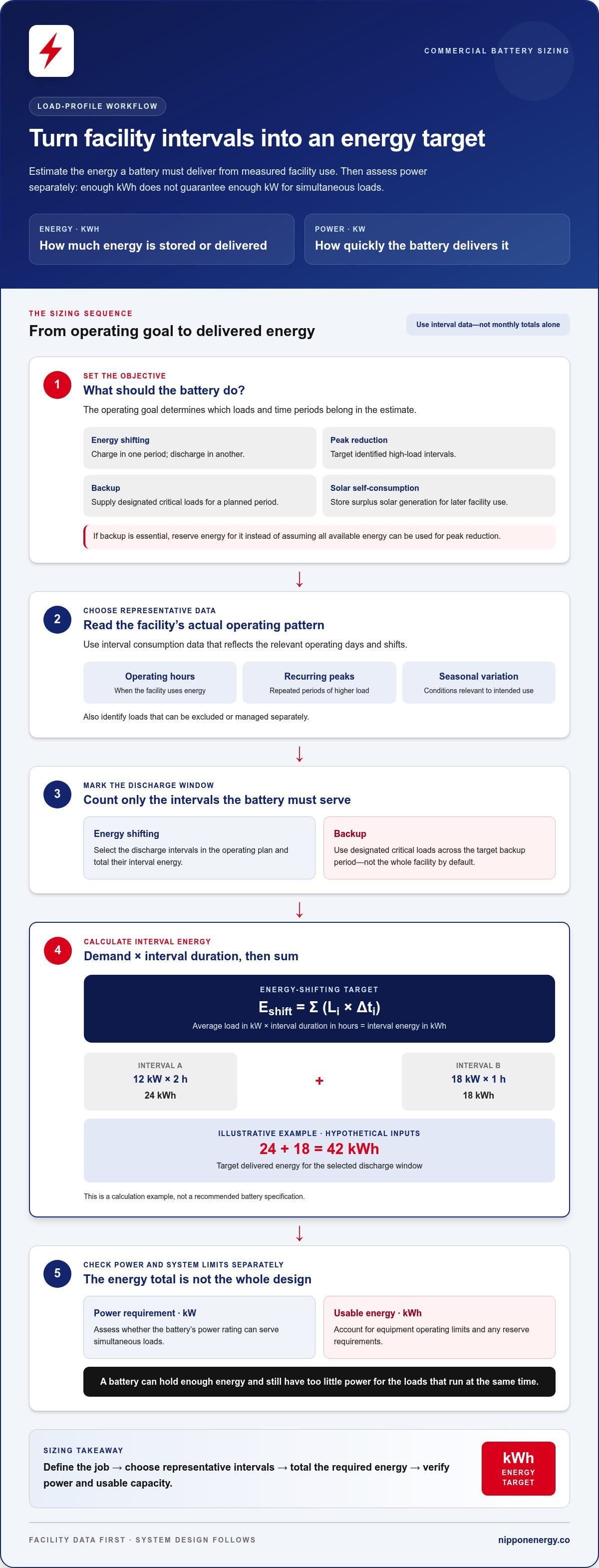
Start with representative interval consumption data covering relevant operating days and shifts. Review operating hours, recurring peaks, seasonal variation, and loads that can be excluded or managed separately. For each interval, multiply average demand in kW by the interval length in hours. The result is an energy estimate grounded in actual facility usage.
Apply this workflow:
- Choose the objective. Specify whether the estimate is for energy shifting, peak reduction, or backup.
- Select representative data. Include operating patterns and seasonal conditions relevant to the intended use.
- Mark the discharge window. Identify the intervals the battery is expected to serve.
- Sum the interval energy. For energy shifting, use Eshift = Σ(Li × Δti), where Li is the average load in interval i, in kW, and Δti is its duration in hours. The result is target discharge energy in kWh.
- For backup, isolate critical loads. Sum only the designated loads over the required backup period.
Illustrative example, hypothetical inputs: A facility selects a discharge window with an average load of 12 kW for two hours, followed by 18 kW for one hour. The target delivered energy is (12 × 2) + (18 × 1), or 42 kWh. This illustrates the calculation, not a recommended battery specification. Assess required power and equipment limits separately.
Convert required delivered energy into nominal battery capacity
Usable capacity is the energy available for the planned operation. Nameplate, or nominal, capacity is the stated total before project-specific limits are applied. Usable battery capacity is not automatically equal to nameplate capacity. Let Ed represent required delivered energy, Cn nominal capacity, u the usable fraction after operating limits and any reserve, and η the verified discharge-path efficiency.
Cn = Ed ÷ (u × η). For the hypothetical 42 kWh target, nominal capacity is 42 ÷ (u × η). Use verified project-specific values for usable fraction and efficiency rather than assuming universal percentages. The EIA Battery Storage Report provides broader context on storage applications, but the calculation must reflect the selected system and site conditions.
This load-based method gives an EPC design a traceable starting point. Nippon Energy’s solar project development and EPC connects the capacity estimate to the wider system architecture and site requirements. Using measured inputs is a practical way to size a commercial solar battery system without relying on a generic facility profile.
Match Battery Power, Discharge Duration, and Load Requirements
Energy capacity determines how much electricity the battery can supply over time. Power rating determines how much it can deliver at once. The battery and inverter must meet the facility’s required simultaneous load. A high kWh estimate cannot compensate for insufficient kW output, so assess both against the load profile and operating strategy.
How much power must the system deliver at once?
Identify coincident peak demand: the loads operating at the same time during the interval the battery must support. This differs from total energy consumption. A site may use substantial energy across a shift but need modest output at any instant, or face a sharp peak when several large loads run together.
Review equipment schedules and note loads that may overlap or create temporary starting demand. Depending on the facility, these may include motors, pumps, compressors, or other equipment with high start-up requirements. Starting demand can differ from normal running demand, so account for relevant operating conditions in the design.
- High power, shorter duration: Serve a concentrated peak or support a short, high-demand interval.
- Lower power, longer duration: Deliver a steadier output for extended backup or energy shifting.
Load sequencing can reduce the peak the battery must serve. Controls that prevent selected equipment from starting simultaneously, or a critical-load panel that separates priority circuits from non-essential loads, may change the required output. Verify the inverter’s continuous and temporary output limits, along with the battery’s discharge limits, against the project requirements.
How long must the battery sustain that output?
Estimate duration by dividing usable energy by planned discharge power: duration (hours) = usable energy (kWh) ÷ discharge power (kW). For example, a hypothetical 60 kWh of usable energy discharged at a constant 20 kW corresponds to three hours under this simplified calculation. This is an illustration, not a recommended system specification.
Short-duration peak support may require higher output over a narrow window. Longer backup or energy-shifting periods may need more usable energy at a lower average output. In practice, duration depends on the changing load profile, conversion losses, reserved energy, and system operating limits. A fixed-power calculation is a starting point; interval-by-interval demand gives a more realistic operating picture.
For facilities in Pakistan, base the design on actual site loads and operating conditions rather than assuming a standard duty cycle. The SEIA Solar+Storage resource provides broader context on solar and storage integration. Project design must still match the system’s power and energy behavior to the facility. Nippon Energy’s commercial solar project development and EPC connects storage and smart inverter integration to defined load requirements.
These checks are central to sizing a commercial solar battery system: confirm what must run together, how long it must run, and which loads can be sequenced or excluded.
Account for Solar Generation, Operating Strategy, and Project Economics
A battery can charge from solar when generation exceeds the facility’s immediate demand, unless grid charging is part of the operating plan. Compare solar output with facility load across matching time intervals rather than relying on daily energy totals. A site may generate enough solar energy over the day in aggregate but have little surplus during available charging hours.
How does solar generation change the required capacity?
Build a time-matched view of solar production, facility consumption, and the intended battery schedule. Identify when surplus generation occurs, how much can be captured, and whether the battery can recharge before the next planned discharge. Test the pattern against different operating days, seasons, and business shifts. A facility that runs mainly during solar hours may use generation directly, while a site with substantial evening demand may have different charging opportunities.
Which operating strategy supports a defensible business case?
Model each potential value stream separately before testing whether one system can serve them together. For peak-demand reduction, use interval demand and the relevant demand-charge structure. For solar self-consumption, estimate how much surplus energy can be stored and later used on site. For backup, define the critical loads and reserve required. Combined operation may involve trade-offs: energy held in reserve for outages is unavailable for daily dispatch.
- Peak-demand reduction: Evaluate demand intervals and the tariff rules that apply to the site.
- Solar self-consumption: Compare surplus generation with later facility demand and export treatment.
- Backup: Account for the protected reserve and the loads it must support.
Financial value depends on dispatch rules and tariffs, which determine when stored energy is charged, retained, or discharged and what each operating choice is worth. For a Pakistan project, use current, site-specific tariff and export assumptions alongside interval load, solar-production, and operating data. Do not treat theoretical battery throughput as a guaranteed saving.
Once the operating schedule and value streams are defined, Nippon Energy’s commercial solar project development and EPC brings the battery, solar, inverter, and controls into an integrated design. This provides a basis for sizing decisions and for monitoring whether the commissioned system follows its intended operating logic.
Turn the Sizing Estimate Into an Integrated Commercial System Design
A preliminary battery estimate becomes useful when it is translated into a coordinated design brief. For a Pakistan commercial site, capture measured operating conditions and site constraints rather than relying on a single capacity figure. A disciplined handoff lets engineering test whether the proposed system can meet its objectives under the facility’s actual operating profile.
What information should a commercial sizing brief contain?
Compile the inputs that define the operating objective: interval consumption data, facility schedules, critical loads, target outcomes, and required discharge duration. Add solar-generation data for relevant operating periods, details of existing solar and electrical equipment, grid conditions, and physical or operational site constraints. Record assumptions for reserve, efficiency, operating limits, and dispatch priorities so each estimate has a clear basis.
- Load and operations: Interval data, shifts, operating hours, critical circuits, and loads that can be sequenced.
- Solar and electrical context: Generation profiles, existing equipment, and relevant site and grid conditions.
- Design assumptions: Target duration, reserve policy, efficiency inputs, operating limits, and dispatch priorities.
Keep the source and period of each input clear. If operating patterns vary by season or shift, note which periods the preliminary sizing represents. This gives the design process a traceable reference and highlights where further site-specific analysis is needed.
How does engineering validate the preliminary battery size?
Validation checks energy capacity and discharge power independently against the defined objective. The design then coordinates the battery with the inverter, solar generation, protection, controls, and operating logic. Equipment ratings must align, and controls must direct charging and discharge according to the intended priorities. Nippon Energy’s project development and EPC process connects the initial sizing brief to system implementation.
The system architecture can include Nippon Energy lithium-ion battery storage and smart AI inverters, integrated through project-specific EPC design. The solar EPC services guide outlines the broader project delivery framework, while the smart AI inverter guide explains the inverter’s role in energy orchestration. After commissioning, monitoring provides visibility into system operation and helps compare observed performance with the defined dispatch strategy.
In practice, how to size a commercial solar battery system describes a structured path from site data to coordinated equipment. Nippon Energy brings battery storage, inverter integration, EPC, and monitoring into that process, with technical assumptions aligned to the project.
Discuss a commercial solar storage project to develop a sizing brief and integrated design around your facility’s requirements.
Move From Estimate to an Operational Plan
A battery specification should reflect how a facility operates. As schedules, equipment use, and energy priorities evolve, keep the design assumptions visible and use performance data to assess whether the system follows its intended operating strategy. This provides a better basis for future adjustments than treating the original estimate as a fixed answer.
Turn the sizing work into a project brief that aligns technical requirements with operational priorities. A clear brief helps the engineering process assess how to size a commercial solar battery system for the site, while keeping decisions grounded in actual data and stated assumptions.
Nippon Energy combines commercial solar project development and EPC with lithium-ion battery storage, smart AI inverters, and post-commissioning monitoring. Discuss your commercial solar storage project to take the next step toward a system designed around your facility’s operating goals.
Frequently Asked Questions
How do you calculate the size of a commercial solar battery system?
Start with interval data and define whether the battery will support backup, peak management, or another objective. Select the relevant periods and total their energy demand to estimate delivered energy. Then account for the battery’s usable fraction and verified discharge losses to estimate nominal capacity. Separate representative operating days from unusual shutdowns or one-off production events so they do not distort the design.
What is the difference between battery capacity in kWh and power in kW?
Capacity in kilowatt-hours (kWh) measures stored energy; power in kilowatts (kW) measures the rate of delivery. A facility may consume modest energy overall but still need high power when several machines run together. Usable kWh divided by discharge kW gives an approximate duration in hours. Actual delivery also depends on equipment limits and how the site’s load changes during operation.
How many hours can a commercial solar battery provide backup?
Backup duration depends on usable battery energy and the connected load, not nominal capacity alone. Divide usable kWh by the average kW demand of the loads served for an initial estimate, then account for discharge limits, reserve policy, and conversion losses. A changing load alters the result: equipment cycling on and off can extend or shorten runtime. Specify which circuits remain energized and which can be shed.
Can a commercial solar battery reduce peak demand?
Yes, if the battery can discharge enough power during the facility’s coincident peak and its controls dispatch energy at the relevant time. Review interval demand to identify overlapping loads, then model how battery output or load sequencing could lower that peak. The financial effect depends on the site’s current tariff and demand-charge rules. Battery energy capacity alone does not establish peak-reduction capability.
Should a commercial battery be sized for the whole building or only critical loads?
Size backup around the resilience the facility needs. Supporting the whole building means accounting for all loads that must remain operational, which can require more energy and simultaneous power capacity. A critical-load approach limits backup to selected circuits, such as essential controls or processes, and can reduce the required system scale. Define exclusions clearly, including equipment that can be shut down or restarted after normal supply returns.
How does solar production affect commercial battery sizing?
Solar affects how much energy is available to charge the battery and when it can be stored. Compare generation with facility demand across matching time intervals to identify actual surplus, rather than relying only on daily totals. Operating shifts and seasonal production patterns can change charging opportunities. If the battery is also expected to charge from the grid, model that separately because its tariff and operating assumptions differ from solar charging.
Can one commercial battery provide backup and reduce energy costs?
One system may serve both purposes, but its controls must balance them. A reserve policy can preserve energy for outages, while daily dispatch uses stored energy for peak reduction or solar self-consumption. The reserve therefore limits energy available for routine operation, and dispatch priorities determine which objective takes precedence when they conflict. Assess each value stream against verified tariffs, export treatment, and facility operating data before projecting financial results.


