

A diesel generator may cost less to buy, but fuel and maintenance can change the comparison over time. This diesel generator vs solar system cost analysis pakistan looks beyond equipment cost to compare the cost of dependable electricity over a system’s life.
It’s reasonable to weigh a generator’s lower initial investment against solar’s higher upfront cost. The right answer depends on electricity use, diesel consumption, operating hours and how often backup is needed. Solar panels alone also won’t supply power during a grid outage or after sunset. Inverter design and battery storage affect what the system can deliver.
This comparison examines the main cost drivers and operating trade-offs for residential and commercial projects in Pakistan. It explains when batteries or a hybrid setup combining solar with a generator may change the economics. Project-specific assumptions, daytime self-consumption and backup requirements all shape the decision. Use them to identify a practical next step for your energy plan.
Key Takeaways
- Use a lifecycle-cost formula that includes the initial system, fuel or grid energy, maintenance and component replacements, not just the purchase price.
- Understand why a standard grid-tied solar inverter may stop supplying power during an outage, and how battery storage can support selected loads when generation is unavailable.
- Start the diesel generator vs solar system cost analysis pakistan with your load profile, outage pattern and required backup duration to make the comparison specific to your home or business.
- Match solar capacity to daytime demand, then assess whether evening use or outage requirements justify adding lithium-ion storage.
- See how panels, smart AI inverters and storage can be planned together through a solar project’s design and EPC process.
Diesel Generator vs Solar System in Pakistan: What Costs Should You Compare?
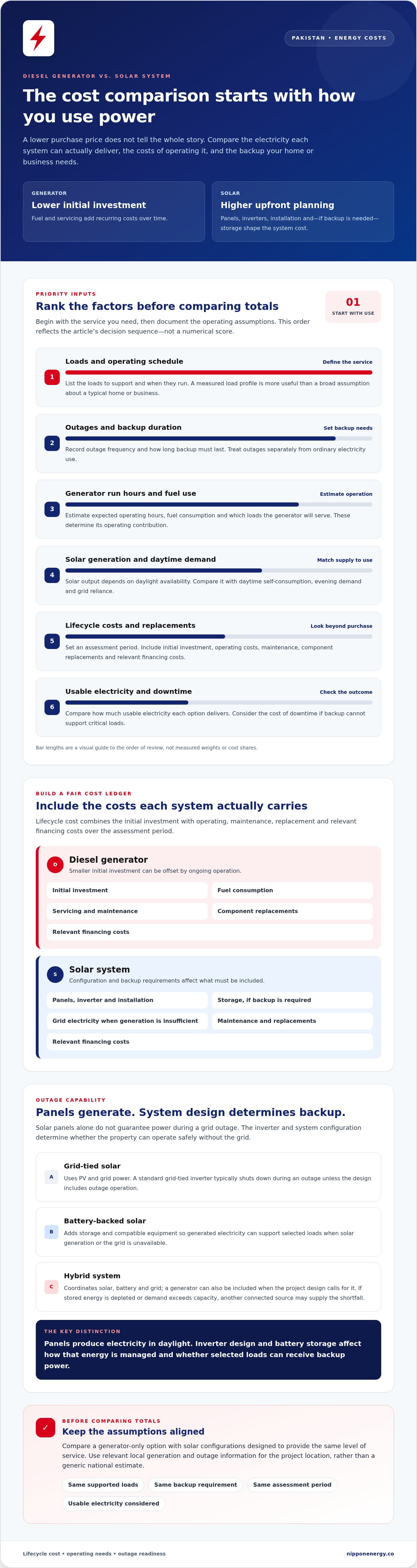
In Pakistan, the decision often starts with a practical trade-off: a diesel generator can require a smaller initial investment, while a solar system needs planning for panels, inverters, installation and, if backup is required, storage. Comparing purchase prices alone can hide what each option will cost to operate and which loads it can reliably power. A useful diesel generator vs solar system cost analysis pakistan compares the cost of delivered electricity over a defined period, not just equipment at the point of purchase.
Lifecycle cost is the initial investment plus operating, maintenance, replacement and relevant financing costs over the assessment period. For a generator, include fuel and servicing. For solar, include grid electricity used when generation is insufficient and any components that may need replacement. The calculation should also show how much usable electricity each option delivers and what downtime could cost if backup is unavailable.
One distinction is essential: a grid-tied solar system generates electricity when conditions allow, but a battery-backed system stores energy to supply selected loads when solar generation or the grid is unavailable. Panels generate power; the inverter, system configuration and battery determine how it is managed and whether backup is available. This framing aligns with the broader discussion of solar in Renewable Energy in Pakistan.
What belongs in a fair cost comparison?
Separate upfront equipment and installation costs from recurring costs, then include maintenance and expected replacements for both options. Record the assessment period and assumptions before comparing totals: expected generator run hours, fuel use, solar generation, grid reliance, financing and required backup duration. Also track usable electricity. A system that costs less but cannot support critical loads during an outage may not meet the project’s actual needs.
Why Pakistan’s outage and usage patterns matter
Compare when electricity is needed with when each option can supply it. A generator’s contribution depends on its expected operating hours and the loads it serves. Solar output is tied to daytime availability, while household or business demand may continue into the evening. Treat grid outages and ordinary consumption as separate inputs: outages define backup needs, while daily use helps determine how much solar energy is needed and when.
Don’t assume one city’s operating conditions represent the whole country. For Lahore, Karachi or another location, use relevant local generation and outage information rather than a generic national estimate. A measured load profile is more useful than a broad assumption about a typical home or business.
Set assumptions before comparing systems
For a clear decision, document the loads to be supported, their operating schedule, outage frequency and required backup duration. Then compare a generator-only option with solar configurations designed to provide the same level of service. This keeps the analysis aligned: panels without storage shouldn’t be treated as equivalent to a system designed to supply power during outages.
How Solar, Batteries, and Diesel Generators Deliver Power During Outages
Solar generation and outage backup are related, but they’re not the same function. Photovoltaic (PV) panels produce electricity during daylight, and a grid-connected system can use that power on-site while the grid is available. What happens during an outage depends on the inverter and system design, not simply on whether panels are installed.
Solar panels alone do not guarantee backup power during a grid outage. A standard grid-tied inverter typically shuts down when the grid fails, so it won’t continue energizing the property on its own. A system configured for backup needs equipment designed to operate safely without the grid, plus storage or another available power source.
Grid-tied solar, battery-backed solar, and hybrid systems
Each configuration serves a different purpose. Grid-tied solar uses PV and the grid, with the grid supplying power when solar output is insufficient. Without outage-capable equipment, it generally won’t provide power during a blackout. Battery-backed solar adds storage so generated electricity can be used later. A hybrid system coordinates solar, a battery, the grid and, when included in the design, a generator. The Solar Energy Technologies and Costs resource provides broader context on PV systems. Lithium-ion battery storage can shift energy use beyond solar production hours.
A hybrid inverter manages power flows among connected sources according to the system design and available energy. During daylight, PV can serve active loads and may charge the battery if generation exceeds immediate demand. When solar output falls, stored energy can support selected loads. If the battery is depleted or demand exceeds system capacity, the grid or a connected generator may supply the shortfall.
- Grid-tied: PV and grid power, with limited backup capability unless the design includes outage operation.
- Battery-backed: PV, storage and often grid interaction, with added battery and compatible inverter costs.
- Hybrid: Coordinated sources, with added control and integration requirements. A generator is included when the project calls for it.
When a generator remains part of the energy strategy
A generator can provide backup when solar production is low and stored energy is insufficient, such as during an extended outage or sustained high demand. It isn’t necessary for every solar project. Its value depends on the loads that must remain powered, the required backup duration and how often it is expected to run.
Plan dispatch rules in advance: which loads receive priority, when stored energy is reserved, and what condition starts generator operation. Expected run hours affect fuel use and servicing needs, while fuel availability affects the practicality of relying on the generator. Maintenance planning matters too, because an idle generator still needs to be ready when called on. Include these assumptions in a diesel generator vs solar system cost analysis pakistan, alongside the cost of the selected backup configuration.
For projects where several sources need to work together, Nippon Energy’s solar project development and EPC can bring panels, lithium-ion storage and smart AI inverters into a designed system.
Which Costs Matter Most: Diesel Generator vs Solar System in Pakistan?
A useful comparison starts with equivalent service: the same load, assessment period and backup expectation. Comparing a generator serving essential circuits during outages with a solar system sized for broader daily consumption can distort the result. In this diesel generator vs solar system cost analysis pakistan, use energy delivered and reliability as the basis for comparison, and make the assumptions visible so they can be adjusted.
| Cost category | Diesel generator | Solar system |
|---|---|---|
| Initial investment (CAPEX) | Generator, installation and required electrical integration. | Panels, inverter, installation and any battery or backup equipment. |
| Energy during operation | Fuel consumed during expected run hours. | Grid electricity used when solar output does not meet demand; account separately for any export value. |
| Maintenance | Scheduled servicing and operating upkeep. | System maintenance and monitoring. |
| Replacements | Components replaced over the assessment period. | Relevant inverter, battery or other component replacements. |
| Backup value | Power available while the generator can operate and fuel is accessible. | Value depends on outage-capable design, storage and the loads supported. |
Lifecycle cost = initial cost + operating costs + maintenance costs + replacement costs + relevant financing costs. Apply the same assessment period to both options. Keep backup value visible as a service requirement rather than treating unlike systems as interchangeable.
Build an apples-to-apples lifecycle comparison
Start with expected load and the energy each option must deliver. Record generator operating hours, fuel consumption, solar generation, battery use, grid imports and the assessment period. Separate diesel and servicing assumptions from solar maintenance and component replacement assumptions. Then test how the result changes when one input changes: higher fuel prices affect generator operation, tariff changes affect grid purchases, and more frequent outages may increase the value of backup capacity.
Use dated, project-relevant inputs rather than an undated headline estimate. If reliable data isn’t available for a sample calculation, leave the figures as editable variables instead of implying universal savings or payback.
Account for Pakistan’s changing cost assumptions
Fuel prices and electricity tariffs can change, so record the source and date for each figure used in a project model. Broader national context is available in the World Bank’s Pakistan’s Energy Sector Overview, but project calculations still need local, applicable inputs. Before assigning value to exported solar power, review current NEPRA requirements and the relevant DISCO’s billing treatment. Don’t assume exported units offset imported units one for one.
A structured solar EPC planning process can align system design with the load, operating profile and backup requirements used in the comparison. Nippon Energy’s solar project development and EPC connects those project inputs to system planning.
How to Choose the Right Option for Your Pakistani Home or Business
The right energy strategy follows the site’s actual operating pattern. A home with steady daytime use has a different profile from a business that needs critical equipment to run through evening outages. Start with measured demand and required reliability, then compare system configurations against those needs.
- Map the load. List appliances, machinery and other equipment, noting their power demand and operating schedule. Separate essential loads from total site demand so backup capacity is based on what must stay online.
- Record the outage pattern. Use site-specific observations to estimate how often outages occur and how long backup may be required. Distinguish grid interruptions from routine consumption, since they affect system sizing in different ways.
- Match supply to timing. Frequent daytime consumption can align with solar generation. Evening demand or outage backup may require storage, while a generator’s suitability depends partly on expected runtime and the loads it must support.
- Check physical and electrical constraints. Assess usable roof or ground area, shading, electrical infrastructure and space for equipment. Include the site’s grid-interconnection requirements and relevant tariff assumptions in the project comparison.
Choose by load profile and required backup
Compare steady daytime use with evening peaks and expected outage duration. A home may prioritize refrigeration, lighting and communications, while a commercial site may need to protect critical equipment or limit operational downtime. These loads help determine whether solar alone meets the main objective or whether storage or generator backup is needed for the required continuity.
For commercial projects, include the cost of interrupted operations alongside equipment and energy costs. A generator-first approach may suit a site with low expected run hours, limited space for solar equipment or a small set of loads that need outage support. That doesn’t make it the right choice for every project. It identifies conditions to test in the lifecycle comparison.
Check site, grid, and project constraints
Usable area and shading affect how a solar layout can be planned, while the electrical infrastructure affects system integration. Review applicable grid-interconnection requirements and local tariff assumptions for the specific site, especially if the project may export electricity. TOPCon is one panel technology to evaluate as part of system design. Nippon Energy supplies TOPCon solar panels, but panel choice doesn’t replace a load and site assessment.
The best option is the one that matches your load profile, expected runtime and required reliability. A project-specific diesel generator vs solar system cost analysis pakistan can compare these factors without relying on a generic household or business scenario.
Build a system plan around measured demand and backup priorities with Nippon Energy’s solar project planning.
Plan a Pakistan Solar Project Around Measurable Energy Costs
A useful comparison becomes a project plan when it connects actual electricity use to equipment requirements. The right choice depends on the site’s demand profile, backup expectations and verified local inputs, not on a generic payback estimate. Record the assumptions behind your analysis so the design can be assessed against the service you need.
What a project-specific solar assessment should account for
Start with recent electricity bills and, where available, interval or equipment-level readings. Note which loads operate during daylight, which run after sunset, and which must stay powered during an outage. Add outage exposure, required backup duration, usable roof or ground area, and any shading or access constraints. For a business, include operating schedules and the consequences of downtime for critical equipment.
These details help align the major components rather than treating each purchase in isolation:
- Panels: HJT or TOPCon modules are selected as part of a system designed around the site’s usable area and generation needs.
- Inverter: A smart AI inverter coordinates system operation according to the planned configuration and connected sources.
- Storage: Lithium-ion batteries can store available solar energy for later use, with capacity and backup loads matched to project requirements.
Nippon Energy supplies HJT and TOPCon solar panels, lithium-ion battery storage systems and smart AI inverters. These components can be evaluated together through system design. For another view of integrated system architecture, explore the NipponHev integrated solar system guide.
From cost comparison to implementation
Translate the comparison into a design brief: documented consumption patterns, critical loads, outage expectations, available installation area, and current tariff or grid-interconnection assumptions relevant to the site. Record which assumptions are measured and which are estimates. This gives the project a consistent basis for planning and reduces the risk of sizing a system around an untested usage pattern.
Solar project development and EPC provide a pathway from project planning and engineering through procurement and construction. Once operational, maintenance and monitoring help track system performance against its design assumptions, so changes in generation or site demand can inform ongoing management. Nippon Energy provides solar project development and EPC, along with solar maintenance and monitoring.
Bring your electricity bills, load schedule, priority backup loads and site details into the discussion. Discuss your solar project with Nippon Energy to connect those inputs with a project-specific system plan.
Turn Your Energy Comparison Into a Clear Project Brief
Convert your cost comparison into decisions the project can act on. Set priorities for the site: which loads are essential, how much downtime is acceptable, and which operating costs need to remain predictable. Then document the assumptions behind your preferred option so they can be assessed against actual demand and site conditions.
A useful diesel generator vs solar system cost analysis pakistan isn’t a fixed verdict for every household or business. It’s a decision framework that can be refined as your usage, backup needs and project constraints become clearer. Treat the initial estimate as a planning tool, then use an engineered design to establish the right system configuration.
Nippon Energy can develop the project around those requirements, from system planning and EPC to ongoing maintenance and monitoring. Plan a solar project around your site’s energy requirements and take the next step with a brief grounded in your operating needs.
Frequently Asked Questions
Can a solar system replace a diesel generator during load-shedding in Pakistan?
Yes, if the system is designed to supply the required loads during outages. A home, for example, may use solar generation and stored energy to support selected circuits, while a site with extended outages or heavier demand may still need another backup source. Compare outage duration and essential equipment with the system’s usable energy and output rather than assuming any solar installation can replace a generator.
Is a battery necessary for solar backup during a grid outage?
Not in every configuration, but a battery is commonly needed to provide stored energy when sunlight is unavailable. Some purpose-designed systems may supply limited loads from solar during daylight without storage, depending on the inverter and its outage operation capability. If backup must continue after sunset or through cloudy periods, estimate the essential load and required duration to determine whether storage can meet the need.
How much diesel does a generator use at partial load?
There’s no single fuel-use figure for partial load because consumption depends on the generator’s engine, rated capacity, condition and operating load. Use the manufacturer’s fuel-consumption curve or technical data for the specific model, then match it to expected load and runtime. Don’t assume fuel use falls in direct proportion to load. Inefficient operation at low loading can affect the estimate.
What happens to a grid-tied solar system when the grid goes down?
A standard grid-tied system typically stops supplying power during an outage because its inverter detects the grid failure and shuts down. This anti-islanding function prevents the system from energizing grid lines while utility workers may be repairing them. To keep selected circuits powered, the system needs equipment configured for backup operation, such as a compatible inverter and storage or another designed power source.
Can a solar system and diesel generator operate together?
Does net metering change the cost comparison in Pakistan?
Yes. The value assigned to electricity exported to the grid can affect projected solar savings, so don’t treat exported units as equal in value to electricity consumed on-site. Review the current rules and billing treatment that apply to the project’s connection and utility before including export credits in a financial model. A conservative estimate should distinguish self-consumed solar energy from electricity sent to the grid.
How do I calculate the payback period for solar compared with a generator?
For a diesel generator vs solar system cost analysis pakistan, estimate simple payback by dividing the solar system’s initial cost by its annual net savings. Calculate those savings from avoided grid purchases and generator fuel or servicing, then subtract solar operating costs and account for expected replacements. Compare systems that serve the same loads over the same period, and show how changes in runtime, tariffs or fuel assumptions affect the result.


