

What makes a solar-powered EV charging system effective is not simply the size of its array, but how well charging demand matches the hours the site produces power. A practical plan for “ev charging station solar integration pakistan” starts with that relationship, then accounts for grid access, outages and the energy vehicles need.
Choosing a configuration means looking beyond equipment. Solar generation may not coincide with charging times, utility requirements and export arrangements need to be considered for the specific site, and battery storage is useful only when it addresses a defined need. A home charger also has different operating patterns from a commercial or fleet charging site.
This 2026 guide compares grid-supported, solar-priority and battery-supported configurations, and explains which site, vehicle and charger details to gather before comparing them. You’ll see how panels, inverter controls, storage and charger hardware work together, and what to account for in Pakistan. The goal is to plan around actual energy use, rather than select equipment in isolation.
Key Takeaways
- Compare grid-supported, solar-priority and solar-plus-storage configurations against your charging schedule and backup objectives.
- For ev charging station solar integration pakistan, assess vehicle energy needs, site conditions and local grid access before sizing the system.
- Plan how PV panels, inverter controls, the selected EV charger and optional battery storage will work together.
- Evaluate battery storage by the charging flexibility and outage resilience you need, rather than assuming it suits every site.
- Use coordinated engineering to align solar generation and energy controls with residential, commercial or fleet charging requirements.
EV charging station solar integration in Pakistan starts with the right system goal
A solar-integrated EV charging station is more than a charger placed beneath solar panels. It coordinates photovoltaic generation, power conversion, charger operation and, where needed, battery storage around a defined charging demand. For ev charging station solar integration pakistan, the goal might be to use more on-site solar, support charging during outages, or serve vehicles that arrive throughout the day.
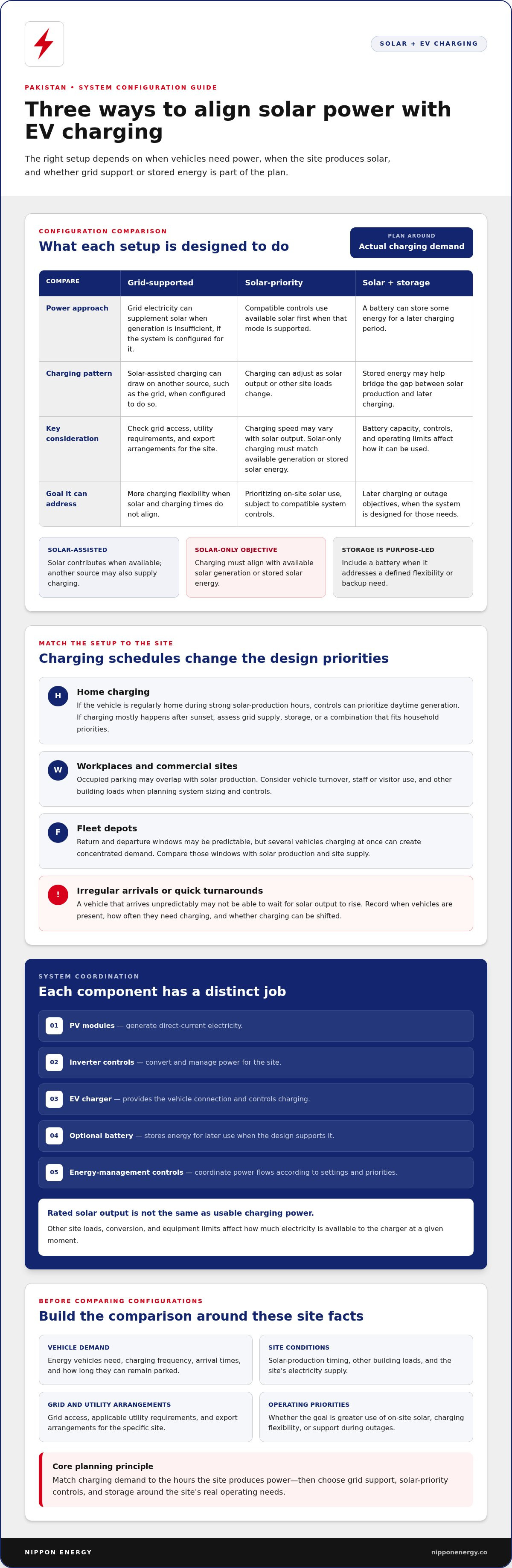
Solar-assisted charging uses solar energy when it is available while allowing another source, such as the grid or a battery, to contribute. Charging exclusively on solar means the vehicle is charged only with solar-generated energy, so charging must match available generation or stored solar energy. The distinction affects scheduling: a solar-assisted setup can offer greater flexibility, while a solar-only objective may require longer parking windows and carefully managed charging.
What does solar integration mean for an EV charging station?
The energy path starts at the photovoltaic (PV) modules, which generate direct-current electricity. Inverter controls convert and manage power for the site, while an EV charger provides the vehicle connection and controls charging. If the design includes a battery, it can store energy for later use. Energy-management controls coordinate these flows according to the system’s settings and priorities.
When solar output is below charging demand, a grid-connected design may draw supplementary electricity from the grid, subject to its configuration and applicable utility arrangements. A battery may also contribute if the system is designed to use stored energy for charging. Each component has a distinct job: the charger is not the solar inverter, and neither one alone determines how the full system operates. Equipment compatibility and project configuration determine which operating modes are available.
Pakistan’s growing solar sector makes coordinated planning relevant for site owners. The overview of solar power in Pakistan provides background on the country’s solar development. For a specific site, the practical question is how local generation will align with vehicle availability and the site’s electricity supply, not how many panels can be installed in isolation.
Which Pakistan users benefit from a coordinated design?
Household charging often follows a predictable pattern: a vehicle may be parked at home overnight, during the day, or both, depending on work and travel routines. If it is regularly at home during strong solar-production hours, controls can prioritize available daytime generation. If charging mostly happens after sunset, the assessment shifts to grid supply, storage or a combination that fits the household’s priorities.
Workplaces may have a useful overlap between occupied parking hours and solar production. Fleet depots can also have predictable return and departure windows, but several vehicles charging at once can create concentrated demand. Commercial sites should account for vehicle turnover, staff or visitor use, and other building loads. These patterns influence both system sizing and control strategy.
Irregular schedules call for a different assessment. A vehicle that arrives unpredictably or needs a quick turnaround may not be able to wait for solar output to rise. Record when vehicles are present, how often they need charging and whether charging can be shifted. Compare that demand profile with site conditions, grid access and operating priorities to identify suitable configurations.
How solar, the grid, and battery storage work together for EV charging
A coordinated system gives each component a distinct role. PV modules generate electricity; a smart AI inverter converts and manages power; an EV charger controls the connection to the vehicle; and the grid can supplement supply when the project is configured for it. An optional battery stores energy for later use, while energy-management controls direct power according to system settings and priorities.
Solar generation capacity describes the array’s rated output, while usable charging power is the electricity available to the charger at a given moment after conversion, site loads and equipment limits are accounted for. These figures are not interchangeable. Other building loads may use some of the array’s output, or the inverter and charger may limit how much power reaches the vehicle. For ev charging station solar integration pakistan, account for these operating conditions alongside vehicle demand.
- Solar-priority: Compatible controls use available solar power first when that operating mode is supported.
- Grid-supported: Grid electricity can supplement solar when generation is insufficient, depending on system configuration.
- Solar-plus-storage: A battery can shift some energy from a generation period to a later charging period, subject to its capacity, controls and operating limits.
How does solar-priority EV charging operate?
In a solar-priority setup, compatible controls can adjust charging to use surplus on-site generation before drawing additional power from the grid. If clouds reduce output or other site loads increase, the power available for charging may change, so charging speed can vary. Some systems can use grid supplementation to maintain charging, while a solar-only objective requires charging to align with available solar or stored energy. Prioritizing self-consumption does not guarantee that every charging session runs exclusively on solar.
That distinction matters in the context of Pakistan’s energy transition. The Sustainable Development Policy Institute’s Mapping the EV Ecosystem in Pakistan examines the wider EV ecosystem, including renewable-energy-based charging. For a project, consider how controls should respond when solar output, site demand and vehicle charging needs change at different times.
When does battery storage change the system design?
Storage can shift some energy use across time: solar electricity generated during one period may be stored for use when the vehicle charges later. It can be useful when parking times do not align well with solar production or when a project has a defined backup objective. A battery does not automatically provide EV charging during an outage; that capability depends on the system architecture and how its components are configured.
Size storage around the site’s load profile, charging schedule and backup priorities, not a general rule. Assess when energy is generated, when vehicles need charging and which loads the battery is intended to support. Nippon Energy’s lithium-ion battery storage systems and smart AI inverters can form part of a coordinated solar project. The lithium-ion battery storage guide explains storage fundamentals in greater depth. Nippon Energy’s solar project capabilities include EPC planning to align system components with defined site requirements.
Compare solar EV charging configurations for homes, businesses, and fleets
Three configurations provide a useful starting point for comparing projects: grid-supported solar, solar-priority charging, and solar with battery storage. None is right for every site. For ev charging station solar integration pakistan, consider when vehicles need energy, how much charging can shift to solar-production hours, the site’s electrical capacity, and whether backup is a defined requirement.
| Configuration | Charging-time flexibility | Backup objective | Control needs | Design complexity |
|---|---|---|---|---|
| Grid-supported solar | Generally flexible when the grid can supplement solar, subject to system settings and site limits. | Grid supply can support charging when solar output is insufficient; this is not battery backup during an outage. | Coordinate solar generation, charger demand and grid supply. | Lower than a storage design, but still requires coordinated equipment and load assessment. |
| Solar-priority | Best suited to charging that can respond to available solar generation; charging power may vary. | Prioritizes on-site solar use, but does not inherently provide outage backup. | Use compatible controls to prioritize solar and manage any grid supplementation. | Depends on the control functions and operating mode selected. |
| Solar-plus-storage | Can shift some stored energy to charging periods outside solar-production hours. | May support selected loads during an outage only if the system is designed for that operation. | Coordinate PV, inverter, battery, charger and backup priorities. | Higher, because storage capacity and system architecture must match the site’s needs. |
Which configuration suits a home or workplace?
Start with the parking window. A household vehicle regularly parked during daylight may suit solar-priority charging, while a vehicle usually charged after work may need grid-supported operation or an assessment of storage. At a workplace, daytime parking can align with solar production, but shared chargers raise questions about access, charging priority and how available power is allocated. Base the choice on schedules, not just charger rating.
Assess charger power, the vehicle’s ability to accept charging, inverter capability and the site’s electrical limits together. A mismatch in any one of these can constrain system operation. This is especially important when existing building loads compete with EV charging for available capacity.
How should fleet and commercial sites compare options?
For fleets and commercial sites, document vehicle arrival times, dwell periods, charging sessions and operating priorities. A depot with predictable daytime parking has different design conditions from a site where vehicles arrive throughout the day and need a quick turnaround. Account for simultaneous charging and other site loads, then compare how much charging can be scheduled around solar availability.
Plan an EV charging station solar integration project in Pakistan
A reliable design begins with the site’s actual operating pattern, not a panel or charger target chosen in isolation. For ev charging station solar integration pakistan, use a structured assessment to connect vehicle demand, solar potential, electrical supply and local utility conditions. Grid reliability and processes vary by location, so base the plan on the specific site rather than a single national assumption.
What information belongs in a Pakistan site assessment?
Build a clear site record before comparing equipment. Include vehicle charging needs, parking duration, existing site loads, available electrical supply and intended operating hours. Survey roof or ground space, shading, electrical infrastructure, and practical locations for panels, the inverter, battery, charger and cabling. These details help establish where generation can be installed and how charging will interact with existing loads.
Separate everyday charging needs from backup requirements. A site may need to keep vehicles charging during normal operations without requiring charging during an outage. If backup is a priority, specify which loads need support and under what conditions. This distinction shapes the system architecture and prevents storage from being sized around an undefined goal.
Which local grid and utility details need current verification?
Before finalizing a grid-connected design, identify the distribution company serving the location and review its current processes and interconnection requirements. Check applicable export, net-metering and tariff provisions against current official Pakistani sources. Requirements can change, and local conditions vary, so do not assume an arrangement for one site applies to another.
Use this planning sequence to turn the assessment into a design brief:
- Define charging demand. Record vehicle numbers, charging frequency, energy needs, arrival and departure windows, and whether sessions can shift to daylight hours.
- Survey the site. Document usable solar area, shading, equipment locations, cable routes and existing electrical infrastructure.
- Assess supply. Establish available site capacity, other major loads, grid access and the site’s experience with outages. Treat backup as a separate operating requirement.
- Model solar generation. Estimate how the site’s solar resource and installation area may align with the charging schedule, rather than sizing solely to a charger’s rated power.
- Compare controls. Evaluate grid support, solar-priority operation and storage against the required flexibility, charging schedule and applicable utility conditions.
For each option, document the assumptions behind the comparison, including vehicle availability, site load patterns and the intended response when solar output changes. Smart inverter controls are part of this coordination. Smart AI solar inverter management can help frame how generation and site demand are managed within the project design.
Nippon Energy’s solar project development and EPC services bring generation, inverter controls and optional storage into a coordinated plan around the selected charger. Plan your solar EV charging project with Nippon Energy around your site data, operating priorities and local supply conditions.
Build a coordinated solar and EV charging solution with Nippon Energy
A solar-integrated charging project works best when generation, power conversion, storage and charging controls are planned as one site energy system. Nippon Energy combines solar project development and EPC with Nippon HJT or TOPCon solar panels, smart AI inverters and optional lithium-ion battery storage. This makes it possible to plan solar generation around the site’s operating profile and selected EV charger, rather than treating each component as a separate purchase.
Engineering must account for how the charger interacts with the rest of the electrical system. The selected charger’s power demand, vehicle charging requirements, inverter capability, existing site loads and available supply all inform the design. In Pakistan, local grid conditions and applicable utility requirements matter too. The resulting project plan can reflect site priorities, whether the aim is to use more daytime solar, provide defined backup support or accommodate flexible charging schedules.
What does coordinated solar project delivery bring together?
Project development and EPC connect site assessment, solar generation planning, inverter selection and optional storage in a coordinated design. The EV charger remains one component of the wider energy system, and its compatibility with other equipment must be assessed for the project. Include maintenance and monitoring in lifecycle planning so owners can consider how system operation will be observed and maintained over time, without assuming a particular performance outcome.
For example, a workplace with vehicles parked during solar-production hours may prioritize coordination between generation and charging controls. A site with later charging needs may assess whether storage supports a defined operating objective. In both cases, engineering connects the chosen system architecture to actual site loads and the selected charger, rather than assuming one configuration suits every property.
What are the next steps for a project discussion?
A useful first discussion starts with practical site information. Prepare:
- Site location and available roof or ground area for solar generation.
- Vehicle usage profile, parking duration and typical charging schedule.
- Existing solar-system details, if panels, inverters or storage are already installed.
- Priorities such as daytime solar use, grid resilience, or flexible charging.
These details help focus the design discussion on actual operating needs. If a solar system is already in place, its equipment and operating pattern can inform how additional generation, inverter controls or storage may fit into the site’s energy architecture. For a new project, the same information provides a structured starting point for comparing system approaches.
Discuss a solar-integrated energy system with Nippon Energy by bringing your site information and charging priorities to the project conversation. Discuss a solar project with Nippon Energy.
Turn your charging priorities into a project plan
For ev charging station solar integration pakistan, Nippon Energy combines project development and EPC with Nippon HJT or TOPCon solar panels, smart AI inverters and optional lithium-ion battery storage. These capabilities support a coordinated solar-energy design around your selected EV charger and site requirements.
Bring your location, vehicle-use profile, charging schedule and any existing solar-system information into the conversation. Clear project inputs provide a stronger foundation for evaluating the design. Discuss a solar-integrated energy project with Nippon Energy and take the next step toward a system designed around your goals.
Frequently Asked Questions
Is solar-powered EV charging practical in Pakistan?
Yes, it can be practical when the site’s solar resource, parking schedule and vehicle energy needs align. For ev charging station solar integration pakistan, start by checking usable roof or ground area, shade at different times, and when the vehicle is available to charge. A home with daytime parking has different opportunities from a vehicle that returns after sunset. Base the design on local conditions rather than assuming the same solar contribution at every site.
Can an EV charge directly from solar panels without a grid connection?
Not by connecting PV panels directly to the vehicle. Solar output must pass through compatible conversion and charging equipment, which controls the electrical supply to the vehicle. An off-grid system may support charging if its inverter, controls and any storage are designed for the required load. Without grid support or adequate stored energy, changing sunlight can limit or interrupt charging, so the design needs to account for charging timing and available power.
Does solar EV charging work during load shedding?
It depends on the system architecture. A standard grid-connected solar system generally stops supplying power during an outage because it cannot safely energize a grid that has lost supply. Charging during load shedding requires a backup-capable design that can isolate from the grid and provide suitable power to the charger. A battery alone does not establish that capability; the inverter, controls, electrical protection and selected charger must support the intended backup operation.
Do I need a battery for solar EV charging?
No, a battery is not essential if charging can use solar generation while it is available and the grid can support other periods. Storage may be useful if the vehicle is usually parked after solar-production hours or if the project has a defined backup objective. Compare the timing and duration of charging needs with the role storage is expected to serve. This helps distinguish a useful storage function from an unnecessary addition.
How do I size a solar system for an EV charging station?
Start with the vehicle’s expected energy use and charging schedule, then account for the site’s other electrical loads and available solar area. The design should also consider local solar conditions, equipment conversion limits and how much charging can be scheduled during generation hours. For multiple vehicles, assess overlapping charging sessions rather than simply adding charger ratings. A site-specific energy assessment is more useful than sizing panels from charger power alone.
Which inverter is suitable for solar-integrated EV charging?
Select an inverter based on the PV array, site loads, grid connection and whether battery storage or backup operation is required. Its power-conversion capability and control functions must work with the selected charger and wider system design. A smart inverter can coordinate energy flows when its supported functions fit the project, but no single inverter choice suits every site. Nippon Smart AI Inverters are part of Nippon Energy’s solar-energy offering.
Can excess solar power be exported while an EV is charging?
Potentially, if solar generation exceeds the charging load and other site consumption, and the system is configured and approved for export under applicable requirements. The available amount can change as sunlight, vehicle charging and building loads vary. Export arrangements, compensation and interconnection processes may differ by location and change over time. Before relying on export in a project assessment, check current requirements published by NEPRA and the relevant distribution company.


