

A larger solar array isn’t automatically the better investment. In Karachi, heat, dust, humidity, and coastal exposure make careful system design and ongoing support as important as equipment selection. When comparing the top solar installers in karachi, look beyond company names and directory listings to the work each provider will actually do for your project.
A useful shortlist should help you judge whether a provider can match a system to your site and energy needs. This 2026 guide compares solar companies and service options serving Karachi, then explains how to assess engineering, equipment, installation, and long-term support. It also distinguishes companies that develop and deliver solar projects from platforms that primarily connect customers with providers.
Nippon Energy serves Karachi from its Korangi Industrial Area office. Its offerings include solar project development and EPC, Nippon HJT and TOPCon panels, lithium-ion battery storage, Smart AI Inverters, maintenance, and monitoring. The sections ahead explain how these capabilities relate to site-specific project needs, compare them with other providers serving the city, and give you a practical framework for weighing design and support before choosing a next step.
Key Takeaways
- Choose an installer based on your site, energy use, and project requirements, not a generic “best” label.
- Use this shortlist of top solar installers in karachi as a starting point, and distinguish project providers from lead-generation directories.
- Compare proposals against the same scope, equipment categories, design assumptions, and support stages.
- Prepare electricity-use records, site details, and priorities to make proposal comparisons more relevant.
- See how Nippon Energy’s Karachi-based EPC, panels, Smart AI Inverters, battery storage, maintenance, and monitoring relate to different project needs.
What makes a solar installer a strong fit for Karachi?
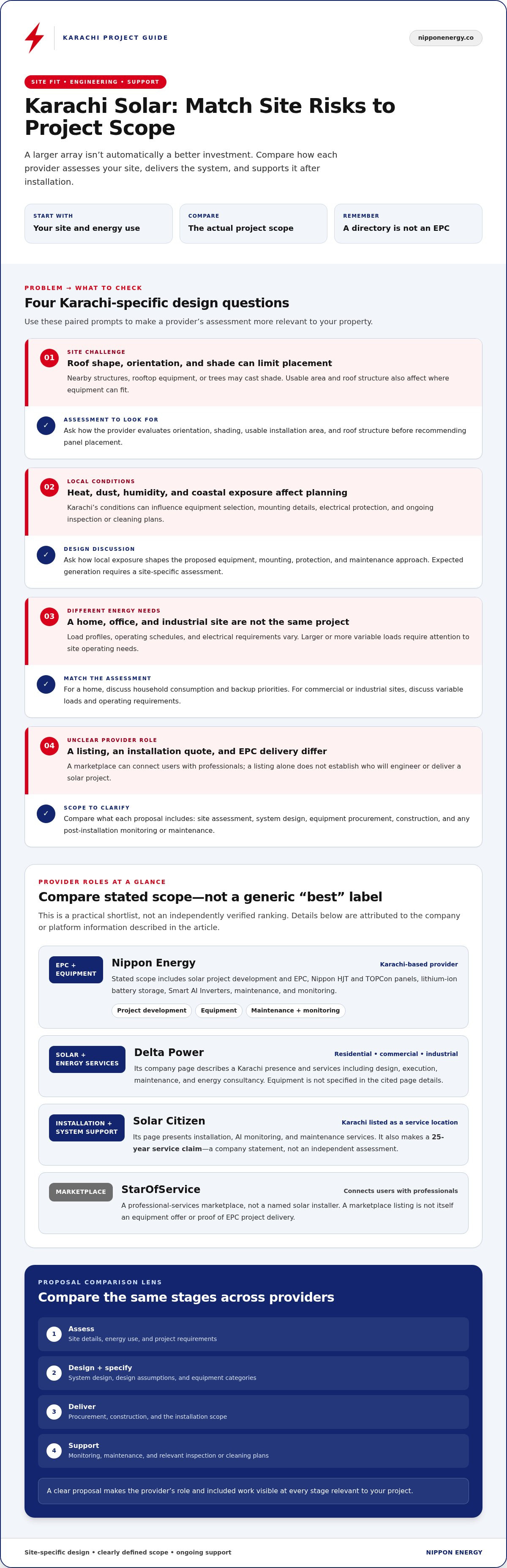
Choose an installer based on how well its project capabilities match your site, not because it carries a generic “best” label. A home, office building, and industrial facility have different load profiles, operating schedules, and electrical requirements. A residential assessment may focus on household consumption and backup priorities. Commercial and industrial assessments need to account for larger or more variable loads and the site’s operating needs.
A qualified solar installer assesses the site, engineers and delivers a system around its requirements, then supports its operation through maintenance or monitoring. Use this as a practical definition when comparing the top solar installers in karachi. Check that each provider’s role is clear at every stage relevant to your project.
How Karachi conditions shape solar project planning
Start the design discussion with the roof or installation area. Orientation affects panel placement, while nearby structures, rooftop equipment, or trees can create shade. Usable area and roof structure help determine where equipment can fit and which installation approach is appropriate.
Karachi’s heat, dust, humidity, and coastal exposure also matter. These conditions can inform equipment selection, mounting details, electrical protection, and inspection or cleaning plans. They don’t guarantee a particular output or point to one design for every site. Expected generation depends on a site-specific assessment. For national context on solar development and related challenges, consult the Solar Power in Pakistan Overview.
Installer, EPC partner, or online directory?
An installer is involved in implementing a solar system, but the exact scope of work can differ. EPC stands for engineering, procurement, and construction. An EPC provider connects system design, equipment procurement, and construction, while monitoring or maintenance may also be part of its wider support.
An online marketplace such as StarOfService helps users find or compare professionals. A directory listing alone doesn’t establish that a provider will engineer or deliver a solar project. Evaluate what each company does for the project rather than treating a profile, rating, or listing as proof of full-scope delivery.
This distinction matters in Karachi because an equipment quote, an installation scope, and integrated project delivery are not interchangeable. Clarify what each proposal includes, from site assessment and system design through construction and post-installation support. Then compare providers against the technical requirements of your project, not just the labels they use.
Top solar installers and solar service options serving Karachi
This is a practical shortlist, not an independently verified ranking or a claim that one provider is right for every project. The entries differ in role and stated scope. Compare them against the work you need, from engineering and equipment selection to installation and ongoing support.
Nippon Energy: Karachi-based solar hardware and EPC
Nippon Energy lists its Karachi office at Plot 14, Sector 15, Korangi Industrial Area. Its offerings include solar project development and EPC, Nippon HJT and TOPCon panels, lithium-ion battery storage, and Smart AI Inverters. It also provides solar system maintenance and monitoring. This brings project development, equipment, delivery, and ongoing system oversight together within one provider’s stated scope.
Delta Power, Solar Citizen, and the marketplace distinction
Delta Power’s company page describes a Karachi presence and work across residential, commercial, and industrial sectors, including design, execution, maintenance, and energy consultancy. Solar Citizen’s page presents installation, AI monitoring, and maintenance services, lists Karachi among its service locations, and makes a 25-year service claim. That duration is the company’s own claim, not an independent assessment.
StarOfService has a different role: it is a professional-services marketplace, not a named solar installation company. Its listings can help users discover professionals, but the marketplace itself doesn’t establish who will engineer or deliver a project. The table separates these roles and attributes the service details to the relevant company or platform.
| Provider | Role | Stated services | Equipment or support details | Source of claims |
|---|---|---|---|---|
| Nippon Energy | Karachi-based solar provider and EPC partner | Solar project development and EPC | Nippon HJT and TOPCon panels, lithium-ion storage, Smart AI Inverters, maintenance, and monitoring | Nippon Energy company information |
| Delta Power | Solar and energy-services provider | Design, execution, maintenance, and energy consultancy; residential, commercial, and industrial sectors | Page describes services, without specifying equipment here | Delta Power company page |
| Solar Citizen | Solar services provider | Installation, monitoring, and maintenance; Karachi is listed as a service location | AI monitoring and a company-stated 25-year service claim | Solar Citizen company page |
| StarOfService | Professional-services marketplace | Connects users with professionals | Marketplace listing, not a solar equipment or EPC offer | StarOfService marketplace page |
For project decisions involving grid connection and export arrangements, the Sustainable Development Policy Institute’s discussion of Pakistan's Solar Net Metering Policies provides market context. To review Nippon Energy’s Karachi-based project and equipment offering, explore its solar project development and EPC services.
How to compare Karachi solar installers beyond headline claims
A proposal is useful only when you can compare its assumptions with another provider’s. Solar proposals are comparable only when they use the same project scope, design assumptions, equipment categories, and service stages. If one quote includes engineering and commissioning while another covers equipment supply alone, their headline totals or system sizes don’t describe equivalent work.
Use the same comparison sheet for every proposal. Record what is included for site assessment, design, procurement, installation, commissioning, and handover. Add the monitoring and maintenance scope. For a broader explanation of integrated project delivery, see solar EPC services and turnkey project delivery.
Engineering, equipment, and project scope
Start with the design basis: the energy-use information considered, site constraints, and project priorities. Then check whether the proposal explains the system configuration and identifies the proposed panel, inverter, and storage categories. Equipment choices should follow the site assessment and project requirements, not a headline efficiency figure or technology label alone.
For example, a proposal may specify TOPCon panels as a technology category without showing that one configuration suits every roof. Nippon Energy offers Nippon TOPCon solar panels; learn more about Nippon TOPCon solar panels. Compare the equipment category and the rationale for the proposed design, leaving model-level specifications to the project documentation.
Check how responsibilities continue through construction and commissioning. Identify who handles procurement, installation, system testing, and handover documentation. A stage-by-stage scope makes gaps easier to spot before you compare proposals.
Monitoring, maintenance, and evidence
Apply the same care to support claims as to equipment claims. Separate verifiable information, such as a written scope or documented project reference, from company-reported statements, promotional language, and platform ratings. A marketplace score describes a platform’s rating signal; it doesn’t by itself demonstrate solar engineering or system performance. Similarly, attribute a stated service duration to the company making the claim rather than treating it as a verified outcome.
Compare what monitoring covers, how system information is made available, and which maintenance tasks are described. A general promise of “support” tells you less than a defined service scope. Nippon Energy provides solar system maintenance and monitoring; its overview of solar system maintenance and performance monitoring explains the role of these services.
When proposals use aligned assumptions, you can assess differences in design, equipment, delivery, and support more precisely. That makes comparisons of the top solar installers in karachi more useful than relying on rankings or broad marketing claims.
A practical checklist for selecting a Karachi solar installer
Proposals with different assumptions are difficult to compare. Make the decision more systematic by giving each provider the same project information and reviewing the same scope categories. Before requesting proposals, prepare electricity-use records, site details, and project priorities. For a Karachi property, include roof orientation, shading, usable area, and concerns about dust, humidity, or coastal exposure. These details help connect the proposed design to the actual site rather than a generic system estimate.
Five steps from energy needs to proposal comparison
- Document electricity use. Gather recent bills or consumption records. Note usage patterns, major loads, and when electricity demand is highest.
- Define backup priorities. If backup is required, list the equipment or areas you want powered during an outage. Clarify how this affects your project objectives.
- Describe the site. Record roof or installation-area details, shading, access constraints, and known structural considerations. Photos or a basic site plan can help communicate the conditions.
- Review the proposed scope. Check what each proposal covers for assessment, engineering, equipment procurement, installation, commissioning, handover, monitoring, and maintenance.
- Align assumptions and compare. Put proposals side by side. Note differences in system configuration, equipment categories, design assumptions, included services, and responsibilities. Separate scope differences from claims that aren’t supported by project details.
Questions a technically complete proposal should answer
A proposal should explain how its system configuration relates to your energy needs and site constraints. It should identify the panel, inverter, and storage categories, describe the monitoring approach, and state the maintenance and handover scope. If proposals use different assumptions, record those differences before comparing system size or expected operation.
Review the current interconnection, net-metering, and permitting requirements that apply to your project in Karachi. Use current official guidance from NEPRA and the relevant electricity distribution company rather than relying on older processes or informal summaries. Requirements can change, so verify the rules relevant to your project before making decisions about export arrangements or approval steps.
This process turns a confusing set of quotations into a structured evaluation of design, delivery, equipment, and support. Nippon Energy’s solar project development and EPC offering connects these stages to project requirements. Explore solar project options with Nippon Energy.
Why consider Nippon Energy for a Karachi solar project?
A solar project brings together site requirements, system design, equipment choices, implementation, and ongoing support. Nippon Energy serves Karachi and offers solar project development and EPC alongside its panel, inverter, and storage categories. Its Karachi office is listed at Plot 14, Sector 15, Korangi Industrial Area.
For readers comparing the top solar installers in karachi, the useful question is how a provider’s stated capabilities relate to the project. Nippon Energy’s combination of EPC, hardware, maintenance, and monitoring offers a connected scope to weigh against your site, energy use, and support priorities.
A connected approach to solar project delivery
Solar project development and EPC connect planning, equipment procurement, and implementation. Nippon Energy supplies Nippon HJT and TOPCon solar panels. Smart AI Inverters and lithium-ion battery storage systems are also equipment categories to consider in relation to project requirements. The appropriate configuration depends on the site and project objectives, so no single equipment category is a universal fit.
Storage may be relevant when project priorities include managing energy alongside solar generation. Consider the role of lithium-ion battery storage systems within the wider system plan. Nippon Energy also provides solar system maintenance and monitoring, extending its stated offering beyond project delivery to ongoing system oversight.
From shortlist to project discussion
Use your comparison criteria to guide the next step: site fit, engineering and delivery scope, proposed equipment categories, monitoring, and maintenance. Bring together electricity-use information, site details, and priorities so the discussion can focus on the needs of your home or commercial property. A clear brief helps connect design choices to intended use rather than generic system claims.
Nippon Energy’s Karachi presence and combination of EPC and solar equipment make it a relevant option to include in your assessment. The project scope can bring panels, inverters, and storage into one design conversation, with maintenance and monitoring as part of the wider service offering. Explore Nippon Energy’s solar solutions for a project-specific path from requirements to system planning: Explore Nippon Energy's solar solutions.
Turn your shortlist into a site-specific solar plan
Assess the top solar installers in karachi by project fit, not a broad ranking. Compare proposals using the same assumptions, then examine site assessment, engineering scope, equipment categories, installation responsibilities, and long-term monitoring or maintenance. Karachi’s site conditions and your energy priorities should guide the system design.
Nippon Energy serves Karachi from its Korangi Industrial Area office and offers solar project development and EPC. Its equipment categories include Nippon HJT and TOPCon panels, lithium-ion storage, and Smart AI Inverters. These capabilities provide a basis for discussing how project planning, equipment selection, and support can align with your requirements, without assuming one configuration fits every property.
Prepare your electricity-use information, site details, and project priorities to make the next conversation focused. Explore Nippon Energy's solar solutions and take an informed step toward planning your Karachi solar project.
Frequently Asked Questions
Who are the top solar installers in Karachi?
No single provider is the right fit for every Karachi solar project. Nippon Energy, Delta Power, and Solar Citizen describe solar services relevant to the city, while StarOfService is a professional marketplace rather than an installer. Compare providers by their stated engineering scope, equipment categories, installation responsibilities, and ongoing support. Then assess how each offering fits your site, energy use, and project priorities instead of relying on a universal ranking.
How do I choose a solar installer in Karachi?
Start by documenting your electricity use, site conditions, and project priorities. Compare proposals using the same assumptions for system design, equipment categories, delivery responsibilities, monitoring, and maintenance. Note whether each proposal includes engineering and commissioning or only equipment supply. Also review current interconnection and net-metering requirements through relevant official sources. A written, comparable scope helps distinguish project-specific technical detail from broad marketing claims.
What should a solar installation proposal include?
A useful proposal should describe the site assessment, system design, proposed equipment categories, project scope, and handover responsibilities. It should also explain any monitoring and maintenance arrangements included in the work. Compare those details across providers before judging headline system descriptions. Differences in assumptions or scope can make proposals appear more similar than they are. Check that the proposal addresses applicable local requirements using current official guidance.
Are solar panels suitable for Karachi’s climate?
Solar panels can be used in Karachi, but system design should account for the specific site rather than rely on a generic estimate. The assessment should consider roof orientation, shading, usable area, structural suitability, heat, dust, humidity, and coastal exposure. These are design considerations, not guarantees of a particular outcome. Expected performance depends on the proposed system and site conditions, so review the project-specific design basis and treat broad climate claims cautiously.
What is the difference between a solar installer and an EPC company?
A solar installer is generally involved in putting a solar system in place. EPC means engineering, procurement, and construction. An EPC provider connects system design and equipment procurement with project construction, though the precise responsibilities vary by company and project. Review the written scope to see which stages are included. Nippon Energy offers solar project development and EPC alongside solar hardware and ongoing system services.
Does a Karachi solar system need battery storage?
No, battery storage isn’t an automatic requirement. Its suitability depends on your backup priorities, energy-use patterns, system design, and budget. Compare options with and without storage using the same site and usage assumptions to understand what storage contributes to your project objectives. Nippon Energy offers lithium-ion battery storage systems, which can be considered when storage aligns with the intended use of the solar system.
How can I compare solar installer claims fairly?
Separate company-reported statements from independently verifiable project information. Use consistent criteria: site assessment, engineering scope, equipment categories, implementation responsibilities, monitoring, and maintenance. Treat marketplace ratings as platform signals, not proof of engineering quality or system performance. Attribute service-duration claims to the company making them. Compare each proposal’s assumptions with your actual site and energy requirements. This makes the top solar installers in karachi easier to assess on relevant project details rather than promotional language.


