

A solar panel cleaning visit can leave an inverter fault or falling energy output undetected. In Karachi, dust and pollution can reduce panel performance between cleanings, but effective solar system maintenance services karachi should look beyond the glass. Cleaning matters, but so do system checks and consistent generation monitoring.
A clean array alone doesn’t show whether a system is performing as it should. Dust, humidity and coastal conditions can affect panels and connections, while inverter alerts, repeated tripping or unexplained drops in generation may need attention. Maintenance is most useful when it connects observed conditions with performance records.
This guide explains which components and performance indicators deserve attention, how Karachi’s conditions can shape cleaning and inspection decisions, and how monitoring can help reveal changes. It also outlines a practical approach to professional maintenance. Nippon Energy provides solar system maintenance and monitoring in Karachi to support a whole-system view of long-term reliability.
Key Takeaways
- Effective solar system maintenance services karachi should connect cleaning, system assessment and performance monitoring, rather than treating every output drop as a dirty-panel problem.
- Use monitoring history and operating conditions to put generation changes in context, and leave roof-level checks to qualified personnel.
- Match the response to the evidence: visible soiling may call for cleaning, while persistent alerts or unexplained changes may need a closer system assessment.
- Keep generation history, observed symptoms and service records together to make follow-up and result comparisons more useful.
- Nippon Energy provides solar system maintenance and monitoring in Karachi, with an office in Korangi Industrial Area.
Why solar system maintenance services in Karachi matter beyond panel cleaning
Cleaning removes surface debris, but it can’t explain every change in a commercial system’s generation. Effective maintenance combines planned inspection, performance review, cleaning when conditions call for it, and follow-up on faults. This broader approach helps distinguish soiling from issues such as shading, inverter alerts or electrical faults, rather than treating every dip as a dirty-panel problem.
When comparing solar system maintenance services karachi, consider the scope as well as the cleaning. A useful performance review compares current generation with the system’s own history and accounts for operating conditions. The effect of dust or residue varies with site exposure, array layout and weather, so a single output-loss percentage shouldn’t be treated as universal. Look for a process that records what was observed, what work was completed and whether performance changed afterward.
What does solar system maintenance include?
Preventive inspection looks for developing concerns; fault repair addresses a diagnosed problem; panel cleaning removes soiling when it’s affecting the array. A whole-system review can consider panel condition, mounting structures, visible wiring, protection equipment and inverter status. For a general overview of what a solar power system includes, these components show why maintenance extends beyond the panel surface.
Monitoring data adds context. A sustained change in generation, an inverter alert or an unexpected shutdown can indicate that an assessment is needed, but the data alone may not identify the cause. Compare trends with operating conditions, then use that evidence to guide what should be investigated. This is more useful than scheduling a cleaning or repair based on an unexplained reading alone.
Why Karachi conditions affect maintenance priorities
Dust and urban pollution can accumulate on panels and reduce the light reaching their surfaces. Bird droppings may create localized soiling that differs from a general layer of dust. Coastal air and salt residue are also worth considering at exposed sites, particularly when reviewing visible surfaces and metal components. These are inspection factors, not proof of damage or a fixed prediction of energy loss.
Seasonal weather can change both cleaning needs and safe access. Dry, dusty periods may leave more deposits, while rain can affect site conditions and the timing of roof work. Rain alone shouldn’t be treated as a reliable substitute for cleaning or inspection. For commercial facilities, schedule decisions should account for observed soiling, generation records, access conditions and operational requirements. Roof-level checks should be handled by qualified personnel, not attempted by staff without appropriate safety measures.
Karachi conditions: what a solar maintenance inspection should examine
A useful inspection connects what can be observed safely with what the system’s performance records show. For commercial sites in Karachi, dust, pollution, coastal exposure and bird activity can affect equipment differently across rooftops. Record visible symptoms and operating data, then investigate before assigning a cause. A marked panel or an inverter alert is a reason to assess the system, not a diagnosis on its own.
Visible signs that merit professional attention
From a safe ground-level vantage point, note cracked glass, unusual marks or components that appear displaced. During an authorized site assessment, a qualified technician can examine mounting hardware, visible cable insulation and signs of corrosion. These observations help direct a closer check; they don’t establish whether a component has failed.
Inverter alerts, repeated shutdowns or a sudden generation change also merit investigation. Record the alert or symptom, including when it appeared, and avoid handling electrical equipment or climbing onto an unsafe rooftop. Arrange an assessment by qualified personnel so the system can be examined safely.
Use monitoring alongside a site inspection
Generation history can help distinguish a gradual change from a sudden interruption. Compare similar operating periods rather than treating one low-output day as proof of a fault. Weather, shading, operating schedules and system status can all affect the comparison. A drop that persists under broadly comparable conditions provides a stronger reason to investigate than a single reading, but it still doesn’t identify the cause.
Linking monitoring records to site observations creates a more complete maintenance picture: data indicates when performance changed, while inspection can look for relevant physical or electrical symptoms. Nippon Energy’s solar system maintenance guide offers a broader framework for connecting system care with performance review.
Turn observations into a clear assessment
Before an assessment, facility teams can record the date, inverter alert, visible concern and any change in operating conditions. Include relevant generation history and note whether shading or nearby site activity has changed. This gives the inspection a useful starting point without asking staff to test, open or repair equipment.
For businesses seeking solar system maintenance services karachi, this evidence-led approach supports a more targeted assessment than cleaning by default. Nippon Energy provides professional solar maintenance and monitoring to support long-term system reliability.
Cleaning, repair, or full solar maintenance: which service fits the issue?
Choose the service based on evidence, not assumption. Surface soiling may justify cleaning, but an inverter alert or a sudden generation change calls for a different assessment. For commercial sites, the right scope depends on system size, site exposure, operating requirements and the condition observed. Routine cleaning alone can’t guarantee system performance because it doesn’t assess every component or explain every output change.
Cleaning
Consider it when visible dust, bird droppings or other surface deposits are present. Compare generation records before and after work, while accounting for weather and operating conditions.
Preventive inspection
Consider it as part of planned system care, especially when site exposure or visible equipment condition warrants review. An inspection can help identify concerns before they become interruptions.
Monitoring review
Use it when generation trends change, alerts appear or performance varies from comparable operating periods. Review the data alongside weather, shading and system status.
Fault diagnosis
Arrange further assessment for repeated shutdowns, persistent alerts or underperformance that remains after cleaning. Qualified personnel can investigate inverter and electrical issues.
When cleaning may be appropriate, and when it is not enough
Visible soiling provides a practical reason to assess whether cleaning is needed, while generation records add context about its possible effect. Avoid assuming a fixed cleaning schedule suits every Karachi site: exposure, panel layout and observed condition differ. If output remains below comparable expectations after cleaning, don’t simply repeat the wash. The cause may lie elsewhere in the system and need assessment.
When monitoring or technical diagnosis deserves priority
An inverter alert, abrupt output change or repeated interruption shifts attention from the panel surface to system behaviour. Monitoring can help establish when the change began and whether it persists, but it doesn’t replace physical inspection. Inverter and electrical checks require qualified personnel. For more context on smart AI solar inverter management, explore how inverter oversight fits into broader system operation.
For businesses evaluating solar system maintenance services karachi, the useful question is not simply whether to clean, but what the evidence supports next. Nippon Energy’s solar system maintenance and monitoring supports a considered approach to system reliability.
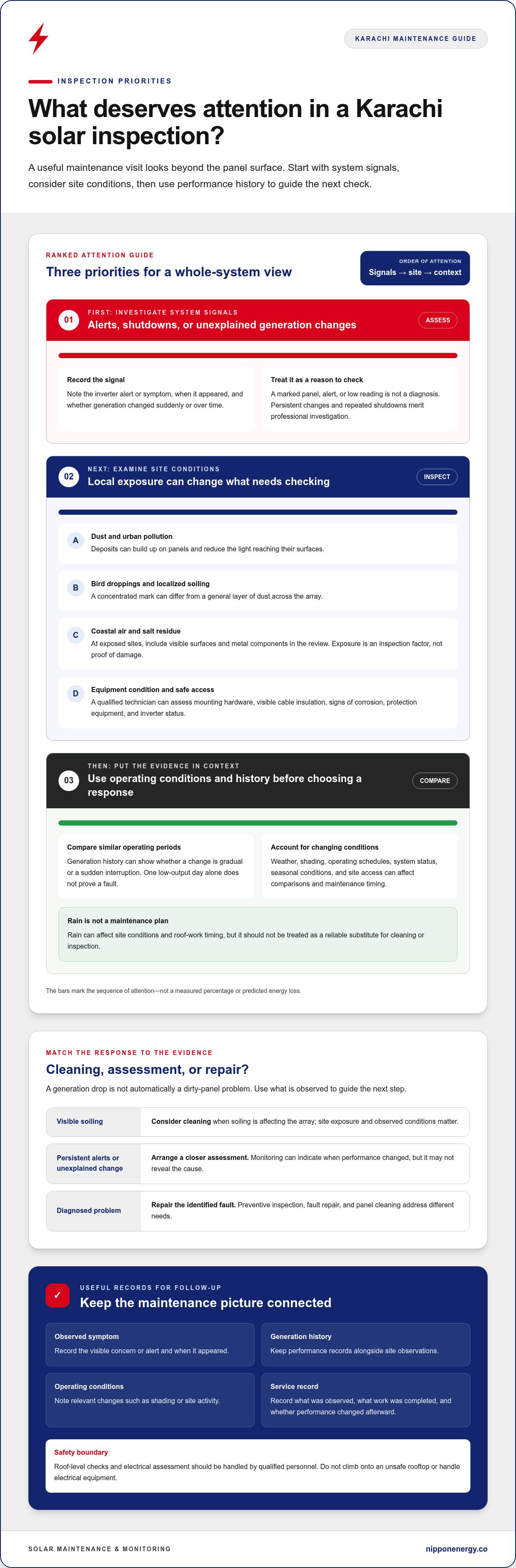
A practical solar maintenance plan for Karachi homes and businesses
A repeatable process turns maintenance from a one-off response into a useful system record. The same principles apply to residential and commercial installations, though system size, site access, operating demands and exposure shape the assessment. Set inspection timing according to observed conditions, system requirements and performance history rather than relying on a universal calendar interval.
- Review monitoring. Check generation history and note alerts, interruptions or changes that persist across comparable operating periods.
- Record symptoms. Write down when unusual output began, what the inverter displayed and any visible changes observed safely from ground level.
- Arrange an assessment. Share the records and describe site access or operating constraints so the review can be planned appropriately.
- Complete approved work. Document the work performed, whether it involved cleaning, inspection or follow-up on a fault.
- Compare results. Review post-service monitoring against an appropriate baseline and similar operating conditions, then record any remaining concerns.
What to record before a maintenance visit
Keep the information concise and factual. Include inverter alerts and their dates, unusual generation readings, recent cleaning or repair work, and visible changes noticed from a safe location. Note access restrictions, business operating hours that affect site work or other relevant site conditions. Don’t open electrical equipment or attempt troubleshooting. These records help qualified personnel assess the issue without creating additional risk.
How to review maintenance outcomes
Compare generation after service with a suitable baseline, accounting for weather, shading and operating conditions. Keep inspection notes, completed work, monitoring observations and unresolved issues together in one system history. A household can keep this in a dated digital file; a business may maintain a shared asset log for its facilities team. Consistent records make later changes easier to interpret.
Results depend on site exposure, system condition, operating conditions and the work performed. If cleaning was completed but output remains unusual, retain that result as evidence for follow-up rather than assuming the work failed or repeating it automatically. This closes the maintenance cycle: review, document, assess, act and measure.
For a structured approach to solar system maintenance services karachi, connect monitoring with documented assessment and follow-up. Explore Nippon Energy solar services for support with solar system maintenance and monitoring.
Nippon Energy solar maintenance services in Karachi: monitoring and next steps
Long-term solar reliability depends on more than responding when equipment stops working. Nippon Energy provides solar system maintenance and monitoring services, bringing performance observations into the broader maintenance picture. For commercial operators, connecting monitoring with maintenance helps organize attention around system behaviour and site requirements. A data change is useful evidence to investigate, not proof of a particular fault or a promise of a specific result.
How monitoring supports a more informed maintenance decision
Generation history gives owners a record to review over time. A sustained change, interruption or inverter alert can help prioritize which concern deserves assessment. That information is most useful when considered alongside operating conditions, such as weather, shading and changes in site use. Monitoring supports investigation; it doesn’t, by itself, establish the cause or replace a professional assessment.
Pairing performance observations with maintenance creates a clearer sequence: identify a change, assess the system in context, then record any work and follow-up observations. Nippon Energy’s Karachi office is located at Plot 14, Sector 15, Korangi Industrial Area.
Move from performance concern to a maintenance plan
Start with the available generation data. Note when the concern appeared, record relevant inverter alerts or operating changes, and describe visible symptoms observed safely from the ground. Share these details as part of a professional assessment. The maintenance scope can then be shaped around the system, site exposure, observed condition and operational requirements.
For a commercial facility, keep monitoring history, assessment notes, completed work and unresolved observations together in the system’s service record. Residential owners can follow the same principle with a dated digital file. Consistent records make it easier to compare later performance with a suitable baseline and provide context for future maintenance decisions.
Nippon Energy supports system reliability through maintenance and monitoring, with service scope shaped around system and site requirements. If you’re ready to discuss your system’s performance concerns and maintenance needs, contact Nippon Energy through the website.
Build long-term confidence in your solar system
Reliable solar performance depends on more than clean panels. In Karachi, maintenance is most useful when it combines condition-based cleaning, broader system assessment and monitoring records that put output changes in context. A generation dip may call for cleaning, while persistent changes or inverter alerts can require further investigation by qualified personnel.
Use a consistent process: review performance history, record symptoms and recent work, arrange an appropriate assessment, and compare results afterward under similar operating conditions. The right maintenance scope depends on the system, site exposure and observed condition, not a one-size-fits-all schedule. These principles make solar system maintenance services karachi more than a cleaning visit: they support informed decisions and long-term system reliability.
Nippon Energy provides solar system maintenance and monitoring services and has a Karachi office in Korangi Industrial Area. With performance evidence and a considered maintenance plan, you can manage your system with greater clarity. Contact Nippon Energy to discuss your solar maintenance and monitoring needs.
Frequently Asked Questions
Is solar system maintenance necessary in Karachi?
Yes, maintenance helps identify soiling, visible damage, inverter alerts and generation changes before concerns persist. Karachi’s dust, pollution and coastal exposure can influence which components need attention, but every site has different conditions. Use generation history and professional inspection to guide decisions rather than assuming all systems need the same work. A considered maintenance plan connects observed conditions with appropriate follow-up.
How often should solar panels be cleaned in Karachi?
There’s no single cleaning interval that suits every Karachi installation. Dust exposure, nearby pollution, bird activity, rainfall, panel angle and observed generation all affect when cleaning may be appropriate. Review monitoring trends and visible soiling, then plan cleaning based on the site’s condition. Avoid relying on a universal schedule or assuming a specific output increase. A professional assessment can help determine whether cleaning is justified.
Can dirty solar panels reduce electricity generation?
Yes, surface soiling can reduce the sunlight reaching photovoltaic cells, but the effect depends on the type and amount of residue, weather, panel angle and system conditions. Broad loss estimates shouldn’t be treated as guaranteed for every installation. If generation changes, compare monitoring data across relevant operating periods and consider weather or shading before concluding that dirt is the cause. Inspection can help determine whether soiling or another issue merits attention.
What does a solar system maintenance service include?
A maintenance assessment may involve reviewing available monitoring data, examining panels and mounting structures, noting visible wiring concerns or inverter alerts, and considering cleaning when appropriate. The scope depends on the system configuration, site conditions and reported issue. Maintenance is broader than washing panels: it helps assess concerns and inform follow-up. Electrical diagnosis and repairs should be handled by qualified professionals. Nippon Energy provides solar system maintenance and monitoring services.
What happens if my solar system output suddenly drops?
Start by noting when the change began and reviewing available generation data and inverter alerts. Weather, shading, system shutdowns or visible soiling may be relevant, but don’t assume any one cause. Avoid opening electrical equipment or climbing onto the roof. If the change persists, alerts recur or damage is visible, arrange a professional assessment. Sharing dates and monitoring observations can help focus the investigation.
Can I clean solar panels myself in Karachi?
Only consider cleaning if you can do so safely in an accessible location and follow the system manufacturer’s instructions. Roof access, electrical equipment, hot surfaces and unsuitable tools can create safety risks or damage components. Avoid climbing onto unsafe rooftops, handling electrical equipment, or using abrasive materials and inappropriate cleaning methods. If access or the correct method is uncertain, professional cleaning can account for the installation and site conditions.
Does solar maintenance include inverter and battery checks?
The maintenance scope depends on the system and the work required. A whole-system assessment can consider inverter alerts and other components; battery testing and repairs should be specified as part of the assessment according to the system’s condition and requirements. Nippon Energy provides solar system maintenance and monitoring services, and its wider solar offering includes inverters and battery storage. Qualified personnel should handle electrical diagnosis.
How can I monitor my solar system performance?
Use the monitoring tools available for your installation to review generation history, alerts and changes over time. Compare similar operating periods where possible, since weather, shading and system use can affect output. Keep dated notes about maintenance and visible concerns so a professional can interpret performance patterns. Monitoring can help identify changes that merit investigation, but it doesn’t replace physical inspection or qualified electrical diagnosis. These records support informed solar system maintenance services karachi decisions.


