

What if your factory could keep production moving through a four-hour outage without relying solely on diesel? Effective backup power for factory during load shedding is more than a standby generator. It is an integrated energy system designed around production schedules, critical equipment and operating costs. An abrupt shutdown can waste materials, extend restart times and expose equipment to voltage fluctuations during grid transitions.
Diesel dependence can bring unpredictable fuel and maintenance costs. Solar-plus-storage offers another approach: generate electricity with solar panels, store it in lithium-ion batteries and coordinate supply through inverters. Nippon Energy brings these components together through its solar project development and EPC services, solar panels, lithium-ion storage and Smart AI Inverters.
This article explains how to size an industrial solution around critical loads, compare battery storage with diesel, and plan solar generation to support more predictable energy costs. You’ll also learn what to consider when selecting panels and designing a system for your factory’s operating conditions.
Key Takeaways
- Map peak and average demand to identify priority backup loads and guide system sizing.
- Assess diesel’s full operating burden, including fuel handling, maintenance and production losses during downtime.
- Compare battery storage and generators over the system’s operating life, not only by upfront cost.
- Plan backup power for factory during load shedding as an integrated system of solar generation, battery storage and power management.
- Consider how Nippon Energy’s EPC services, NipponHev and solar and storage offerings can support a factory-specific energy architecture.
The Industrial Impact of Load Shedding: Beyond Simple Power Cuts
A factory outage is measured in more than the hours without grid electricity. Sudden interruptions can leave work in process unusable, force machinery through lengthy restart sequences and disrupt production commitments. Load shedding describes deliberate interruptions to electricity supply. Industrial sites can also experience voltage dips and unstable transitions that affect equipment even when the grid does not go down completely.
Operational Disruptions in Modern Manufacturing
CNC machines, programmable logic controllers (PLCs) and automated production lines depend on stable power. A voltage dip or abrupt transfer can trigger faults, interrupt control sequences or require recalibration before production resumes. The consequences can include scrapped material, lost machine time and delayed orders. Restarting a line can also shift production schedules, affect deliveries and leave downstream processes waiting for components.
The Financial Drain of Diesel Dependence
A useful diesel comparison looks beyond the generator’s purchase price. Levelized cost of energy (LCOE) considers the cost of producing electricity over a system’s operating life. For diesel, that includes fuel consumption and price volatility, routine maintenance, engine wear and the logistics of keeping fuel available. A low upfront equipment cost can therefore hide a significant recurring operating burden.
Fuel storage also requires planning for safe handling, replenishment and continuity of supply. Consumption rises with operating hours and load, making it expensive to cover frequent or long outages with fuel alone. Solar-plus-storage shifts some supply to onsite generation and stored electricity. Nippon Energy’s solar project development and EPC services can align system design with factory demand, while Nippon Lithium-ion Battery Storage provides an alternative to relying primarily on diesel. The investment profile changes, with more emphasis on planned capital expenditure and less exposure to recurring fuel and engine-maintenance costs.
Diesel generation produces direct emissions. Solar generation paired with battery storage can reduce reliance on combustion during interruptions and routine operations. For manufacturers responding to customer expectations or sustainability requirements, tracking energy use and reducing operational emissions can support greener production goals. The practical task is to build resilience around the factory’s loads, operating priorities and long-term energy strategy, rather than simply keeping a generator ready.
Designing a High-Performance Industrial Backup Architecture
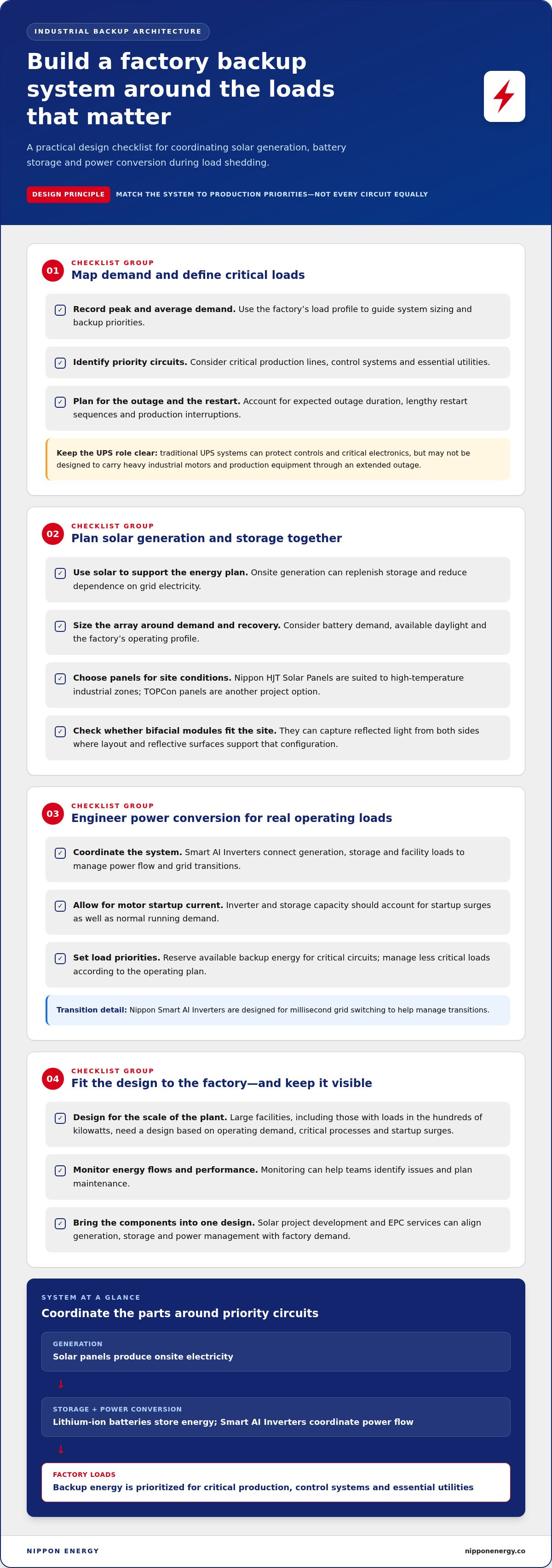
At factory scale, backup power is not simply a battery connected to an inverter. It is an integrated energy system that coordinates onsite generation, battery storage and power conversion around the facility’s load profile. A large plant, including one with loads in the hundreds of kilowatts, needs a design that accounts for operating demand, critical processes and equipment startup surges. This is the foundation of reliable backup power for factory during load shedding.
Storage holds energy for use when grid supply is interrupted or solar generation falls. Nippon Lithium-ion Battery Storage can be integrated with solar panels and Smart AI Inverters to respond to changing energy conditions. The design should reflect factory priorities rather than treating every circuit as equally critical. The U.S. Department of Energy’s research on the economic costs of long-duration power outages underscores why outage planning should account for operational consequences, not just lost electricity.
High-Efficiency Generation: HJT and TOPCon
Solar generation can replenish storage and reduce dependence on grid electricity. Nippon HJT Solar Panels are suited to high-temperature industrial zones. TOPCon solar panels provide another option for project design. Compare expected yield against the factory’s climate, roof or ground conditions and operating profile. Bifacial modules can capture reflected light from both sides where the site layout and reflective surfaces support that configuration. Plan array capacity around battery demand and available daylight so the system can recover between interruptions.
Intelligent Orchestration with Smart AI Inverters
Smart AI Inverters connect generation, storage and facility loads to coordinate power flow and grid transitions. For heavy motors, engineering must account for startup current as well as normal running demand. Inverter and storage capacity should reflect those transient requirements. Load-priority settings can reserve available backup energy for critical production lines, control systems and essential utilities, while less critical loads are managed according to the operating plan.
Monitoring adds visibility into system performance and energy flows, helping teams identify issues and plan maintenance. Nippon Energy’s solar project development and EPC services bring system components into a factory-specific design, while NipponHev supports an integrated energy architecture. For a closer look at lithium-ion battery storage and industrial energy planning, explore Nippon Energy’s solutions at Nippon Energy.
Nippon Lithium-Ion Storage vs. Diesel Generators: The 2026 Comparison
When assessing backup power during load shedding, compare the system’s lifetime operating value, not just its purchase cost. Diesel generators provide dispatchable power, but fuel consumption, maintenance and engine wear add recurring costs. Battery storage requires a different capital investment and is most useful as part of an integrated design with solar generation and power conversion.
Nippon Lithium-ion Battery Storage can respond to changing power conditions. Paired with Nippon Smart AI Inverters, it supports millisecond grid switching to help reduce the interruption associated with generator startup. Batteries use no onsite fuel while discharging and have fewer mechanical components than combustion engines. Lifespan and cycle performance depend on the specified equipment and operating conditions, so assess system documentation and expected duty cycles rather than assume a universal figure.
The ROI of Energy Independence
To evaluate a solar-plus-storage project in Pakistan, compare the full cost of ownership over the same planning period. Include the installed system investment, expected solar generation, battery use, grid electricity displaced, avoided diesel consumption and ongoing maintenance. Model the factory’s actual load profile and outage pattern, then test how sensitive the payback period is to fuel prices, operating hours and battery dispatch. This creates a project-specific estimate instead of relying on headline savings that may not fit the site.
NipponHev can form part of an integrated energy architecture, coordinating solar, storage and power management. Its contribution to return on investment depends on how the system is designed around the facility’s loads and energy use. A stronger renewable-energy profile may also support sustainability reporting and customer requirements, but it does not automatically confer a certification or determine the facility’s valuation. Explore NipponHev as one part of that assessment.
Environmental and Noise Factors
Battery storage produces no exhaust or engine noise while discharging. Solar charging can further reduce reliance on fuel-based electricity and support lower operational emissions. Manufacturers exporting internationally may need to respond to customer carbon-data requests and applicable trade-related requirements, so energy records and emissions accounting matter. Those obligations depend on the market and product; a solar-storage installation alone does not establish compliance.
Evaluate battery chemistry and thermal management against the factory environment, especially in hot operating conditions. Nippon Energy’s lithium-ion storage and solar EPC services can be incorporated into a project-specific design. Assessing load requirements, climate, operating cycles and sustainability objectives together gives decision-makers a sounder basis for comparing storage with diesel.
Implementing Factory-Scale Backup: A Strategic Roadmap
Factory-scale backup design starts with operational data, not a generator rating alone. A facility with large motors, process equipment and control systems needs an architecture that accounts for average and peak demand, startup surges and the duration of the loads it must support. This helps align solar generation, battery capacity and inverter performance with production priorities.
Step 1: Load Profiling and Feasibility
Map the facility’s load over representative production cycles. Separate essential circuits from loads that can be reduced or paused during an interruption. A critical production line, PLC controls and safety systems may need priority, while non-essential loads can be shed to preserve stored energy. Review roof condition, usable area, shading and electrical infrastructure before planning Nippon TOPCon arrays or other generation capacity.
Industrial energy feasibility means balancing peak load capacity and battery depth of discharge with the facility’s operating profile and available generation.
For a large site, compare expected daytime solar production with the energy needed to serve loads and recharge storage. Account for seasonal conditions and system losses. Engineering should also consider the solar DC-to-AC ratio, inverter capacity, battery discharge limits and required reserve. These factors help determine whether the system can recover between outages. Installed panel capacity alone does not establish that it can.
Step 2: Engineering and EPC Execution
Turnkey execution coordinates system design, equipment integration, installation sequencing and commissioning. At an operating factory, construction can be planned around production schedules and site access to manage disruption. Nippon Energy’s solar EPC services connect project development with delivery of an integrated solar and storage system.
Grid integration requires attention to existing distribution equipment, protection settings and the intended operating mode. Net-metering arrangements and utility processes vary by location, so account for applicable local requirements in the design. In Pakistan, this includes considering relevant NEPRA and utility requirements as part of project planning, since one process does not apply identically to every site.
Before commissioning, test transfer behavior, load-priority settings and system response under representative operating conditions. Establish a solar system maintenance schedule covering inspections, performance monitoring and timely attention to faults. Regular upkeep supports system performance but does not guarantee a specific lifespan. For a factory-specific implementation plan, explore Nippon Energy’s industrial solar EPC solutions.
Why Nippon Energy is the Architect of Industrial Resilience
Industrial resilience depends on how well energy generation, storage, power conversion and project execution work together. Nippon Energy offers HJT and TOPCon solar panels, lithium-ion battery storage, Smart AI Inverters, and solar project development and EPC. These offerings help manufacturers plan backup power for factory during load shedding around production requirements rather than treating each component as a separate purchase.
Site conditions matter. High temperatures can affect solar performance, while factory operations create distinct demand patterns and space constraints. Nippon HJT technology is suited to high-temperature industrial zones. Project planning can account for the site’s operating environment, energy profile and critical loads. Nippon Energy’s industrial project capabilities support manufacturers in Pakistan, including facilities in Lahore and Karachi, with EPC delivery tailored to the factory.
Global Expertise, Local Impact
For manufacturers in Lahore and Karachi, an effective design starts with the plant’s operating schedule, essential processes, grid connection and available installation space. Nippon Lithium-ion Battery Storage and Smart AI Inverters can be integrated with solar generation to manage energy flows and support responsive grid transitions. Solar system monitoring gives facility teams visibility into performance, helping them identify issues and plan maintenance.
Industrial energy security is a long-term operating strategy, not a single equipment decision. A coordinated project can help reduce diesel dependence and improve control over how onsite generation and stored energy serve factory loads. NipponHev can support an integrated architecture, with system configuration shaped around manufacturing needs rather than a one-size-fits-all package.
Next Steps: Plan Around Your Factory’s Loads
Prepare a practical project brief before engineering begins. Include interval load data where available, production schedules, essential and deferrable loads, outage priorities, site drawings and installation constraints. These details help define system capacity and how solar, storage and inverter controls should work together.
Nippon Energy’s solar project development and EPC process takes a project from site and load assessment into system design and implementation planning. For industrial facilities, a tailored NipponHev configuration can align generation, storage and power management with the operating profile. Explore Nippon Energy’s industrial energy solutions to discuss a factory-specific path toward greater energy resilience.
Build a More Resilient Energy Strategy for Your Factory
Industrial backup power works best as a coordinated system, not a standalone response to outages. A factory-specific load profile helps define which operations need priority support. Solar generation, lithium-ion storage and intelligent inverters can then be designed to work together, helping reduce diesel dependence, protect production continuity and improve visibility into energy use.
The right backup power for factory during load shedding starts with practical engineering: assess peak and average demand, identify critical loads, and size generation and storage around the facility’s operating needs. Nippon Energy combines HJT and TOPCon solar panels, lithium-ion battery storage, Smart AI Inverters and project development and EPC to support industrial energy architectures.
Move from outage planning to a deliberate energy strategy. Explore Nippon Energy’s industrial solutions and take the next step toward dependable, lower-carbon operations. A carefully designed system can help your factory respond to future challenges with greater confidence.
Frequently Asked Questions
Can a solar battery system really run heavy industrial machinery during load shedding?
Yes, a solar-battery system can support heavy machinery if it is engineered for the factory’s demand and operating conditions. The design needs to account for continuous load, motor startup surges, inverter capacity, battery discharge limits and the required backup duration. Factories can prioritize essential lines and controls instead of backing up every circuit. A detailed load profile helps establish whether the planned system can support the required equipment.
What is the typical ROI for a factory-scale lithium-ion backup system in 2026?
There is no single ROI figure for every factory. Payback depends on energy use, outage pattern, tariffs, diesel consumption, system design and capital cost. Compare expected lifetime benefits with the installed cost, including avoided fuel and maintenance, solar energy used onsite, and any reduction in grid purchases. Model different operating scenarios, since actual savings depend on how the system is dispatched and maintained.
How long does it take for a Nippon Lithium-ion system to switch on during a power cut?
Transition performance depends on the complete system, particularly the inverter and its configuration, rather than battery chemistry alone. Nippon Smart AI Inverters are designed for millisecond grid switching to support a rapid change in power supply. For a factory, engineering should also account for transfer settings, connected loads and motor-start requirements. These factors determine how the system responds onsite and which operations can remain supported during an interruption.
Do I need to replace my existing diesel generators completely?
No. A factory can retain generators as part of a hybrid energy strategy while using solar and lithium-ion storage in other operating conditions. Batteries can respond quickly and reduce generator runtime, while a generator may remain available for extended outages, low solar availability or other defined contingencies. The right balance depends on critical loads, outage duration, fuel logistics and operating priorities. Include generator controls and system integration in project design.
How many hours of backup can a 500kWh Nippon Lithium-ion system provide?
Backup duration depends on the factory’s load and the system’s usable battery energy. As a simple theoretical example, 500 kWh divided by a steady 100 kW load equals five hours before accounting for conversion losses, reserve settings or limits on usable discharge. Actual runtime may be shorter, and motor surges can affect performance. Use measured load data and the system’s specified usable capacity to estimate duration for your facility.
Are HJT solar panels better than TOPCon for factory roofs in hot climates?
Nippon HJT technology is suited to high-temperature industrial zones, making it an option to assess for hot-climate factory sites. That does not mean TOPCon is unsuitable. The right choice depends on site conditions, available roof area, shading, expected generation and project design. Compare the technologies against the factory’s local climate and energy needs, then size the array to support daytime loads and the planned battery-recharging approach.
What maintenance is required for an industrial-scale solar backup system?
Maintenance typically includes inspecting panels and mounting structures, cleaning panels as site conditions require, reviewing inverter and battery-system alerts, and checking electrical connections and system performance. Monitoring helps identify changes in output or faults that need attention. The maintenance plan should reflect equipment guidance, environmental exposure and operating conditions. Nippon Energy provides solar system maintenance and monitoring to support ongoing system oversight and performance management.
Is net metering available for industrial solar installations in Pakistan?
Net-metering eligibility and procedures depend on current rules and the relevant utility’s requirements, which can change over time. An industrial project should assess its grid connection, export capability and applicable approval process during feasibility and EPC planning. Build the financial model around expected onsite solar use, and treat any export credits as dependent on the rules that apply to the specific installation rather than as guaranteed savings.


