
The right solar system for a poultry farm isn’t simply the one with the most panels. It’s the one designed around the equipment and operating loads that matter most. Ventilation, cooling and lighting can shift electricity demand across seasons and production schedules, while an interruption may put essential operations at risk. That’s why solar solutions for poultry farms should start with measured demand, not a standard system size.
Compare solar-only, solar-plus-storage and grid-connected designs carefully. Each configuration suits a different balance of daytime energy use, backup priorities and site requirements. This guide explains how to assess farm consumption and critical loads, then compare panels, inverters and lithium-ion storage—such as systems available through Greenbank Solar—against those needs.
You’ll also learn what to include in an EPC scope, from project development and equipment selection through installation, monitoring and maintenance. With a clear view of operating priorities and long-term reliability, you can evaluate a system design by how well it fits your poultry house, rather than by panel capacity alone.
Key Takeaways
- Map ventilation, cooling, lighting, pumping, feeding and control loads to their schedules before setting system capacity.
- Evaluate solar solutions for poultry farms by measured demand, critical loads, site conditions and modeled generation, not panel capacity alone.
- Compare grid-connected solar, solar with storage and hybrid configurations by outage response, grid dependence and operating priorities.
- Use a defined EPC scope to connect site assessment, design, procurement, installation, commissioning and handover.
- Plan for ongoing performance visibility with monitoring, considered cleaning, equipment checks and maintenance records.
Solar Solutions for Poultry Farms Start with the Farm’s Energy Profile
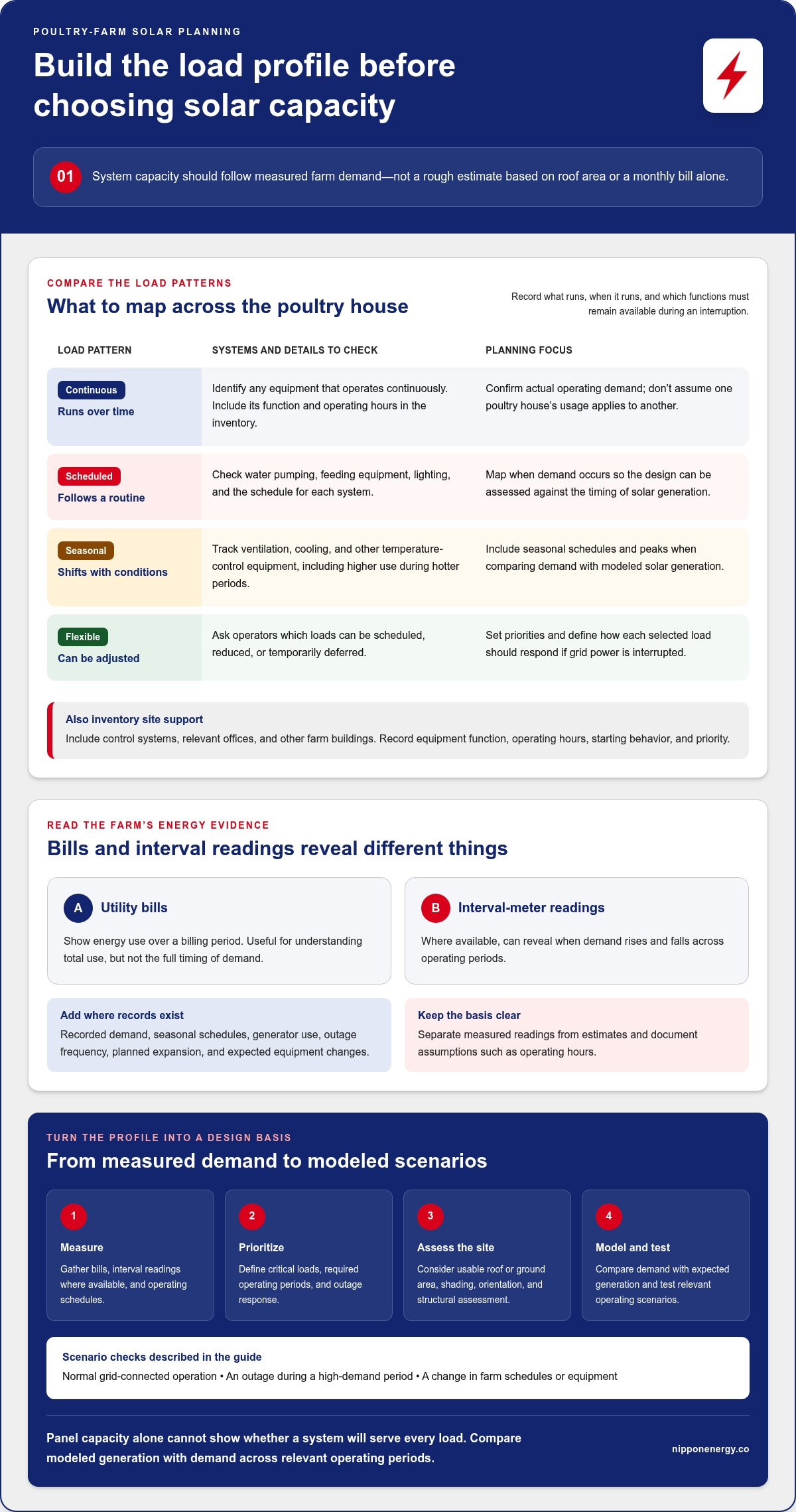
System capacity should follow the farm’s operating demand, not a rough estimate based on roof area or a monthly bill alone. Poultry-house ventilation, cooling and temperature control can carry different loads across seasons, while water, feeding and lighting follow their own schedules. Start by identifying what runs, when it runs and which equipment must remain available during an interruption. Nippon Energy’s solar project development and EPC work connects that load assessment to equipment selection and system design.
A poultry farm load profile is the timing and scale of facility electricity demand. It distinguishes continuous loads from scheduled tasks, seasonal peaks and non-critical uses. Flock type, facility layout, local climate and operating practices all affect that profile, so one house’s assumptions shouldn’t automatically be applied to another.
Which poultry-house systems should a solar assessment include?
Build an equipment inventory that records each system’s function, operating hours, starting behavior and priority. Include ventilation fans and installed temperature-control equipment, then account for water pumping, feeding equipment, lighting, controls and relevant offices or support buildings. Note which loads run continuously, follow a schedule, rise during hotter periods or can be deferred. This makes critical farm functions visible before you consider system capacity.
- Environmental control: ventilation, cooling and other temperature-control equipment.
- Daily operations: water pumps, feeders and lighting.
- Site support: control systems, offices and other farm buildings where relevant.
What farm data helps size a solar project?
Bring together utility bills, interval-meter readings where available, recorded demand and seasonal operating schedules. Bills show energy use over a billing period; interval data can reveal when demand rises and falls. Add generator use, outage frequency, planned expansion and expected equipment changes where records exist. Separate measured readings from estimates, and document assumptions such as operating hours so the design basis is clear and can be refined.
For a ground-mounted project, land use may also shape early site discussions. Agrivoltaics describes combining solar energy and agriculture on the same land. It’s a concept to consider alongside poultry-house loads, not a substitute for measuring them.
How to Size Solar and Storage Around Poultry-Farm Loads
Once the farm’s load profile is established, sizing becomes a sequence of engineering decisions: measure demand, define operating priorities, assess the site, model solar generation and test operating scenarios. Solar and battery capacity should be modeled against measured loads and operating priorities. Solar solutions for poultry farms need to account for both the amount of electricity used and when it’s required.
Panel capacity alone can’t show whether a system will serve every load. The design must compare expected generation with demand over relevant operating periods, including seasonal changes and lower-generation conditions. Array layout also depends on usable roof or ground area, shading, orientation and structural assessment. For a ground-mounted site, the USDA Climate Hubs’ overview of pairing solar power with agriculture describes land-use approaches that can include chickens around panels. It provides context for site planning, not a substitute for farm-specific load or engineering analysis.
How should a poultry farm define critical loads?
Work with farm operators to separate equipment essential to operations from loads that can be scheduled, reduced or temporarily deferred. Rank each selected load by priority, required operating period and response if grid power is interrupted. This creates a defined backup scenario for the design, rather than assuming storage must supply every building and device.
When should a project include battery storage?
Compare daytime solar use with evening demand, outage exposure and the backup duration the farm wants to plan for. Then assess battery power capability against the loads that may run together, and energy capacity against how long they need to operate. A battery can support selected loads or shift energy use, but its role depends on the engineering and chosen scenario. Explore lithium-ion battery storage fundamentals for a deeper explanation.
Model practical cases, such as normal grid-connected operation, an outage during a high-demand period, and a change in farm schedules or equipment. Record assumptions for load combinations, solar production and backup priorities. If a scenario exposes a gap, revise the design. This lets Nippon lithium-ion battery storage systems and smart AI inverters be assessed within a farm-specific project rather than as standalone equipment. Nippon Energy’s solar project development and EPC brings load assessment, equipment selection and system design into one project scope.
Compare Poultry-Farm Solar Configurations by Reliability and Control
Once farm priorities are defined, compare system architectures by what they’re designed to do during normal operation and a grid interruption. Grid-connected solar can serve farm demand that coincides with solar generation, subject to system configuration. Solar panels alone don’t automatically provide uninterrupted power during outages. Backup depends on how the system is engineered, including inverter capability, storage and the loads selected for support.
| Configuration | Intended loads | Grid dependence | Outage response | Controls and design considerations |
|---|---|---|---|---|
| Grid-connected solar | Loads operating while solar power is available | Remains connected to the grid | Solar alone shouldn’t be assumed to power the farm during an outage | Model generation against daytime demand; assess export and interconnection under applicable Pakistan requirements |
| Solar with storage | Solar-served loads plus selected loads assigned to storage | Can remain grid-connected, depending on design | May support designated loads when configured for backup | Match inverter and battery capability to selected loads, runtime priorities and operating conditions |
| Engineered hybrid | Loads allocated across available sources, such as solar, grid, storage and, where designed, a generator | Depends on the operating strategy and available sources | Response depends on source integration, controls and the backup plan | Define source priorities, transitions, generator integration and applicable interconnection requirements in the design |
Grid-connected solar versus solar with storage
The key difference is timing and outage response. Grid-connected generation can offset farm demand that coincides with solar production, but it doesn’t automatically shift surplus solar into evening use or supply equipment during a power cut. Storage may bridge a gap between generation and demand or support designated loads, provided the system is engineered for that role. Neither configuration is universally best. The choice depends on operating schedules, grid conditions and the farm’s reliability priorities.
How do inverters and controls affect farm operations?
An inverter converts solar-system power into a form used by electrical loads and, depending on its design, coordinates system operation. Controls and monitoring help operators understand system status and manage equipment groups according to the project’s operating plan. Nippon Smart AI Inverters can be assessed as part of that system design. For more detail, see the smart AI inverter guide.
For solar solutions for poultry farms, treat export, backup and generator integration as design questions, not assumed features. A project-specific configuration can define which loads receive priority and how available sources are coordinated, while accounting for applicable Pakistan grid-interconnection and export requirements.
Evaluate Poultry-Farm Solar EPC Scope, Site Readiness, and Project Economics
What should a poultry-farm solar proposal make clear?
A proposal should show its design basis: the load data used, assumptions made, system boundaries and intended operating modes. It should also define the equipment scope and explain commissioning tests, project documentation, monitoring arrangements and handover responsibilities. If flock schedules, equipment or buildings may change, identify those possibilities so the design basis and any future revisions are understood.
- Assessment and design: site findings, demand inputs, layout and system configuration.
- Delivery: procurement, installation and commissioning responsibilities.
- Handover: operating documentation, monitoring setup and records provided to farm staff.
How can buyers assess project economics without relying on headline claims?
Compare modeled generation with the farm’s actual consumption timing, not just its total energy use. The share of solar power used on site depends on how generation aligns with operating demand. Handle any export assumptions in line with applicable Pakistan requirements. Evaluate the project over a stated operating horizon, and test how results change if schedules, energy use or equipment plans shift.
Ask for the model’s assumptions to be visible, including generation estimates, self-consumption, degradation and maintenance needs. Scenario analysis helps reveal which inputs most affect the project case. Treat savings or payback as estimates, not guarantees, because they depend on site conditions and operating assumptions.
Nippon Energy’s solar project assessment connects site readiness, EPC scope and operating data.
Plan Long-Term Poultry-Farm Solar Performance with Monitoring and Maintenance
Commissioning establishes the system baseline; monitoring and planned maintenance help operators understand performance afterward. For solar solutions for poultry farms, that visibility matters because a production deviation or system alert may warrant investigation before it affects operating decisions. Monitoring won’t identify every cause on its own, but it can direct attention to changes in generation, availability or equipment status.
What should farm operators monitor after commissioning?
Track solar generation, system availability and inverter status, along with relevant consumption data where the monitoring setup supports it. Compare actual performance with the agreed design baseline, accounting for operating conditions, and investigate material deviations rather than assuming a single cause. Keep operating logs, maintenance records and incident notes accessible to farm operators and the project team. These records help distinguish a recurring issue from a short-term variation.
How can EPC and maintenance support continuity over time?
Nippon Energy’s solar project development and EPC work connects assessment, design, installation, commissioning and handover. Its maintenance and monitoring services support ongoing system visibility. Clear handover documentation gives farm staff a reference for system operation and escalation, while performance records help inform maintenance decisions. Explore the solar system maintenance guide for broader planning considerations.
A practical maintenance plan can include:
- Planned inspections: review accessible equipment and installation areas for visible issues, following the system’s operating and safety procedures.
- Cleaning decisions: consider observed soiling and its potential effect on output, while accounting for site conditions and safe access.
- Equipment checks: review inverter status, alerts and relevant system components as part of planned maintenance.
- Records: document inspections, cleaning, incidents and corrective work to build a usable performance history.
Schedule site work around farm operations, access controls, worker safety and applicable biosecurity procedures. Define how maintenance access is coordinated without disrupting essential activities, and avoid relying on unsupported fixed intervals. Review the plan as equipment, site conditions or farm practices change.
Discuss your poultry-farm project and operating requirements with Nippon Energy to align EPC, monitoring and maintenance planning: discuss a poultry-farm solar project.
Build a Solar Plan Around Your Farm’s Priorities
Reliable solar planning starts with a clear picture of how the poultry farm uses electricity, when demand peaks and which loads matter most. That measured profile helps determine whether a grid-connected design, storage or a hybrid configuration fits the farm’s operating priorities. Panel capacity alone can’t establish outage performance or long-term value.
Strong solar solutions for poultry farms also depend on site readiness, transparent EPC responsibilities and a practical plan for monitoring and maintenance. Nippon Energy’s project development and EPC services bring assessment, design and delivery into one scope, with Nippon HJT and TOPCon solar panels, lithium-ion storage and smart AI inverters available to assess against project requirements. Ongoing monitoring and maintenance support visibility into system performance over time.
Move from general estimates to a project framework based on your farm’s loads, site conditions and operating plans. Discuss a poultry-farm solar project with Nippon Energy and take the next step toward a system designed around your operation.
Frequently Asked Questions
Can solar power run a poultry farm?
Yes, solar can supply electricity to poultry-farm operations, with the system design determining which loads it serves and when. The assessment should account for ventilation, cooling, lighting, water pumping, feeding equipment and controls, along with their schedules and seasonal demand. Grid-connected solar can serve loads that coincide with generation; storage or an engineered hybrid design may address other operating priorities. Solar alone doesn’t automatically provide uninterrupted power during an outage.
How do you size a solar system for a poultry farm?
Size solar solutions for poultry farms using measured energy demand and operating priorities, not a monthly bill or panel capacity alone. Review utility bills, interval-meter data where available, demand records and seasonal schedules. Identify continuous, scheduled, seasonal and critical loads, then assess the site and model generation against consumption timing. Document estimates and assumptions, including planned equipment or facility changes, so the design can be evaluated against realistic farm operations.
Is battery storage necessary for a poultry farm solar system?
No, battery storage isn’t necessary for every poultry-farm solar project. It may be useful when the farm wants to shift solar energy to periods with less generation or support selected loads during an outage. Evaluate evening demand, outage exposure, desired backup duration, battery power capability and energy capacity against the chosen loads. Don’t assume storage will power every building or piece of equipment without a project-specific capacity and runtime assessment.
What happens to a poultry farm solar system during a power outage?
Outage response depends on system architecture and equipment. A grid-connected solar system without a designed backup function shouldn’t be assumed to keep supplying farm loads when the grid fails. A system engineered with storage and compatible controls may support selected loads, subject to its configuration and capacity. Define which equipment receives priority, how long it needs support and whether generator integration is part of the design.
Can solar panels support ventilation and cooling equipment?
Yes, a solar system can be designed to serve ventilation and cooling equipment, but the design must reflect actual electrical requirements and operating patterns. Record operating schedules, seasonal peaks and equipment starting behavior, then assess these loads alongside other farm demand. The inverter and system configuration must align with the selected equipment and operating scenario. If backup is required, define which fans or cooling loads need support and assess storage accordingly.
How do I compare solar EPC proposals for a poultry farm?
Compare proposals by their design basis and delivery scope, not by panel capacity alone. Look for documented load data, assumptions, site findings, system boundaries and intended operating modes. Review equipment selection, procurement, installation, commissioning tests, handover documents, monitoring and maintenance responsibilities. Check how future equipment changes could affect the design, and assess economic models against consumption timing and stated assumptions. In Pakistan, interconnection and export considerations should reflect applicable requirements.


