

In 2026, battery storage is no longer just backup for Pakistani businesses. It’s a strategic tool for managing energy costs and protecting operations. For enterprises evaluating energy storage solutions for business pakistan, the key question is which system can balance reliable power with a credible return on investment. Under NEPRA’s 2026 net billing framework, new solar users may receive around PKR 9–11 per unit for exported electricity while paying full retail rates for grid power. That makes using more of the energy generated on-site increasingly valuable.
Rising capacity charges, frequency fluctuations and the maintenance burden of legacy lead-acid systems all make grid dependence harder to manage. Advanced lithium-ion storage paired with intelligent energy management can help businesses store solar power, support critical loads and reduce exposure to costly grid purchases.
This guide examines how Nippon Lithium-ion Battery Storage Systems and Nippon Smart AI Inverters fit into a resilient commercial energy strategy. You’ll learn what shapes system design, how to assess savings and payback potential, and how integrated solar and storage can support greater energy independence and dependable operations in 2026.
Key Takeaways
- Use an energy audit and load profile to separate critical operations from flexible loads before sizing a battery system.
- Compare lifecycle performance and maintenance needs, not just upfront capacity, when evaluating storage against legacy battery setups.
- Model peak shaving and load leveling against your facility’s operating pattern to identify where storage may improve energy-cost control.
- Consider how energy storage solutions for business pakistan can combine solar generation, lithium-ion storage and intelligent inverter management.
- Nippon’s integrated solar, storage and EPC capabilities can support a tailored transition to a storage-first operating model.
Navigating Pakistan’s 2026 Energy Landscape: Why Businesses are Moving Beyond Grid Dependency
For Pakistani industry, grid electricity brings two operational challenges: a difficult cost structure and inconsistent power quality. Capacity payments and surcharges can squeeze margins even when a plant’s consumption is stable. NEPRA’s approved industrial tariff for January 2026 is PKR 33.48 per kWh, making every unit saved or shifted a meaningful part of energy planning. Storage gives businesses more control over when they draw power, rather than relying on the grid for every operating hour.
The Cost of Inaction: Grid Volatility in 2026
Tariffs are only one part of the cost of grid dependence. Frequency fluctuations and interruptions can affect variable-speed drives, automated controls, precision equipment and production lines. The result may be process disruption or equipment stress. A correctly engineered battery system, paired with suitable power-conversion controls, can support selected loads during short disturbances and planned peak periods. Start by mapping critical loads and operating schedules, then assess storage against those needs.
Traditional UPS units and lead-acid batteries still serve some applications, but frequent cycling can make them a costly fit. Maintenance needs and limited cycle life may make them less suitable for continuous energy shifting. Lithium-ion storage is designed for repeated charging and discharging, allowing it to play a more active role than emergency backup alone.
From Backup Power to Strategic Energy Orchestration
Battery Energy Storage Systems (BESS) combine battery modules, power-conversion equipment and controls to store electricity and deliver it when needed. A business can prioritize critical loads, charge storage from on-site solar during the day, then discharge during evening operations or high-demand periods. This can increase on-site use of solar generation, particularly under Pakistan’s 2026 net billing framework, where new applicants receive a lower rate for exported electricity than the retail cost of grid power.
BESS is critical infrastructure for 2026 because it enables businesses to manage power availability, timing and load priorities as part of everyday operations.
This is the shift from emergency backup to active energy management. Instead of sizing storage only to cover an outage, businesses can assess how it supports production continuity, peak shaving and solar use after sunset. Energy storage solutions for business pakistan should be evaluated against the facility’s load profile, power-quality requirements and operating schedule, not simply battery capacity. Storage can also support sustainability planning by increasing the share of on-site renewable power used directly, while complementing grid supply where required.
The Architecture of Modern BESS: Integrating Lithium-Ion with Smart AI Orchestration
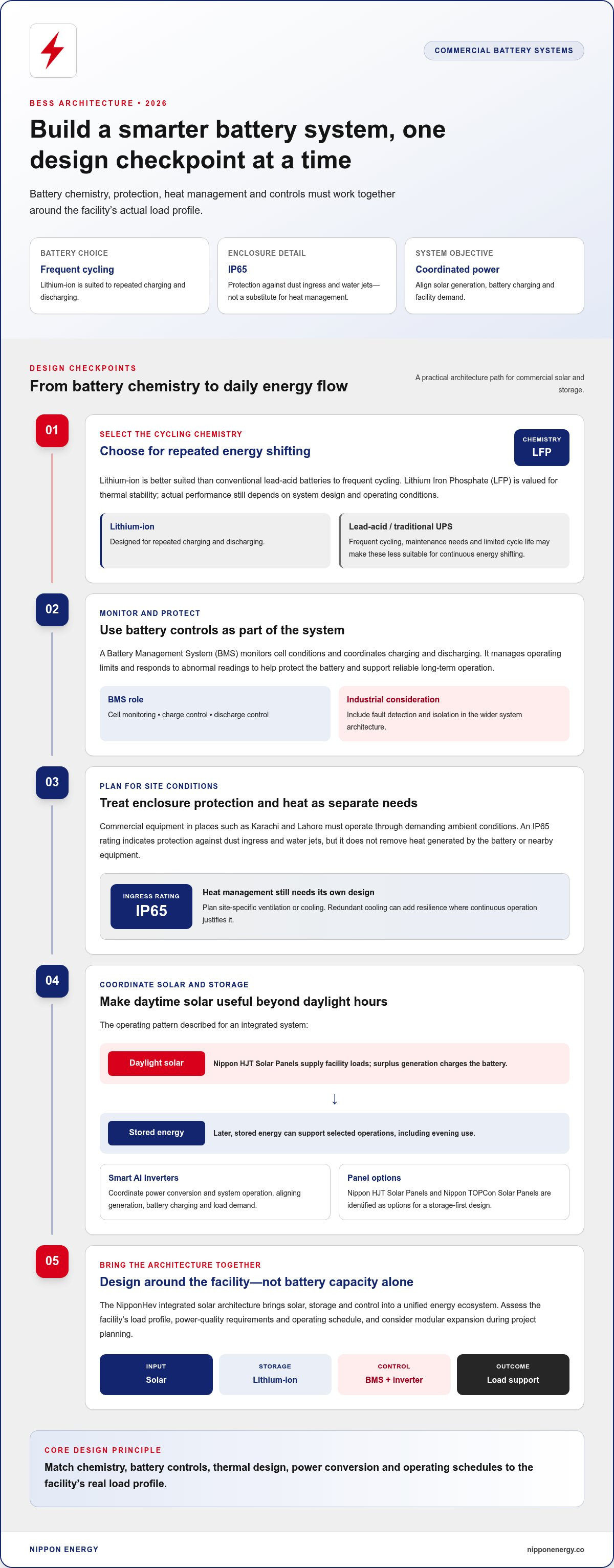
A commercial battery system performs as well as the architecture around it. Battery chemistry, thermal conditions, power conversion and control logic must work together to serve the facility’s actual load profile. This is important in Karachi and Lahore, where equipment must operate through demanding ambient conditions. The U.S. International Trade Administration’s overview of Pakistan’s energy sector provides context for the country’s evolving energy mix and the growing role of renewables.
Chemistry, thermal design and battery control
Lithium-ion batteries are better suited than conventional lead-acid batteries to frequent cycling, which is essential when storage shifts solar energy into later operating hours. Lithium Iron Phosphate (LFP) is a lithium-ion chemistry valued for thermal stability, though actual performance depends on system design and operating conditions. Nippon Lithium-ion Battery Storage Systems use proprietary chemistry optimized for high-cycle life.
A Battery Management System (BMS) monitors cell conditions and coordinates charging and discharging. By managing operating limits and responding to abnormal readings, it helps protect the battery and support reliable long-term operation. For industrial installations, consider fault detection and isolation alongside the BMS as part of the wider system architecture.
Enclosure protection and heat management address different needs. An IP65 rating indicates protection against dust ingress and water jets, but it doesn’t remove heat generated by the battery or surrounding equipment. Site-specific ventilation or cooling design is therefore essential. Redundant cooling can add resilience where continuous operation justifies it.
Integrating solar with intelligent storage
Solar panels and storage deliver more value when coordinated as one system. During daylight, Nippon HJT Solar Panels can supply facility loads while surplus generation charges the battery. Later, stored energy can support selected operations, extending the usefulness of solar beyond production hours. Nippon Smart AI Inverters coordinate power conversion and system operation, helping align generation, battery charging and load demand.
The NipponHev integrated solar architecture brings solar, storage and control into a unified energy ecosystem. Nippon TOPCon Solar Panels offer another option for a storage-first design. Consider modular expansion during project planning, assessing system capacity and compatibility against present and anticipated loads. For businesses evaluating energy storage solutions for business pakistan, Nippon Energy’s integrated EPC approach connects these design choices into a coordinated project.
Review Nippon’s integrated solar and storage solutions as a starting point for planning a system around your operational requirements.
Calculating ROI for Industrial Storage: Peak Shaving and Load Leveling in Pakistan
A battery’s financial value depends on how it changes a facility’s energy profile, not simply on its installed capacity. In Pakistan, assess peak shaving, load leveling, solar self-consumption and any applicable time-of-use differences against actual meter data and the site’s tariff category. The Institute for Energy Economics and Financial Analysis examines storage’s role in the future of Pakistan's electricity grid, but each facility still needs its own operating and tariff analysis.
The financial mechanics of peak shaving
Peak shaving uses stored energy to reduce short periods of high grid demand. If a facility’s measured peak is 500 kW, a modeled 20% reduction would mean targeting a 100 kW lower peak during the relevant interval. Treat this as a scenario to test, not a savings guarantee. The battery must have sufficient power, usable energy and state of charge when the surge occurs.
On a K-Electric or LESCO bill, peak shaving can lower the demand-based component where the customer’s tariff includes one, while reducing grid energy purchases only for the units the battery actually supplies. It doesn’t automatically reduce every bill component. Review the tariff and meter interval data to identify which charges can change.
Load leveling serves a different purpose. By charging during lower-demand periods and discharging as plant demand rises, a BESS can smooth the facility’s grid draw and help stabilize its energy profile. Grid arbitrage follows a similar principle: charge when electricity is cheaper and discharge when it is more expensive. Before relying on arbitrage, account for round-trip efficiency, charging costs, battery degradation and the applicable tariff periods.
Build a project-specific return model
Use a transparent comparison instead of relying on a generic payback promise. Estimate annual value from demand-charge reductions, shifted grid energy, increased use of on-site solar and any avoided generator operation. Then subtract charging costs, conversion losses, maintenance and the cost of battery replacement over the analysis period.
- Simple payback: upfront project cost divided by estimated annual net savings.
- Levelized Cost of Storage (LCOS): lifetime storage costs, including charging, maintenance and replacement, divided by lifetime energy discharged.
- Scenario check: compare conservative, expected and high-utilization cases using the facility’s actual load profile.
Don’t assume a 10-year cycle life or a fixed import surcharge in the model unless those inputs are supported by the system specification and current project costs. Compare storage longevity and maintenance requirements with alternatives such as diesel generation, using site-specific fuel, servicing and operating records. This framework helps businesses assess energy storage solutions for business pakistan based on measurable operating value. Nippon Energy’s integrated storage systems can be evaluated against the same load, tariff and lifecycle assumptions.
Implementation Strategy: Transitioning Industrial Operations to a Storage-First Model
A storage-first project should begin with operating data, not a battery capacity selected in isolation. The objective is to match energy supply, power demand and backup priorities to the way the facility actually runs. A disciplined implementation sequence can reduce oversizing, expose integration constraints early and give the business a measurable basis for evaluating energy storage solutions for business pakistan.
Start with the load profile, then size the system
Step 1: Audit energy use. Review utility bills and interval meter data alongside production schedules, existing solar output and generator or UPS operation. Record both normal demand and short-duration surges. A shift change or motor start can create a different requirement from steady production.
Step 2: Separate critical from flexible loads. Identify equipment that must remain powered, such as controls, safety systems or essential process lines, and distinguish it from loads that can pause or shift. This defines the backup objective and how long storage must support those loads.
Step 3: Size for usable energy and power. Total battery capacity isn’t the same as usable capacity. Operating limits and conversion losses affect the energy delivered to loads. Compare required energy in kilowatt-hours with discharge power in kilowatts. For heavy machinery, assess the inverter’s discharge capability and the battery’s C-rating against starting surges as well as continuous demand. Plan for expansion based on forecast load growth, available space and compatible system architecture.
Engineer the solar, storage and grid interface
Step 4: Design the integration. Map how the BESS will connect with existing solar PV, the grid and facility distribution equipment. Define when the system charges, which loads it supplies, how it responds to grid interruptions and what operating limits protect the installation. Nippon Energy’s solar EPC services bring project design and execution into a coordinated process, with engineering tailored to the site.
Site conditions matter. Industrial properties in Karachi and Lahore can have different space, dust, heat, ventilation and electrical-infrastructure constraints. An IP65 enclosure may suit certain outdoor installations, but the rating alone doesn’t address heat removal or guarantee suitability for every site. Specify enclosure protection, cooling, clearances and electrical safeguards together.
After commissioning, performance monitoring and scheduled maintenance help track system operation and identify developing issues. Nippon Energy’s solar system maintenance and monitoring supports ongoing oversight of the installation. Include these requirements in the project plan from the outset.
For a site-specific transition plan, explore Nippon Energy’s solar EPC solutions.
Nippon Energy’s Turnkey Storage Infrastructure: Future-Proofing Your Enterprise
A dependable storage installation depends on more than battery capacity. Inverter controls, battery health monitoring, thermal design and integration with solar and grid supply must work as a coordinated system. Nippon Energy brings these elements together through Nippon Lithium-ion Battery Storage Systems, Nippon Smart AI Inverters and solar project development and EPC, giving industrial operators an integrated foundation for long-term energy planning.
Intelligent orchestration with Smart AI Inverters
Nippon Smart AI Inverters form the control interface between generation, storage, grid supply and facility loads. In a properly designed system, control logic can use live operating data and configured tariff schedules to prioritize solar self-consumption, battery charging or discharge. This enables a more deliberate allocation of available energy than a fixed backup-only response.
Monitoring adds another layer of control. Tracking system performance and battery operating conditions can help identify deviations that warrant attention. Maintenance teams can use operating records to plan inspections and respond to developing issues. Nippon Energy’s solar system maintenance and monitoring supports ongoing oversight. These capabilities can strengthen operational readiness, but they don’t establish a specific uptime figure. Continuity depends on load priorities, system sizing, configuration, site conditions and maintenance.
Thermal design, protection and local execution
High ambient temperatures make thermal design a core engineering consideration for installations in Pakistan. Cooling and ventilation must suit the equipment, enclosure and site layout. An IP65 rating, where specified for equipment, describes protection against dust and water jets, not cooling performance. Assess both requirements together, particularly for outdoor installations exposed to heat and dust.
Nippon Energy’s presence in Karachi’s Korangi Industrial Area and Lahore provides a local base for project coordination and maintenance. Site conditions vary, so engineering should account for electrical infrastructure, available space, operating environment and the facility’s critical loads. A turnkey EPC approach connects system design, equipment integration and installation planning, while ongoing monitoring supports performance review after commissioning.
For enterprises assessing energy storage solutions for business pakistan, an integrated hardware and engineering approach can simplify coordination across solar generation, batteries and power conversion. Nippon Energy’s offering includes proprietary lithium-ion chemistry optimized for high-cycle life, alongside solar and inverter technologies. Assess system value through project-specific design, operating data and maintenance planning, rather than assuming savings or uptime.
Build a More Resilient Energy Strategy for 2026
For Pakistani enterprises, storage can do more than bridge an outage. A well-designed BESS can help manage peak demand, smooth facility loads and extend the use of on-site solar beyond daylight hours. The key is to size it around measured operating patterns and critical loads, then evaluate its costs and potential savings using the business’s actual tariff and energy data.
System architecture matters as much as capacity. Pairing Nippon Lithium-ion Battery Storage Systems with Nippon Smart AI Inverters and solar generation can coordinate energy flows, while monitoring and maintenance support informed performance management. Nippon Energy’s proprietary lithium-ion chemistry is optimized for high-cycle life, with local EPC presence in Karachi and Lahore.
Choosing energy storage solutions for business pakistan is a strategic decision that should connect engineering design to operational priorities and a realistic return model. Nippon Energy brings storage, solar and AI-driven energy management together to help businesses plan for greater resilience and control.
Explore Nippon Energy’s solar EPC solutions and take the next step toward an energy system designed around your enterprise. A measured plan today can help build a stronger foundation for tomorrow’s operations.
Frequently Asked Questions
What is the typical payback period for industrial energy storage in Pakistan?
There isn’t a single verified payback period for industrial battery storage in Pakistan. The 2026 estimate of 3.5 to 5 years applies to commercial solar installations generally, not to storage as a standalone investment. For energy storage solutions for business pakistan, model the facility’s actual load profile, tariff, usable battery capacity, charging losses, maintenance and expected savings from peak shaving or increased solar self-consumption.
Can Nippon Lithium-ion Battery Storage Systems handle high temperatures in Sindh?
Nippon Lithium-ion Battery Storage Systems use proprietary chemistry optimized for high-cycle life. In Sindh, system design should account for site temperatures, equipment placement, ventilation or cooling, and battery management controls. These factors help keep equipment within its specified operating limits. Don’t assume an enclosure rating alone establishes temperature suitability. Thermal design and protection are separate considerations.
How does peak shaving reduce my monthly electricity bill?
Peak shaving uses stored energy to reduce grid consumption during short periods of high demand. If your tariff includes a demand-based charge, lowering the measured peak may reduce that part of the bill. Battery discharge can also offset some grid energy purchases. The effect depends on your tariff structure, meter intervals, battery power and available charge. Reviewing actual billing and load data shows which charges may change.
Is it possible to go 100% off-grid using NipponHev for my business?
Off-grid operation may be feasible for some businesses, but it depends on the facility’s energy use and site conditions. NipponHev is an integrated system offering, while a full-independence design must account for daytime and nighttime demand, seasonal solar generation, battery capacity, peak loads and periods of low generation. Critical operations may also require additional resilience planning. A site-specific energy audit is essential before setting an off-grid target.
What is the difference between lead-acid and lithium-ion cycle life?
Lithium-ion batteries are generally better suited to frequent charging and discharging than conventional lead-acid systems, which can require more maintenance and may need replacement sooner under intensive cycling. Actual cycle life depends on chemistry, operating temperature, depth of discharge, charging controls and maintenance. Nippon Lithium-ion Battery Storage Systems use proprietary chemistry optimized for high-cycle life, but compare system specifications rather than assuming a fixed lifespan.
Do I need to replace my existing inverters to add energy storage?
What maintenance is required for a commercial BESS?
Commercial BESS maintenance typically includes reviewing system monitoring data and alarms, inspecting electrical connections, and checking battery-management and thermal-control operation. The maintenance plan should follow equipment requirements and site conditions rather than relying on a generic schedule. Nippon Energy provides solar system maintenance and monitoring to help track system performance and identify issues for assessment. Keep operational records to support fault diagnosis and lifecycle planning.
Are there any government incentives for business energy storage in 2026?
In 2026, the State Bank of Pakistan’s Revised Financing Scheme for Renewable Energy offers subsidized financing for eligible renewable energy projects, with rates often around 6% per year. Accelerated first-year depreciation of up to 90% for solar equipment is also identified. These provisions aren’t blanket storage grants, and eligibility or tax treatment can depend on project details and applicable scheme rules.


