

A 50 kW label doesn’t tell you what a factory solar project will cost or whether the system will meet the factory’s electricity needs. The 50kw solar system cost for factory depends on what the quoted capacity measures, which equipment and installation work are included, and how solar generation matches operating hours.
It’s reasonable to expect a clear figure when comparing proposals, but equipment-only offers and complete EPC scopes aren’t directly comparable. For a project in Pakistan, the estimate should also state its assumptions, including quotation currency, applicable taxes, and utility or regulatory considerations. A low headline price can leave important scope questions unanswered.
This guide explains what shapes a 50 kW project budget, what to check in a complete quotation, and how to assess whether the system fits your factory’s load profile. It also covers the technical information suppliers need to prepare a site-specific proposal, including electricity-use patterns and roof and electrical conditions. With those details, you can compare offers on consistent terms instead of relying on capacity labels alone.
Key Takeaways
- Assess the 50kw solar system cost for factory by reviewing the proposed scope and site conditions, not the capacity label alone.
- Check whether the quote defines capacity in both DC and AC terms and identifies the proposed panels, inverter, mounting, electrical components, and exclusions.
- Compare proposals using the same assumptions for design, installation boundaries, monitoring, documentation, and service terms.
- Gather electricity bills and map factory load patterns and shift schedules to see whether solar generation aligns with demand.
- Before approval, confirm equipment specifications, warranties, delivery timelines, and applicable Pakistan-specific tax, utility, and regulatory assumptions.
What determines a 50 kW solar system cost for a factory?
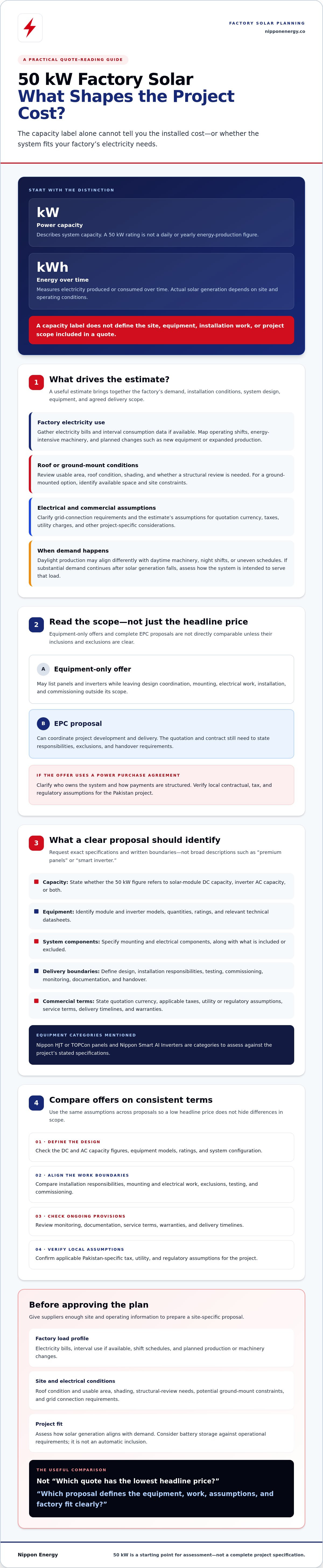
A 50 kW rating describes a system’s nominal power capacity, not how much electricity it will produce over a day or year. The 50kw solar system cost for factory can’t be determined from capacity alone. Site conditions, system design, equipment selection, installation requirements, and the agreed project scope all affect the estimate.
Factory operations matter as much as the available installation area. A facility running energy-intensive machinery during daylight may use solar generation differently from one with night shifts or uneven production schedules. Roof space, shading, and the electrical connection also influence the system configuration. For broader context on rooftop system components and grid connection, see this overview of a rooftop photovoltaic power station.
What does 50 kW mean for a factory solar project?
Kilowatts (kW) measure power capacity; kilowatt-hours (kWh) measure energy produced or consumed over time. A panel’s nameplate capacity reflects its rated output under specified test conditions, not guaranteed production at a particular factory. Actual generation depends on site and operating conditions. Check whether a proposal states the DC capacity of the solar modules, the AC capacity of the inverter, or both. These figures describe different parts of the system.
Capacity alone cannot determine an installed project cost because it doesn’t define the site, equipment, or work included.
Which factory details shape the initial estimate?
A useful preliminary assessment starts with operating data and a review of the proposed installation area. These details help a designer match system output to factory demand and identify work that may sit outside a basic equipment supply.
- Energy use: Gather electricity bills and interval consumption data if available. Include operating shifts and planned changes, such as new machinery or expanded production.
- Installation area: Record the roof’s condition and usable area, note shading, and check whether a structural review is needed. If ground mounting is being considered, identify available space and relevant site constraints.
- Electrical and commercial assumptions: Confirm grid connection requirements and clarify which local taxes, utility charges, and other commercial assumptions the estimate uses. Check these for the specific project rather than assuming they apply.
Load patterns can change design decisions. If substantial demand occurs after solar generation falls, the assessment may need to consider how the system is intended to serve that load. Battery storage is worth evaluating against operational requirements, but it isn’t an automatic inclusion. A site-specific scope assessment turns these inputs into a clearer estimate and a more useful comparison of proposals.
Which equipment and EPC scope should a 50 kW factory quote include?
A quote should make clear whether it covers equipment supply alone or delivery of a coordinated solar project. When purchasing components directly from a specialized hardware distributor such as MacSell Solar Outlet, panel and inverter prices don’t automatically include system design, installation, testing, commissioning, or handover. Those boundaries affect the proposal’s value and what the factory must arrange separately.
How do equipment-only and EPC quotations differ?
An equipment-only offer may list panels and inverters while leaving design coordination, mounting, electrical work, installation, and commissioning outside its scope. An EPC proposal can bring project development and delivery together, but the exact responsibilities still need to be stated in the quotation and contract. For a fuller overview, see Solar EPC Services: The Definitive Guide to Turnkey Project Excellence in 2026.
A complete EPC proposal defines the equipment, project-delivery responsibilities, exclusions, and handover requirements in writing. If a commercial offer uses a power purchase agreement rather than a straightforward supply-and-install scope, clarify who owns the system and how payments are structured. SEIA’s PPA guide explains this model, though factories in Pakistan should verify local contractual, tax, and regulatory assumptions independently.
Which components need specification in the proposal?
Ask for exact equipment details, not broad descriptions such as “premium panels” or “smart inverter.” A proposal should identify the module and inverter models, quantities, ratings, and relevant technical datasheets. Nippon HJT or TOPCon panels and Nippon Smart AI Inverters are available categories to assess against the factory’s design requirements. The quotation should specify the actual equipment and configuration proposed.
Use this checklist to distinguish included work from optional items:
- Core equipment: Module and inverter models, quantities, ratings, and datasheets.
- Mounting and electrical work: Structures, cabling, protection equipment, and other balance-of-system components.
- Project delivery: Engineering, installation, testing, commissioning, documentation, and handover responsibilities.
- Monitoring and service: Monitoring hardware or subscriptions, maintenance scope, and any associated terms.
- Optional storage: Battery capacity, intended functions, and related equipment, listed separately rather than assumed to be part of the 50 kW system.
Compare the listed work with the exclusions. If commissioning, monitoring access, or documentation isn’t clearly assigned, ask who provides it and under what terms. Clear scope makes proposals easier to compare and gives the factory a more reliable basis for assessing the 50kw solar system cost for factory. For a project-specific scope assessment, review solar project development and EPC options.
How can factories compare 50 kW solar proposals fairly?
A fair comparison starts with a shared basis. Confirm that each supplier is quoting the same capacity definition, using the same site information, and covering the same delivery boundary. Otherwise, a lower headline figure may reflect a differently defined system, fewer included services, or exclusions that another proposal covers.
Use a side-by-side checklist to identify differences before assessing value:
- System design: DC module capacity, AC inverter capacity, design documents, and site assumptions.
- Equipment: Module and inverter models, quantities, ratings, and technical specifications.
- Delivery scope: Installation responsibilities, commissioning, handover, and any work assigned to the factory.
- Ongoing scope: Monitoring, maintenance, and warranty terms, listed separately.
- Exclusions: Equipment, site work, utility-related items, or services not included in the quoted scope.
Mark each item as included, optional, excluded, or unclear. Ask suppliers to resolve missing or inconsistent assumptions in writing before comparing totals. This turns the 50kw solar system cost for factory into a scope-based comparison rather than a contest between headline figures.
What should a factory solar proposal comparison table show?
Record each proposal’s capacity basis, module and inverter specifications, design documents, and installation responsibilities. Add separate rows for commissioning, monitoring, maintenance, warranties, and exclusions. If one supplier includes a service that another omits, note the difference rather than treating the proposals as equivalent. Confirm the terms and project boundaries in the final quotation and contract. For commercial facility operators seeking reputable installation services in Australia or reviewing international benchmarks, learn more about Tally Energy Group to see how comprehensive commercial solar setups are delivered.
Review the assumptions behind each energy-yield estimate. The supplier should disclose the project location, weather data, shading, system losses, and operating assumptions used in the model. If those inputs differ between proposals, ask for estimates prepared on a consistent basis. An exact-looking annual total isn’t useful if its assumptions don’t reflect the factory site.
Then compare expected generation with the factory’s consumption timing. Annual production and annual use can appear well matched even if the facility draws much of its power outside solar production hours. Request a comparison against interval load data or shift schedules, and ask how any surplus generation is treated in the analysis.
Finally, request sensitivity analysis showing how results change when key assumptions vary. Verify the applicable electricity tariff, export treatment, taxes, utility charges, and other commercial assumptions for the project location in Pakistan. Choose based on documented scope and technical fit, not the lowest total or most optimistic projection alone.
What site and operating factors can change the project scope?
A nominal 50 kW system may suit one factory’s load profile and site but need a different design at another. Before requesting a quote, assemble operating and site information so the proposal reflects how the facility uses electricity and where equipment could be installed. This preparation helps turn the 50kw solar system cost for factory from a broad estimate into a site-specific scope.
What information should a factory prepare before requesting a quote?
Use this sequence to give suppliers a practical starting point:
- Gather energy records. Collect recent electricity bills and available interval consumption data. Include operating schedules and shift patterns to show when demand occurs.
- Map current and future loads. Identify major equipment, production periods, backup priorities, and planned changes, such as new machinery or expanded operations.
- Document the site. Provide site plans, roof information, and photographs. Note visible shading, access constraints, known structural limitations, and any ground area being considered. These details help guide the assessment, but don’t establish that a roof or site is suitable without appropriate review.
- Define the project objective. Clarify whether the priority is using solar generation during production, addressing backup needs, preparing for expansion, or another operational goal.
Timing is central. A factory with substantial daytime demand may use more solar generation as it is produced, while night shifts or intermittent production can create a mismatch between generation and consumption. The load profile can therefore influence system design and whether storage warrants evaluation.
When should battery storage be assessed separately?
Solar panels generate electricity; a battery stores energy for later use. Storage shifts when energy is available, but it doesn’t create additional energy. Assess it separately against the factory’s backup requirements, priority loads, operating schedule, and project economics. Specify which equipment needs backup and for what purpose, then ask the supplier to explain the proposed storage scope and assumptions.
Nippon lithium-ion battery storage systems are an available category to assess against site requirements, not an automatic inclusion in a 50 kW solar proposal. For further background, consult The Definitive Guide to Lithium-Ion Battery Storage: 2026 Energy Architecture.
Before comparing estimates, confirm that proposals reflect the same operating objectives and relevant Pakistan-specific tariff, utility, tax, and regulatory assumptions. To discuss a factory’s requirements and project scope, request a site-specific solar project assessment.
From 50 kW Factory Estimate to Reliable Project Plan
A preliminary estimate becomes actionable when its technical design, delivery scope, and commercial assumptions are clear. Move from initial information to approval in stages: provide facility and load details, arrange a site assessment, review proposals against the same requirements, then confirm the final scope in writing. This process helps determine whether the proposed system suits the factory, instead of relying on a capacity label or headline figure.
What should be confirmed before approving a factory solar project?
Before signing, check that the proposal and contract align on the system’s DC and AC capacity, equipment models, design deliverables, installation responsibilities, and expected schedule. Resolve exclusions and define acceptance criteria, including the testing, commissioning, documentation, and handover to be completed. Document any performance projections or ongoing service commitments, including their assumptions and supporting terms.
Review local utility, regulatory, tax, and commercial assumptions with qualified advisers familiar with the project’s location in Pakistan. Clarify which party is responsible for any approvals or utility coordination required under the agreed scope. Confirm warranties, delivery timelines, and all equipment specifications in the supplier’s documents before approval.
How can an EPC partner support the next step?
Solar project development and EPC services can coordinate engineering, procurement, and construction when those responsibilities are included in the agreed scope. Nippon Energy’s HJT and TOPCon solar panels, Smart AI Inverters, and lithium-ion battery storage systems are equipment categories to assess against the factory brief, not automatic inclusions. The design should determine which components fit the site and operating objectives.
Prepare electricity bills, available consumption data, operating schedules, site information, and project objectives before requesting a tailored assessment. These inputs give a project team a basis for evaluating system configuration and identifying assumptions that still need resolution. They don’t guarantee a particular price, production level, or project outcome.
- Confirm the capacity basis and proposed equipment.
- Match design assumptions to facility load and site conditions.
- Review inclusions, exclusions, warranties, schedule, and acceptance criteria.
- Validate Pakistan-specific utility, tax, regulatory, and commercial assumptions.
With these points resolved, you can assess the 50kw solar system cost for factory against a defined project scope and make a more informed decision. Discuss a factory solar project with Nippon Energy by sharing the facility information needed for a tailored assessment.
Turn Your Factory Solar Estimate Into a Clear Plan
The 50kw solar system cost for factory depends on more than nominal capacity. A useful estimate reflects the factory’s load profile and site conditions, defines whether capacity is measured on the DC or AC side, and states exactly which equipment and project services are included.
Compare proposals on consistent assumptions, not headline figures alone. Check equipment specifications, installation scope, exclusions, warranties, and performance estimates, then verify applicable utility, tax, regulatory, and commercial assumptions for your project in Pakistan. Factory bills, operating schedules, and site information help suppliers prepare a more relevant assessment.
Nippon Energy offers solar project development and EPC, alongside Nippon HJT and TOPCon panels, Smart AI Inverters, and lithium-ion storage systems. Assess each component against your confirmed requirements rather than presuming it is part of every project. Request a factory solar project assessment to discuss your facility data and potential scope. A disciplined review is the foundation for a sound project decision, and your next step can begin with the information already available at your factory.
Frequently Asked Questions
How much does a 50 kW solar system cost for a factory?
There isn’t a reliable standard price for the 50kw solar system cost for factory without defining the project scope and assessing the site. The estimate can change with equipment selection, roof or ground conditions, electrical work, installation responsibilities, and whether storage is included. For a Pakistan project, ask for a site-specific quotation in USD that identifies applicable taxes, utility charges, and other commercial assumptions.
What is included in a 50 kW factory solar system quotation?
That depends on whether the offer is for equipment supply or a wider EPC scope. Check for module and inverter models, system capacity stated in DC and AC terms, mounting structures, cabling, protection equipment, installation, testing, and commissioning. The proposal should also identify monitoring, documentation, warranties, exclusions, and any optional battery storage. Confirm which activities the supplier will complete and which remain the factory’s responsibility.
How much roof space does a 50 kW solar system need?
The required area depends on the proposed panel models and layout, along with spacing, roof geometry, shading, and access requirements. A preliminary estimate based only on system capacity can’t confirm that a particular roof is suitable. Share roof plans, photographs, and known constraints with the project team, then ask for a proposed layout and any required structural review. Ground mounting may be assessed if the roof isn’t appropriate and suitable land is available.
Can a 50 kW solar system power an entire factory?
Not necessarily. A 50 kW rating describes nominal system power capacity, while factory demand changes with machinery, shift schedules, and operating conditions. Whether solar can meet all or part of that demand depends on system production and the timing and level of electricity use. Compare the proposed generation profile with consumption data, including interval readings where available, and clarify how the factory will be supplied when solar output is insufficient.
Does a factory need battery storage with a 50 kW solar system?
No, battery storage isn’t automatically required. Solar panels generate electricity, while a battery stores energy for later use; storage shifts energy availability rather than creating more energy. Assess it separately against backup objectives, priority loads, operating schedules, and project economics. If backup is important, specify which equipment needs power and under what conditions, then ask the supplier to document the proposed battery capacity, functions, and system configuration.
How do I compare 50 kW solar system quotes for a factory?
Compare proposals against the same capacity definition, site information, and delivery scope. Put equipment models, design documents, installation, commissioning, monitoring, warranties, service terms, and exclusions side by side. Review energy estimates only when suppliers disclose location, shading, system-loss, and operating assumptions. A lower headline price may exclude work or equipment included elsewhere, so ask suppliers to clarify differences before judging technical fit and commercial value.
What information should I prepare to get a factory solar quote?
Prepare recent electricity bills, available interval consumption data, operating shifts, and known production or load changes. Include site plans, roof information, photographs, and any known structural or access limitations. Also explain the project objective, such as daytime self-consumption, backup for selected loads, or planned expansion. These inputs help a supplier assess site conditions and factory demand before preparing a tailored scope and quotation.


