

Could the lowest 10kW solar quote be the wrong system for your home? The 10kw solar system price in pakistan 2026 for home depends on more than panel capacity. An on-grid setup, a hybrid system with battery storage, and an off-grid design use different equipment and serve different needs. Online rates can look comparable even when they cover very different scopes.
It’s reasonable to expect a clear price and a complete list of what’s included. Panels, inverter, battery capacity, installation, electrical protections, and commissioning can all affect the final proposal, and some items may be excluded from a headline rate. Your daytime electricity use and backup requirements matter as much as the system’s rated capacity.
This guide explains the main factors behind a 10kW home solar quote in Pakistan, what to check in the equipment and project scope, and how to compare proposals on consistent terms. It also explains how panel, inverter, and storage choices affect system design. Nippon Energy offers HJT and TOPCon panels, lithium-ion battery storage, Smart AI Inverters, and EPC project delivery options. Confirm specifications and inclusions for each proposal.
Key Takeaways
- The 10kw solar system price in pakistan 2026 for home depends on the system configuration and quoted scope, so compare itemized proposals rather than headline rates.
- Check whether each proposal specifies panels, inverter, mounting, cabling, electrical protection, installation, and commissioning. Confirm separately whether battery storage is included.
- Choose between on-grid, hybrid, and off-grid designs based on grid access and backup priorities. Battery capacity and the loads it supports affect backup duration.
- Use recent electricity bills, daytime consumption, essential loads, and outage priorities to assess whether 10kW suits your household.
- Request a site-specific proposal using your location, bills, roof details, backup needs, and preferred system type. Then verify equipment availability and compatibility.
10KW Solar System Price in Pakistan 2026: What a Homeowner Is Actually Comparing
There is no reliable single price for a 10kW home solar system without confirming its architecture, equipment, installation scope, and current local quote. An on-grid design, a hybrid system with batteries, and an off-grid system serve different needs, so their prices are not directly comparable. To assess the 10kw solar system price in pakistan 2026 for home, first establish what the proposal includes and how the system is designed to operate at your property.
What does 10kW mean for a home solar system?
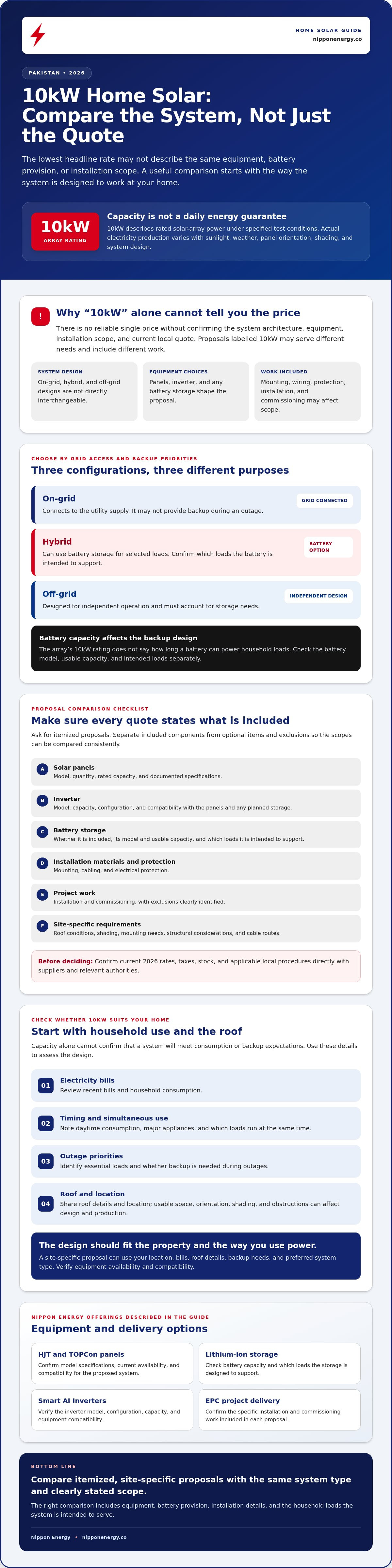
10kW describes the solar array’s rated power capacity under specified test conditions. It does not guarantee a fixed amount of electricity each day. Actual energy production, measured in kilowatt-hours, varies with sunlight, weather, panel orientation, shading, and system design. A roof with limited usable space or obstructions may perform differently from an unshaded roof, even when both proposals state the same capacity.
Suitability also depends on how your household uses electricity. Review when major appliances run, which loads operate at the same time, and whether you need power during outages. Capacity alone cannot confirm that a system will meet your household’s consumption or backup expectations. For broader context on the country’s solar sector, see Solar power in Pakistan.
Why do Pakistan solar quotes differ?
System architecture affects both equipment and purpose. An on-grid system connects to the utility supply but may not provide backup during an outage. A hybrid configuration can use battery storage for selected loads, while an off-grid design must account for independent operation and storage needs. These options are not interchangeable, and battery capacity affects the design and proposal.
Quotes can also vary by city, current equipment availability, roof conditions, and the work included. A site survey may identify shading, mounting requirements, structural considerations, and cable routes that affect the design. Compare panel and inverter models, battery inclusion and capacity, mounting, cabling, electrical protection, installation, and commissioning. Confirm current 2026 rates, taxes, stock, and any applicable local procedures directly with suppliers and relevant authorities before deciding.
A headline system rate is useful only when the equipment, architecture, and included work are clearly defined. Ask each supplier to itemize the proposal so you can compare equivalent scopes instead of treating every system labeled 10kW as the same package.
What Should a 10kW Home Solar Quote in Pakistan Include?
A useful quote identifies the equipment and work behind the stated system capacity. Ask for an itemized proposal that separates included components from optional items and exclusions. That makes it easier to compare scope, not just the 10kW label. Pakistan’s market context is covered in the International Trade Administration’s Pakistan renewable energy overview, but your home’s quote still needs to reflect its site and equipment choices.
Panels, inverter, and system architecture
Panel technology and specifications affect the array design. Compare the quoted model, quantity, rated capacity, and documented specifications rather than assuming one technology is best for every roof. For background on one option, see this guide to TOPCon solar panels. Confirm current availability and compatibility in Pakistan before selecting a specific model.
The inverter should suit the intended operating mode and grid connection. Ask the installer to state its model, capacity, configuration, and compatibility with the proposed panels and any planned storage. A proposal for a grid-connected design is not equivalent to one designed for battery backup.
Battery storage, protection, and installation scope
Battery storage is a configuration choice, not an automatic part of every 10kW system. If storage is included, check the battery model and usable capacity, then identify which household loads it is intended to support. The array’s 10kW rating does not specify how long a battery can power those loads. For more context, consult this lithium-ion battery storage guide.
Use this checklist to request comparable details from each installer:
- Panels: model, quantity, rated capacity, and documented specifications.
- Inverter and battery: model and configuration. List battery capacity and confirm whether storage is included or optional.
- Mounting and cabling: specify the mounting approach, cable scope, and any stated exclusions.
- Electrical protection: itemize isolators, surge protection, and other included protection components.
- Project work: state whether installation and commissioning are included, and describe any work excluded from the quote.
A configuration-specific proposal connects equipment selection to a defined project scope. Nippon Energy lists HJT and TOPCon panels, lithium-ion storage, Smart AI Inverters, and EPC among its offerings. Verify availability, compatibility, and proposal inclusions for your project. You can review Nippon Energy’s solar offerings as you prepare questions about equipment and scope.
On-Grid, Hybrid, or Battery-Backed: Which 10kW Configuration Fits?
A 10kW array can be paired with different system architectures, each serving a different purpose. The lowest headline quote may exclude batteries or describe an on-grid design when you need outage backup. Compare the configuration and equipment before judging the 10kw solar system price in pakistan 2026 for home.
| Configuration | Function | Backup capability | Quote implications |
|---|---|---|---|
| Grid-connected | Works with the utility grid to supply the home from solar and, as configured, draw from or export to the grid. | Usually no backup during an outage unless the design includes separate backup capability. | Check inverter type, grid connection scope, and whether storage or backup equipment is excluded. |
| Hybrid | Coordinates solar, grid supply, and battery storage according to the system design. | Can support designated loads during an outage if the equipment and battery configuration provide that function. | Confirm battery capacity, supported loads, inverter compatibility, and which backup circuits are included. |
| Off-grid | Designed to operate without relying on a utility grid connection. | Depends on the array, storage, and load design, particularly when solar generation is limited. | Storage and system sizing must reflect household demand and expected periods without adequate solar input. |
How do grid-connected and hybrid systems differ?
In a grid-connected system, the inverter synchronizes with the utility supply. Its behavior during an outage depends on its design and installed equipment, so don’t assume solar panels alone will keep the home powered. A hybrid inverter can manage battery charging and selected backup loads, but its operation depends on the system configuration. Confirm current export rules and utility requirements for your location before including grid exports in a financial assessment.
When does battery storage belong in the quote?
Start by identifying which appliances you need during an outage, how often outages affect your home, and how long those loads should run. Then ask the installer to distinguish the battery’s rated capacity from its usable energy and from the solar array’s power rating. Backup duration depends on usable stored energy, selected loads, and operating conditions, not on a 10kW array rating alone. NipponHev may be relevant to an integrated-system discussion. Review the NipponHev integrated solar system guide for its described scope, and confirm current availability and compatibility.
Don’t treat estimated savings or payback as guaranteed. Ask which assumptions the estimate uses, including your recent consumption, daytime self-use, current tariff, and any compensation for exported electricity. Compare proposals using the same assumptions and confirm current utility procedures. This gives you a sounder basis for choosing between a lower-cost grid-connected design and a battery-backed configuration tailored to your outage priorities.
How to Check Whether a 10kW Solar System Fits Your Pakistan Home
System size should follow your household’s load profile and roof conditions, not a standard package label. Before comparing the 10kw solar system price in pakistan 2026 for home, gather the information an installer needs to design and explain a site-specific proposal.
Use consumption and backup needs to test system size
Review recent electricity bills and note monthly units, then record when your household uses power. Energy consumption over time differs from peak demand: several appliances running together may require more inverter capacity than the daily total alone suggests. List essential outage loads separately, such as lighting, refrigeration, or selected fans, and identify which appliances can remain grid-dependent.
Share your outage priorities and the duration you want backup to support. This helps the installer assess whether the proposed array, inverter, and any storage align with your needs. A 10kW system cannot by itself guarantee that bills will disappear or that every load will remain powered during an outage.
Ask for a roof survey and a like-for-like proposal
Request a roof survey that records usable area, panel orientation, shading, structural considerations, and cable routes. These details affect the practical array layout and installation scope. Ask each supplier to use the same system architecture and backup requirement when preparing a comparison. That way, you can assess proposals against a consistent design brief.
- Match the quoted panel and inverter models, quantities, and documented specifications.
- Confirm whether battery storage is included, and specify its capacity and intended backup loads.
- Compare mounting, cabling, electrical protection, installation, commissioning, and written exclusions.
- Ask what generation assumptions inform the estimate and whether it assumes electricity exports.
For grid-connected proposals, verify current export and interconnection procedures with NEPRA and the relevant DISCO for your location. Requirements and utility processes can change, so don’t rely on an old quote or a general estimate to determine what applies to your property.
Compare project scope, not just the headline figure
When you want the equipment and project-delivery scope considered together, review exactly what the proposal includes. Nippon Energy lists solar project development and EPC among its offerings. Its solar EPC services guide provides further context on project delivery. Confirm the actual scope, product availability, and compatibility for your home.
Prepare your recent bills, roof information, load priorities, and preferred architecture before requesting a tailored discussion. Discuss a site-specific solar proposal with Nippon Energy.
Request a Site-Specific 10kW Solar Proposal from Nippon Energy
A useful proposal starts with your home’s actual conditions, not an assumed standard package. Nippon Energy offers HJT and TOPCon solar panels, lithium-ion battery storage systems, Smart AI Inverters, and solar project development and EPC. These may be relevant options for a residential design, subject to current availability, specifications, and compatibility in Pakistan. A configuration-specific proposal can show how the selected equipment and project scope relate to your household’s needs.
What information should you prepare before requesting a quote?
Provide your installation city and recent electricity bills so the proposed design can be assessed against your consumption. Add a list of essential appliances and clarify which ones you want to operate during an outage. Describe the backup duration you have in mind instead of assuming the 10kW array rating determines how long loads will run.
Include available roof area, known shading, and details about existing electrical equipment that may help explain the site. State your preferred architecture, such as grid-connected, hybrid with battery storage, or off-grid. If you’re considering grid export, mention that goal so the proposal can account for utility procedures that need to be confirmed for your location.
How to review a Nippon Energy proposal
Check the written proposal against the equipment documentation and your agreed design brief. Confirm the panel and inverter models, quantities, specifications, and compatibility. If storage is proposed, check the battery model, capacity, and intended backup loads. Don’t infer package contents from product availability alone.
Ask for a clear description of the included scope and exclusions. The document should state who is responsible for installation and commissioning, and clarify whether electrical protections and monitoring are included. Request written details about after-sales responsibilities rather than assuming they are part of the quoted work. If EPC project delivery is proposed, confirm exactly which project activities that scope covers.
For a fair comparison, give alternative suppliers the same bills, roof information, system architecture, backup requirement, and assumptions about generation or export. Then compare the resulting equipment and responsibilities side by side. This helps you assess the 10kw solar system price in pakistan 2026 for home in the context of what the proposal actually delivers, without treating any estimate as a guaranteed outcome.
Prepare your site and usage details, then request a site-specific solar proposal from Nippon Energy.
Build a Solar Proposal Around Your Home’s Needs
The right 10kW design is defined by more than its capacity. Your household’s electricity use, roof conditions, grid connection, and backup priorities determine which configuration makes sense. To assess the 10kw solar system price in pakistan 2026 for home, compare itemized proposals with matching equipment, architecture, and project scope. Confirm current specifications and local requirements before deciding.
Nippon Energy offers HJT and TOPCon solar panels, lithium-ion storage, Smart AI Inverters, and solar EPC services as potential components of a home system, subject to confirmed availability and compatibility. Share your recent bills, location, roof details, and backup needs to help clarify the design and what the proposal includes.
Request a site-specific solar proposal from Nippon Energy to clarify the system your home needs and compare its scope with other proposals.
Frequently Asked Questions
How much does a 10kW solar system cost in Pakistan in 2026?
There isn’t one reliable national price for a 10kW home system without a defined design and scope. The 10kw solar system price in pakistan 2026 for home depends on location, panels, inverter type, battery inclusion, roof and electrical work, installation scope, and current stock. Request an itemized proposal based on a site survey, then compare equivalent configurations. Verify current figures directly with the supplier, including the quote date and exactly what’s included. For those interested in seeing how solar installations can be structured without initial capital outlay, check out MEE Energy to explore zero-upfront-cost models.
What is included in a 10kW solar system for a home?
The phrase can describe different packages, so check the written inclusions rather than assuming a standard set of equipment. Ask whether the quote covers panels, inverter, mounting structure, cabling, electrical protections, installation, commissioning, and monitoring. Treat lithium-ion storage as a separate configuration unless the proposal explicitly includes it. Confirm each component’s model and quantity, and ask the supplier to document exclusions and responsibilities so you can compare proposals on matching terms.
Is a 10kW solar system enough to power a house in Pakistan?
It depends on your household’s energy use, peak simultaneous loads, daytime consumption, roof conditions, and whether you expect backup during outages. A 10kW rating describes system capacity, not guaranteed daily production or a specific bill outcome. Review recent electricity bills and list essential appliances, then discuss those details with a qualified designer. Ask for production assumptions based on your location, roof orientation, shading, and proposed system design before deciding whether the size fits.
Can a 10kW solar system run during a power outage?
It depends on the system architecture and installed equipment. A grid-connected system may not supply power during an outage unless it has suitable backup capability. A hybrid design may support selected circuits when paired with compatible storage and controls. Ask the installer to identify which loads will operate, the expected duration under stated assumptions, and the equipment included. Confirm how the system behaves during an outage rather than inferring backup capability from the array’s 10kW rating.
Does a 10kW solar system in Pakistan need a battery?
No, a battery isn’t necessary for every home. Storage may suit households that prioritize backup during outages, while a grid-connected configuration may fit a different consumption and export profile. Consider essential loads, outage expectations, architecture, and current utility rules. Compare proposals that state solar-array capacity separately from battery capacity and usable energy, then ask how the proposed storage relates to your backup loads and desired duration.
How do I compare quotes for a 10kW home solar system?
Can I sell excess solar electricity back to the grid in Pakistan?
Export eligibility, compensation, interconnection, and application procedures depend on current national rules and the relevant distribution company. Older online summaries may not reflect the process that applies to your home. Ask the installer to verify the latest NEPRA requirements and your local DISCO’s procedures. Request written confirmation of any export assumptions used in the design or financial estimate, and confirm applicable requirements for your location before relying on potential grid exports.


