

What if the main risk in an off-grid solar project isn’t too few panels, but a system that can’t keep critical equipment running when conditions change? For off-grid solar for remote industrial sites, reliable power depends on matching generation, storage, controls, and backup to the site’s actual operating demands.
That challenge is familiar to teams planning mines, processing facilities, and other remote operations in Pakistan. Demand can shift by hour or season, while difficult access can make equipment failures and routine maintenance harder to manage. Sizing from a single peak-load figure can miss the operating patterns that determine whether essential systems stay online.
This guide explains how to define critical and flexible loads, estimate generation needs, and size battery storage around autonomy and operating requirements. It also covers how inverters, controls, and backup power work together, and what to assess when choosing project partners and planning maintenance. The goal is a resilient system designed around operational continuity, not panel capacity alone.
Key Takeaways
- Off-grid solar for remote industrial sites should be planned around operational continuity, site conditions, and the consequences of losing power.
- Separate critical loads from flexible demand to give system designers a clear basis for sizing generation and storage.
- Compare solar-plus-storage, backup generation, and hybrid configurations against operating requirements rather than assuming one approach fits every site.
- Use a structured project workflow, from load audits and site surveys to design validation and commissioning, to reduce sizing gaps.
- Build monitoring, maintenance access, spare-parts planning, and operator responsibilities into the system plan from the start.
Off-grid solar for remote industrial sites starts with operational requirements
An off-grid system operates independently of the utility grid, so its design must account for how a site uses power and what happens when supply is limited. The Stand-alone power system (SAPS) overview describes the basic architecture of independent generation, storage, and regulation. At an industrial site, those components must also be matched to process demand, continuity targets, and local operating conditions.
Definition: An off-grid system is an independent power architecture sized around a site’s loads, required autonomy, and environmental and logistical conditions.
That distinction matters at scale. A standalone sensor or communications unit may have a small, predictable demand. An industrial facility can combine large loads, changing shifts, motor start-ups, safety systems, and processes with different consequences if power is interrupted. Panel nameplate capacity alone cannot show whether the system can serve those loads through changing weather or outside peak sunlight hours. The design brief needs demand over time, not just a total in kilowatts.
Which industrial loads must remain powered?
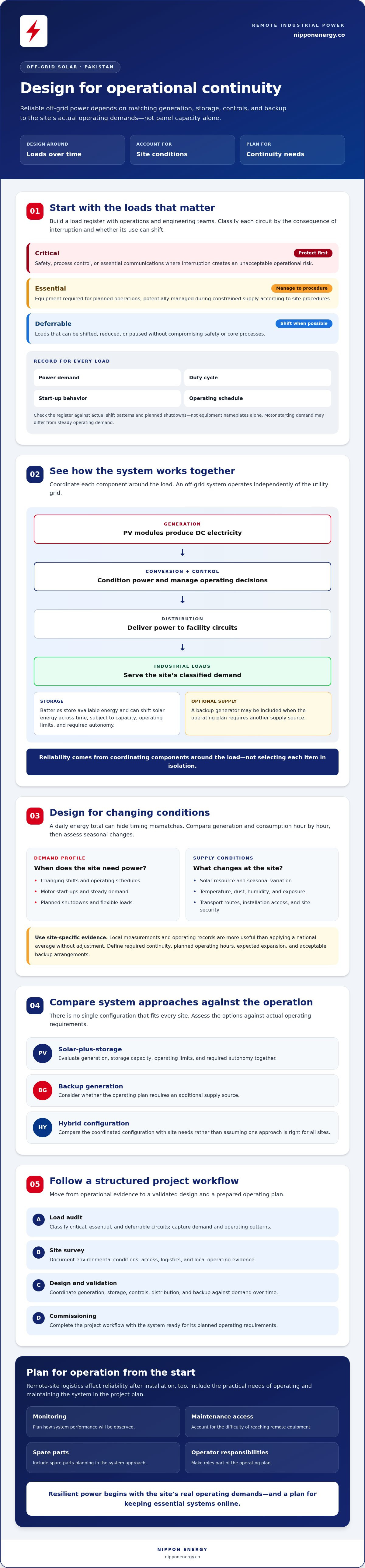
Build a load register with operations and engineering teams, then classify each circuit by the consequence of interruption and how much its use can be shifted:
- Critical: Loads needed for safety, process control, or essential communications where interruption creates an unacceptable operational risk.
- Essential: Equipment required for planned operations but potentially managed during constrained supply, according to site procedures.
- Deferrable: Loads that can be shifted, reduced, or paused without compromising safety or core processes.
For every load, record power demand, duty cycle, start-up behavior, and operating schedule. Include monitoring and communications equipment the site depends on. A motor’s starting demand, for example, may differ materially from its steady operating demand, so engineers need both values when assessing equipment and controls. Check the register with operators against actual shift patterns and planned shutdowns, rather than relying only on equipment nameplates.
What remote-site conditions change the design?
Use site-specific evidence rather than broad assumptions. Document solar resource and seasonal variation, temperature, dust, humidity, and exposure, then assess how these conditions may affect generation, equipment selection, and maintenance intervals. Conditions can vary considerably between sites in Pakistan, so local measurements and operating records are more useful than applying a national average without adjustment.
Logistics are design inputs too. Review transport routes, installation access, site security, and the availability of local technical support. Then define required continuity, planned operating hours, expected expansion, and acceptable backup arrangements. These decisions establish the operating envelope engineers must use to size and coordinate the system.
How off-grid solar components work together at an industrial site
In off-grid solar for remote industrial sites, reliability comes from coordinating components around the load, not selecting each item in isolation. PV modules produce DC electricity; conversion equipment conditions power for the system and loads; batteries store available energy; controls manage operating decisions; and distribution equipment delivers power to facility circuits. For heavy industrial facilities and mining operations, robust medium-voltage distribution transformers, such as those cataloged on africaswitchgear.co.za, are essential for safely stepping and routing power to demanding circuits. A backup generator is optional, but may be included when the operating plan requires another supply source.
Illustrative energy flow:
PV modules → conversion equipment and controls → facility distribution → industrial loads
↕
Battery storage
Optional: backup generator → system controls or distribution, according to the engineered configuration
How do solar generation and battery storage balance demand?
Compare generation and consumption hour by hour, then assess seasonal changes. A daily energy total can conceal a mismatch: demand may peak before solar production rises or continue after it falls. Storage shifts some available solar energy across time, subject to its capacity, operating limits, and the site’s required autonomy. For additional context, see this lithium-ion battery storage guide.
Lithium-ion storage is not a single specification. Check chemistry, usable capacity, charge and discharge limits, temperature range, and integration requirements against current product documentation and project conditions. Define the battery’s role alongside load priorities and any planned backup, rather than treating it as a standalone capacity decision.
What roles do inverters and energy controls perform?
Inverters convert electrical power into the form required by system components and loads. Controls can coordinate PV output, battery charging and discharge, supply to loads, monitoring, and backup operation where configured. Load-management functions may help prioritize or limit selected circuits, but their availability and behavior depend on equipment capability and project engineering. Confirm operating modes, communications, alarm functions, and generator interaction in the applicable documentation. The smart AI solar inverter guide covers inverter fundamentals.
Component coordination is central to enhancing system reliability, but a general reference on solar and storage cannot replace site-specific design validation. Confirm the operating sequence for low solar output, battery limits, equipment faults, and backup transitions before commissioning. Nippon Energy offers solar project development and EPC, along with solar equipment categories. Assess suitability against project requirements and current specifications, and review solar project development and EPC when comparing integrated project approaches.
Can off-grid solar keep a remote industrial site reliable?
Yes, if the system is engineered and operated against defined continuity requirements. Reliability depends on the site’s demand profile, solar generation, storage capacity and limits, control strategy, any backup source, and maintenance arrangements. A design that meets average daily energy use may still fall short during consecutive low-generation periods or an equipment outage.
Autonomy targets must be based on site data and agreed operating criteria, not a generic number of backup hours. Teams should define which loads must remain powered, how long they need support, and what operating conditions the system must withstand.
| Architecture | Strengths | Design dependencies | Questions to verify |
|---|---|---|---|
| Solar plus storage | Stores available solar energy for use when generation falls or demand continues beyond sunlight hours. | Seasonal solar resource, consecutive low-generation periods, load profile, battery operating limits, and autonomy target. | Which loads can storage support, for how long, and what happens when the battery reaches its operating limit? |
| Solar with backup generation | Can provide another supply source when solar output is low or equipment is unavailable. | Generator capacity, fuel access, start and transfer sequence, maintenance, and required operator procedures. | Which conditions trigger backup, which loads are served, and how is fuel availability managed at the site? |
| Hybrid solar, storage, and backup | Combines energy shifting with a separate backup source, subject to the control design. | Integration between inverter, battery, generator, controls, and distribution; defined priorities and operating modes. | Have transitions and failure responses been documented and tested during commissioning? |
What happens during low solar generation or equipment downtime?
Model seasonal resource variation and multiple consecutive low-generation days against hourly site demand. Then test scenarios such as reduced PV output, battery limits, inverter downtime, or a communications fault. Depending on the design, controls may prioritize critical circuits or call on an included backup source. Neither response should be assumed: confirm operating behavior in equipment documentation and project-specific settings.
For off-grid solar for remote industrial sites, avoid claims of uninterrupted operation unless the assumptions are validated and commissioning results document the system’s response. A defined test plan should cover agreed operating modes and important failure scenarios.
How should resilience and redundancy be evaluated?
Map single points of failure across generation, conversion, storage, controls, and distribution. Consider whether redundancy is justified by the operational consequence of losing a component, the time required to reach the site, and the practical ability to maintain or replace equipment. Additional equipment can support resilience, but it also adds components that need inspection and servicing.
Before commissioning, assign responsibility for alarms, remote visibility, response decisions, and escalation. Confirm which performance trends operators can see with the configured monitoring system, who reviews them, and what action follows an alert. Clear procedures turn system visibility into an operational response.
How to scope and size an off-grid industrial solar project
A disciplined project sequence turns operating requirements into an engineered system brief. For off-grid solar for remote industrial sites, capacity calculations are only as dependable as the demand records, site data, autonomy criteria, and current equipment specifications behind them. In Pakistan, document conditions at the specific site rather than assuming regional averages reflect its seasonal resource, exposure, or access constraints.
What information should a project team prepare?
Assemble interval consumption data, load schedules, process requirements, and records for any existing power system. Add site coordinates, shading, available mounting area, environmental exposure, transport and installation access, and communications availability. Record continuity objectives, expansion scenarios, maintenance constraints, and who owns each operational decision. This information helps engineers test design assumptions against real site conditions before equipment is selected.
What should design, EPC, and commissioning cover?
Request documented assumptions, equipment compatibility, protection strategy, and operating limits. Confirm installation scope, site safety responsibilities, procurement and delivery constraints, test procedures, monitoring configuration, operator training, and as-built documentation. A useful overview of delivery considerations is this solar EPC services guide.
Use this workflow to move from project data to a validated system:
- Audit demand: Gather interval consumption, operating schedules, start-up demands, process requirements, and existing power-system information.
- Survey the site: Verify coordinates, shading, mounting locations, environmental exposure, access routes, communications, and installation constraints.
- Set operating criteria: Agree on continuity objectives, autonomy requirements, backup arrangements, and which loads may be limited during constrained supply.
- Model and size: Compare demand profiles with seasonal generation estimates, storage needs, equipment limits, and planned future loads. Validate calculations against current module, inverter, and battery specifications.
- Review and procure: Check design assumptions, equipment compatibility, protection, delivery access, installation scope, and responsibilities before procurement proceeds.
- Test and hand over: Follow documented commissioning procedures, verify operating modes and monitoring, train operators, and provide as-built records and maintenance responsibilities.
Design validation should show how the system is expected to operate under agreed conditions, including constraints and contingencies. Commissioning then checks that installed equipment and controls perform according to the approved design. It does not replace sound inputs or clear acceptance criteria. To assess an integrated delivery approach, review Nippon Energy’s solar project development and EPC offering and confirm project scope and equipment suitability with the project team.
Operate and maintain remote industrial solar for long-term performance
For remote industrial solar, long-term performance depends on more than equipment selection. Monitoring access, maintenance routes, spare-parts availability, and operator responsibilities should be established during design. In Pakistan, site conditions and travel constraints vary, so maintenance procedures need to reflect the actual environment and access plan rather than a generic schedule.
What should remote monitoring and maintenance include?
Define which system data operators can access, which alarms the system can generate, who reviews them, and who is responsible for escalation. Subject to monitoring capabilities and configuration, useful indicators may include solar production, battery state and operating status, inverter output, system faults, and changes in performance over time. For critical site infrastructure like pumps and HVAC units, dedicated alert systems such as inTouch R&B provide remote monitoring to ensure facility conditions remain stable. Confirm communications dependencies and the response plan for connectivity loss. Remote visibility depends on the system configuration and available communications.
Set inspection and maintenance tasks using equipment guidance, environmental exposure, and site access constraints. Dust may make module cleaning relevant, while inspections can help identify visible damage, loose connections, or blocked ventilation. Establish safe work procedures and define who can perform corrective maintenance. Firmware management should follow equipment documentation and a controlled process, with version records and a plan to assess compatibility before updates. For lifecycle planning, consult this solar system maintenance guide.
How can an engineering partner reduce project uncertainty?
Evaluate whether a prospective partner can explain how generation, storage, inverter controls, commissioning, and ongoing maintenance fit the project scope. Ask for documented assumptions, equipment compatibility, responsibility boundaries, operating procedures, and performance-verification methods. For a remote site, clarify spare-parts planning, maintenance access, operator training, alarm ownership, and the scope of any continuing support before agreeing on delivery expectations.
Use this checklist when comparing project partners:
- Are design assumptions, load inputs, and equipment specifications documented and traceable?
- Are procurement, installation, testing, commissioning, and handover responsibilities clearly assigned?
- Does the maintenance plan account for site conditions, travel access, spare parts, and operator capability?
- Are monitoring functions, alarm escalation, and performance checks defined for the selected configuration?
- Are service scope, exclusions, and response responsibilities stated clearly?
Nippon Energy offers HJT and TOPCon solar panels, lithium-ion battery storage systems, smart inverters, solar project development and EPC, and solar system maintenance and monitoring. Confirm suitability and specifications against the site’s requirements. If you’re evaluating off-grid solar for remote industrial sites, include Nippon Energy’s solar project development and EPC offering in your partner assessment.
Build a More Resilient Power Plan for Your Remote Site
Reliable off-grid solar for remote industrial sites starts with operational requirements, not equipment capacity alone. Define which loads must remain powered, assess demand across operating periods, and set autonomy targets using site conditions and agreed continuity criteria. These inputs help engineers coordinate generation, storage, controls, and backup around the realities of a specific site in Pakistan.
Project planning should also account for access, monitoring, maintenance, and operator responsibilities from the outset. System performance depends on validated design assumptions, compatible equipment, documented commissioning, and a practical operating plan. Treat these as connected parts of one project, not tasks to resolve after installation.
Nippon Energy offers solar panels, lithium-ion battery storage, smart inverters, solar project development and EPC, and solar maintenance and monitoring. Equipment suitability and specifications should be confirmed against your project requirements. Discuss your remote-site solar project requirements with Nippon Energy to explore the next steps for a system designed around your operation.
Frequently Asked Questions
What is off-grid solar for a remote industrial site?
Off-grid solar supplies a site without relying on a conventional grid connection. Its design coordinates solar generation, power conversion, storage, controls, and any configured backup around the facility’s actual demand. For an industrial project, define critical loads, operating schedules, continuity requirements, site conditions, and maintenance constraints before choosing equipment capacity. This helps engineers assess the complete power system rather than treating panel output as the only design measure.
Can off-grid solar power a remote industrial facility 24/7?
It can be engineered to support defined operating requirements, but continuous operation isn’t guaranteed by panels or batteries alone. Engineers need to assess demand patterns, seasonal solar resource, storage capacity and limits, backup strategy, equipment ratings, and maintenance response. Before relying on a proposed design, request documented assumptions and scenarios covering low-generation periods, component outages, and changes in site demand. Confirm how the system is expected to respond under each condition.
How do you size an off-grid solar system for an industrial site?
Start with measured or validated load data, including operating schedules, peak demand, start-up behavior, and critical-load priorities. Then assess site-specific solar resource and seasonal conditions, storage and autonomy requirements, conversion equipment, backup needs, and planned expansion. Capacity calculations depend on verified site inputs and current equipment specifications. A daily energy estimate alone can miss hourly demand peaks or operating patterns that affect system performance and continuity.
What happens if solar generation is low for several days?
System behavior depends on available storage, load priorities, controls, and whether the design includes a backup source. A configured control strategy may prioritize selected circuits, but this capability and its operating logic must be confirmed for the specific system. Project teams should review consecutive low-generation scenarios, autonomy assumptions, backup arrangements, alarms, and operator responsibilities before commissioning. Clear procedures help site teams respond within the limits established by the design.
Do remote industrial sites need batteries with off-grid solar?
Batteries are often considered when solar generation and demand occur at different times or when the project has defined continuity requirements. Whether storage is suitable, and how it should be configured, depends on load profiles, operating conditions, backup strategy, and project objectives. Confirm battery chemistry, usable capacity, operating limits, and compatibility against engineering documentation and current specifications. Storage should be assessed as part of the complete power architecture, not as an isolated capacity choice.
Can an off-grid industrial solar system include a backup generator?
Yes, a project may include backup generation when its continuity objectives, site conditions, and operating strategy call for it. The design should specify how the generator coordinates with solar generation, storage, controls, and prioritized loads. Confirm the operating sequence, maintenance responsibilities, fuel supply arrangements, and applicable local requirements for the project location. Don’t assume backup starts automatically or supports every circuit. Verify those functions in project documents and commissioning tests.
What information is needed for an off-grid solar project assessment?
Prepare load and operating data, site location, installation area, environmental conditions, access limitations, communications requirements, and details of any existing power system. Also document critical loads, acceptable interruptions, expansion plans, maintenance capability, and stakeholder responsibilities. For off-grid solar for remote industrial sites, these inputs help engineers create transparent design assumptions and identify missing measurements or specifications that need verification. Complete project information supports a more focused technical assessment.


