

What if the biggest factory electricity savings come not from installing more panels, but from controlling when and how energy is used? If you’re researching how to reduce factory electricity bill with solar, rising tariffs are only part of the picture. Peak demand charges can increase monthly costs, while unstable power can put sensitive machinery at risk.
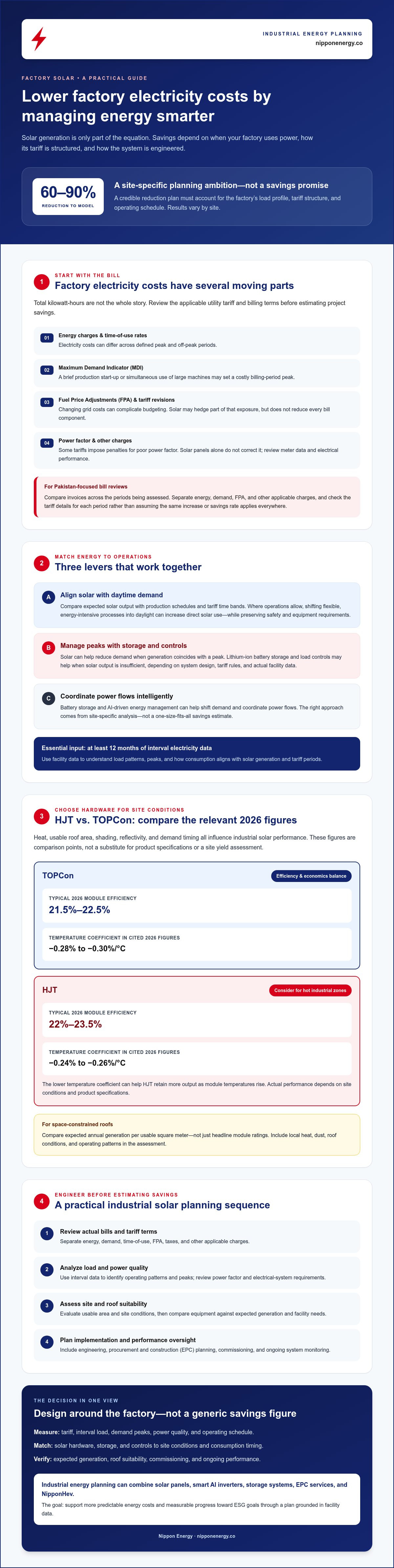
Solar can offset grid consumption, but a credible plan for a 60% to 90% bill reduction must account for your factory’s load profile, tariff structure, and operating schedule. Battery storage and AI-driven energy management can help shift demand and coordinate power flows. The results, however, depend on site-specific analysis, not a one-size-fits-all savings promise.
This guide explains the technical and financial considerations behind industrial solar in 2026, from comparing TOPCon and HJT panels to assessing battery storage for peak shaving. You’ll also learn why at least 12 months of interval electricity data matters, how to review power quality requirements, and how an engineered system can support more predictable energy costs and measurable progress toward ESG goals.
Key Takeaways
- Learn how to reduce factory electricity bill with solar by aligning system design with tariff components, operating patterns, and peak demand.
- Compare HJT and TOPCon for industrial sites, including how high-temperature conditions can influence panel selection.
- Assess whether lithium-ion battery storage could help manage demand peaks, using your facility’s actual electricity data.
- Understand key EPC planning considerations, including site feasibility, roof suitability, commissioning, and ongoing system monitoring.
- Explore how Nippon Energy’s solar panels, smart AI inverters, storage systems, EPC services, and NipponHev can support industrial energy planning and decarbonization goals.
The Industrial Energy Crisis: Why Factory Bills are Skyrocketing in 2026
Factory electricity costs depend on more than total kilowatt-hours. An industrial bill may include energy charges, time-of-use rates, fuel price adjustments, demand charges, taxes, and other tariff components. The exact structure depends on the utility and applicable tariff. In Pakistan, check the current industrial tariff schedule and billing terms before modelling a project. Outdated rates or assumptions can distort expected savings.
Maximum Demand Indicator (MDI) charges can make brief load peaks costly. A production start-up or several large machines running at once may set the billing-period demand peak, even if the higher load lasts only a short time. The impact depends on the tariff and factory load profile. Solar can help reduce demand when generation coincides with the peak. Battery storage and load controls may help with peaks that occur when solar output is insufficient, subject to system design and tariff rules.
Power factor also deserves attention. Motors and other inductive loads draw reactive power, which can lower power factor and lead to penalties where the tariff imposes them. Solar panels alone do not correct poor power factor. Review meter data and electrical-system performance, then assess suitable corrective measures with qualified technical professionals.
Understanding Industrial Time-of-Use (ToU) Tariffs
ToU tariffs charge different rates during defined peak and off-peak periods. This affects industrial ROI because the cost of electricity changes by time of use. Compare the utility’s time bands with production schedules and expected solar output. If operations allow, shifting flexible, energy-intensive processes into daylight hours can increase direct solar use. Any schedule change must preserve production, safety, and equipment requirements.
The Hidden Costs: FPA and Quarterly Adjustments
Fuel Price Adjustments (FPA) and other periodic tariff revisions can complicate budgeting because grid costs may change between billing or review periods. Solar can hedge part of that exposure by supplying some electricity from an installed system, but it will not reduce every bill component. Grid imports, tariff changes, and system operating costs still matter. A photovoltaic (PV) system uses components that convert sunlight into usable electricity. Its industrial design determines how that power integrates with factory loads.
Pakistan-focused bill review: To understand how energy costs changed at a specific factory from 2025 to 2026, compare invoices across both years and separate energy, demand, FPA, and other applicable charges. Check each period’s tariff and adjustment details rather than assuming a national increase or applying another country’s figures. Then assess how solar generation aligns with the facility’s consumption and tariff periods. This evidence-based analysis helps explain how to reduce factory electricity bill with solar without assuming the same savings rate applies to every site.
Strategic Hardware: HJT and TOPCon for Industrial Scale
Factory solar performance depends on more than a module’s nameplate efficiency. Roof area, temperature, shading, reflectivity, and the timing of electrical demand all affect energy yield. HJT is a premium option for hot industrial zones because its temperature coefficient is lower than TOPCon’s in the 2026 figures used here: approximately -0.24% to -0.26%/°C for HJT, compared with -0.28% to -0.30%/°C for TOPCon. That difference can help HJT retain more output as module temperatures rise, although actual results depend on site conditions and product specifications.
TOPCon can suit projects where balancing efficiency and project economics is a priority. Typical 2026 module efficiency is 21.5% to 22.5% for TOPCon and 22% to 23.5% for HJT, with higher-efficiency models available in both categories. On a space-constrained factory roof, compare expected annual generation per usable square meter rather than relying on headline module ratings. For facilities in Pakistan, include local heat, dust, roof conditions, and operating patterns in the yield assessment.
Nippon HJT Solar Panels: Maximizing Yield per Square Meter
HJT cells combine crystalline silicon with thin passivation layers that help limit electron recombination, supporting efficient energy conversion. Nippon HJT Solar Panels are an option for industrial applications, including hot-climate sites. Verify PID resistance against the specific module’s technical documentation and test data rather than assuming it from the cell type alone. Review TOPCon solar panel technology alongside HJT specifications to compare options for your facility.
Efficiency, Degradation, and Lifetime Economics
Lower degradation can improve lifetime energy generation and reduce levelized cost of energy (LCOE), provided other project assumptions remain comparable. Do not assume every N-type panel has the same degradation profile or identical warranty terms. Compare manufacturer datasheets for warranted output, annual degradation assumptions, product coverage, and test conditions. Use those values in the project model to create a more reliable basis for comparing expected energy output over the system’s operating life.
Bifacial modules can capture reflected light from the rear surface. They may increase yield by up to 30% on flat roofs with high-albedo coatings, but this is a site-dependent potential, not a universal forecast. Roof finish, row spacing, mounting height, and shading all affect the result. A site assessment can help determine whether expected rear-side generation supports the design choice.
For factories assessing how to reduce factory electricity bill with solar, the best panel is the one that suits the roof and operating profile, not simply the one with the highest efficiency rating. Nippon Energy’s solar project development and EPC services can support an assessment of HJT and TOPCon options. Explore its industrial solar solutions to review the available technologies.
Peak Shaving with Lithium-ion Battery Storage
Solar panels reduce grid imports while they are generating, but a factory’s highest demand may occur during a production surge or outside peak sunlight hours. Battery storage can address that separate cost. It charges when energy is available, then discharges to support loads during a demand peak. This is peak shaving. It may reduce an MDI charge if the battery lowers the measured peak under the facility’s tariff rules, but it cannot guarantee that every surcharge will disappear.
Size the system around the demand profile, not monthly kilowatt-hours alone. Use at least 12 months of interval electricity data to identify peak timing, duration, and recurring loads. Then model the potential reduction in billed demand against battery capacity, power output, charging source, efficiency losses, operating limits, and tariff terms. A battery that discharges too early may not have enough charge left for the actual billing peak.
Financial Impact of Peak Shaving
Estimate value by comparing the demand charge before and after a realistic peak-reduction scenario. Then include energy shifting and system operating costs in the financial model. Battery controls can respond quickly to changing loads, but response time depends on the battery, inverter, controls, and site configuration. Confirm performance requirements in the project specifications rather than assuming millisecond response.
Cycle life is the number of charge-and-discharge cycles a battery can complete under stated operating conditions before reaching a defined capacity threshold. It does not automatically represent a 10-year service life. Treat 10 years only as a modelling assumption unless the specific Nippon Lithium-ion Battery Storage System documentation confirms applicable cycle, warranty, and operating terms. Depth of discharge, temperature, charge rate, and cycling frequency all affect lifetime performance.
Intelligent Energy Management
Nippon Smart AI Inverters can support energy orchestration by coordinating solar and storage with factory loads. They can be considered as part of a system designed to monitor load patterns and manage energy flows. Whether automated load shedding or machinery prioritization is available depends on system design and controls. Define which loads are critical before specifying those functions.
Monitoring data can help facility teams identify recurring demand spikes, unexpected consumption, or equipment operating outside planned schedules. Lithium-ion storage is one option for frequent cycling, but it is not the only possible industrial choice. Compare options using cycle-life data, usable capacity, maintenance requirements, and the factory’s duty cycle. Nippon Energy’s storage systems and smart inverters can be assessed together as part of an industrial solar project. See its industrial energy solutions for an overview.
The EPC Framework: Implementing Industrial Solar
For a factory, solar implementation must fit the building, electrical network, tariff, and production schedule. An Engineering, Procurement, and Construction (EPC) framework coordinates the project from initial feasibility through commissioning. This helps avoid treating panels as a stand-alone purchase. A typical five-stage sequence is:
- Feasibility: Review energy bills, interval load data, site conditions, and project objectives.
- Engineering: Develop the system layout, structural approach, electrical design, and performance model.
- Procurement: Specify and source suitable panels, inverters, and any storage equipment.
- Construction: Install and integrate the system with attention to factory operations and site safety.
- Commissioning: Test system operation, protection, monitoring, and handover procedures.
Coordinate each stage with facility personnel to plan access, shutdown windows, and interfaces with existing equipment. This sequencing helps address operational constraints while planning how to reduce factory electricity bill with solar.
Start with the roof and electrical network. A structural assessment should establish whether the roof can accommodate the proposed system’s dead load and relevant environmental loads over its intended service life. Consider roof condition, support structure, mounting method, and site-specific exposure. Electrical engineering must also address how solar connects to the factory’s distribution system, including switchgear compatibility, protection coordination, isolation, and power quality. High-voltage interfaces require project-specific design and review by qualified professionals.
Net metering and export arrangements are jurisdiction-specific and may change. Before including export revenue in a financial model, confirm current eligibility, interconnection requirements, metering rules, and compensation terms with the relevant utility or authority. If those details are not confirmed, model the project conservatively.
Feasibility and Financial Modeling
Feasibility should combine site survey findings with load data. Shadow analysis and 3D modeling can help assess roof obstructions, array layout, and expected generation. Forecasts remain estimates and depend on their assumptions. Financial models should state the tariff, self-consumption, export treatment, operating costs, and financing assumptions used to calculate payback period and internal rate of return (IRR). Explore solar EPC services to learn about coordinated project delivery.
Maintenance and Monitoring for Performance
Dust and industrial residue can reduce generation, so maintenance plans should reflect site conditions and safe access requirements. Compare automated cleaning with scheduled manual inspection based on water availability, soiling patterns, roof design, and operating cost. Solar system maintenance and monitoring can help track performance and flag abnormal inverter or generation data for investigation. Predictive fault detection depends on the monitoring system’s capabilities and configuration.
For an industrial project assessment, discuss solar EPC and system requirements with Nippon Energy.
Nippon Energy: Your Partner in Industrial Decarbonization
Industrial energy planning depends on how well generation, storage, conversion, and factory demand work together. Nippon Energy offers HJT and TOPCon solar panels, lithium-ion battery storage, Nippon Smart AI Inverters, solar project development and EPC, and system maintenance and monitoring. Its offerings can support projects in Pakistan, the Middle East, and Europe. Site-specific requirements still matter: factory load profiles, roof conditions, operating schedules, and local grid arrangements shape the right design.
That planning can also support decarbonization goals. A factory can track solar generation and grid consumption to inform internal energy reporting and demonstrate progress to customers or supply-chain partners. Base reporting claims on measured data and the methodology required by the relevant customer or framework, rather than assuming an installation alone establishes progress.
The NipponHev Integrated Advantage
NipponHev is part of Nippon Energy’s product line. Before treating it as a defined combination of HJT, storage, and AI controls, confirm the actual configuration and specifications with the project team. Integration planning can help ensure panels, inverters, storage, and facility loads work toward a common design objective. A clearly scoped EPC agreement can also define responsibilities across project stages. Confirm interfaces, performance assumptions, commissioning scope, and future expansion provisions before work begins.
Growth planning matters. If production lines or shifts may expand, document electrical capacity, available roof area, inverter and switchgear constraints, and provisions for future equipment in the original design. This gives decision-makers a basis for assessing later additions without assuming every component can scale unchanged.
Securing Your Industrial Future
A well-engineered energy system can reduce exposure to grid purchases, but evaluate it alongside operational requirements, maintenance planning, and the factory’s decarbonization objectives. For export manufacturers, documented renewable generation can contribute to a broader sustainability record. It does not, by itself, establish compliance with a buyer’s standards. Confirm the evidence and reporting format each customer expects.
For a practical evaluation, assemble recent electricity bills, interval load data, production schedules, roof information, and any planned capacity changes. Nippon Energy’s EPC and equipment offerings can then be assessed against the facility’s requirements, without relying on generic savings projections. Explore the NipponHev system and confirm whether its documented configuration fits your factory’s energy objectives.
Build a More Predictable Energy Strategy for Your Factory
Reducing factory electricity costs takes more than adding panels. Start with tariff and interval-load data to see how energy charges, demand peaks, and operating schedules shape the bill. Then compare HJT and TOPCon against site conditions, and assess whether battery storage can address demand peaks that solar generation alone may not cover.
Industrial solar works best as an engineered system. Nippon Energy offers HJT and TOPCon solar panels, solar project development and EPC, AI inverters, and lithium-ion storage for facility-specific planning in Pakistan. Each project still needs an assessment of factory loads, roof conditions, operating schedules, and grid arrangements. These are practical foundations for deciding how to reduce factory electricity bill with solar without relying on generic savings assumptions.
Take the next step by reviewing your factory’s electricity bills, load data, roof conditions, and expansion plans. Discuss industrial solar project development with Nippon Energy and identify a technically grounded path toward lower grid exposure and measurable decarbonization progress. A well-planned system can help your factory move forward with greater control over its energy future.
Frequently Asked Questions
How much can solar actually reduce my factory's monthly electricity bill?
There is no reliable universal percentage because savings depend on how much solar power the factory uses directly, its tariff, operating hours, system design, and export compensation. Solar typically offsets grid energy during generation; it may not eliminate fixed charges or demand penalties. To estimate how to reduce factory electricity bill with solar, model at least 12 months of interval consumption alongside bills and production schedules. Then compare expected generation with the facility’s actual load.
What is the typical payback period for an industrial solar system in 2026?
There is no single dependable payback period for industrial solar in 2026. The result varies with project scope, site yield, self-consumption, tariff structure, export rules, maintenance assumptions, and financing costs. A useful financial model calculates payback and internal rate of return using the factory’s energy data and clearly stated assumptions. Treat generic online estimates as preliminary, not as a forecast for your facility or a guarantee of results.
Does my factory need to stop production during the solar installation process?
Not necessarily, but some installation and electrical integration activities may require restricted access, planned shutdowns, or temporary equipment isolation. The impact depends on the roof layout, installation method, connection point, and factory schedule. During project planning, ask the EPC team to identify which work can proceed alongside production and which tasks require outages. A documented installation sequence helps facility managers coordinate safety, access, and production priorities before construction begins.
Can solar panels survive the high heat and dust of industrial zones in Pakistan?
Solar panels can operate in hot, dusty environments, but heat affects output and accumulated dust can reduce generation. The 2026 figures used here show HJT temperature coefficients of about -0.24% to -0.26% per °C, compared with -0.28% to -0.30% per °C for TOPCon. Actual performance depends on the selected module, site temperature, mounting, and maintenance. Specify panels using verified technical documentation and plan cleaning around local soiling conditions.
What is the difference between HJT and TOPCon panels for industrial use?
HJT and TOPCon are both high-efficiency N-type technologies, but their performance characteristics and project economics differ. The 2026 figures used here place typical HJT efficiency at 22% to 23.5% and TOPCon at 21.5% to 22.5%. HJT also has a lower temperature coefficient in those ranges. For a hot site or space-constrained roof, compare expected energy yield per usable area, module specifications, and project assumptions rather than choosing by efficiency alone.
How does net metering work for industrial consumers under current regulations?
Net metering generally involves measuring electricity imported from and exported to the grid, with export treatment determined by applicable rules and the utility arrangement. Eligibility, interconnection steps, metering requirements, and compensation can vary by location and may change. Before including export credits in a project forecast, confirm current requirements directly with the relevant utility or authority. Model the system’s economics primarily around on-site use unless export terms are verified for your facility.
Is battery storage mandatory for reducing industrial electricity bills?
No. A factory can reduce grid consumption with solar without installing a battery, especially when production overlaps with daylight generation. Storage may be relevant if the facility wants to manage demand peaks that occur when solar output is low, but its value depends on the tariff, load profile, and battery design. Compare the expected demand-charge reduction and energy-shifting benefit with system operating assumptions. Interval data is essential to determine whether storage makes financial sense.
What kind of maintenance is required for a multi-megawatt solar plant?
A multi-megawatt plant needs a planned maintenance and monitoring approach tailored to its equipment and operating environment. Typical checks include reviewing generation and inverter data, inspecting modules and mounting structures, assessing cabling and electrical connections, and cleaning modules when soiling warrants it. Monitoring can flag unusual output or equipment behaviour for investigation. Establish access and safety procedures, record maintenance actions, and follow the relevant equipment documentation rather than applying an unsupported universal service schedule.


