

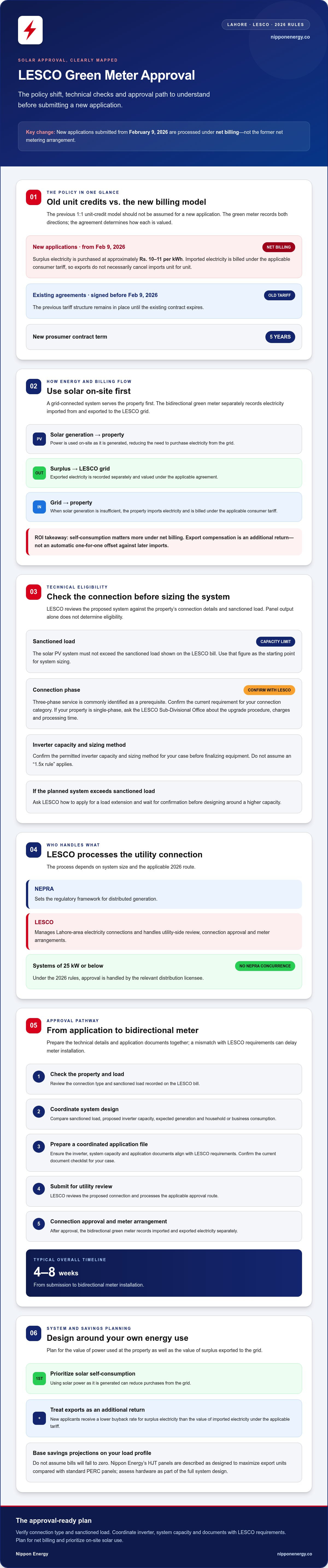
A green meter approval is a technical audit as much as a paperwork process. If you’re researching how to get a net metering license in lahore, the first step is understanding that new applications submitted from February 9, 2026, are processed under net billing rules, not the former net metering arrangement.
That change affects how solar exports contribute to your return on investment. New applicants receive a lower buyback rate for surplus electricity, making system sizing and on-site energy use more important. Your inverter, system capacity, and application documents must also align with LESCO requirements, so a mismatch can create delays before the bidirectional meter is installed.
This guide sets out the 2026 LESCO process, the documents and technical checks to prepare, and a realistic approval timeline: typically 4 to 8 weeks from submission to meter installation. It also explains the rules for systems up to 25 kW and the costs to confirm before applying, without relying on outdated fee assumptions. Nippon Energy’s Lahore EPC team handles NEPRA and LESCO documentation, helping you approach approval with a technically coordinated system and a clear plan for maximizing solar self-consumption.
Key Takeaways
- Learn how to get a net metering license in lahore by preparing for LESCO’s current application process and checking the technical requirements before submission.
- Understand how your three-phase connection and sanctioned load affect solar system eligibility and capacity planning.
- See how the 2026 shift to net billing changes the value of exported electricity and why using more solar power on-site matters.
- Identify the application documents and key approval steps involved in securing a bidirectional meter from LESCO.
- Compare solar hardware and EPC support to understand how system design and coordinated documentation can help prevent avoidable delays.
Understanding Net Metering Regulations in Lahore (2026)
For a LESCO customer, solar approval now needs to be understood in the context of a major policy shift. Net metering traditionally allowed a consumer’s exported electricity to offset imported units on a one-for-one basis. But for new applications from February 9, 2026, Pakistan’s framework has shifted to net billing. Existing agreements signed before that date retain their previous tariff structure until the contract expires.
In practical terms, a grid-connected solar system serves the property first. Any surplus can flow to the LESCO grid, while the property imports electricity when solar generation is insufficient. A bidirectional “green meter” records imported and exported electricity separately, providing the readings used to calculate the bill under the applicable agreement. For a broader explanation of the basic billing mechanism, see Understanding Net Metering.
The Role of LESCO and NEPRA
LESCO manages Lahore-area electricity connections and processes applications for systems connected to its distribution network. NEPRA sets the regulatory framework for distributed generation, while LESCO handles utility-side review, connection approval, and meter arrangements. The process depends on system size: under the 2026 rules, systems of 25 kW or below no longer require NEPRA concurrence, with approval handled by the relevant distribution licensee. This distinction matters when planning how to get a net metering license in lahore, because the applicable route affects the application file and review process.
Financial Impact: ROI and Unit Credits
The former 1:1 unit-credit model should not be assumed for a new 2026 application. Under net billing, exported electricity is purchased at approximately Rs. 10–11 per kWh, while imported electricity is billed under the applicable consumer tariff. This means exports don’t necessarily cancel peak or off-peak consumption unit for unit. The green meter records the two energy flows; the billing arrangement determines how each is valued.
For example, a household that generates surplus electricity during the day and imports power later may receive export compensation, but that compensation is not automatically equal to the cost of the later imports. New prosumers have a five-year contract term. Existing agreements signed before February 9, 2026, remain under their old tariff structure until expiry.
That makes self-consumption central to ROI: using solar power as it is generated can reduce purchases from the grid, while exports provide an additional, lower-valued return. Nippon Energy’s HJT panels are designed to maximize export units compared with standard PERC panels. Review Nippon HJT Solar Panels as part of a system-level assessment, and base savings projections on your own load profile rather than assuming bills will fall to zero.
Technical Eligibility and Prerequisites for LESCO Net Metering
Before planning a system, check the electrical connection and the sanctioned load recorded on your LESCO bill. The solar system’s capacity cannot exceed the property’s sanctioned load, so panel output alone doesn’t determine eligibility. LESCO reviews the proposed connection against its technical requirements, making an accurate load assessment a critical first step in how to get a net metering license in lahore.
Connection type and phase conversion
Three-phase service is commonly identified as a prerequisite for grid-connected solar approval, but confirm the current requirement for your connection category directly with LESCO before installation. If your property has a single-phase connection, ask your LESCO Sub-Divisional Office about upgrading to three-phase service, including the application procedure, applicable charges, and expected processing time. These details can depend on the property and utility assessment, so don’t rely on a generic cost or timeline.
Sanctioned load and system capacity
Use the sanctioned-load figure on your bill as the starting point for system sizing. The current requirement is that the solar PV system must not exceed that load. Don’t assume an “1.5x rule” applies: confirm the permitted inverter capacity and sizing method with LESCO for your case before finalizing equipment. If your planned system exceeds the sanctioned limit, ask LESCO how to apply for a load extension and wait for confirmation before proceeding with a design based on a higher capacity.
A feasibility assessment should compare the sanctioned load, proposed inverter capacity, expected generation, and household or business consumption. Nippon Energy’s solar project feasibility studies explain how coordinated project planning can align system design with site and utility requirements.
Inverter approval and rooftop readiness
Grid-connected inverters must satisfy applicable technical and safety requirements, including anti-islanding protection, which prevents the system from supplying the grid during an outage. LESCO’s accepted equipment requirements and any model lists can change, so verify the exact inverter model before purchase. Nippon Smart AI Inverters are pre-certified for LESCO net metering, helping address this equipment checkpoint; non-compliant hardware can lead to technical objections or application delays.
The roof also needs suitable space and structural capacity for the proposed array and mounting system. Have the installation area assessed for obstructions, access, and structural condition rather than assuming every usable-looking roof section is suitable. A coordinated EPC assessment can bring these checks together; review Nippon Energy’s Lahore EPC services as one reference when comparing project-planning support.
The 7-Step Application Process for a Net Metering License
For new Lahore applications submitted after February 9, 2026, the process is handled under net billing rules through the PITC Net Billing Portal. For systems of 25 kW or less, NEPRA concurrence is no longer required; LESCO is responsible for approval. This distinction matters: don’t assume every applicant needs a separate NEPRA license or that an older paper-based workflow still applies. LESCO processing, from submission to bidirectional meter installation, typically takes 4 to 8 weeks.
- Confirm eligibility. Check your LESCO connection type, sanctioned load, proposed system capacity, and the current requirements for your application category.
- Select a qualified installer. Use an AEDB-certified installer, a requirement for the installation and application process. Confirm that the proposed grid-tied inverter meets current LESCO technical requirements.
- Prepare the application file. Assemble the current Distributed Generation Application Form and Schedule-I if required by the applicable process. Include equipment details and supporting technical documents.
- Submit through the correct channel. New applications are processed through the PITC Net Billing Portal. Check the portal instructions for any LESCO office follow-up or supporting documents rather than assuming submission must begin at an SDO.
- Respond to technical review. LESCO assesses the application and system information. Address any clarification or technical objection before installation or commissioning proceeds.
- Complete inspection and approval. Where an inspection is scheduled, ensure the installed system matches the submitted design and required safety provisions. Obtain the applicable approval or NOC before export operation.
- Arrange bidirectional meter installation. Follow LESCO’s instructions for meter procurement, sealing, and commissioning. Confirm the meter records import and export readings before relying on the system for billing.
Documentation checklist
Prepare the latest portal forms and ensure the application details match the final system design. Supporting material may include panel and inverter datasheets, a single-line wiring diagram, and protection details. The outline references Schedule-I; verify the current form version and exact attachments on the PITC portal or with LESCO before filing, as requirements can vary by application category.
For equipment research, review TOPCon solar panels and the selected inverter’s technical documentation. Wiring diagrams and protection schemes should be prepared or reviewed by a qualified professional, and submitted in the format LESCO requires.
Inspection and common technical issues
Inspection readiness starts with safe, accessible equipment and a system that matches the approved design. Confirm earthing and surge protection are installed as specified, and that the inverter’s anti-islanding protection can prevent power from feeding the grid during an outage. Learn how a smart AI solar inverter fits into a compliant system, then verify its exact model against current LESCO requirements.
Missing documents, inconsistent capacity information, incorrect wiring, or unresolved protection issues can prompt objections or rework. Nippon Energy’s in-house team handles NEPRA and LESCO documentation as part of its Lahore EPC work; review solar project and EPC support when comparing application coordination options.
Maximizing Net Metering ROI with Advanced Solar Hardware
Under Lahore’s 2026 net billing framework, exported electricity is valued at approximately Rs. 10–11 per kWh, while imported units are billed under the applicable tariff. That makes system performance important, but it also makes self-consumption a central part of ROI: electricity used on-site can reduce grid purchases, while surplus exports earn the applicable buyback rate. Panel selection, inverter compatibility, and energy-use patterns should therefore be assessed as one system.
Low-quality or poorly matched panels may produce fewer units over time, reducing the energy available for both household use and export. Lahore’s high summer temperatures also make it important to compare manufacturers’ performance data under heat, rather than choosing solely by rated capacity. Nippon Energy’s HJT panels are designed to maximize export units compared with standard PERC panels. Review the available module datasheets and compare their temperature and degradation specifications before projecting long-term returns; don’t assume a particular output advantage or service life without verified product data.
HJT and TOPCon panel selection
HJT and TOPCon are advanced solar technologies, but their suitability depends on the specific module, roof conditions, system design, and cost assumptions. Compare verified datasheets for rated output, temperature coefficient, and degradation warranty terms. These figures help estimate how heat and gradual performance change may affect generation. A panel’s contribution to ROI is not determined by technology label alone; accurate design and installation also affect usable generation and export.
Inverters, batteries, and monitoring
The inverter is central to both safe grid connection and operational performance. A model that meets LESCO’s technical requirements can reduce the risk of equipment-related objections during approval; Nippon Smart AI Inverters are pre-certified for LESCO net metering. That supports technical alignment, but it doesn’t remove the need for complete documentation or guarantee a faster approval decision. Explore how smart AI solar inverters fit into system planning.
Battery storage can retain surplus generation for later use, helping increase self-consumption and reduce reliance on grid imports when solar output falls. Its value depends on the property’s load profile and system economics, so assess it alongside, not separately from, the solar design. Learn more about lithium-ion battery storage.
Use system monitoring and LESCO meter readings to compare generation, on-site consumption, exports, and billed imports. Investigate discrepancies by checking the relevant dates and meter readings before drawing conclusions about billing accuracy. To assess solar hardware and system design for your Lahore property, explore Nippon Energy’s solar solutions.
Choosing a Turnkey EPC Partner for Net Metering Excellence
A solar installer may focus on supplying and mounting equipment. An EPC partner coordinates the project as a connected system, from technical design and hardware selection through installation and application documentation. That distinction matters because the application depends on the installed system matching the submitted specifications. Coordinated planning can reduce avoidable rework and handoffs, but no partner can guarantee a particular LESCO approval timeline.
For homeowners considering how to get a net metering license in lahore, the practical advantage of turnkey EPC is continuity: the team designing the system can also keep its equipment details, electrical drawings, and application information aligned. This is not a substitute for LESCO’s review or approval. It can, however, make it easier to identify gaps before submission rather than after a technical objection.
End-to-end documentation and coordination
Nippon Energy provides end-to-end EPC services in Lahore, and its in-house team handles NEPRA and LESCO documentation. This gives the project a technical architect who can coordinate system information with the paperwork, while the homeowner has a clearer point of contact for project-related questions. Before appointing any EPC partner, confirm who prepares and checks each document, who submits it through the applicable channel, and how technical queries will be handled.
Ask the partner to confirm that the proposed engineering design, equipment datasheets, and installed configuration remain consistent throughout the project. “Pre-vetted” should mean the design and components have been checked against current technical requirements, not that approval is guaranteed. LESCO and NEPRA retain their respective review and decision-making roles.
Long-term performance and project records
Approval is one milestone. Continued system performance also depends on sound operation, maintenance, and accurate records. Periodic checks can help identify faults or changes in generation, while monitoring data can support troubleshooting. Nippon Energy offers solar system maintenance; ask what checks are included and how findings are documented. Don’t assume that routine maintenance replaces any inspection or reporting requirement set by LESCO.
For commercial systems, establish a maintenance and safety-review schedule suited to the equipment and site. Keep system documents, service records, and meter information organized. If your agreement has a defined term, verify renewal or continuation requirements with the relevant authority well before it expires rather than assuming renewal is automatic.
To discuss coordinated solar project development and EPC for a Lahore property, contact Nippon Energy’s Lahore team about a turnkey net metering solution.
Plan Your Lahore Solar System for Lasting Value
LESCO approval depends on more than submitting forms. A system must align with your sanctioned load, technical requirements, and the current application process. For new applicants, the 2026 net-billing framework also makes self-consumption and realistic export assumptions central to return on investment.
Before committing to equipment, verify the applicable LESCO requirements and assess how your property uses electricity. High-efficiency HJT panels can support strong generation, while coordinated engineering and complete documentation help keep the project technically aligned. Nippon Energy provides Lahore EPC services, with an in-house team handling NEPRA and LESCO documentation.
If you’re ready to plan how to get a net metering license in lahore around a properly designed solar system, secure your turnkey net metering solution with Nippon Energy. A clear technical plan is a practical first step toward a more resilient energy future.
Frequently Asked Questions
How long does it take to get a net metering license in Lahore?
LESCO processing typically takes 4 to 8 weeks from application submission to bidirectional meter installation. This is an indicative timeframe, not a guaranteed completion date. The application route and documents depend on your system category, and technical objections or missing information can add delays. For new applications, check the PITC Net Billing Portal requirements and follow LESCO’s instructions for any additional review or inspection steps.
What is the total cost of net metering in Pakistan for 2026?
There isn’t one fixed total cost for every applicant. LESCO charges can vary according to the property’s sanctioned load and applicable meter or processing requirements. Installer handling charges, if any, are separate, and regulatory fees may depend on system size and category. Before applying, request an itemized estimate that distinguishes LESCO charges from installer costs, then confirm current fees with LESCO or the relevant authority.
Can I apply for net metering if I have a single-phase meter?
A single-phase connection may not meet LESCO’s technical eligibility requirements, so confirm your connection category with the relevant LESCO office before purchasing equipment. If LESCO requires three-phase service for your proposed system, ask about the conversion process, required documents, charges, and timing. Include any necessary connection upgrade in your project plan, and don’t assume an application will be accepted until LESCO confirms the requirements for your property.
Is it mandatory to use NEPRA-approved solar panels and inverters?
Don’t assume that every panel needs a separate NEPRA approval label. Equipment must meet applicable technical requirements, and the grid-tied inverter must have anti-islanding protection. Verify the proposed inverter model against current LESCO requirements before installation. The installer must be AEDB-certified for the installation and application process. Ask for equipment datasheets and confirm that the submitted design matches the hardware installed at your property.
What happens to my exported units if LESCO has a power outage?
A compliant grid-tied inverter with anti-islanding protection stops supplying electricity to the grid during an outage, helping protect utility workers. Therefore, electricity generated during that period isn’t exported to LESCO and won’t register as an export unit on the meter. Previously recorded exports are accounted for under your applicable agreement and billing arrangement. Battery backup may support selected loads, but it doesn’t permit unsafe grid export during an outage.
Do I need a separate license for a commercial property in Lahore?
Commercial use alone doesn’t determine whether a separate NEPRA concurrence is required; system capacity and application category matter. Under the 2026 rules, systems of 25 kW or less no longer require NEPRA concurrence, with approval handled by LESCO. For larger systems, confirm the applicable licensing and concurrence requirements with LESCO and NEPRA before installation. Your sanctioned load and approved system capacity must also align.
Can I increase my solar system capacity after getting the license?
Don’t add panels or inverter capacity on the assumption that your existing approval automatically covers the change. The installed capacity must remain within the sanctioned load and the system capacity approved for your connection. Contact LESCO before modifying the system to confirm whether revised technical documents, review, or approval are required. Keep the final equipment configuration consistent with the records used for your application and meter arrangements.
What is the “Green Meter” and who provides it in Lahore?
A “Green Meter” is the bidirectional meter used to record electricity imported from the grid and electricity exported by your solar system. LESCO manages the meter installation for connections in its service area, following the applicable application review and approval process. Once it’s installed, check that import and export readings are being recorded correctly, then compare those readings with your bill under the agreement’s current net-billing terms.


