

Industrial solar is not a routine construction project; it is an engineered energy architecture built to insulate manufacturing assets from volatile utility tariffs. When commissioning a turnkey solar power plant for factory operations, the primary operational hazard isn't the technology itself, but the production downtime and fragmented accountability that come from juggling multiple equipment vendors and sub-contractors.
Every industrial operator understands that unchecked peak-demand charges eat into operating margins, yet risking line stoppages during a disjointed installation is out of the question. You shouldn't have to compromise daily plant output to achieve energy independence.
A fully unified turnkey deployment resolves this tension by aligning advanced generation, battery storage, and intelligent inverter controls under a single engineering umbrella. In this 2026 industrial guide, you'll discover how integrated project execution eliminates operational friction, minimizes maintenance overhead, and locks in predictable energy security for 25 years and beyond.
Key Takeaways
- Explore how an end-to-end turnkey solar power plant for factory facilities replaces fragmented vendor management with unified EPC accountability and predictable 25-year energy yields.
- Learn why cell architecture selection, specifically high-efficiency Nippon HJT Solar Panels and Nippon TOPCon Solar Panels, dictates system performance in high-temperature manufacturing environments.
- Examine the structural, electrical, and grid compliance assessments required to deploy large-scale solar infrastructure without interrupting daily manufacturing output.
- Discover how integrating Nippon Smart AI Inverters and Nippon Lithium-ion Battery Storage Systems stabilizes operational loads and offsets volatile utility peak charges.
- Review the engineering principles behind the NipponHev architecture and its systematic approach to de-risking high-capacity industrial clean energy projects.
What is a Turnkey Solar Power Plant for Factory Operations?
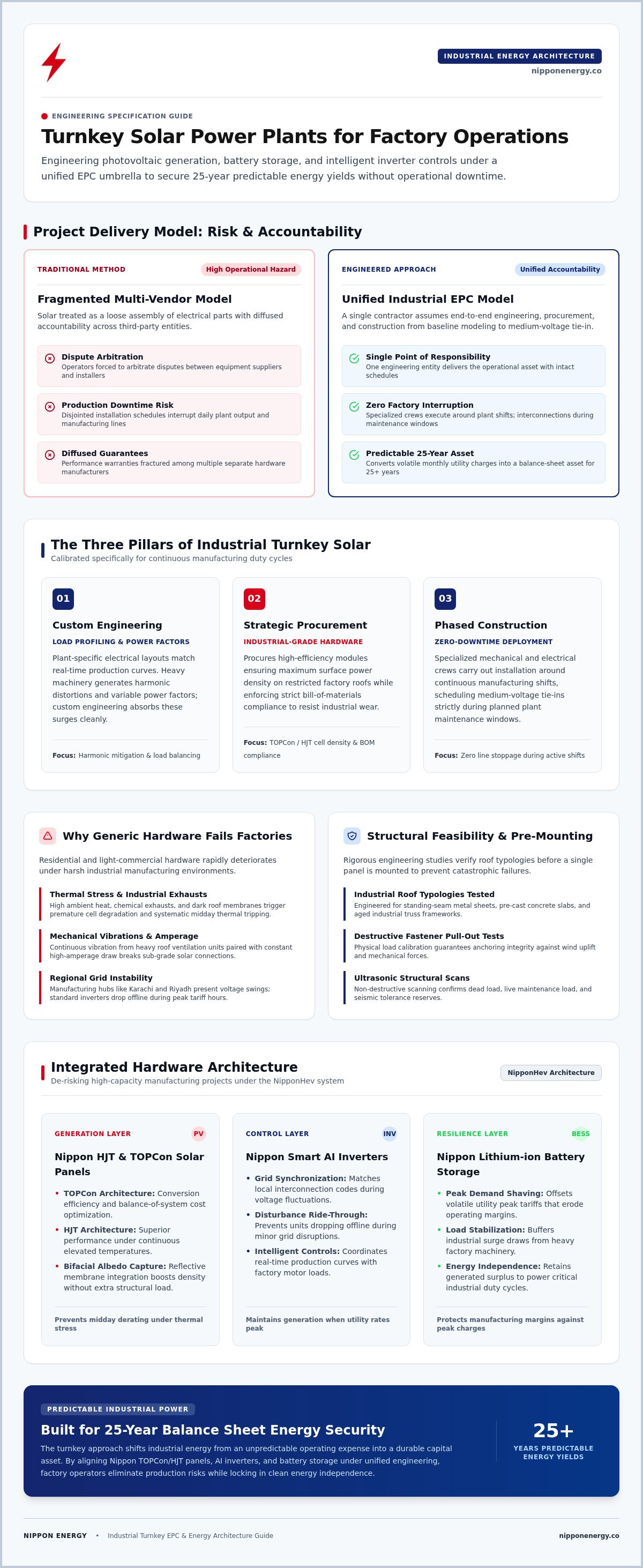
A turnkey solar power plant for factory facilities is a unified engineering, procurement, and construction (EPC) model where a single contractor assumes end-to-end delivery of the operational asset. Rather than treating solar as a loose assembly of electrical parts, the turnkey model engineers the entire photovoltaic system to function as a predictable, load-bearing utility on site. This approach shifts industrial power from an unpredictable monthly operating expense to a balance-sheet asset engineered for decades of generation.
Industrial managers in 2026 operate under tighter margins and stricter uptime requirements. Fragmented multi-vendor models force plant operators to arbitrate disputes between equipment suppliers, structural engineers, and electrical contractors. Turnkey delivery establishes a single point of responsibility. When one engineering entity handles everything from initial baseline modeling to medium-voltage tie-in, performance guarantees remain unambiguous, schedules stay intact, and operational accountability never diffuses across third parties.
The Core Pillars of Industrial Turnkey Solar
Industrial EPC relies on three interdependent pillars calibrated for continuous manufacturing duty cycles:
- Custom Engineering: Plant-specific electrical layouts match real-time production curves. Heavy machinery produces harmonic distortions and variable power factors; turnkey engineering designs the system to absorb these industrial surges cleanly.
- Strategic Procurement: Procuring industrial-grade modules, such as high-efficiency topcon solar panels, ensures high surface power density on restricted manufacturing roofs while securing strict bill-of-materials compliance.
- Phased Construction: Specialized mechanical and electrical crews execute installations around plant operations, completing interconnections during scheduled maintenance windows to prevent downtime.
Why 'Off-the-Shelf' Solutions Fail Factories
Residential or light-commercial equipment fails under industrial conditions. Industrial roofs endure high ambient heat, chemical exhausts, heavy vibration from ventilation units, and continuous high-amperage draw. Standard commercial modules degrade rapidly in these micro-climates, leading to premature cell degradation and thermal tripping.
Grid synchronization presents another major hurdle. Industrial zones in manufacturing hubs like Karachi and Riyadh feature distinct grid stability characteristics, including voltage fluctuations and strict local interconnection codes. Generic solar providers often deploy standard inverters that drop offline during minor grid disturbances, shutting down generation exactly when utility power is most expensive.
Rigorous feasibility studies prevent structural failures. Industrial facilities utilize diverse roof typologies, including standing-seam metal sheets, pre-cast concrete slabs, and aged truss systems. A true turnkey solar power plant for factory deployment begins with destructive fastener pull-out tests and ultrasonic structural scans to confirm dead, live, and seismic load tolerances before a single panel is mounted.
Industrial Energy Architecture: Hardware Selection for Maximum ROI
Nameplate wattage is an incomplete metric for industrial procurement. When specifying a turnkey solar power plant for factory facilities, the true levelized cost of energy hinges on cell physics under thermal stress. Industrial operations generate significant radiant heat through ventilation shafts, process exhausts, and dark roof membranes. As documented in research on Solar for Industrial Processes by the U.S. Department of Energy, engineering photovoltaic assets to withstand continuous industrial stress prevents systematic midday derating during peak production shifts. Pairing advanced cell architecture with bifacial mounting on reflective roof membranes captures diffuse albedo radiation, boosting energy density without increasing structural load.
Nippon HJT vs. TOPCon for Industrial Use
Selecting between Nippon TOPCon Solar Panels and Nippon HJT Solar Panels depends on local ambient climate and facility layout constraints. TOPCon architecture provides exceptional conversion efficiency and balance-of-system cost optimization, making it an ideal candidate for broad industrial footprints in moderate temperature zones.
For factories operating in extreme climates like Riyadh or Karachi, where ambient roof temperatures routinely surpass 60°C, Nippon HJT Solar Panels offer superior thermodynamics. Heterojunction technology features a low temperature coefficient of approximately -0.26%/°C, preserving critical kilowatt-hours when midday heat typically degrades conventional silicon output. With dual-surface bifaciality and structural resistance to potential-induced degradation (PID), HJT ensures consistent power output across a 30-year lifecycle. Engineering teams can assess site-specific thermal degradation models directly through nipponenergy.co to determine the ideal module matrix.
Smart AI Inverters: The Brain of the Factory
Photovoltaic panels generate raw DC energy, but the inverter architecture governs power quality across the factory floor. Heavy manufacturing equipment, such as injection molding presses and CNC machines, introduces acute harmonic distortion and reactive power demands. Deploying a smart ai solar inverter network stabilizes the industrial microgrid by delivering automated, millisecond-level reactive power compensation and active power filtering.
These intelligent units utilize machine-learning algorithms to detect string anomalies, pinpoint arc faults, and track thermal abnormalities before they evolve into line-stoppage events. The inverters also integrate directly with scheduled industrial load shedding protocols, synchronizing on-site solar, battery storage, and utility power without voltage dips or production interruptions.
Turnkey vs. Traditional Installation: A Risk-Benefit Analysis
Traditional industrial procurement treats solar like commercial construction, dividing the scope between independent engineering consultants, separate hardware distributors, and local trade contractors. This fragmented model introduces severe financial exposure. When actual generation underperforms, the installer faults module quality, the distributor cites improper inverter calibration, and the engineering consultant claims structural variances altered tilt angles. Selecting a turnkey solar power plant for factory facilities eliminates these coordination gaps by anchoring the complete engineering lifecycle to one responsible entity.
According to commercial deployment resources from the Solar Energy Industries Association (SEIA), seamless coordination between technical engineering, code compliance, and structural mounting dictates the economic viability of commercial rooftop arrays. Turnkey contracts replace finger-pointing with direct operational ownership. From initial electrical schematics to high-voltage grid interconnection, every project phase rests on the same engineering team, ensuring full accountability for commercial operation dates and system reliability.
Quantifying the Turnkey Advantage
Executing solar integration under a turnkey EPC structure systematically de-risks plant cash flows:
- Electrical Architecture Matching: Inverters, DC cabling, and cell topologies are engineered as a synchronized circuit, preventing clipping losses and thermal bottlenecking.
- Procurement Clout: Direct supply-chain integration bypasses retail equipment markups, securing consistent, utility-scale hardware specifications across massive industrial rooftops.
- Zero-Downtime Installation: Craning operations, structural anchoring, and transformer ties are staged around factory shift patterns, allowing manufacturing shifts to proceed uninterrupted.
The Role of Performance Guarantees
The core deliverable of an industrial energy asset is its Performance Ratio (PR), which is the empirical relationship between raw irradiance and delivered AC electricity. Traditional installations often abandon plant managers after initial commissioning, leaving facility teams to troubleshoot inverter faults, module soiling, and balance-of-system degradation on their own. Underperforming strings drain capital return silently while industrial utility charges escalate.
In contrast, a turnkey solar power plant for factory power delivery incorporates structured operational oversight. Pairing unified development with ongoing solar system maintenance ensures that predictive thermographic sweeps, preventative cleaning, and inverter firmware updates protect asset uptime. This structural continuity guarantees that the modeled financial returns translate directly into lower operational overhead for the factory's 25-year operating horizon.
The EPC Lifecycle: Implementing Solar in an Active Industrial Environment
Executing a turnkey solar power plant for factory deployment requires a disciplined, multi-stage engineering progression designed to protect ongoing production. Industrial EPC moves through five technical milestones:
- Feasibility and Site Assessment: High-precision structural audits evaluate truss load tolerances, while electrical data loggers map 24-hour demand profiles and harmonic levels.
- Custom Engineering and Permitting: System designers generate single-line diagrams, relay coordination schemes, and local utility compliance filings tailored to regional grid codes.
- Precision Procurement: Tier-one hardware procurement secures verified bills of materials, deploying Nippon HJT Solar Panels or Nippon TOPCon Solar Panels based on site-specific irradiance and thermal conditions.
- Execution and Commissioning: Field teams install racking, DC cabling, and step-up transformers, executing medium-voltage switchgear cutovers during pre-planned plant shutdowns.
- Monitoring and Maintenance: Post-commissioning telemetry feeds active generation data into centralized supervisory systems to track ongoing balance-of-system health.
Navigating Grid Coordination and Net Metering
Grid integration policies in 2026 demand robust compliance architectures. Regional utilities enforce rigorous technical guidelines governing harmonic injection, reactive power support, and anti-islanding protection. Switchgear modernization must account for bidirectional energy flow, ensuring protective relays instantly disconnect export circuits if grid faults occur.
In municipal or utility territories that enforce strict Zero Export mandates, automated control loops become essential. Nippon Smart AI Inverters dynamically modulate generation thresholds to match real-time facility demand, preventing reverse-power feed into the external grid without stalling internal machinery.
Integrating Lithium-Ion Battery Storage
Deploying dedicated lithium ion battery storage unlocks true operational resilience for facilities running continuous shifts. High-capacity Nippon Lithium-ion Battery Storage Systems capture daytime solar surpluses and discharge them during peak evening tariff periods, shielding plant balance sheets from extreme time-of-use utility surcharges.
Beyond tariff management, industrial battery integration serves as high-speed UPS infrastructure. When municipal feeder lines suffer voltage sags or total dropouts, stored power bridges the gap instantaneously. This millisecond-level transition protects sensitive automated assembly lines, PLC networks, and CNC tooling from abrupt shutdowns. To evaluate your facility's electrical infrastructure for integrated storage and solar deployment, consult with our industrial EPC team to schedule a comprehensive technical site survey.
Nippon Energy’s Turnkey Advantage: The NipponHev System
Industrial facilities require unified energy systems rather than disconnected electrical assemblies. The nipponhev system represents an integrated industrial architecture engineered to eliminate technical fragmentation. Nippon Energy functions as a High-Tech Architect, applying disciplined Japanese engineering standards across demanding industrial corridors in Tokyo, Dubai, Riyadh, and Karachi. By unifying proprietary module fabrication, intelligent power conversion, and dedicated battery storage, deploying a turnkey solar power plant for factory operations shifts from an uncertain construction exercise into a precise asset integration. Through end-to-end solar epc services, industrial parks secure full structural, electrical, and grid compliance under a single accountability model.
Engineering Excellence and Performance Monitoring
Preserving generation assets requires active technical oversight. Nippon Energy ensures high system availability through structured Solar System Maintenance and Monitoring, streaming real-time string metrics, thermal gradients, and harmonic parameters directly to centralized plant dashboards.
Nippon Smart AI Inverters continuously analyze impedance shifts and thermal anomalies, isolating minor electrical faults before they cause inverter trips or line disruptions. Standardized preventative maintenance protocols, such as calibrated thermographic drone scans and contactor torque verifications, maintain balance-of-system integrity. This systematic approach preserves capital value and ensures the generation asset meets modeled output metrics across its entire operational life.
Next Steps for Factory Owners
Transitioning an operating manufacturing plant to dedicated solar generation follows a methodical pathway:
- Phase 1: Facility Energy Audit: Engineers evaluate 15-minute interval demand data, review single-line diagrams, and assess structural dead-weight capacities.
- Phase 2: Technical Proposal: Nippon Energy delivers an engineered layout, complete with cell selection, battery sizing, and financial yield projections tailored to local utility tariff structures.
- Phase 3: EPC Execution: Turnkey delivery moves through permitting, switchgear synchronization, and full asset commissioning without disrupting active production lines.
Plant managers ready to stabilize operational expenses can contact Nippon Energy to engineer your factory’s energy future with a resilient turnkey solar power plant for factory operations.
Architecting Your Industrial Energy Independence
Industrial manufacturing in 2026 demands absolute control over escalating operational overhead. Commissioning a turnkey solar power plant for factory operations eliminates the systemic liabilities of multi-vendor procurement, replacing project fragmentation with single-source engineering accountability. By integrating proprietary Nippon HJT and TOPCon panel hardware with high-capacity storage and intelligent controls, your plant secures predictable, low-cost power while insulating production margins from volatile utility tariffs.
Nippon Energy applies disciplined Japanese engineering standards to complex industrial corridors across the globe. Our end-to-end EPC responsibility unites design, structural civil works, medium-voltage tie-ins, and 25-year performance warranties under one technical partner. You don't have to risk factory downtime or compromise production schedules to achieve sustained energy autonomy. Take the definitive step toward permanent energy sovereignty today: Request a Professional Industrial Energy Audit from Nippon Energy and engineer an energy architecture built for the next quarter-century of industrial growth.
Frequently Asked Questions
What is included in a turnkey solar project for a factory?
A turnkey solar power plant for factory operations covers the complete lifecycle from initial structural assessment to final commissioning and grid interconnection under a single contract. This scope includes mechanical load engineering, utility compliance filings, module and inverter procurement, high-voltage switchgear synchronization, and civil works. Experienced commercial and industrial solar providers such as GES ENERGY implement this integrated delivery model so operators receive a fully operational generation asset without coordinating multiple subcontractors, ensuring performance guarantees stay anchored to one engineering entity.
How long does it take to install a turnkey solar power plant?
Most industrial turnkey installations span four to eight months from initial feasibility to active commissioning. The timeline breaks down into two months for structural auditing, engineering layout, and regional utility permitting, followed by equipment procurement and physical construction. Interconnection and switchgear tie-ins take roughly two to four weeks. They're scheduled during planned plant maintenance windows to ensure zero disruption to daily manufacturing cycles.
Will solar panels interfere with my factory's existing electrical machinery?
Properly engineered solar systems don't interfere with industrial machinery. Advanced setups utilize Nippon Smart AI Inverters engineered with integrated active power filters to suppress line harmonics and correct power factor variations. These controls isolate the PV array from inductive surges caused by arc welders, CNC machinery, and heavy industrial motors, ensuring clean, synchronized alternating current across the plant's internal distribution bus.
Can a turnkey solar plant provide power during a grid outage?
A grid-tied solar plant alone automatically shuts down during an outage for utility line safety. However, integrating a turnkey solar power plant for factory facilities with dedicated Nippon Lithium-ion Battery Storage Systems enables islanding mode. When grid voltage drops, the intelligent switchgear isolates the factory microgrid within milliseconds, supplying continuous power to priority production lines and preventing catastrophic downtime.
What is the difference between HJT and TOPCon for industrial use?
The primary distinction lies in temperature resilience and cell architecture. Nippon TOPCon Solar Panels offer high efficiency and cost-effective balance-of-system economics across moderate industrial climates. Nippon HJT Solar Panels deliver a superior temperature coefficient of -0.26%/°C and higher bifaciality. That makes HJT the optimal technical choice for high-heat manufacturing zones, like Riyadh or Karachi, where ambient rooftop temperatures frequently degrade standard cell output.
How much roof space does a 1MW factory solar plant require?
A 1MW industrial installation typically requires approximately 60,000 to 80,000 square feet of unobstructed roof area. The exact footprint depends on panel wattage and cell efficiency. Deploying high-density Nippon HJT or TOPCon modules reduces the required mounting space compared to legacy panels. That leaves critical clearance around roof vents, exhaust fans, HVAC systems, and safe perimeter access corridors for maintenance teams.
How do I manage maintenance for a large-scale industrial solar plant?
Industrial maintenance shouldn't be handled by in-house plant staff. Nippon Energy provides structured Solar System Maintenance and Monitoring, utilizing AI-driven diagnostic telemetry to track string-level generation in real time. Field maintenance routines include calibrated thermographic drone sweeps to identify hotspot anomalies, scheduled automated wash cycles to clear industrial particulates, and periodic contactor torque verifications across all medium-voltage switchgear.
What is the typical ROI for a turnkey solar plant in an industrial setting?
Return on investment depends on regional electricity tariffs, daytime load profiles, and available local tax incentives. Facilities offsetting high peak industrial rates typically recover capital expenditures within three to six years. Because industrial turnkey hardware is built for 25 to 30 years of continuous generation, factories effectively lock in decades of predictable, near-zero-cost electricity after the initial payback threshold. When budgeting capital outlays, facility managers can explore Project-based installation and configuration fees to benchmark implementation costs across commercial engineering frameworks.


