

Rooftop solar alone cannot insulate heavy industry from an increasingly unstable electrical infrastructure. When manufacturing directors evaluate achieving true energy independence for my factory in faisalabad, they confront a punishing operational baseline: sudden FESCO feeder interruptions trigger costly loom resets, while effective industrial tariffs climbing past Rs. 60 per unit steadily compress export margins. Running backup diesel generators to bridge these daily disruptions burns through working capital, particularly when extreme Punjab summer temperatures degrade standard solar array efficiency right when motor loads peak.
You already know that maintaining uninterrupted manufacturing requires an integrated engineering approach rather than piecemeal equipment. In this guide, you will discover the exact engineering roadmap to transition your Faisalabad manufacturing plant from vulnerable grid reliance to autonomous, resilient industrial power. We break down the technical deployment of heat-tolerant solar architectures, synchronized lithium-ion storage, and smart orchestration to guarantee continuous plant uptime, slash levelized energy expenses, and satisfy strict international decarbonization audits.
Key Takeaways
- Achieving true energy independence for my factory in faisalabad requires shifting from passive net billing to an engineered generation and storage architecture that completely isolates operations from grid volatility.
- Deploying thermal-resilient module chemistries, including Nippon HJT Solar Panels and Nippon TOPCon Solar Panels, safeguards system yields against severe Punjab summer heat and high ambient temperatures.
- Executing phased structural verification and electrical audits enables continuous manufacturing plants to integrate high-capacity solar and storage without interrupting sensitive production lines.
- Implementing proactive cleaning and monitoring protocols directly counters rapid module soiling, hot-spot formation, and performance attenuation caused by regional dust and textile spinning lint.
- Partnering with a single accountable entity for Solar Project Development and EPC ensures unified warranties and seamless synchronization between storage units and Nippon Smart AI Inverters.
The Industrial Power Landscape in Faisalabad: Why Energy Autonomy Is Critical
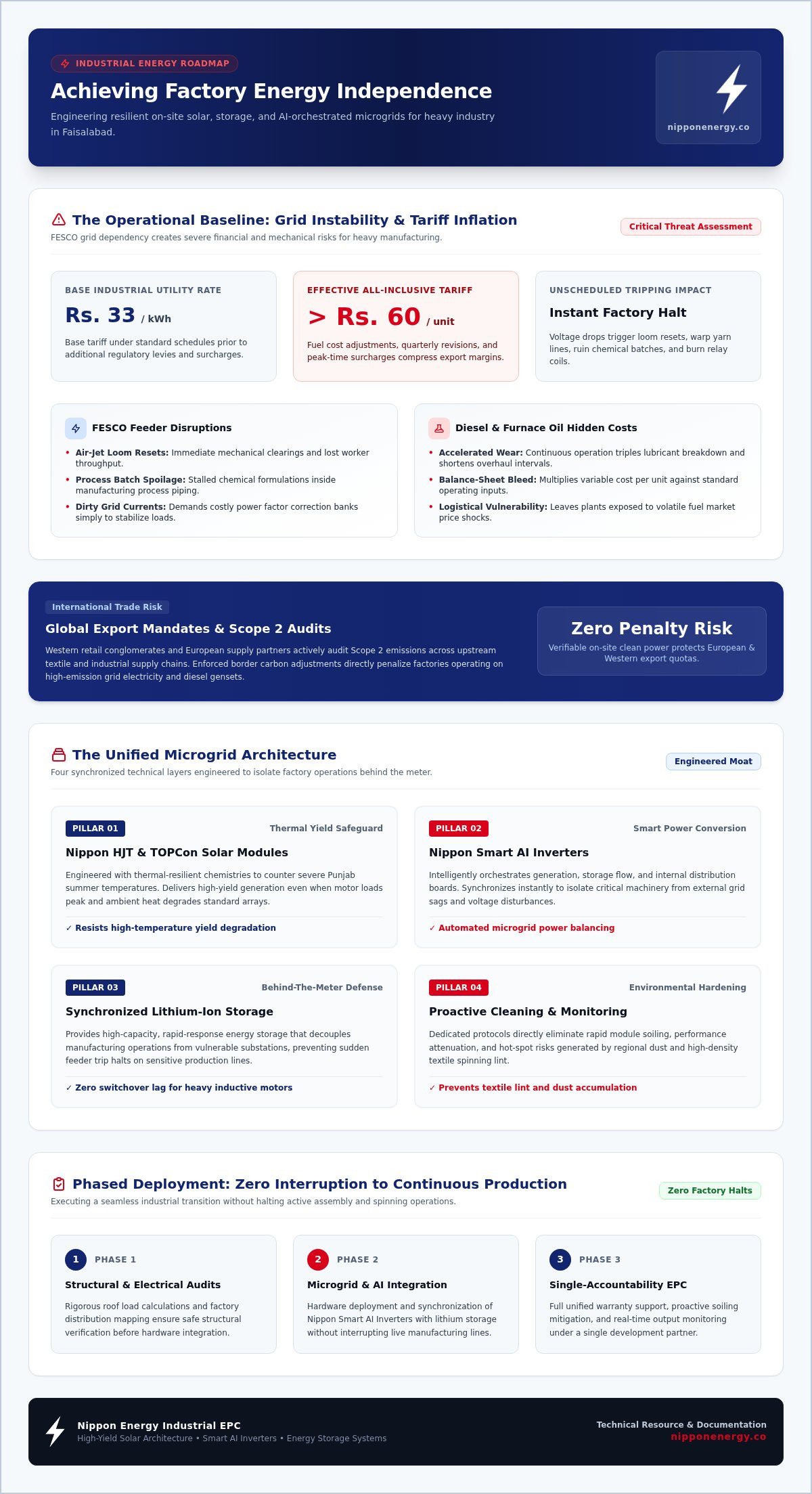
Operating as Pakistan's primary industrial and distribution hub, Faisalabad houses high-density textile, chemical, and engineering clusters that run on razor-thin operating margins. In this environment, escalating utility tariffs under FESCO schedules deliver direct hits to operational solvency. Base industrial rates sit above Rs. 33 per kilowatt-hour, but fuel cost adjustments, quarterly tariff revisions, and peak-time surcharges regularly push effective all-inclusive rates well beyond Rs. 60 per unit. For industrial operations running high inductive loads, unmanaged grid reliance drains capital reserves every single month.
An industrial microgrid physically decouples manufacturing operations from vulnerable grid substations by orchestrating on-site generation and rapid-response energy storage behind the factory meter. This continuous electrical moat keeps plant equipment running when utility feeders collapse.
Heavy production machinery cannot tolerate erratic supply. Securing comprehensive energy independence for my factory in faisalabad has shifted from a forward-looking sustainability target to an urgent defensive engineering requirement.
FESCO Grid Volatility and Unscheduled Manufacturing Outages
Unannounced feeder tripping causes immediate technical chaos across manufacturing floors. Voltage sags disengage contactors, force air-jet looms to halt instantly, and ruin entire batches of chemical formulations within process piping. The resulting downtime generates immense financial loss: warped yarn lines, manual mechanical clears, burned relay coils, and lost worker throughput. Industrial facilities are routinely forced to install expensive external power factor correction banks simply to counter dirty grid currents.
The True Cost of Diesel and Furnace Oil Backup Generation
Relying on internal combustion generation offers a brittle, high-cost safety net. Procuring bulk diesel and heavy furnace oil exposes plants to immediate fuel market shocks and complex delivery logistics. Running continuous backup power triggers distinct compounding expenses:
- Accelerated mechanical wear: High-hour thermal operation triples lubricant breakdown and shortens top-end overhaul intervals.
- Severe balance-sheet bleed: Generator operation multiplies your variable cost per unit compared to primary production inputs.
- Heightened operational risk: Mechanical failure during sudden grid drops leaves heavy inductive equipment stalled without warning.
Global Export Mandates: Meeting International Clean Energy Standards
International market access now dictates technical power choices. Western retail conglomerates and European supply partners actively audit the Scope 2 emissions of their upstream textile manufacturers. The phased enforcement of border carbon adjustments directly penalizes goods produced using high-emission grid power or diesel gensets. Establishing verifiable, on-site energy independence for my factory in faisalabad secures the green energy data needed to pass multinational compliance audits without risking overseas export quotas.
Industrial System Architecture: Selecting High-Yield Solar and Storage Hardware
Basic solar installations often fail under industrial operating constraints. When engineering true energy independence for my factory in faisalabad, system designers must orchestrate generation, power conversion, and storage into a unified microgrid architecture. This synchronized approach fulfills the critical move towards more secure, environmentally sustainable, lower-cost sources of energy within Pakistan's manufacturing sectors, protecting facilities against utility shocks while stabilizing internal distribution boards.
Nippon HJT vs. Nippon TOPCon: Mitigating High-Temperature Degradation
Summer rooftop operating conditions across Punjab easily surpass 45 degrees Celsius, creating severe thermal losses in standard p-type silicon cells. Heterojunction technology solves this drop through an ultra-low temperature coefficient, preserving higher wattage output under sustained heat. While high-efficiency topcon solar panels deliver reliable commercial yields with advanced n-type cell structures, Nippon HJT Solar Panels provide superior bifaciality. On industrial roofs coated with reflective white membranes, bifacial rear-side capture harnesses diffuse albedo light, maximizing daily kilowatt-hour production per square meter.
Nippon Smart AI Inverters for Dynamic Industrial Load Orchestration
Industrial manufacturing machinery creates erratic load profiles characterized by intense inductive startup spikes and harmonic feedback. Nippon Smart AI Inverters manage these dynamic variations through integrated digital signal processing, delivering steady power conditioning across plant operations:
- Dynamic power factor correction: Automatically balances reactive currents on-site, eliminating steep utility penalty charges.
- Sub-second islanding: Isolates the factory microgrid seamlessly during external feeder dropouts without phase mismatches.
- Self-consumption tracking: Directs daytime generation to active motor drives first, preventing low-value wholesale exports under current net billing policies.
Nippon Lithium-Ion Battery Storage Systems: 24/7 Factory Autonomy
Achieving round-the-clock reliability requires high-capacity chemical storage rather than spinning thermal reserve. Containerized lithium iron phosphate configurations detailed in our breakdown of lithium ion battery storage provide exceptional thermal stability and long cycle endurance. Nippon Lithium-ion Battery Storage Systems deploy sub-millisecond switching to isolate programmable logic controllers from dirty line noise. They discharge during costly evening utility windows to shave peak demand surcharges, allowing continuous operations across third shifts.
Factory owners evaluating long-term microgrid engineering can review technical deployment options through Nippon Energy to align generation assets directly with plant load curves.
How to Deploy Industrial Solar Without Halting Factory Operations: A Phased Roadmap
Executing an industrial microgrid cannot come at the cost of current production quotas. Manufacturing leaders seeking energy independence for my factory in faisalabad must implement a phased installation strategy that completely protects live operations. Deploying high-capacity solar and storage assets aligns directly with Pakistan's Alternative and Renewable Energy Policy 2019, but real-world execution demands structural and electrical isolation during active manufacturing shifts.
Standard zero-downtime commissioning relies on parallel balance-of-plant construction alongside isolated tie-in procedures, ensuring that the primary factory bus remains energized while technicians stage the new generation assets.
Engaging a specialized technical partner for solar epc services establishes single-source accountability across design, procurement, structural staging, and final electrical cutovers.
Phase 1: Structural Load Testing and Harmonic Electrical Auditing
Engineering teams begin by analyzing existing physical and electrical constraints before moving hardware to the site. Certified structural engineers inspect roof trusses, purlins, and sheet profiles to confirm dead load capacities, live load allowances, and regional wind uplift limits. Concurrently, electrical specialists log plant harmonic profiles using power analyzers. Mapping total harmonic distortion across large motor controllers and variable frequency drives ensures the incoming generation hardware interfaces smoothly with inductive plant equipment.
Phase 2: Turnkey Engineering, Procurement, and Safe Rigging
Material logistics and mechanical staging require disciplined planning to avoid disturbing ground-level factory workflow. Specialized rigging crews execute module lifts, bracket hoisting, and switchgear placement during scheduled night shifts or weekend plant maintenance intervals:
- Logistical segregation: Crane operations and hardware drop zones remain completely isolated from raw material delivery docks and finished goods transport bays.
- Pre-terminated distribution: Sub-distribution cabling and DC bus assemblies are prefabricated off-floor to limit the presence of installation personnel inside active spinning, weaving, or packaging rooms.
- Industrial racking integration: Mounting frameworks utilize non-penetrative clamps or reinforced standing-seam brackets engineered to maintain absolute roof waterproofing integrity.
Phase 3: Substation Integration and Automated Synchronous Switchover
The final phase links the solar arrays, battery storage banks, and intelligent inverters directly with the plant medium-voltage or low-voltage switchboard. System integration engineers complete all breaker tie-ins and secondary wiring during a single planned maintenance shutdown. Automated synchronizing relays match phase angle, frequency, and voltage curves with incoming utility feeds before closing the primary bus tie. Testing verifies islanded operation, load-shedding triggers, and instant battery response under simulated feeder drops, delivering uninterrupted energy independence for my factory in faisalabad without unscheduled downtime.
Overcoming Faisalabad's Environmental and Operational Challenges
Harsh regional operating environments quickly penalize unmanaged hardware deployments. Achieving lasting energy independence for my factory in faisalabad requires an active engineering strategy that counteracts fine agricultural dust, heavy textile particulate matter, and intense summer thermal stress. Left unaddressed, localized airborne debris forms an opaque film across module glass, while severe ambient heat pushes power conversion electronics past safe operating limits. Ensuring generation uptime demands systematic, engineered operational workflows rather than generic site maintenance.
Establishing disciplined protocols through specialized solar system maintenance preserves baseline photovoltaic yield and protects critical capital equipment against premature field failure.
Managing Heavy Soiling from Industrial Smog and Textile Fluff
Airborne spinning lint from textile mills bonds with seasonal winter smog, creating a sticky, dense surface layer across rooftop arrays. This crust blocks direct solar irradiance and creates persistent partial shading across module cell strings. If neglected, localized shading forces shaded bypass diodes into continuous conduction, inducing severe cell hotspots and eventual backsheet burn-through. Facilities must deploy semi-automated, non-abrasive cleaning systems utilizing pressurized, demineralized water. This prevents mineral scale deposits, avoids glass pitting, and restores optimal optical transmission without micro-scratching protective anti-reflective coatings.
Protecting Inverters and Energy Storage from Extreme Ambient Heat
Extreme ambient temperatures across central Punjab regularly drive rooftop thermal pockets well beyond rated electronics tolerances. Unshaded equipment undergoes heavy thermal derating, sharply cutting power output right when plant cooling and processing loads peak. Reliable microgrid survival requires structured thermal mitigation:
- Shielded, ventilated inverter housing: Inverters must sit under structural solar canopies or within positive-pressure, shaded outdoor enclosures equipped with heavy-duty forced-air circulation.
- HVAC-regulated storage enclosures: Nippon Lithium-ion Battery Storage Systems must operate inside insulated, climate-controlled containerized enclosures to maintain core cell temperatures within precise thermal thresholds.
- Automated thermal protection logic: Nippon Smart AI Inverters leverage continuous component telemetry to cycle integrated cooling systems before thermal throttling limits generation.
Predictive Monitoring and Thermographic Drone Inspections
Manual string testing across multi-megawatt industrial rooftops proves slow and inefficient. Effective plant management uses digital asset platforms that continuously monitor string-level electrical performance. High-resolution infrared drone thermography scans thousands of modules in minutes, detecting localized hotspots, bypassed sub-strings, and microcracks invisible to the naked eye. Plant operators can immediately isolate degraded hardware before minor panel variances escalate into costly feeder trips.
To audit your site's physical readiness and protect your long-term energy yield, consult with Nippon Energy's technical team for full-cycle plant engineering support.
Selecting an Industrial Solar Partner: The Strategic Advantage of Nippon Energy
Sourcing disparate generation and storage hardware leaves factory directors vulnerable when system faults occur. Independent panel vendors, battery importers, and third-party electricians routinely assign blame to each other during inverter synchronization failures or unexpected load tripping. Achieving true energy independence for my factory in faisalabad requires a singular engineering authority capable of synchronizing generation, power conversion, and electrochemical storage into a cohesive microgrid. Nippon Energy acts as this high-tech architect, unifying advanced Japanese manufacturing standards with full-cycle project ownership.
The Turnkey Engineering Advantage: Hardware Sourcing to Commissioning
Nippon Energy manages the entire project lifecycle through full-scope Solar Project Development and EPC. By deploying proprietary Nippon HJT Solar Panels alongside Nippon Smart AI Inverters and Nippon Lithium-ion Battery Storage Systems, we remove multi-vendor liability from your operational balance sheet:
- Single-point accountability: Every system component undergoes rigorous factory compatibility testing before delivery, preventing interface mismatches between array outputs and battery charge controllers.
- Regulatory management: Our dedicated engineering staff oversees all FESCO technical filings, transformer synchronization requirements, and mandatory load flow studies for capacity expansions.
- Lifecycle operational security: Comprehensive Solar System Maintenance and Monitoring guarantees real-time fault isolation, protecting factory operations against unpredicted outages.
Evaluating Multi-Decade Asset Reliability and Bankability
Industrial solar microgrids must be evaluated through the lens of levelized cost of energy across a multi-decade operational horizon. Low upfront equipment prices rarely translate into long-term savings if module degradation accelerates under high ambient heat. Nippon HJT architectures combine crystalline silicon with amorphous silicon layers, minimizing power loss over decades of industrial operation. When paired with high-durability racking and Japanese structural discipline, these systems deliver predictable kilowatt-hour yields, shielding export manufacturing margins from continuing utility tariff revisions.
Take the Step Toward Industrial Independence
Protecting continuous industrial output begins with an accurate assessment of plant electrical loads, roof structural limits, and peak consumption curves. Deploying custom-engineered Nippon TOPCon Solar Panels or Nippon HJT arrays paired with containerized storage establishes permanent energy independence for my factory in faisalabad.
Partner with Nippon Energy for your turnkey industrial solar infrastructure to audit your plant's potential and secure 24/7 manufacturing resilience.
Securing Long-Term Industrial Autonomy
Uncontrolled utility tariff revisions and sudden feeder dropouts cannot remain recurring risks on your operational balance sheet. Transitioning your facility from grid exposure to microgrid stability transforms a critical vulnerability into a competitive manufacturing advantage. By integrating thermal-resilient Nippon HJT Solar Panels and Nippon TOPCon Solar Panels with containerized lithium-ion storage, plant operators isolate their machinery from utility disruptions while fulfilling mandatory overseas decarbonization protocols.
True energy independence for my factory in faisalabad requires unified engineering discipline rather than piecemeal equipment sourcing. Partnering with a dedicated engineering provider establishes complete interoperability across generation, power conditioning, and long-term asset monitoring. When generation assets match your plant's dynamic load curves, factory uptime remains guaranteed around the clock.
Take direct control of your operational future. Schedule an Industrial Energy Feasibility Audit with Nippon Energy today to engineer permanent resilience for your production lines.
Frequently Asked Questions
Can a solar and battery microgrid power a heavy textile mill in Faisalabad without grid power?
Yes, an engineered microgrid combining solar arrays and battery storage can fully power heavy spinning or weaving machinery off-grid. By dimensioning Nippon HJT Solar Panels alongside containerized Nippon Lithium-ion Battery Storage Systems, the system handles heavy motor startup currents without utility reliance. This synchronized design delivers true energy independence for my factory in faisalabad, maintaining continuous production cycles even during extended regional blackout events.
How much rooftop space is required to install a 1 MW industrial solar system?
A 1 MW industrial array typically requires between 55,000 and 65,000 square feet of clear rooftop area. Deploying higher-efficiency modules like Nippon TOPCon Solar Panels or Nippon HJT Solar Panels reduces the physical footprint compared to conventional p-type silicon. This compact footprint leaves adequate clear space for access pathways, structural walkways, and specialized maintenance equipment required for routine cleaning.
What happens to factory operations during the transition from the FESCO grid to solar power?
Factory operations continue without disruption when the system utilizes a zero-downtime commissioning protocol. Nippon Smart AI Inverters and automated synchronizing switchgear match internal phase, frequency, and voltage profiles with the grid before shifting loads. The physical cutover executes in milliseconds during standard off-shift maintenance windows, preventing unexpected motor drops, loom resets, or line tripping across continuous production floors.
Is net metering viable for high-capacity industrial power consumers in Punjab?
Pakistan replaced traditional net metering with a net billing framework under NEPRA 2026 regulations. FESCO purchases surplus exported electricity at wholesale buyback rates of approximately Rs. 8 to 11 per unit, which is far lower than retail import tariffs. Consequently, securing energy independence for my factory in faisalabad relies on prioritizing 100% on-site self-consumption and battery storage rather than exporting excess energy back to the grid.
How do high ambient summer temperatures in Faisalabad affect solar panel efficiency?
Ambient temperatures exceeding 45 degrees Celsius heat rooftop panels beyond 65 degrees, inducing severe voltage drops in standard modules. Standard silicon panels lose significant output under these conditions due to unfavorable temperature coefficients. In contrast, Nippon HJT Solar Panels feature a substantially lower temperature coefficient, maintaining stable wattage output and mitigating structural thermal degradation throughout extreme Punjab heatwaves.
What is the typical lifespan of industrial lithium-ion battery storage systems in Pakistan?
Tier-one lithium iron phosphate storage architectures deliver an operational lifespan of 10 to 15 years, corresponding to 6,000 or more full charge cycles under managed conditions. Nippon Lithium-ion Battery Storage Systems maintain this longevity by operating inside climate-controlled, HVAC-regulated containers. Active thermal management protects internal cell chemistry from ambient heat, preventing premature capacity degradation over extended industrial operational lifecycles.
Can an industrial solar system synchronize with existing on-site diesel generators?
Yes, advanced solar microgrids synchronize seamlessly with thermal gensets through dynamic fuel-saver controllers. Nippon Smart AI Inverters monitor real-time generator loading to prevent reverse-power feeding, maintaining a minimum spinning reserve of 20 to 30 percent. This automated hybridization cuts diesel consumption by up to 70 percent during grid outages without risking engine carbon fouling or mechanical stalling.


