

Deploying generic inland hardware for a commercial solar installation Karachi industrial enterprises depend on is an expensive design error. Between coastal humidity, airborne marine chlorides, and localized sulfur emissions, unfortified arrays degrade rapidly before returning your capital investment. Manufacturing leaders across Korangi, Port Qasim, and SITE already battle escalating K-Electric peak tariffs and volatile fuel cost adjustments that eat away export margins. You know that relying solely on centralized utility power threatens operational stability, but installing fragile infrastructure only trades one commercial vulnerability for another.
This enterprise guide provides the regulatory, engineering, and financial blueprint required to deploy an industrial-grade energy asset built for coastal durability. You'll discover how marine-resilient N-type cell architectures resist extreme atmospheric corrosion, how to clear K-Electric interconnection under NEPRA's 2026 Prosumer framework, and how integrated battery storage preserves uninterrupted manufacturing output.
Key Takeaways
- Overcome escalating utility tariffs and grid volatility by transitioning manufacturing operations toward captive, self-reliant photovoltaic generation.
- Protect generation assets against coastal salinity and extreme summer heat through C5-rated structural mountings and marine-grade double-glass encapsulation.
- Optimize capital expenditure returns on your commercial solar installation Karachi facility by strategically sizing for daytime self-consumption versus hybrid battery integration.
- Accelerate project commissioning timelines with disciplined structural dead-load audits and pre-emptive K-Electric technical interconnection compliance.
- Ensure continuous 25-plus year operational lifecycles by demanding institutional-grade Tier-1 EPC verification and strict component flash-test validation.
Karachi Commercial Solar Landscape: Industrial Drivers and Grid Realities
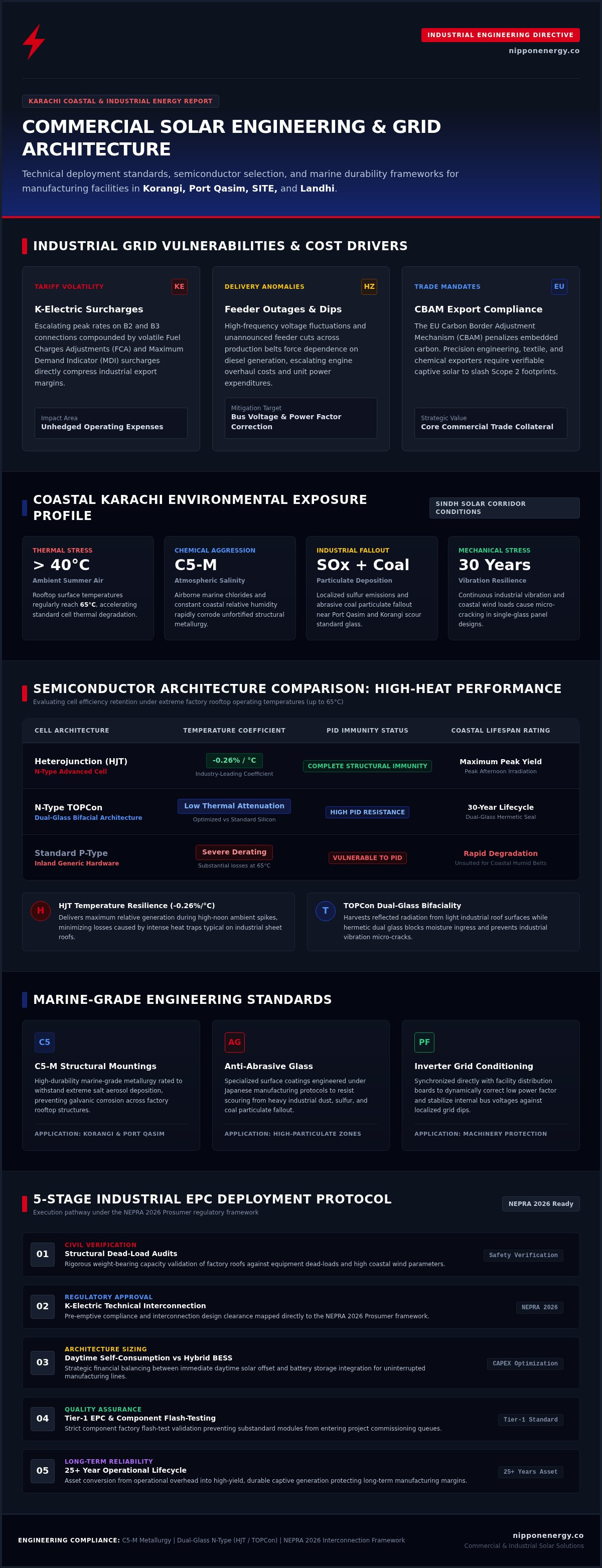
Operating an industrial manufacturing plant across Karachi's production belts means absorbing relentless utility tariff revisions. Between volatile Fuel Charges Adjustments (FCA), escalating Maximum Demand Indicator (MDI) surcharges, and climbing base rates on K-Electric B2 and B3 connections, complete grid reliance directly erodes export margins. In this volatile operating environment, it's clear that an enterprise-grade commercial solar installation karachi manufacturers commission functions as an indispensable capital hedge, converting unpredictable operational overhead into fixed, amortized power generation assets.
Grid Vulnerabilities Across Karachi Industrial Corridors
Facilities situated across SITE, Korangi Industrial Area, Landhi, and Port Qasim face recurring power delivery anomalies, ranging from high-frequency voltage fluctuations to unannounced feeder outages. Bridging these operational gaps with conventional diesel generators imposes severe balance-sheet penalties. Fuel consumption and continuous engine overhaul costs inflate baseline unit expenses far beyond standard retail tariffs. High-capacity photovoltaic arrays eliminate this drag. By synchronizing industrial-grade inverters directly with facility distribution boards, these systems actively correct low power factors and stabilize internal bus voltages, shielding sensitive automated machinery from localized grid dips.
Corporate Sustainability and International Export Mandates
For Karachi's textile, chemical, and precision engineering exporters, renewable generation addresses an urgent commercial imperative. The European Union's Carbon Border Adjustment Mechanism (CBAM) penalizes embedded carbon in imported goods, turning environmental accounting into a decisive trade hurdle. Captive solar arrays decisively slash Scope 2 greenhouse gas footprints across factory operations. As tracked by data on solar power adoption in Pakistan, leading export facilities now treat clean energy infrastructure as core commercial collateral, utilizing verifiable green production certificates to secure preferential international supplier contracts.
Engineering Commercial Solar for Karachi Coastal and Industrial Climates
Coastal Karachi combines elevated relative humidity, sulfurous industrial airborne particulates, and ambient summer temperatures exceeding 40°C. Standard commercial solar equipment deployed in temperate inland climates fails quickly under these combined chemical and thermal stressors. A reliable commercial solar installation karachi manufacturers invest in demands C5-M marine-grade structural metallurgy, dual-glass hermetic encapsulation, and semiconductor architectures engineered to minimize thermal attenuation. Large-scale regional energy programs, such as the World Bank Sindh Solar Energy Project, highlight the technical necessity of deploying resilient, high-yield infrastructure capable of sustaining continuous generation across southern Pakistan's demanding environmental profile.
Semiconductor Selection: HJT vs TOPCon in Coastal High-Heat Conditions
Standard P-type silicon suffers severe performance derating as factory rooftop surface temperatures reach 65°C. Industrial operators require modern N-type cell architectures to maintain maximum harvest efficiency:
- Heterojunction (HJT) Cells: Feature an industry-leading temperature coefficient of -0.26%/°C, ensuring maximum relative output during peak afternoon irradiation while offering complete structural immunity to Potential Induced Degradation (PID).
- N-Type TOPCon Technology: Deploying dual-glass topcon solar panels delivers superior bifacial energy yield from reflective industrial roof membranes. The dual-glass construction prevents moisture ingress and resists mechanical micro-cracking caused by heavy industrial vibrations over a 30-year lifecycle.
Nippon Energy aligns these architectures with Japanese manufacturing protocols, incorporating anti-abrasive glass coatings that resist particulate scouring from industrial dust and coal particulate fallout near Port Qasim and Korangi.
Marine-Grade Structural Engineering and Wind-Load Resilience
Salt aerosol deposition accelerates rust on generic galvanized mounting structures within two to four years. Racking infrastructure in coastal zones must meet ISO 12944 C5-M marine classifications, utilizing hot-dip galvanized steel with an 85 to 100 µm zinc layer or high-grade anodized aluminum. Fasteners must be strictly specified as A4 (AISI 316) marine-grade stainless steel to prevent galvanic corrosion.
Wind-load engineering presents an equally critical parameter. Coastal industrial arrays must withstand Arabian Sea cyclonic wind gusts between 140 and 160 km/h. On trapezoidal or standing-seam industrial metal roofs, certified non-penetrating clamping systems distribute mechanical loads directly across primary purlins without compromising factory waterproofing. For enterprise facilities evaluating site viability, partnering with Nippon Energy's EPC engineering team provides access to rigorous static structural modeling and coastal-rated hardware deployment.
Commercial System Architectures: Net Metering, Hybrid BESS, and Microgrids
Selecting an energy typology defines both operational survivability and capital payback schedules. An effective commercial solar installation karachi industrial facilities deploy cannot rely on generic configurations. Systems must balance daytime grid offset against utility curtailment and localized grid dropouts. While simple grid-tied systems maximize financial returns by displacing daytime tariff tiers, unbuffered arrays automatically disconnect during utility outages under mandatory anti-islanding regulations. Maintaining continuous production lines requires an architectural shift toward hybrid topologies that incorporate high-capacity energy storage and dynamic generation controls.
High-Capacity On-Grid Architecture and K-Electric Net Metering
On-grid systems configured for three-phase medium-voltage interconnections deliver rapid capital recovery by offsetting expensive daytime units. However, NEPRA's regulatory transition toward net billing emphasizes captive self-consumption over generation export. Turnkey industrial designs integrate automated reverse-power relays and fast-acting zero-export limiters to prevent uncompensated grid backfeed. Deploying smart ai solar inverters enables active power factor conditioning and autonomous grid synchronization, maintaining compliance with K-Electric utility mandates while stabilizing the plant's internal busbar voltages.
Industrial Hybrid Microgrids with Integrated Lithium-Ion Storage
Mitigating evening peak-hour tariffs requires pairing generation assets with responsive electrochemical storage. Industrial facilities increasingly incorporate commercial lithium ion battery storage to perform automated peak shaving between 6:00 PM and 10:30 PM, directly avoiding punitive peak surcharges. Technical frameworks outlined in the IRENA renewables readiness assessment for Pakistan highlight how distributed storage mitigates localized feeder congestion and empowers commercial users to navigate grid instability.
Modern microgrid architectures coordinate these storage banks directly with existing diesel and natural gas gensets:
- Zero-Second Transfer: Static transfer switches isolate the internal plant grid during utility drops, preventing manufacturing resets on automated textile looms or packaging lines.
- Genset Fuel Optimization: Battery arrays absorb rapid transient motor spikes, eliminating the requirement to maintain fossil-fueled generators at inefficient, continuous low-load spinning reserves.
- Modular System Integration: Implementing the nipponhev system consolidates photovoltaic generation and high-capacity storage into a synchronized enterprise architecture, securing round-the-clock operational continuity across industrial operations.
Step-by-Step Commercial EPC Execution and Regulatory Licensing in Karachi
Commissioning an enterprise-scale commercial solar installation karachi factories can depend on requires a disciplined, phase-gate execution model. Moving from preliminary site assessment to active grid energization is an engineering-intensive process where structural safety, protection coordination, and regulatory compliance intersect. Bypassing rigorous engineering validation risks structural failures during monsoon gale cycles or protracted connection delays from utility review teams.
Pre-Engineering Audits and Feasibility Studies
Execution begins with non-destructive structural audits to confirm dead-load and live-load capacities across industrial roof decks. Engineering teams deploy drone photogrammetry to map precise shading vectors, while digital irradiance models simulate real-world yield against seasonal cloud cover patterns. Electrical engineers run load-flow simulations to verify that existing medium-voltage transformers, switchgear, and busbars handle the rated solar throughput. Protection coordination studies establish exact tripping curve thresholds between the PV distribution boards and the plant's main incomers, preventing sympathetic trips during localized grid disturbances.
Navigating K-Electric and NEPRA Interconnection Compliance
Connecting distributed generation assets to the private utility network in Karachi involves a rigid multi-stage clearance path. The legal and technical roadmap requires methodical submission handling:
- Interconnection Application: Prepare comprehensive engineering single-line diagrams (SLDs), equipment specification sheets, and array layouts for formal submission to K-Electric's Net Metering Facilitation Centre.
- Grid Impact Studies: Complete mandatory load-flow analyses for capacity sanctions, verifying that local distribution transformers remain within regulatory thermal loading thresholds.
- Utility Inspection: Coordinate physical witness testing with K-Electric's Energy Conservation and Metering teams to validate anti-islanding trip times, total harmonic distortion levels, and earth-fault protection.
- Bi-directional Meter Commissioning: Secure the official concurrence notice and install compliant four-quadrant electronic energy meters to enable automated billing adjustments.
Commissioning, Performance Testing, and Asset Handover
Before commercial handover, systems undergo cold and hot commissioning under strict IEC 62446 guidelines. Field engineers execute high-voltage insulation resistance testing, polarity checks, and string-level IV-curve tracing to detect any cell micro-defects prior to energization. Modern telemetry modules connect each inverter string to centralized cloud supervisory control architectures, giving enterprise energy managers real-time insight into performance ratios and predictive maintenance alerts. To streamline this entire transition from feasibility modeling to utility energization, consult with Nippon Energy's industrial EPC team to execute your facility's power infrastructure.
Selecting an Industrial Solar EPC: Engineering Standards vs Marketplace Risks
Industrial solar procurement differs fundamentally from commercial retail contracting. Sourcing components through unverified brokers or residential installers exposes capital projects to uncertified hardware, poor installation practices, and premature cell degradation. For an enduring commercial solar installation karachi enterprises require institutional-grade engineering firms that back procurement with audited manufacturing documentation, direct balance-sheet accountability, and verifiable performance guarantees.
Due Diligence Criteria for Enterprise Solar EPC Contracts
Enterprise stakeholders must enforce strict technical benchmarks before committing capital under turnkey solar epc services contracts:
- Factory Flash-Test Audits: Mandate serial-tracked electroluminescence (EL) testing records and factory flash-test sheets to confirm positive power tolerances and eliminate micro-fractured cells prior to shipping.
- Contractual Performance Ratios: Guarantee minimum weather-adjusted Performance Ratio (PR) benchmarks, typically between 78% and 82%, tied directly to EPC milestone sign-offs.
- Local Spares Inventory: Verify that the contractor maintains local Karachi warehousing for critical replacement components, string fuses, and inverter control boards to minimize downtime.
- Preventative Maintenance Regimes: Enforce structured solar system maintenance protocols, including string-level thermographic inspection and regular demineralized module washing, preventing airborne particulate calcification on active cell surfaces.
The Nippon Energy Industrial Advantage in Karachi
Operating directly from Plot 14, Sector 15, Korangi Industrial Area, Nippon Energy maintains an active engineering headquarters within Karachi's core manufacturing district. The company deploys proprietary Japanese-engineered Nippon HJT and Nippon TOPCon solar panels built specifically to resist maritime humidity, ambient salt fog, and severe summer heat. High-velocity cloud telemetry pairs with dedicated on-site engineering crews to correct balance-of-system anomalies before they impact factory production schedules. Enterprise manufacturers ready to establish captive generation assets can schedule an enterprise industrial site evaluation with the engineering team.
Future-Proofing Industrial Power Infrastructure in Karachi
Transforming rising utility expenditures into an amortized balance-sheet advantage requires engineering discipline over retail shortcuts. Transitioning to an institutional-grade commercial solar installation karachi manufacturers count on protects ongoing operations from volatile grid tariffs, satisfies rigorous international export mandates like CBAM, and isolates industrial lines from severe feeder instability. Success hinges on deploying resilient cell architectures and C5-rated metallurgy engineered specifically to endure southern Pakistan's demanding coastal atmosphere.
From our engineering facility situated at Plot 14, Sector 15, Korangi Industrial Area, Nippon Energy delivers end-to-end turnkey EPC execution across Karachi's core manufacturing zones. We integrate Japanese-developed N-type TOPCon and Nippon HJT modules designed for high-heat environments, backed by contractual Performance Ratios and cloud-integrated telemetry. Request an Industrial Solar Engineering Feasibility Study from Nippon Energy to secure predictable, long-term power independence for your enterprise.
Frequently Asked Questions
How long does the K-Electric and NEPRA commercial net-metering process take in Karachi?
The standard regulatory clearance timeline with K-Electric and NEPRA typically spans five to eight weeks. This schedule includes structural and electrical documentation audits, distribution transformer load-flow assessments, on-site anti-islanding witness inspections, and bidirectional meter commissioning. Delays can occur if distribution substations approach technical saturation caps, making pre-engineering utility coordination vital for timely energization.
How does Karachi coastal salinity affect commercial solar panel lifespan?
Atmospheric chlorides and maritime moisture accelerate corrosion across solar hardware, degrading standard framing, junction boxes, and metallic fasteners within two to four years. For a resilient commercial solar installation karachi industries require dual-glass encapsulation, IP68 junction protection, and ISO 12944 C5-rated mounting structures paired with A4 grade stainless steel fasteners. These engineering protections shield internal circuitry against corrosive ingress, ensuring a durable twenty-five to thirty-year operating life.
What is the standard payback period for a commercial solar installation in Karachi?
Industrial systems engineered primarily for high daytime self-consumption typically achieve capital payback within three to four years. While historic export-heavy arrangements face longer recovery horizons under updated net-billing structures, offsetting expensive industrial grid units and steep fuel adjustment surcharges yields immediate operational savings. Facilities with heavy baseline daytime operations recover their capital expenditure rapidly through direct utility bill reduction.
Can commercial solar run heavy manufacturing loads during a K-Electric power outage?
Grid-tied photovoltaic systems disconnect during outages under utility anti-islanding mandates. However, hybrid configurations integrating commercial lithium-ion battery storage and automated microgrid controllers run inductive factory machinery without interruptions. In these advanced setups, solar panels and battery reserves synchronize directly with on-site backup generators, balancing motor startup transients while avoiding continuous low-load generator running expenses.
What roof reinforcement is required before mounting industrial solar systems?
Structural reinforcement requirements depend on initial dead-load and live-load capacity assessments conducted by registered structural engineers. While concrete roofs readily support ballast mounts, pre-engineered metal buildings often need localized rafter stiffening or purlin reinforcement. Arrays must withstand dead module weights alongside 140 to 160 km/h coastal wind uplift forces, requiring non-penetrating clamping systems that preserve roof watertightness without adding excessive dead weight.
How does ambient summer temperature impact solar module output in Sindh?
Extreme summer temperatures exceeding 40°C push rooftop panel operating temperatures past 65°C, degrading output across standard solar cells. High-performance N-type TOPCon and Nippon HJT modules feature ultra-low negative temperature coefficients around -0.26%/°C, significantly minimizing thermal power dropouts compared to legacy P-type panels. Selecting advanced cell chemistries ensures factories maintain stable generation yields even through peak heatwaves across southern Sindh.
What ongoing maintenance do industrial solar systems require in Karachi?
Continuous performance for an industrial commercial solar installation karachi relies on bi-weekly scheduled cleanings using demineralized water to counteract airborne particulate and salt encrustation. Operational teams must execute annual string-level IV-curve tracing, thermal drone scans to locate localized hot spots, and torque verification on mechanical fasteners. High-velocity cloud telemetry continuously monitors string currents to detect systemic anomalies before generation losses impact production schedules.


